
Where the Spirits Walk: Immersion in the Heart of Hela, Papua New Guinea (2026)
In 1935, Australian prospector Jack Hides became the first outsider to walk into the Tari Basin. He was searching for gold, but what he found was far more profound: a vast, hidden valley where men adorned themselves with bird-of-paradise plumes and intricate face paint, living in a complex society utterly unknown to the world. His expedition, “The Papuan Wonderland,” introduced the Huli people to the global stage, not as a discovery, but as the beginning of a conversation that continues today.
The Story Behind Tari’s Basin, Papua New Guinea
To understand Tari, you must understand that its history is not written in stone monuments, but in the living memory of its people, the Huli Wigmen. For over a thousand years, the fertile basin, cradled by the rugged Southern Highlands, nurtured a sophisticated agricultural society. Their history is measured in generations of *hameigini* (big men), powerful leaders who gained status not through warfare alone, but through oratory, wealth in pigs and pearl shells, and deep knowledge of ritual magic. The landscape itself is a chronicle, with sacred sites like *Baiyer River* and *Mount Ambua* serving as the physical anchors for origin stories and spirit worlds.
The 20th century brought seismic shifts. After Hides’ 1935 patrol, the region remained largely isolated until the 1950s when missionaries and government patrols established a permanent presence. The construction of the Highlands Highway in the 1960s connected Tari to the coast, accelerating change. Yet, the most transformative event was the discovery of the massive Hides gas field in 1987, one of the largest in the Southern Hemisphere. This brought immense wealth and complex challenges, placing Tari at the epicenter of Papua New Guinea’s resource economy. Today, travelers discover a place navigating the delicate balance between immense cultural pride and the pressures of the modern world, where a man in a bilum (string bag) might chat on a smartphone, but his identity is still rooted in the clan lands his ancestors have tended for centuries.
Neighborhood by Neighborhood
Tari Township: The Beating Heart
Tari Township, centered on the main road connecting the airstrip to the government station, is a vibrant, dusty hub of activity. This is where you’ll feel the pulse of modern Hela Province. The architecture is functional: corrugated iron market stalls, low-slung government offices, and simple guesthouses. The sensory experience is immediate—the smell of diesel and roasting sweet potato, the vibrant chatter in Tok Pisin and Huli, the dazzling colors of women’s meri blouses. Your day begins at the sprawling main market, best visited in the cool of the morning (around 7 AM), where highland produce like kaukau (sweet potato), pitpit (a local vegetable), and brilliant orchids are sold. The Tari Cultural Centre, near the government station, is your essential first stop to gain context. This isn’t a neighborhood for leisurely strolls so much as an observation post for daily life, where PMVs (Public Motor Vehicles) load up with people and goods, and the energy is one of purposeful commerce.
The Clan Settlements: Life in the Round Houses
To step off the main road and into one of the surrounding clan settlements is to enter a different world. These are not neighborhoods in a conventional sense, but familial hamlets centered on a men’s house (*anda*) and surrounding women’s houses (*andagi*). The architecture is iconic: perfectly circular houses with towering, steep thatched roofs made from kunai grass, appearing like mushrooms sprouting from the emerald landscape. The air is cleaner, filled with wood smoke and the sounds of children and livestock. Life here revolves around the garden, the pig, and the clan. Visitors are often struck by the meticulous care of the grounds—swept earth and decorative plants—and the profound sense of place. A local might invite you to sit by the fire in the anda, a space thick with history and ritual, where stories are shared. This is the living heart of Huli culture, where custom (*pasin*) dictates the rhythm of the days.
Ambua Lodge & The Tari Gap: Where the Clouds Rest
A world away from the basin floor, a 45-minute drive up a rough mountain road leads you to the Tari Gap and the famed Ambua Lodge. At an elevation of 2,100 meters, this “neighborhood” is defined by mist, moss-covered trees, and a profound silence broken only by the calls of exotic birds. The lodge itself, a collection of traditional-style bungalows, offers a comfortable base but the real magic is outside. This is the realm of the Raggiana bird-of-paradise and countless other species. Pre-dawn hikes with local guides (cost: approximately 100 PGK/$28 USD per person) take you to secluded hides to witness the spectacular displays of the birds. The climate is cool and damp, the atmosphere serene and detached. Staying here, you experience the ecological wealth that has sustained and inspired Huli culture for millennia, looking down from the cloud forest onto the tapestry of the basin below.
The Local Table: What the Huli Actually Eat
Huli cuisine is a testament to the bounty of the highland gardens and the central role of the pig. Meals are hearty, simple, and deeply communal. The undisputed staple is the *mumu*, an underground oven that is both a cooking method and a social event. A pit is lined with hot stones, followed by layers of meat (usually pork or chicken), kaukau (sweet potato), taro, greens like *kumu*, and pitpit, all wrapped in banana leaves. The earth is packed back over it, and the feast steams for hours. To be invited to a mumu is to be welcomed into the community. For daily eating, the diet revolves around roasted or boiled kaukau, often accompanied by greens cooked with coconut milk if available. Protein comes from the precious pigs, which are a form of currency and status, and thus not eaten daily. Travelers will find simple, filling meals at guesthouses in Tari Township, but the true culinary experience is the mumu, which you can often arrange through your guide or lodge as part of a cultural visit (plan for a cost of 150-200 PGK/$42-56 USD per person for this experience, which includes the feast and ceremony).
For a true local market experience, head to the Tari main market in the early morning. Here, you can sample roasted kaukau or corn cooked over open fires for a few kina. Don’t miss trying *au*, the local Highland salt, made from burning certain plants and leaching the ash, giving it a distinctive, smoky flavor that locals cherish. Your best bet for a reliable local meal is at the restaurant of the **Tari Airport Lodge**, where you can get a plate of rice, chicken, and kumu for around 25 PGK ($7 USD).
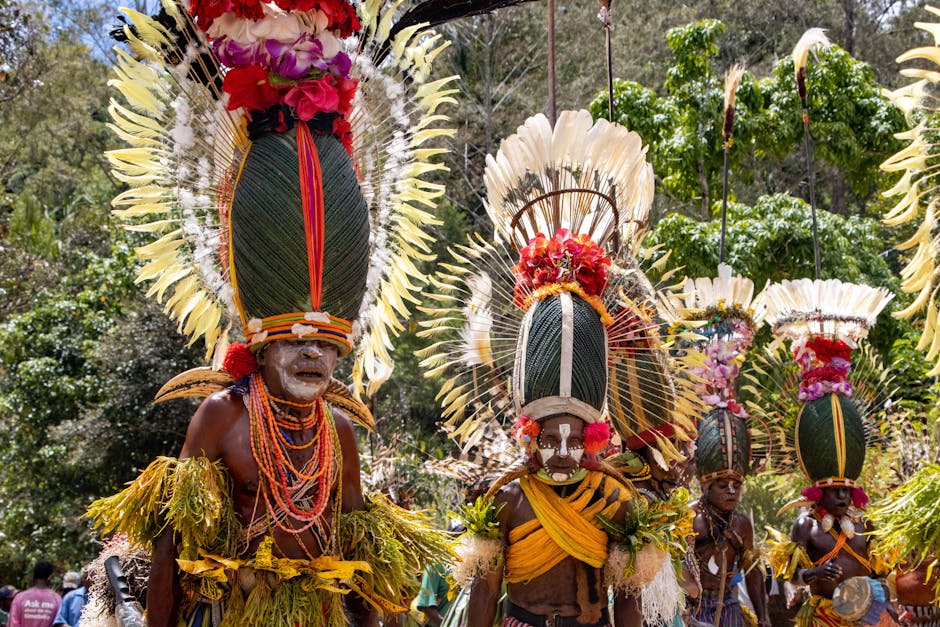
Colorful tribal dancers in traditional attire at a cultural festival in Pap…, Tari’s Basin, Papua New Guinea
Art, Music & Nightlife
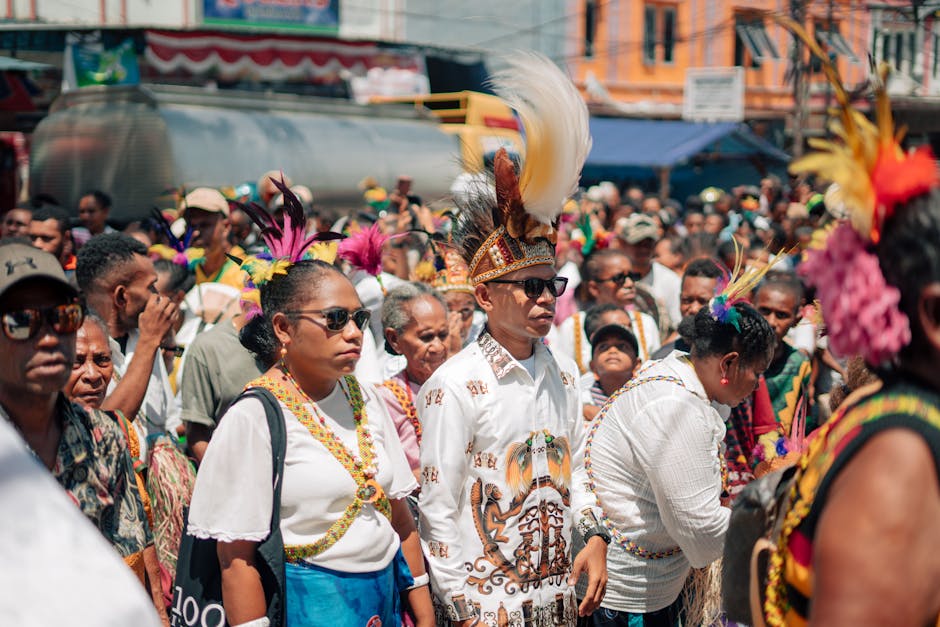
The artistic expression in Tari is worn on the body and performed in ceremony. This is not a destination for galleries or concert halls; the art is living. The most spectacular visual art is the personal adornment of the Huli Wigmen. Men spend years growing and cultivating their elaborate wigs (*hanea*), which are shaped using a bamboo frame and decorated with feathers of the bird-of-paradise, cassowary plumes, and bright flowers like orchids. The accompanying face and body paint, using ochre, white clay, and charcoal, creates a breathtaking, otherworldly appearance. You can witness this at the spectacular **Huli Wigmen Cultural Show**, usually held near Tari Township. It’s not a daily performance for tourists but a genuine gathering; your lodge or guide will know if one is scheduled during your visit (cost is typically 50-80 PGK/$14-22 USD).
Music is primarily vocal and rhythmic, centered around *singsings*. These are not casual songs but powerful, choreographed performances that tell stories of ancestors, battles, and the spirit world. The deep, resonant chanting, accompanied by kundu drums and the rustle of grass skirts, is mesmerizing. “Nightlife” as understood in Western terms doesn’t exist. Evenings are for family, storytelling by the fire, or planning for the next day’s garden work or ceremony. For travelers, the night brings the incredible symphony of the rainforest at Ambua Lodge or the profound, star-filled silence of the highland night—an experience more memorable than any bar.
Practical Guide
- Getting There: Fly from Port Moresby (POM) to Tari (TIZ) with Air Niugini or PNG Air. Flights are not daily, so book well in advance. Expect fares from 600-900 PGK ($170-$250 USD) one-way. Book at Skyscanner
- Getting Around: There are no rental cars. Your options are PMV trucks (cheap but unpredictable, ~10 PGK per short trip) or hiring a private 4×4 with driver/guide through your lodge. This is essential for safety and access. A full day with a guide and vehicle costs 400-600 PGK ($110-$170 USD).
- Where to Stay: For comfort and birding, **Ambua Lodge** is world-class (from $250 USD/night, all-inclusive). In Tari Township, the **Tari Airport Lodge** is basic but clean and secure (approx. 200 PGK/$56 USD per night). Check Booking.com for availability, but often direct booking via email is required.
- Best Time: The dry(er) season from May to October offers the best trekking and birdwatching conditions. The annual **Huli Wigmen Festival** is usually held in August—confirm dates locally.
- Budget: A realistic daily budget for a guided, comfortable trip (mid-range lodge, guide, meals, flights) is $300-$400 USD per person per day. Backpacking independently is strongly discouraged due to safety and logistical complexities.

A senior woman stands smiling amidst vibrant traditional Papua New Guinean …, Tari’s Basin, Papua New Guinea
What Surprises First-Time Visitors
Most travelers arrive expecting a “primitive” culture and are instead humbled by its profound complexity. The sheer intellectual depth of Huli society surprises visitors—the intricate kinship systems, the detailed knowledge of ecology, the sophisticated oratory and debate skills. You quickly realize you are not looking at a “simple” life, but a different kind of complexity, one built on social and spiritual networks rather than technology. The formality and grace of interactions are also striking. Huli people are often reserved at first; a warm smile and a respectful demeanor go much further than boisterous friendliness.
The other great surprise is the landscape’s visceral beauty. Photographs can’t capture the scale of the emerald basin, the dramatic cloud formations rolling over the mountains, or the shock of color when a bird-of-paradise flashes through the undergrowth. It feels profoundly ancient and alive. Finally, visitors are often taken aback by the juxtaposition of tradition and modernity. Seeing a wigman expertly check his Facebook on a smartphone isn’t a contradiction here; it’s simply the latest chapter in a long history of the Huli engaging with the wider world on their own terms.
Your Tari’s Basin, Papua New Guinea Questions
Is it safe to travel to Tari? Safety is the paramount concern. Tari, like much of the Highlands, has a reputation for tribal conflict. However, these conflicts are highly localized and clan-based. They almost never involve tourists. Your safety is managed by traveling with a respected local guide from the area. They navigate the complex social landscape, ensuring you are a welcomed guest. Never travel without this local facilitation. Following your guide’s advice explicitly makes for a very secure experience.
How do I respectfully interact and take photos? Respect is everything. Never, ever take a photograph of a person without explicit, clear permission. A smile and a gesture to your camera is the universal question. For posed photos of Wigmen, expect to pay a small fee (20-40 PGK), which is a standard and fair practice. Dress modestly. When visiting a clan settlement, a small gift of betel nut or tobacco for the *hameigini* (big man) is a appreciated gesture of thanks, which your guide will help you arrange.
What should I absolutely pack? Beyond the usual travel items, pack for cool, wet, and muddy conditions even in the dry season. Essentials include: sturdy, broken-in waterproof hiking boots; quality rain gear; warm layers (fleece, thermals); a powerful headlamp; a good pair of binoculars for birding; a refillable water bottle with purification tablets/filter; and a generous supply of small-denomination kina notes for market purchases and photo fees. Leave your valuables and jewelry at home.

Dancers in traditional Papuan attire performing under night lights in Jayapura, Tari’s Basin, Papua New Guinea

