
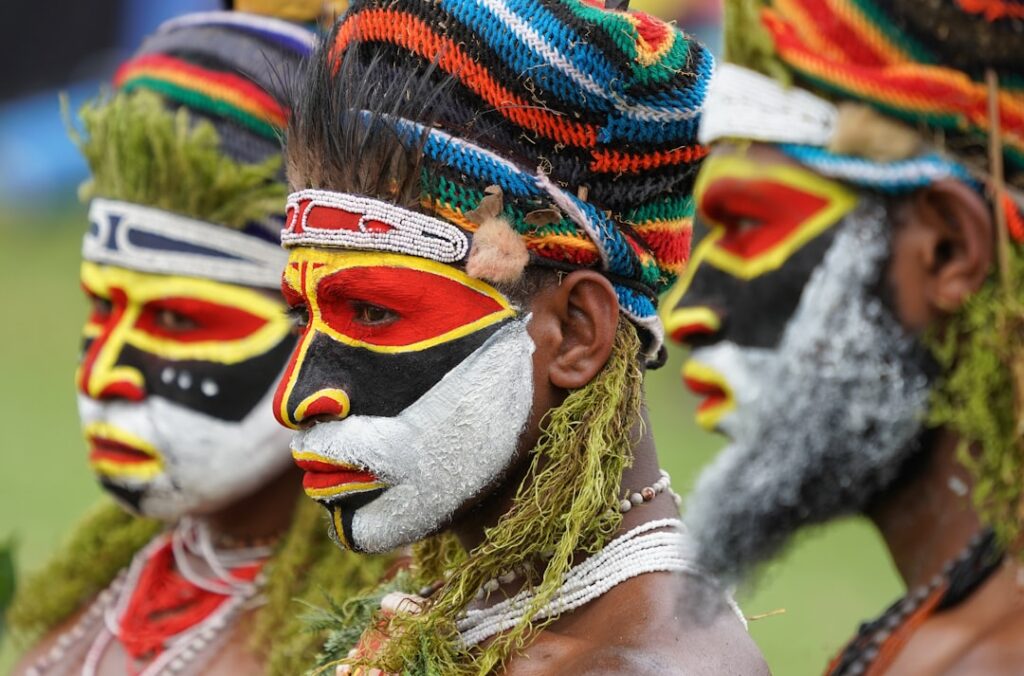
Tari, Papua New Guinea (2026)
In 1935, Australian gold prospector Mick Leahy, one of the first outsiders to penetrate the interior, stood on a ridge overlooking the Tari Basin. Below him, a world unfolded that defied all European understanding: meticulously terraced gardens, smoke curling from thatched longhouses, and the distant, rhythmic thunder of kundu drums. He wrote in his diary of seeing men adorned with “feathers of impossible birds,” their skin gleaming with oil and ochre. In that moment, the Highlands, long thought to be an empty wilderness, revealed itself as one of the most densely populated and culturally complex regions on Earth.
The Story Behind Tari’s Highlands, Papua New Guinea
The history of the Tari Valley is not written in stone monuments or crumbling castles, but in the living memory of the Huli people, whose ancestors have cultivated these fertile slopes for over a millennium. This is a history measured in generations of sweet potato harvests, in the intricate trade routes for salt, axe stones, and bird-of-paradise plumes, and in the sacred genealogies that connect every man to his ancestors. For centuries, the world of the Huli was self-contained, governed by complex cycles of ritual warfare, bride price, and elaborate compensation ceremonies designed to maintain a fragile balance between rival clans.
This profound isolation was shattered with what locals call “the coming of the government” in the 1950s. Australian patrol officers established the first administrative post, bringing with them a new religion, new laws, and an end to inter-tribal warfare. The introduction of the steel axe and the cash economy created seismic shifts. Yet, the Huli have performed a remarkable act of cultural curation. They did not abandon their past; they selectively integrated the new, ensuring their core identity—their connection to the land (their “papa graun”), their belief in ancestral spirits (dama), and their iconic personal adornment—remains the bedrock of life.
Neighborhood by Neighborhood: The Tari Basin
Tari Station: The Crossroads
Tari Station, the administrative and commercial hub, is a fascinating study in cultural juxtaposition. You’ll walk down a dusty main street where men in crisp business shirts pass warriors with faces painted in brilliant yellow ochre and wearing traditional wigs of human hair adorned with cassowary feathers. The air carries the scent of diesel, baking bread from the local store, and woodsmoke. This is where you arrange permits, find basic supplies, and feel the pulse of modern Highland life. Key spots are the bustling market, where mothers sell bundles of kau kau (sweet potato) and pitpit (a local vegetable), and the airstrip, a vital lifeline where small Cessnas buzz in and out like metallic dragonflies against the emerald mountains.
The Village Clusters: Life Along the Footpaths
To understand Tari, you must leave the station and follow the muddy footpaths that spiderweb into the valleys. Here, in clusters like Koroba, Margarima, or Pori, you enter a different rhythm. Life revolves around the circular, thatched-roof family houses and the separate, larger hausman (men’s house). The architecture is organic: walls of woven pitpit, floors of packed earth, and roofs thatched with kunai grass so thick it turns silver in the sun. You’ll hear the constant chatter of pigs, the most important measure of wealth and central to every ceremony. The sensory experience is profound—the cool, damp earth underfoot, the distant sound of a bamboo flute, the sight of smoke seeping through the thatch at dusk as families gather inside.
The Sacred Sites: The Spirit of the Land
Beyond the villages lie places that hold the spiritual geography of the Huli. These are not marked on tourist maps but are known to every local. A particular grove of trees might be a ritual ground for initiation ceremonies. A certain waterfall is where boys learn the secrets of manhood. A specific, gnarled banyan tree is believed to be the home of a powerful dama (ancestral spirit). Travelers often discover that the landscape itself is a narrative. Your guide might point to a hill and recount a legendary battle from five generations past, or to a spring where the first Huli ancestor emerged. The Highlands are not a passive backdrop; they are a living, storied participant in daily life.
The Local Table: What the Huli Actually Eat
The Huli diet is a testament to ingenuity and the supremacy of the sweet potato. The staple, kau kau, is not a side dish but the foundation of every meal, baked in earth ovens or roasted directly in the ashes of the fire. Protein comes from the prized pigs, reserved for significant feasts (sing-sings), and from smaller game or river fish. A typical family meal is communal and simple: mounds of steaming kau kau, greens like aibika (spinach) or kumu, and perhaps a small portion of boiled pork or chicken. The flavors are earthy, clean, and satisfying, designed for sustenance in a demanding physical environment.
Travelers must seek out a “mumu,” the traditional Highland feast. This is not something you order at a restaurant; it’s an event you are invited to. A pit is dug, heated stones are placed inside, followed by layers of meat (pork, chicken), vegetables, and greens, all wrapped in banana leaves. The pit is covered with earth and left to steam for hours. The result is incredibly tender, smoky, and infused with the essence of the leaves. For a taste of daily commerce, visit the Tari Station market early, around 7 AM. Here, you can sample roasted kau kau bought directly from a gardener, or try a stick of sugarcane for a burst of energy. Look for “Tari Market Kitchen,” a simple stall run by a local family, for a hearty plate of rice, greens, and stew.

Green trees on island surrounded by water during daytime, Tari’s Highlands, Papua New Guinea
Art, Music & Nightlife
The creative expression of the Huli is worn on the body and performed in ceremony. Art is life. The most famous art form is the Huli wigman’s elaborate headdress, crafted from human hair, ochre, and feathers of the Raggiana bird-of-paradise. Men train for years as “wig schools” to grow and style these magnificent creations, which are central to their identity and used in major sing-sings. You’ll also see intricate beadwork, carved bamboo pipes, and woven bilums (string bags) of stunning complexity, each pattern telling a story.
Music is the heartbeat of celebration. The deep, resonant boom of the kundu drum calls people together. The rhythmic chanting and synchronized dancing of a sing-sing, with hundreds of participants in full regalia, is a spectacle of sound and color that is utterly mesmerizing. There is no “nightlife” in a Western sense. After dark, life retreats into the family houses, lit by firelight. However, during festival times—most notably the annual Tari Show in August—the entire basin comes alive. This is the ultimate showcase, where dozens of clans gather in a friendly but fiercely proud competition of song, dance, and adornment. It is an unforgettable, immersive experience of living culture.
Practical Guide
- Getting There: Fly into Port Moresby (POM) from international hubs like Brisbane, Singapore, or Manila. From POM, take a domestic flight on Airlines PNG or PNG Air to Tari (TIZ). Flights are daily but weather-dependent. Book at Skyscanner
- Getting Around: On foot or by 4WD vehicle with a local driver. There are no taxis or public transport. A hired 4WD with driver/guide costs approximately 400-600 PGK ($110-$170 USD) per day. Walking between nearby villages is common but always go with a guide.
- Where to Stay: Options are basic but authentic. At Tari Station, the Ambua Lodge (a 40-minute drive away) offers stunning views and comfort. In Tari itself, guesthouses like the Tari Haus provide simple, clean rooms. Check Booking.com for Ambua Lodge; local guesthouses are often booked via tour operators.
- Best Time: The dry season, from May to October, offers clear skies, cooler temperatures, and accessible roads. The major Tari Show is in August.
- Budget: A realistic daily budget for a guided trip, including basic lodging, meals, guide, and transport, starts at $250-$400 USD per person per day. Independent budget travel is extremely challenging and not recommended for safety and logistical reasons.

A beautiful aerial view of Port Moresby at sunrise, Tari’s Highlands, Papua New Guinea
What Surprises First-Time Visitors
The first surprise is the sheer vibrancy and pride of the culture. Many arrive expecting a culture in decline, but they find a people fiercely attached to their traditions. Seeing a young man in jeans and a t-shirt meticulously applying yellow ochre to his face for a ceremony corrects the misconception that modernity erases tradition. Here, they coexist seamlessly. The depth of knowledge about the environment is another marvel. Your Huli guide can name every plant, its uses—medicinal, practical, spiritual—and the stories associated with every hill and stream.
Furthermore, the concept of “wealth” is profoundly different. A man’s status is not measured by his bank account but by the number of pigs he owns, the quality of his garden, his knowledge of genealogy, and his ability to speak eloquently in compensation ceremonies. Travelers often discover that the famed “Huli wigmen” are not performers for tourists; they are respected community members upholding a sacred tradition, and their “wig schools” are serious, years-long commitments. The respect they command is palpable and deeply moving to witness.
Your Tari’s Highlands Questions
Is it safe to travel to Tari? Safety in Tari is entirely dependent on local knowledge and respect. The tribal fighting depicted in media is highly localized and not directed at tourists. However, the area is not for independent backpackers. Your safety is ensured by traveling with a reputable, locally-owned tour operator who has relationships with the clans, understands the current social climate, and can guide you through the necessary protocols. They will obtain the required permits and ensure you are a welcomed guest, not an intruder.
What is the most important cultural etiquette I should know? Respect is paramount. Always ask permission before taking photographs of people—a smile and a gesture with your camera is understood. Do not walk between people who are conversing. When entering a village, let your guide introduce you and explain your purpose. Dress modestly. Most importantly, understand that you are a guest on someone’s ancestral land. A small gift of tobacco or betel nut (provided or suggested by your guide) for a village chief is a customary and appreciated gesture of respect.
How do I experience the culture authentically without being intrusive? The key is to visit with a community-based tourism initiative. These are often set up by the clans themselves. You might stay in a simple village guesthouse, share meals with a family, and participate in daily activities like gardening (if invited) or learning to make a bilum. This provides direct economic benefit to the community and fosters a genuine exchange. Attending a sing-sing during a festival is a public celebration where visitors are welcome. Remember, you are not visiting a museum exhibit; you are engaging with a living, dynamic culture. Listen more than you speak, be patient, and show genuine curiosity.

Explore the lush tropical beauty of Salamaua’s coastline with sandy beaches…, Tari’s Highlands, Papua New Guinea

