
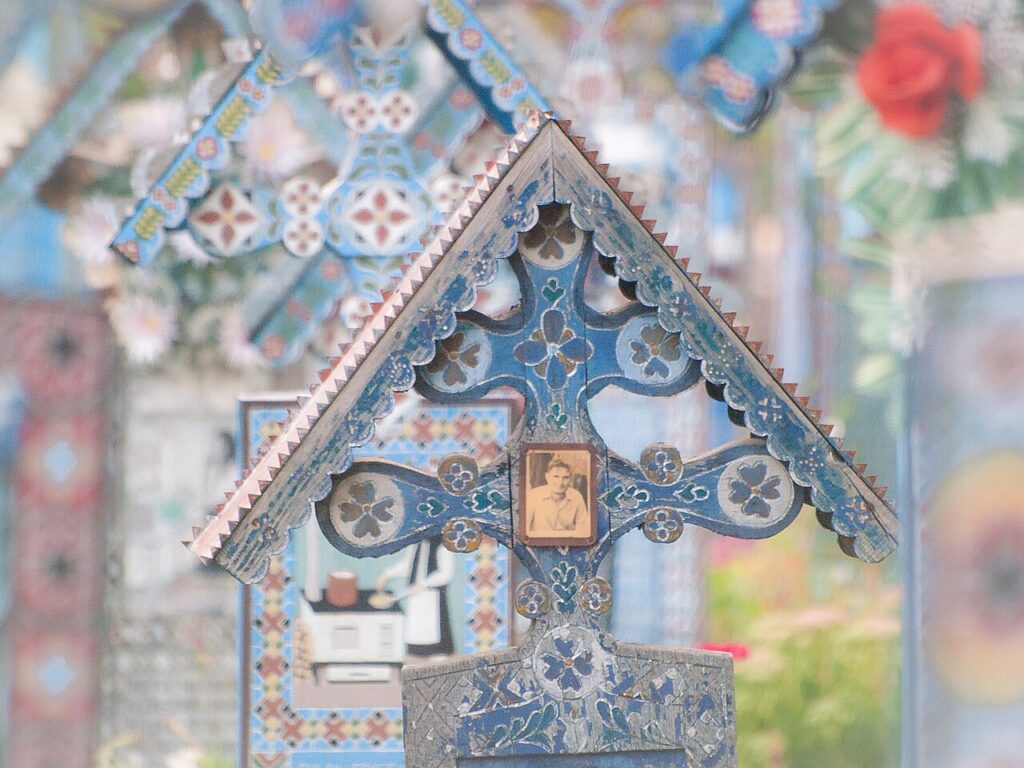
Beyond the Merry Cemetery: How Săpânța, Romania, Paints Death with a Smile (2026)
In 1935, a local woodcarver named Stan Ioan Pătraș chiseled his first brightly painted oak cross in the hilltop cemetery of Săpânța, a remote village in Maramureș. Instead of somber black, he chose azure blue and sunflower yellow, and instead of grieving words, he carved a witty epitaph about the deceased’s love for wine and arguing with his wife. That single act of irreverence transformed a burial ground into the world’s only “Merry Cemetery” — and put this tiny Romanian village on the global map of cultural wonders.
The Story Behind Săpânța, Romania
You might think Săpânța has always been defined by its colorful graves, but the village’s history runs much deeper — and darker. Nestled in the Mara River valley at the foot of the Gutâi Mountains, this settlement was first documented in 1373 under the name “Sapuncha.” For centuries, it was a forgotten peasant hamlet in the Maramureș region, a land that was part of the Kingdom of Hungary until the Treaty of Trianon in 1920 handed it to Romania. The villagers, mostly Orthodox Romanians, lived by the rhythms of the seasons — cultivating potatoes, raising sheep, and hewing timber into the legendary wooden churches that still dot the landscape. The most famous of these, the Church of the Holy Archangels (built 1748), stands just a mile from the cemetery, its tall spire a testament to the region’s Gothic-inspired wooden architecture.
The turning point came when Stan Ioan Pătraș began his unusual tombstone project. Inspired by local folk traditions of poetic mourning — where families would compose humorous verses about the deceased at wakes — he transformed grief into an art form. Pătraș worked for over four decades, carving and painting more than 800 crosses until his death in 1977. Each one tells a micro-story: a woman spinning wool, a soldier in uniform, a drunkard with a flask. The epitaphs are brutally honest, often funny, and always human. One reads: “Here rests my mother-in-law / If she’d lived another year / I’d have had to move away.” Another warns: “Don’t cry for me, friend / I was a blacksmith / Now I rest / You work.” In 2005, UNESCO gave the Merry Cemetery its unofficial blessing by listing the region’s wooden churches as a World Heritage site, and travelers have flocked here ever since — but the village has never lost its quiet, stubborn authenticity.
Neighborhood by Neighborhood
The Cemetery Quarter (Nord-Est)
Start your exploration at the heart of Săpânța’s fame: the Merry Cemetery itself, situated on a gentle slope just north of the main road (DN 109C). You’ll approach through a simple wooden gate, and suddenly the riot of blue and yellow crosses rises before you, each one a hand-painted biography. Plan to spend at least two hours here — not just snapping photos, but reading the epitaphs (most have Romanian and English translations on plaques). Nearby, the Pătraș Workshop, just a hundred meters downhill on Strada Principală, is where you can watch living carvers continue the tradition. Here, you’ll see the same deep azure paint — made from a secret local recipe — being applied to fresh oak crosses. The air smells of turpentine, wood shavings, and fresh paint like a carpenter’s workshop crossed with an artist’s studio. Don’t miss the small museum (entry 10 lei, about $2.20) next door, which displays a replica of Pătraș’s original workshop tools and a collection of early crosses that never got placed.
The Village Center (Centru)
Descending south from the cemetery, you enter the village’s civil heart along the main drag — a single paved road lined with two-story houses, many with wide porches and steep roofs. Here you’ll find the local grocery shop, a pharmacy, and the town hall. The pace is slow: locals sit on benches outside their gates, talking in Romanian (and a few in the Ukrainian dialect spoken by the small ethnic minority in the area). The standout landmark is the Church of the Holy Archangels, a fortified wooden wonder built without a single nail. Travelers often discover that the interior is entirely frescoed with 18th-century biblical scenes painted directly onto the timber — a hidden treasure that predates the cemetery by two centuries. Entrance is free, but you should offer a small donation to the caretaker. Across the street, the village pub, “La Stan,” serves cold Ursus beer (6 lei) and homemade plum brandy (10 lei for a generous shot) — stop here to see where old men debate politics and the price of firewood.
The Rural Fringe (Valea Săpânței & Magină)
To truly understand Săpânța, you need to wander beyond the village proper into the rolling farmland and forest edges that surround it. The road that runs east alongside the Săpânța River will take you past hayfields where locals still scythe by hand in July, and past herds of sheep guarded by Carpathian shepherd dogs. About two kilometers from the center, you’ll reach the small hamlet of Magină — a cluster of traditional wooden houses with steep, shingled roofs and hand-carved gateways. This is where you’ll see life that hasn’t changed much in a century: women in embroidered blouses washing wool in the river, farmers loading hay onto horse-drawn carts. For the best view of the entire valley, hike up the dirt path behind the cemetery to Crucea lui Pătraș (Pătraș’s Cross), a tall wooden cross on a hill where the artist himself is buried in a modest grave — a surprise for first-time visitors, since his grave is not in the cemetery but overlooking it.
The Local Table: What Natives Actually Eat
Food in Săpânța is a celebration of hearty, simple ingredients — pork, potatoes, cornmeal, and sour cream — cooked with the kind of care that only a grandmother can muster. Your best bet for a true local meal is not a restaurant, but a private home. Arrange a dinner through a local guesthouse, or look for the sign for “Masa la Țăran” (Farmer’s Meal) along the main road. For about 50 lei ($11), you’ll sit down to a spread: sarmale (cabbage rolls stuffed with pork and rice, smothered in tomato sauce and sour cream), mămăligă (polenta) with warm cheese and fried pork cracklings, and a side of zacuscă, a smoky roasted eggplant spread. The star of the meal is horincă, the local double-distilled plum brandy that hits at 55% alcohol. Locals recommend sipping it slowly before the first course — it’s not for the faint of heart.
The “Merry Cemetery, Săpânța, Romania
For a quick bite during your cemetery visit, the small food kiosk at the entrance sells pâine cu slănină — thick slices of rustic bread topped with cured pork fat and raw onion, a classic Maramureș snack that costs 8 lei. And if you want to stock up on artisanal produce, visit the weekly market on Saturday morning in the church square. You’ll find jars of wild strawberry jam, smoked cheese from the Gutâi Mountains, and dark, dense honey from the forest edge. Don’t leave without buying a wedge of caș afumat — a smoked sheep’s cheese that locals pair with a thick slice of sourdough and a dollop of sour cream for the perfect before-dinner bite.
Art, Music & Nightlife
The creative soul of Săpânța is, of course, the ongoing legacy of the Merry Cemetery. But you’ll find that the village’s artistic heartbeat pulses strongest in the woodcarving workshops. The Pătraș Workshop (mentioned above) is the most famous, but there are at least four other family-run ateliers on the same street where carvers like Grigore Rus and Ioan Radu continue the tradition. Visit in the morning (8am to noon) to see them at work — you can commission a custom epitaph for your own memorial (prices start around 1,500 lei, $330) if you’re feeling particularly playful about death. The ephemeral art scene also appears in the form of troițe — small hand-carved wooden crosses that dot the roadsides, each one a folk-art prayer.
Music here is rooted in the doina, a slow, mournful style of song that often turns into a party when the țambal (hammered dulcimer) and vioară (fiddle) kick in. You won’t find a nightclub in Săpânța, but you will find live folk music at the occasional village feast (șezătoare) — especially around the patron saint days. The most important is the Feast of Saint John the Baptist on June 24, when the village hosts a three-day festival with dancing in the streets, grilled sausages, and endless horincă. On a regular evening, your nightlife is limited to the pub “La Stan”, where the music is a transistor radio playing Romanian pop music and the occasional accordion by a tipsy patron. Savvy visitors know that the real show is the sunset over the hills from the cemetery — a quiet, reflective end to a day spent contemplating mortality with a smile.
Practical Guide
- Getting There: The nearest major airport is Baia Mare (BAY), about 35 kilometers away with seasonal flights from Bucharest and a few European hubs. Alternatively, fly into Cluj-Napoca (CLJ) — three hours by car — and rent a car. Book flights at Skyscanner
- Getting Around: A car is essential; public buses between Săpânța and Sighetu Marmației (the nearest town, 14 km away) run twice daily (5 lei). Rent a car from Sighetu for about 120 lei/day ($26). Parking is free at the cemetery.
- Where to Stay: Stay in a traditional guesthouse (pensiune) near the cemetery. Casa Alex is top-rated with double rooms from 180 lei ($40) including breakfast. For more comfort, try Pensiunea La Castel in Sighetu. Check Booking.com
- Best Time: May to September for warm weather and green hills. June offers the longest days and the festival on the 24th. Avoid November–March when many guesthouses close and the cemetery looks bleak under snow.
- Budget: For one person, budget around 200 lei ($44) per day — that covers accommodation, three meals, a bottle of horincă, and bus fare. A thriftier traveler can get by on 130 lei ($29).

Green pine trees near mountain under blue sky during daytime, Săpânța, Romania
What Surprises First-Time Visitors
The biggest shock is how tiny Săpânța is. You might expect a bustling tourist town, but the village has fewer than 3,000 residents and only a handful of places to eat. The Merry Cemetery itself occupies an area no larger than a small football pitch. Travelers often arrive expecting a theme park and find instead a living village where children play football beside the crosses and old women sell apricots from baskets. The intimacy is moving — you’re literally walking among the dead, each one known by the living.
Another pleasant surprise is the warmth of the locals. Don’t be shy about greeting people with “Bună ziua” (good day); you’ll often be invited into a garden for a glass of horincă or shown a family album of weddings and harvests. While English is not widely spoken beyond the cemetery ticket office, younger villagers study it in school and will help you with enthusiasm. One last shock: the epitaphs are not all humorous. Many are heartbreakingly tender — a mother’s lament for a son lost in the war, a wife’s tribute to a faithful husband. You’ll laugh and cry in the same row of crosses, which is exactly what Stan Ioan Pătraș intended: death is a mirror of life, and life is both absurd and sacred.
Your Săpânța, Romania Questions
Is the Merry Cemetery safe to visit alone?
Absolutely. Săpânța is one of the safest villages in Romania, with virtually no violent crime. The cemetery is open 24/7, but you should visit during daylight (April–October 8am–8pm, November–March 9am–6pm) to fully appreciate the paintings. The ticket office charges 10 lei for adults (2.20 USD). Locals often leave their doors unlocked, and hitchhiking is common among the few tourists. Solo travelers will feel completely at ease wandering the paths, especially in summer when other visitors and farmers are out.

White and brown concrete building surrounded by green trees under blue sky …, Săpânța, Romania
How can I read the epitaphs if I don’t speak Romanian?
Many crosses now have small brass plaques with English (and sometimes German or French) translations attached. Additionally, the library at the workshop has a booklet (20 lei) that translates every epitaph in the cemetery — a handy companion. If you’re lucky, a local guide like Maria, who runs the small tourist information stand by the gate, will offer free explanations. She knows the story behind every cross and will even recite the epitaphs in rhyme if you buy her a beer afterward.
Can I take photos or film inside the cemetery?
Yes, you are welcome to photograph and film for personal use. Commercial filming requires permission from the village mayor’s office (contact them through the workshop). Drones, however, are banned because the crosses are delicate and the wind from low-flying drones can damage the paint. Stick to ground-level shots — you’ll find no shortage of stunning angles, especially in late afternoon when the golden light warms the blue wood. The one unspoken rule: don’t sit on the graves or lean crosses for a close-up. Respect that these are actual graves of actual people who rest there — and whose descendants might be watching from the village’s front porches.

