
Beyond the Pacific Sands: Why Ocós, Guatemala, Beckons the Adventurous Soul (2026)
In 1524, Pedro de Alvarado’s conquistadors stumbled upon a narrow strip of black volcanic sand along Guatemala’s Pacific coast, where the Xinca people had traded salt and dried fish for centuries. They named it “Ocós” after the local word for “place of the turtles,” little knowing this sleepy fishing hamlet would one day become a sanctuary for travelers seeking raw, unpolished beauty. The ocean still roars with the same primal energy, and the turtles—though scarcer—still crawl ashore under the moon’s watchful eye.
By the late 19th century, a small port had formed to export coffee and sugar from inland fincas. During the 1970s, the Guatemalan government carved a paved road through the jungle, and Ocós suddenly became accessible to weekenders from Quetzaltenango and Guatemala City. But unlike the overdeveloped resorts of Monterrico or San José, Ocós never succumbed to mass tourism. Locals still wave from wooden fishing boats, and the only high-rise you’ll see is a nearly abandoned observation tower built by a short-lived hotel venture in 1998. Today, Ocós remains a place where you can hear nothing but the crash of waves and the cry of pelicans—a rare gem in a region increasingly paved over.
Neighborhood by Neighborhood
El Centro: The Heartbeat of the Pueblo
You’ll find El Centro wrapped around the central park, a compact grid of pastel-colored concrete buildings with corrugated tin roofs. The main street, Calle Principal, runs perpendicular to the beach and is lined with tiny tiendas selling cold Gallo beer, plastic sandals, and overripe papayas. On weekends, the park fills with families eating elotes locos (ears of corn slathered in mayonnaise and chili powder) while children kick soccer balls across the dusty plaza. Your best bet for breakfast is Comedor Doña Marta on 4a Avenida, where for Q25 (about $3) you get a plate of scrambled eggs, black beans, fresh tortillas, and a mug of sugary coffee—served under a corrugated awning while roosters crow nearby. Unlike the more touristy areas, El Centro feels lived-in, raw, and utterly authentic; you’ll seldom hear English spoken here.
La Playa: Where the Ocean Meets the Village
Stretching south from the central park, La Playa is the ribbon of sand that gives Ocós its reason for being. One block of pavement gives way to a dirt track that runs parallel to the shore for about two kilometers. Here you’ll find a scatter of rustic palapas—thatched-roof restaurants where locals recommend the ceviche de camarón (shrimp ceviche) and fried fish fresh off the pangas. Mariscos El Pescador, a family-run spot at the southern end, has been serving the same recipe for more than thirty years. Travelers often discover that the beach itself is a study in contrasts: black volcanic sand that burns your feet by midday, and a steady surf that’s strong enough to knock you off your feet if you venture too deep. Seasoned visitors know to bring water shoes because the sand is littered with broken shells and sharp volcanic pebbles. As dusk falls, the beach transforms into a social arena—local boys play soccer, couples stroll hand in hand, and somewhere a portable speaker blasts reggaetón.
Los Manglares: The Backwater Sanctuary
To the north and east of the village, Los Manglares is a maze of narrow canals lined with dense mangle trees. Most tourists overlook this area entirely, which is your gain. Locals recommend hiring a lancha (motorboat) from Don Rigo’s Boat Dock for Q150 ($20) for a two-hour tour through the mangrove tunnels. Here you’ll spot iguanas sunning on branches, herons stalking fish, and if you’re lucky, a crocodile gliding silently beneath the surface. The air smells of salt, mud, and decaying leaves—a primordial scent that feels ancient and wild. The neighborhood itself has no streets; families live in stilted wooden houses accessible only by boat. This is where Ocós’s soul reveals itself: a community intimately entwined with water, where life moves to the rhythm of the tides. Plan to go early morning (6–8 a.m.) for the best birdwatching before the heat thickens.
The Local Table: What Natives Actually Eat
Food in Ocós is defined by what comes out of the sea that morning. The fishing fleet—a dozen or so wooden pangas painted turquoise and yellow—departs before dawn and returns around 9 a.m. to the small market at the foot of Calle Principal. You can buy your own red snapper, corvina, or sierra directly from the fishermen and ask any of the comedoras to grill it for a fee. But the dish every traveler must seek out is tapado, a coconut-based seafood stew that’s unique to Guatemala’s Pacific coast. Unlike its Honduran cousin, the Ocós version is lighter, thickened with green plantain and spiced with achiote and chile cobanero. The best version is served at Comedor La Cabaña de Doña Chonita, a humble structure of bamboo and palm fronds set just behind the beach. For Q40 (about $5), you get a bowl of tapado loaded with shrimp, fish, and crab legs, accompanied by a heap of rice and a stack of fresh corn tortillas. Doña Chonita herself will come to your table, her hands still dusted with masa, and ask if you want more chiltepe—the fiery little pepper she grows in her backyard. This is not haute cuisine; it is honest, generous, and unforgettable.

This is a view of Santa Maria and the Rio Ocos watershed from the ridge of …, Ocós, Guatemala
Beyond seafood, the local diet leans heavily on the usual Guatemalan staples: black beans, rice, eggs, and tortillas. But what surprises visitors is the abundance of tropical fruit—mangoes, bananas, coconuts, and the chewy, sweet jocote plum that ripens in August. Every Friday and Saturday, a small market sets up in the central park where vendors sell champuradas (corncakes), atol de elote (sweet corn drink), and fresh-squeezed limeade. Your best bet is to eat like a local: a simple breakfast at your posada, a ceviche lunch at the beach, and then a big dinner of grilled fish or tapado. Skip the imported snacks—the real flavor of Ocós is in its simplicity.
Art, Music & Nightlife
Ocós isn’t known for a booming art scene, but that doesn’t mean it lacks creative soul. The village has a small Casa de la Cultura on 2a Calle, a faded building where local painters and artisans occasionally exhibit work inspired by the mangrove landscapes and the endless horizon. During Semana Santa (March/April), residents create dazzling alfombras—sawdust carpets dyed in brilliant colors—that line the streets during religious processions. If you’re lucky enough to visit during the Fiesta Patronal de San José (March 19), you’ll see traditional baile de la conquista performed by schoolchildren, a colonial-era dance you’ll find nowhere else in Guatemala.
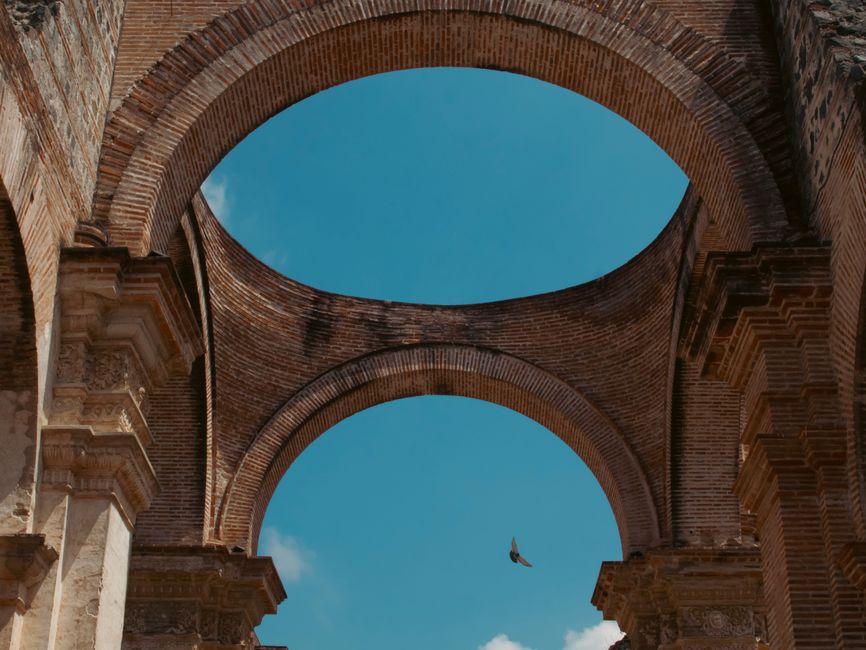
Elegant ancient brick arches of a historic ruin in Antígua, Ocós, Guatemala
Music in Ocós is more about the beat of everyday life than staged performances. Most nights, the main square fills with the crackle of a TV from a nearby shop, mixed with the strum of a guitar from a teenager’s porch. The only real nightlife is Bar La Mona, a two-room cantina at the northern edge of the beach that opens around sunset. Locals gather here to drink cerveza and play dominoes under a single bare bulb; the floor is sand, the music is sometimes a jukebox with worn-out cumbia tracks. You’ll find no neon, no cover charge, no pretension—just salt air, cold beer, and the occasional impromptu dance when a good song comes on. For a more collective experience, visit during the Día de la Playa (first Sunday in February), when the whole village sets up grills, brings speakers, and turns the shore into an all-day party.
Practical Guide
- Getting There: Fly into La Aurora International Airport (GUA) in Guatemala City on major carriers like American Airlines, United, or Delta. From there, you’ll need to take a bus or rent a private shuttle. Book flights at Skyscanner.
- Getting Around: In Ocós, you walk everywhere—the village is only about 1.5 kilometers long. For the mangroves, hire a lancha (Q150 for 2-hour tour). To reach Ocós from Guatemala City, take a Pullman bus to Coatepeque (Q80, 3 hours), then a microbus or tuk-tuk to the coast (Q25, 30 minutes).
- Where to Stay: For comfort, stay at Hotel Playa Ocós in La Playa (Q300/night, basic but clean). For authentic village life, try Casa de Lino in El Centro (Q150/night, shared bath). Check Booking.com
- Best Time: November to April is the dry season—skies are clear, waves are calm, and turtles nest from December to March. Avoid May–October (rainy season) when roads flood and mosquitoes swarm.
- Budget: Q250–Q350 per day ($32–$45) including a basic room, three meals, and one local tour. Beer costs Q10–Q15; a full meal at a comedor is Q35–Q50.
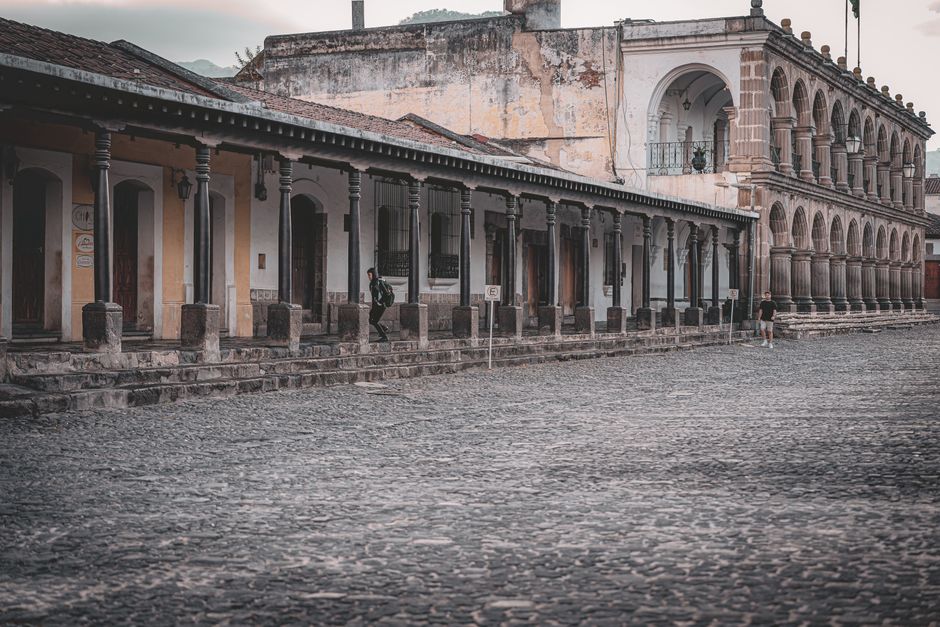
Elegant colonial buildings with stone archways and cobblestone streets in A…, Ocós, Guatemala
What Surprises First-Time Visitors
The silence. You might arrive expecting a lively beach town, but Ocós is profoundly quiet, especially on weekdays. After sunset, the only sounds are the surf, the occasional dog bark, and the distant hum of a generator. Many travelers admit feeling disoriented at first—there are no touts hawking tours, no bartenders shouting about happy hour. The surprise, however, quickly becomes a gift: you learn to sit still, to watch the tide slide out, to listen to your own breath. This is a place that rewards patience.
Another shock is the cold current. The Pacific water off Ocós is fed by the Humboldt Current, which sweeps up from Antarctica, so the ocean temperature rarely exceeds 22°C (72°F). First-timers wade in expecting warm, tropical water and gasp as the chill hits their ankles. Locals will laugh and tell you, “Es refrescante”—it’s refreshing. You’ll get used to it after a few days, and some visitors find it invigorating, especially under the midday sun. The flip side is that the strong rip currents mean you should never swim alone or far from shore; the beach has no lifeguards.
Finally, visitors are surprised by the friendliness of the people. Despite the language barrier—most locals speak Spanish only, and some older residents speak Mam—you’ll be greeted with a warm “buenos días” every time you pass someone on the street. Don’t be surprised if a fisherman offers you a taste of his freshly caught corvina, or if a grandmother insists you take a seat on her porch. In Ocós, hospitality is not a service—it’s a reflex.
Your Ocós, Guatemala Questions
Is Ocós safe for solo travelers, especially women? Yes, but with standard precautions. Ocós is a tight-knit community where everyone knows everyone. Street crime is extremely rare, but you should avoid walking alone on the beach after dark simply because the path is unlit and uneven. Women traveling alone report feeling safe in El Centro and La Playa during daytime hours. It helps to learn a few phrases in Mam or Spanish; locals warm quickly to travelers who try to speak their language. Carry only small amounts of cash, and leave valuables in your room.
Can you see sea turtles in Ocós, and how? Absolutely—the town’s name means “place of the turtles.” Olive ridley and black turtles nest on the beach from December to March, primarily at night. You can join a turtle walk led by the local conservation group Grupo Tortuguero Ocós. They patrol the beach from 8 p.m. to midnight and are happy to let visitors tag along for a small donation (Q50). They also run a hatchery on the northern end of La Playa where you can see baby turtles released in January and February. Do not try to find nests on your own—you could disturb them or step on eggs.
What’s the internet and electricity situation? Electricity is reliable (though outages happen during storms). Internet is another story. Most hotels and restaurants have Wi-Fi that works for messaging and browsing, but don’t expect streaming speeds. Your best connection is at Hotel Playa Ocós, where the router is close to the reception area. Cell service with Claro or Tigo is strong on the beach, weaker in Los Manglares. Plan to disconnect—Ocós is the perfect place to stow your phone and watch the pelicans. Savvy travelers download offline maps and podcasts before arriving.

