
Where the Ganges Runs Clear: Rishikesh’s Ancient Call to Wanderers (2026)
In 1968, four mop-haired musicians stepped off a dusty bus near the banks of the Ganges, their eyes fixed on the ashram of Maharishi Mahesh Yogi. The Beatles had come to Rishikesh seeking transcendence, and within weeks, the world’s press descended on this once-sleepy river town. By the time they left in April, Rishikesh had been transformed from a local pilgrimage site into a global magnet for seekers of all stripes—a shift that echoes in every incense-scented lane and yoga mat you encounter today.
The Story Behind Rishikesh, India
Rishikesh’s sacred identity stretches back millennia, long before the Beatles turned it into a countercultural icon. According to legend, the sage Raibhya Rishi performed such intense penance here that Lord Vishnu appeared, granting the place the name “Rishikesh”—meaning “lord of the senses.” By the 9th century, the town had become a key stop on the Char Dham pilgrimage route to the Himalayan shrines of Badrinath, Kedarnath, Gangotri, and Yamunotri. Every year, hundreds of thousands of Hindu devotees passed through, bathing in the holy Ganges at the Triveni Ghat before heading into the mountains.
The colonial era brought a different kind of traveler. British officers stationed at the nearby hill station of Mussoorie discovered Rishikesh as a healing retreat, drawn by its dry climate and mineral springs. They built bungalows along the river, and by the 1920s, the town had a small railway station, connecting it to Haridwar and the plains. But the real turning point came in 1968. Maharishi Mahesh Yogi, a Transcendental Meditation guru, had established his ashram on a remote hillside above the Ganges. When the Beatles arrived—along with Mia Farrow, Donovan, and Mike Love—the ashram became the epicenter of a global spiritual revolution. Though the ashram closed in the 1990s and now lies in atmospheric ruins, its legacy endures in the hundreds of yoga schools, meditation centers, and wellness retreats that line the riverbanks today. In 2013, devastating floods washed away bridges and buildings, but Rishikesh rebuilt, emerging with better infrastructure and an even stronger sense of purpose: to remain a place where ancient tradition meets modern seeking.
Neighborhood by Neighborhood

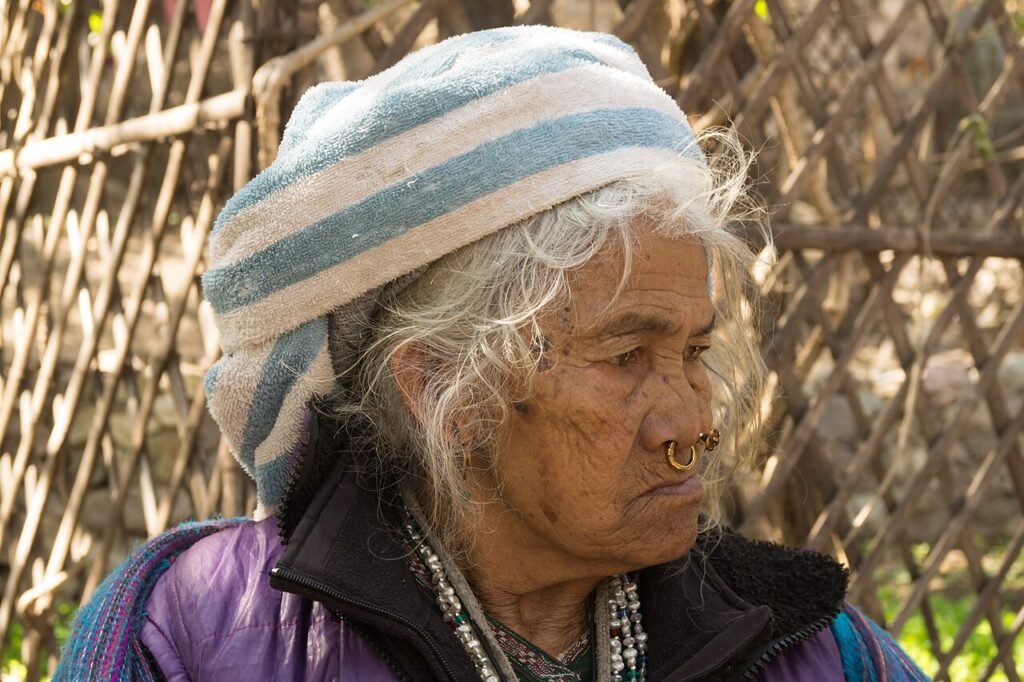
Native Garhwali Woman In Rishikesh, Rishikesh, India
Laxman Jhula
Cross the swaying suspension bridge of Laxman Jhula, and you step into the old heart of Rishikesh. Narrow cobblestone alleys twist between buildings painted in saffron and faded blue, their balconies draped with prayer flags. Street vendors sell copper bells, beaded malas, and tiny brass Ganga idols. The air smells of sandalwood incense, frying samosas, and the faint sweetness of hashish—a legacy of the hippie era that still hovers in the air. The main square, just off the bridge, is dominated by the ancient Trayambakeshwar Temple, dedicated to Lord Shiva, a 12th-century stone structure you can walk through in five minutes. Locals recommend climbing the steep steps behind the temple at sunset for an unparalleled view of the river and the distant Himalayas. The bridge itself is the busiest artery; pedestrians, cows, and monkeys jostle for space. On the east bank, you’ll find the Beatles Ashram (officially Chaurasi Kutia) now abandoned but open to visitors. Most tourists overlook the jungle trails that lead to hidden caves and meditation caves above the ashram—seasoned travelers pack a flashlight and explore the graffiti-covered walls where John Lennon once wrote lyrics.
Ram Jhula
About a kilometer downstream, the newer, wider Ram Jhula bridge connects the town to Swarg Ashram, a dense spiritual enclave. This neighborhood feels quieter and more organized than Laxman Jhula, with wide pedestrian lanes lined with ashrams, yoga shalas, and Ayurvedic massage centers. The iconic Parmarth Niketan Ashram, a sprawling complex with a marble courtyard, hosts the evening Ganga Aarti every night at 6:00 p.m. You’ll see dozens of devotees floating diyas—tiny leaf boats with candles—on the river as priests chant Sanskrit hymns. The aarti is free, but plan to arrive by 5:30 to claim a spot on the ghat steps. Just behind the ashram, the Ram Jhula market offers a more curated shopping experience: organic spices, handmade incense, and silk scarves. Travelers often discover that the best chai in the neighborhood comes from a tiny stall called “Chai Sutta Bar” on the second lane off the bridge—try the ginger-cardamom brew for 20 rupees. The banks here are lined with hammocks strung between trees, and on any given afternoon you’ll see travelers reading, meditating, or simply watching the river flow. This is the most tranquil neighborhood for a long stay.
Tapovan
A 15-minute walk uphill from Ram Jhula, Tapovan feels like a different world—and a different budget. This neighborhood, perched on a ridge overlooking the Ganges, has become the epicenter of Rishikesh’s luxury wellness scene. Whitewashed villas, boutique yoga retreats, and organic cafés dot the leafy streets. The atmosphere is polished but still spiritual; many of the studios here offer teacher training courses that cost $2,000 or more for a month-long immersion. The highlight is the view: from many rooftop terraces, you can see the entire river valley, with the Shivalik Hills rising in the distance. Tapovan’s main drag, Tapovan Road, is lined with vegetarian restaurants serving everything from Mexican bowls to traditional thalis. Try “The Country Cafe” for a breakfast of fresh mango lassi and avocado toast (around 400 rupees). Locals recommend the “Shiva Garden” for a relaxed dinner under fairy lights—their paneer tikka is legendary. If you’re here for yoga, the most respected studio is “Rishikesh Yog Peeth,” founded by the well-known teacher Yogi Chetan. Most tourists overlook Tapovan because it requires a steep climb from the river, but savvy visitors book accommodation here for the peace and the sunrise views.
The Local Table: What Denizens Actually Eat
Rishikesh is a strictly vegetarian, alcohol-free town—a prohibition rooted in its status as a holy city. This might sound limiting, but you’ll find that the local cuisine is anything but boring. The foundation of Rishikesh’s food culture is sattvic cooking: simple, pure, and plant-based, using ingredients like lentils, vegetables, whole grains, and ghee. No onion or garlic is used in many ashram kitchens—these are believed to stimulate base passions—but outside the ashram walls, you’ll find full-flavored dishes that use them freely. The defining meal is the “thali,” a platter of small bowls containing dal, sabzi (vegetable curry), roti, rice, papad, and a sweet like kheer. The best thali in town is served at “Chotiwala” on Laxman Jhula Road—a legendary institution that has been open since 1969. For 200 rupees, you get an endless refill of food served on a steel plate, seated on the floor in a traditional setting. The secret is to ask for “extra ghee” on your roti; they’ll pour a small ladleful from a copper pot.

Photo of cityscape during nighttime, Rishikesh, India
For street food, head to the vegetable market near the Ram Jhula bridge, where vendors sell “samosas” and “kachoris” from dawn until noon. The samosas here are smaller than the ones you’ll find in Delhi, filled with spiced potatoes and green peas, deep-fried in peanut oil, and served with a tamarind-date chutney that is both sweet and tangy. Do as locals do: buy a paper cone of them for 30 rupees and eat them walking along the ghats. Another must-try dish is “aloo puri”—a breakfast staple of soft fried bread with a potato curry—served at “Mohan Ji’s Dhaba” behind the Laxman Jhula market. The secret is the masala mix, which includes dried mango powder and fennel seeds. Wash it down with a glass of “lassi” (sweetened yogurt drink) from the same stall—the thick, creamy version is the best in town. If you’re staying in an ashram, you’ll eat what the sadhus eat: a simple meal of rice and dal served on a banana leaf, eaten with your right hand. It’s an experience that changes how you think about food, stripping it down to its nourishing essence.
Art, Music & Nightlife
Rishikesh’s creative scene is inseparable from its spiritual pulse. Music, especially drumming and chanting, fills the air after sunset. The most authentic place to experience it is the International Yoga Festival, held every March at Parmarth Niketan Ashram. For a week, the ashram grounds buzz with kirtan sessions, classical dance performances, and workshops on sacred sound. But if you can’t make the festival, visit the “Phool Chatti Ashram” any Tuesday or Thursday evening at 7:00 p.m. for a free kirtan led by local monks. The energy is electric—travelers often find themselves swaying and clapping without understanding a word of the Sanskrit lyrics. For a more contemporary music scene, head to “The Beatles Cafe” near the abandoned ashram, which hosts live acoustic sets every Friday evening. You’ll hear covers of Western folk and rock, alongside original compositions by traveling musicians.

A very tall building sitting on the side of a river, Rishikesh, India
Nightlife in Rishikesh is subdued compared to other Indian tourist hubs. The street lights dim by 10:00 p.m., and the only sounds are the river and temple bells. But this quiet is part of the charm. Many travelers gather at the rooftop cafés in Laxman Jhula for a final chai under the stars. “The Little Buddha Cafe” has a rooftop viewpoint where you can watch the fireflies and the distant lights of Taopvan. If you want a taste of the old hippie energy, the “German Bakery” on Tapovan Road stays open until 11:00 p.m., serving brownies, cakes, and ginger tea. There’s no bar, but you can buy “bhang”—a cannabis-infused drink—legally from government-licensed shops in the market. Use with caution: it’s potent and can knock you off your feet if you’re not accustomed. The real nightlife in Rishikesh is the Ganga Aarti at Parmarth Niketan, held every evening at 6:00 p.m., where you’ll find hundreds of locals and visitors singing, dancing, and floating lamps on the holy river.
Practical Guide
- Getting There: Your best bet is to fly into Dehradun’s Jolly Grant Airport (DED), just 20 kilometers from Rishikesh. IndiGo and Vistara operate daily flights from Delhi, Mumbai, and Bangalore—book at Skyscanner. From the airport, a taxi costs around 1,000 rupees to the town center. Alternatively, you can take a train to Rishikesh Railway Station (Rishikesh Okhla) from Delhi—the overnight “Garhwal Express” arrives in the morning and costs about 200 rupees for a sleeper class. Once you’re in town, everything is walkable or accessible by shared auto-rickshaw.
- Getting Around: Walking is the best way to explore the main neighborhoods—the bridges are pedestrian-only. For longer distances, shared auto-rickshaws run between Laxman Jhula, Ram Jhula, and Tapovan for 30 to 50 rupees per person. A private rickshaw from one end of town to the other costs around 200 rupees. If you’re adventurous, rent a bicycle for 150 rupees per day from shops near the bus stand. Note: no motorbikes are allowed within the sacred zone, but you can hire a taxi for trips to nearby attractions like the Neer Garh Waterfall (30 minutes, 500 rupees round-trip).
- Where to Stay: For budget travelers, stay in Laxman Jhula or Ram Jhula—dorm beds cost as little as 400 rupees per night at “Zostel Rishikesh” or “Himalayan Hostel.” For mid-range, Tapovan offers charming guesthouses like “The Glass House” (1,500 rupees/night) with river views. If you’re going for luxury, the “Ananda in the Himalayas” is a world-class spa resort in the hills above (from 30,000 rupees/night). Check availability and book at Booking.com. For an authentic ashram experience, book a room at Parmarth Niketan (donation-based, around 500 rupees/night) straight from their website.
- Best Time: The ideal months are October through March, when the weather is cool and dry, with temperatures ranging from 10°C to 25°C. Avoid July and August—the monsoon brings heavy rain and floods (the 2013 disaster is a stark reminder). March is perfect for the International Yoga Festival,

