
Beyond the Roman Ghosts: Why Annaba (2026)
In August 430 AD, as Vandals laid siege to the walls of Hippo Regius, an aged St. Augustine lay on his deathbed in this very city, ordering the Psalms of David to be copied and hung on his chamber walls. For fourteen centuries, his bones would travel—first to Sardinia, then to Pavia—but his spirit never truly left these Mediterranean shores. When you walk the ruins of his basilica today, you feel that ancient pulse, a reminder that Annaba has always been a crossroads where empires collide and saints are made.
The Story Behind Annaba, Algeria
You will find Annaba’s layers written in stone, soil, and salt. Founded by Phoenician traders as Hippo around 1200 BC, this deep-water port became one of Roman North Africa’s most prosperous cities, exporting grain, olive oil, and wine across the empire. By the 4th century AD, Hippo Regius was a Christian stronghold where Augustine served as bishop from 396 to 430, penning his Confessions and City of God in a modest study overlooking the harbor. When you stand on the ancient forum today, you can trace the grid of Roman streets—the cardo and decumanus—still visible beneath your feet.
The Vandals sacked Hippo in 431, and for the next millennium the city receded into a quiet fishing town called Bled Bouna, or simply “the gate.” The French seized it in 1832, renaming it Bône and transforming it into a colonial showcase—wide boulevards, grand civic buildings, and a port that shipped iron ore from the mines of Ouenza. Travelers today can still see this French imprint in the elegant facades of Avenue de la Révolution and the tidy grid of the Centre Ville. When Algeria won independence in 1962, the city reclaimed its Berber name: Annaba, meaning “place of the jujubes,” a nod to the wild fruit trees that once lined its hillsides. Modern Annaba is a city of 450,000 souls, where the steel mills of El Hadjar smoke on one horizon and the Roman ghosts of Hippo Regius whisper on the other.
What strikes first-time visitors most is how this city refuses to be pinned down—it is simultaneously Roman, Berber, Arab, French, and fiercely Algerian. You will find monuments to both the Christian saint Augustine and the Muslim warrior Abd al-Qadir within a mile of each other. The city has been invaded by Vandals, Byzantines, Arabs, Spaniards, Ottomans, and French, yet it retains a distinct character that locals guard with pride. As one Annabi friend told you, “We do not change for conquerors. Conquerors change for us.”
Neighborhood by Neighborhood

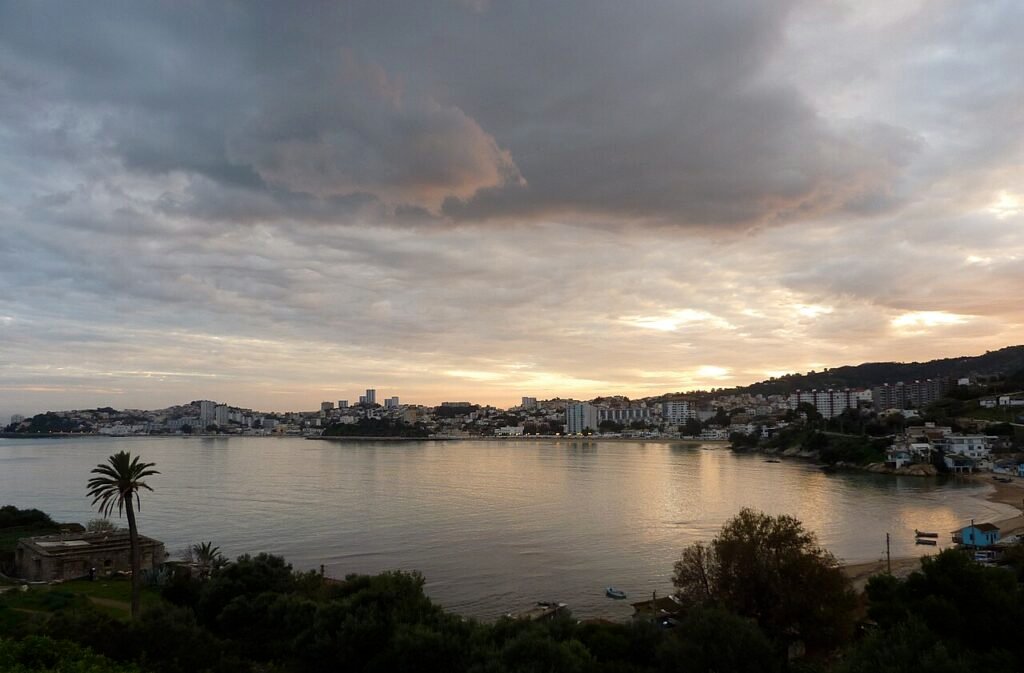
Iss074e0491560 (April 19, Annaba, Algeria
Centre Ville & Place de la Révolution
You will feel the French colonial pulse most strongly in Centre Ville, where the city’s grandest architecture lines wide, tree-shaded boulevards. Start at Place de la Révolution, the central square that locals still call “La Place d’Armes,” where the ornate Hôtel de Ville (town hall) faces a fountain surrounded by palms. On any given morning, you will see men in djellabas drinking coffee at sidewalk cafes while women in elegant hijabs shop at Galeries Lafayette—the old Parisian department store, now Algerian-owned but still selling French perfumes alongside local ceramics. The streets here have a rhythmic order: Rue de la République for bookshops and stationers, Rue du 8 Mai 1945 for textile shops, Rue de la Révolution for patisseries where you can buy makroud (date-stuffed semolina cookies) and baklava dripping with honey. Your best bet for a morning coffee is Café du Théâtre on Place de la Révolution, where the old Annabi gentlemen gather for dominos and debate politics. The architecture is a mix of neo-Moorish and French art deco—look up at the wrought-iron balconies and mosaic-tiled entryways that give the neighborhood its quiet elegance.
Sidi Salem & the Old Medina
Wander east from Centre Ville, and you will descend into Sidi Salem, the old medina that predates the French grid. Here the streets narrow to three-person width, and the smell of frying fish, baking bread, and incense fills the air. This is Annaba’s most authentic quarter, where Berber, Arab, and Ottoman influences layer like sediment. The 17th-century Mosque of Sidi Salem sits at the heart of the district, its minaret a simple square tower that locals say marks the grave of a holy man who tamed a crocodile. Every Thursday morning, the Souk Sidi Salem bursts into life: vendors sell second-hand clothes, plastic sandals, and mountain honey; butchers hang whole lambs from hooks; and old women in tribal tattoos sit cross-legged, selling hand-painted henna pouches. You will notice that the houses here turn inward—from the street, only high walls and small windows are visible, but if a door opens, you glimpse a central courtyard with a djennan (garden) of lemon trees, jasmine, and a trickling fountain. Travelers who linger in Sidi Salem discover that the neighborhood rewards patience: the best couscous in Annaba, locals insist, is made in the tiny, signless kitchen of a widow named Fatima on Rue Sidi Soufi, where you can eat a bowl of lamb couscous with seven vegetables for 300 DZD (about $2.50) if you arrive before noon.
La Verdure & the Corniche
If Centre Ville is the brain and Sidi Salem the soul, then La Verdure is Annaba’s lungs. This boulevard along the Mediterranean, lined with palm trees and pastel-colored apartment blocks, is where the city comes to breathe. On a Saturday evening, you will see families strolling the corniche, couples sitting on the red benches, and children flying kites over the sea. The beach itself—Plage de la Verdure—is a narrow strip of golden sand where locals swim year-round (even in December, the shiverers insist). At the western end of the corniche, you will find the Municipal Casino, a Belle Époque masterpiece of cream-colored tile and arched windows that now houses a restaurant and event space. Your best bet for sunset is the terrace of Le Pirate, a seafood restaurant perched at the water’s edge where you can order grilled shrimp (1,500 DZD for a platter) and watch the fishing boats bob in the harbor. Above La Verdure rises the Forest of Annaba, a cork oak forest on the slopes of Mount Edough, where locals forage for wild mushrooms in spring and hike the trails that offer panoramic views of the city, the sea, and on clear days, the mountains of Sardinia 200 kilometers across the water.
The Local Table: What Annabi Denizens Actually Eat

Black camera lens on white table, Annaba, Algeria
You have not truly eaten in Annaba until you have shared a meal in an Annabi home, but since that invitation may not come on your first visit, you can approximate the experience at the Marché Couvert, the covered market on Rue de l’Indépendance. Here, the rhythm of the table begins: you buy your produce, your fish, your spices, your bread, and you bring them home to cook. Annabi cuisine is Mediterranean with Berber depth—olive oil from the Kabylie mountains, saffron from the south, lemons from the orchards of Edough, and fish from the port where the boats dock at dawn. The defining dish of Annaba is chakhchoukha, a Berber masterpiece of torn flatbread layered with lamb, tomatoes, chickpeas, and a broth scented with cinnamon and harissa. You will find it at Restaurant El Bahia on Rue de la Révolution, where the owner Ali has been making chakhchoukha for forty years—he does not give you a menu; he asks how hungry you are and brings the appropriate amount.
Seafood is the city’s other pillar. Every morning at 6:00 AM, the auction at Port de Pêche sends sardines, anchovies, sea bass, and red mullet to the market stalls. You must eat sardines at least once—grilled on a brazier over charcoal, seasoned only with salt and a squeeze of lemon, eaten with your fingers on the harbor wall. The best spot is Chez Hassan, a hole-in-the-wall on the port where a dozen sardines with bread and salad costs 500 DZD (about $4). Travelers often overlook mlawi—a flaky, fried flatbread eaten with honey or cheese—but you will find it at the open-air bakery in Sidi Salem, where the baker presses the dough on a hot dome and you can watch the butter melt. Your Annabi hosts will insist you finish every meal with tmar (dates) and lben (buttermilk), a combination that seems odd until you taste the cold, tangy milk cutting the sweetness of the Medjool dates.
Art, Music & Nightlife

Green mountains near body of water, Annaba, Algeria
Annaba’s soul finds its voice in malouf, the Andalusian classical music tradition that traveled across the Mediterranean from 9th-century Córdoba to North Africa. The Conservatoire de Musique de Annaba, housed in a former colonial mansion on Rue de la Mer, teaches young Annabis the nuba—the complex suite of instrumental and vocal pieces that can last hours. You can hear malouf performed live at the Festival International de la Musique Malouf, held each first week of August at Théâtre Régional de Annaba (Place de la Révolution). Tickets are usually free, and the audience sits in respectful silence, then erupts into applause at the khalaf (the emotional high point of the piece). For something more contemporary, head to the Centre Culturel de Annaba on Rue du 19 Mai, where local painters exhibit work that blends Berber symbolism with abstract expressionism—you will see canvas after canvas of women in haiks (traditional wraps) rendered in electric blues and reds.
Nightlife in Annaba is not what you might expect from a “conservative” country. The corniche comes alive after dark, especially at Le Phénix, a beachfront lounge where young Annabis sit on floor cushions smoking sheesha and drinking mint tea while a DJ spins Algerian raï mixed with electronic beats. The scene peaks on Thursday and Friday nights (the weekend here), and you will need to book ahead at Le Phénix—call +213 38 86 12 34, or ask your hotel concierge. For something quieter, the Café Littéraire at the old municipal library hosts poetry readings on the last Saturday of each month, where you can hear verse in Arabic, French, and Tamazight all in the same evening. Travelers who expect Annaba to be a dry city are surprised to find small bars tucked away in Centre Ville—try Le Select on Boulevard de la Soummam, a wood-paneled haunt where old French settlers once drank pastis and where today Algerians drink Houria (a local lager beer) and watch football matches on a crackling television.
Practical Guide
- Getting There: Rabah Bitat Airport (AAE) receives flights from Algiers (Air Algérie, 1 hour, from 8,000 DZD), Paris (Air France, Transavia, 2.5 hours, from €200), and Istanbul (Turkish Airlines, 3 hours). Budget travelers should book flights on Skyscanner and aim for shoulder season (May or October) for lowest fares.
- Getting Around: Shared taxis (called “clandestos”) run fixed routes for 50–100 DZD per ride—just wave one down and call out your destination. Private taxis cost 300–500 DZD for a cross-city trip; agree on the fare before you get in. The city is walkable in Centre Ville and Sidi Salem, but you will need a taxi for La Verdure and the ruins of Hippo Regius (about 500 DZD from the center).
- Where to Stay: For colonial charm, book a room at Hotel Seybouse International (Rue de la Révolution, from 8,000 DZD/night), a 1920s grand hotel with marble floors and a rooftop terrace. For budget comfort, Résidence El Ksour in La Verdure (from 4,000 DZD/night) has clean rooms and sea views. Check both on Booking.com.
- Best Time: May–June and September–October are ideal—temperatures hover around 25°C (77°F), the beaches are uncrowded, and the sea is warm enough for swimming. July–August can be oppressively hot (35°C+), and November–February is cool and rainy (10–15°C).
- Budget: A mid-range traveler should expect to spend about $60–80 per day: $20 on accommodation, $15 on food, $10 on transport, $15 on entry fees and activities, and $10–20 on incidentals. Budget travelers can survive on $30–40/day with hostels and street food.

