
Val-d’Or, Canada Weekend: Gold Mines, Northern Lights & The Best Poutine North of Montreal (2026)
You step off the plane into air so crisp it feels like the sky itself is taking a deep breath. The scent of pine and ancient rock mingles with the distant rumble of a mining elevator descending into the earth. It’s 9:45 AM on a Friday in early September, and Val-d’Or—the Valley of Gold—has just begun to whisper its secrets. Over the next forty-eight hours, you’ll descend 300 feet underground into a real gold mine, paddle across mirror-still lakes, and eat a plate of poutine that will ruin all other poutine for you. Welcome to Abitibi.
Quick Facts Before You Go
- Best Months: June through September for warm lake swimming and hiking; late September through October for the explosion of fall colours that seasoned photographers chase
- Currency: Canadian Dollar (CAD). $1 USD gets you roughly $1.35 CAD at press time
- Language: French is the primary language, though you’ll find English spoken widely at hotels, mining tours, and most restaurants. Learning “bonjour” and “merci” will get you warm smiles
- Budget: $120–$180 CAD per day covers mid-range accommodation, three meals, and one paid activity. Budget-conscious travelers can manage on $90 CAD
- Getting There: Fly into Val-d’Or Airport (YVO) from Montreal in about 1 hour 30 minutes via Air Canada or Pascan Aviation. Book at Skyscanner for best fares
Day 1: Into the Belly of the Earth
Your first morning begins not with a sunrise hike, but with a descent. You pull on a yellow hard hat and a fluorescent vest, and the guide—a retired miner named Marcel with a voice like gravel—hands you a headlamp. “You are about to go where the money came from,” he says, and then the elevator doors close and you drop into darkness. The City of Gold tour isn’t a museum—it’s the real shaft of the old Lamaque Mine, and you will feel the weight of 300 feet of Canadian Shield above you.
- Morning (8–11am): Book the Underground Mine Tour at La Citée de l’Or (Cité de l’Or, 90 Avenue Perreault). The tour costs $49 CAD per adult and runs 2.5 hours. You’ll ride the original cage elevator down the shaft, walk through drifts carved in 1934, and watch a 100-pound ingot being poured. Arrive by 8:30 AM to beat the school groups—the 9:00 AM tour is the quietest.
- Lunch: Head straight to Le Cabestan (1030 3e Avenue), a bright bistro where locals gather for the $18 CAD smoked meat sandwich on rye with house pickles. The secret is the side of their “poutine Cabestan”—goat cheese curds, ale gravy, and a sprinkle of fresh chives. You will be tempted to order a second.
- Afternoon (1–5pm): Drive 15 minutes north to Arbraska Laflèche (240 Chemin de la Forêt), a tree-to-tree adventure park set in old-growth forest. The Via Ferrata course ($45 CAD, 3 hours) lets you clip into steel cables and walk the side of a granite cliff 50 feet up. For something quieter, hike the 2-kilometre Sentier de la Chute to a 20-metre waterfall where you can swim in the plunge pool. Most tourists skip this—you will have the place nearly to yourself on a Friday afternoon.
- Evening: Dinner at Restaurant Le P’tit Bœuf (1420 Rue de l’Église). Order the filet mignon with a peppercorn cream sauce ($32 CAD). Afterward, drive 10 minutes to Parc de la Pointe-aux-Lièvres on Lac Lemoine. If the sky is clear, you’ll see stars here like you’ve never seen them—the northern lights are visible from late August through April on nights with low cloud cover. Locals recommend the app “Aurora Forecast” to time your visit.

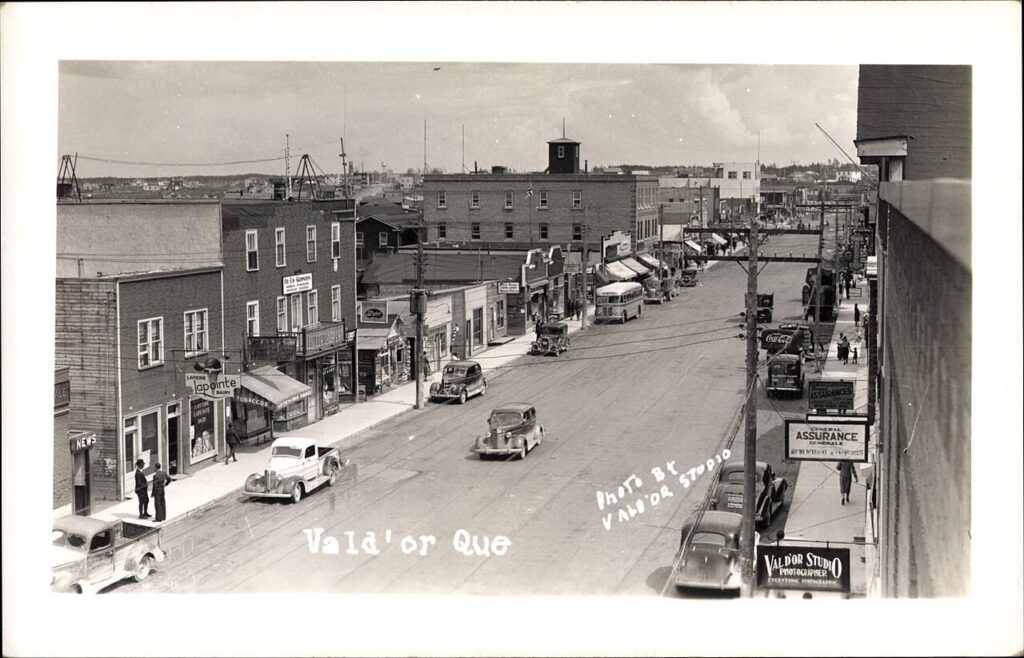
Une vue de la rue principale (3e Rue) à Val-d’Or au Québec., Val-d’Or, Canada
Day 2: Lakes, Logging History & Lapointe’s Gravy
If Day 1 was about going down, Day 2 is about going out. You wake to the sound of loons calling across Lac Blouin, and the morning light is that particular northern gold that photographers wait years to capture. Today you’ll explore the region’s other great industry—timber—and you’ll eat something at a dairy bar that will become a core memory.
- Morning (8–11am): Start with breakfast at Boulangerie La Mie du Village (1120 3e Avenue), where the croissants arrive warm from the oven at 7:30 AM. Order the “pain au chocolat maison” ($4 CAD) and a café au lait. Then drive 20 minutes east to the Village Forestier (forest village, 300 Route de l’Aéroport), a living-history site that recreates a 1940s logging camp. The self-guided tour ($14 CAD) takes you through the cookhouse, the blacksmith’s forge, and the bunkhouse where lumberjacks slept on straw mattresses. You’ll hear recordings of actual loggers singing in French—it’s haunting and beautiful.
- Midday (11am–1pm): This is where savvy visitors know to go: Lapointe’s Dairy Bar (1172 3e Avenue), open since 1962. The poutine here is considered by many to be the best in Quebec—and that’s saying something. The curds squeak against your teeth, the gravy is dark and peppery, and the fries are double-fried in beef tallow. A regular size is $10 CAD. Do not skip the “poutine garnie” with smoked meat on top for $14 CAD. Arrive before noon to avoid the twenty-minute queue.
- Afternoon (1–4pm): Drive to Parc Régional du Réservoir Decelles (40 minutes north), a massive reservoir dotted with hundreds of islands. Rent a canoe from the park office ($35 CAD for 3 hours) and paddle through the channels. You’ll see bald eagles, osprey, and if you’re quiet, the occasional moose wading in the shallows. Travelers often discover that the best swimming is at Plage du Camping, where the water is shallow and warm by mid-August.
- Final Evening: Your farewell dinner deserves something special. Book a table at Le Florentin (1000 3e Avenue, second floor), a French-inspired restaurant that locals have kept secret for years. The chef, a Quebec City transplant, does a slow-roasted duck confit with wild blueberries ($38 CAD) that tastes like the forest itself. After dinner, walk one block to Microbrasserie Abitibi (1045 3e Avenue) for a flight of four local craft beers ($14 CAD). Their “Blonde du Prospecteur” is a crisp, honey-kissed ale that pairs perfectly with the lingering taste of duck and berries.

Flag of Canada, Val-d’Or, Canada
The Food You Can’t Miss
Val-d’Or’s food culture is a conversation between two worlds: the hearty, butter-and-cream cuisine of rural Quebec and the wild, smoky flavours of Indigenous Cree and Anishinaabe cooking. You’ll taste this dialogue most clearly at Le Bistro du Cuisinier (1032 3e Avenue), where the chef serves a “tourtière du Nord” (a meat pie made with moose, bison, and wild mushrooms, $22 CAD) that’s been passed down through three generations. The crust is lard-based and shatters at the touch of a fork. Locals recommend ordering it with a side of “ketchup aux fruits”—a sweet, spiced fruit chutney that cuts through the richness.

Pink and green map, Val-d’Or, Canada
For street food, you cannot miss the poutine at Lapointe’s (mentioned above), but also watch for the Frite Alors! food truck that parks outside the mining museum on weekends. Their “poutine forestière” ($12 CAD) comes topped with wild mushrooms sautéed in butter and a handful of fresh parsley. It tastes like someone made poutine in a cabin in the woods—because someone did.
Dessert deserves its own paragraph. Go to Crèmerie Chez Sylvie (1201 3e Avenue) and order the “sucré à la crème”—a maple-and-cream frozen treat that’s somewhere between ice cream and fudge. A single scoop is $5 CAD, and you will dream about it later.
Where to Stay for the Weekend
Your best bet is to stay within walking distance of 3e Avenue, the city’s main artery where almost everything happens. Hôtel Val-d’Or (1100 3e Avenue) is the most central option, with clean, modern rooms starting at $140 CAD per night. The on-site restaurant is average, but you’re steps from everything that matters. Book via Booking.com for the best cancellation policy.
For a quieter experience, Auberge L’Étape (1171 Rue des Grognards) sits on the edge of Lac Lemoine, with rooms that have lake views starting at $160 CAD per night. You’ll wake to mist rising off the water and the sound of loons—worth every extra dollar. Check availability on Airbnb for vacation rentals on the lake, which often go for $110–$150 CAD per night with full kitchens.
Before You Go: Practical Tips
- Getting Around: You absolutely need a car. Rental agencies at YVO airport include Budget and Enterprise, with compact cars starting at $45 CAD per day. The city is walkable along 3e Avenue, but the best attractions—the mine, the forest village, the reservoir—are 15 to 40 minutes away by car. Uber doesn’t exist here; taxis are $15–$25 CAD per ride within town.
- What to Pack: 1) A headlamp or good flashlight—the mine tour is dim, and evening stargazing requires light discipline. 2) A fleece or mid-weight jacket even in summer; evenings drop to 10°C by late August. 3) Bug spray with DEET—the blackflies and mosquitoes in June and July are relentless. 4) A swimsuit—the lakes are warm enough for swimming from mid-June through early September.
- Common Tourist Mistakes: Most tourists assume everything is open on Sunday—it’s not. Many restaurants and the Village Forestier close on Sundays from September through May. Plan your weekend to arrive on Friday and leave Sunday afternoon, or shift your Friday activities to Saturday and save Sunday for driving and hiking. Another mistake: skipping the Cree cultural exhibits at the mining museum. The Musée d’Abitibi-Témiscamingue (in the same complex as the mine) has a small but powerful exhibit on Indigenous gold mining history that most visitors walk right past.
- Money-Saving Tip: Buy the Passeport Découverte ($45 CAD) from the tourist office at 1010 3e Avenue. It gives you entry to the mine tour, the forest village, and the museum for a combined cost of $45 CAD—saving you nearly $30 CAD versus buying individual tickets. The pass is valid for the entire summer season, so you can use it across two days.

