
Aksum, Ethiopia Weekend: Obelisks, Ancient Churches & The Ark of the Covenant (2026)
The morning air in Aksum carries a scent of frankincense from the Church of St. Mary of Zion, mingling with the earthy aroma of roasting coffee from a nearby tella house. You step off the plane, blinking into the highland sun, and within minutes the gravity of this ancient capital settles on your shoulders—this is where the Queen of Sheba once walked, where the Ark of the Covenant is said to rest, and where 1,700-year-old stelae pierce the sky like stone fingers. Over two days, you’ll unravel a story older than most empires.
Quick Facts Before You Go
- Best Months: October through February, when the skies are clear, temperatures hover around 20°C (68°F), and the main rainy season (June–September) has passed.
- Currency: Ethiopian birr (ETB). As of early 2025, 1 USD = ~57 ETB. Bring crisp, new US dollars for easier exchange.
- Language: Tigrinya and Amharic are official; English is understood in hotels, restaurants, and at major sites. Learning “selam” (hello) goes a long way.
- Budget: Mid-range travelers will spend $50–80 per day, including meals, entry fees, and a few taxi rides. Budget options exist for $30–40 daily if you stick to guesthouses and street food.
- Getting There: Axum Airport (AXU) receives daily flights from Addis Ababa (Ethiopian Airlines, ~1 hour 30 minutes). Round-trip tickets start around $150. Book at Skyscanner for the best rates.
Day 1: Stelae, Kings & the Ark’s Mystery
Your first morning begins with the low hum of chanting from a Coptic church. You grab a strong macchiato at your hotel—Ethiopians take coffee seriously, even if it’s poured from a thermos—and head straight for the Northern Stelae Park. This is where the ancient Axumites erected huge granite monoliths as royal tombstones. The tallest standing one, the Great Stele of Axum, rises 23 meters (75 feet) above the ground; you’ll find its former 33-meter companion, now broken, lying like a fallen titan. Locals here will tell you these stones were carved and moved without iron tools, a feat that still puzzles engineers.
- Morning (8–11am): Explore Northern Stelae Park and the archaeological field. Entry fee is 300 ETB (~$5.30) per person. Spend an hour among the stelae, then walk 50 meters to the Tomb of the Brick Arches (included in ticket) and the underground Tomb of King Kaleb and King Gebre Meskel. The tombs date to the 6th century—you’ll crouch through narrow passages to see stone sarcophagi.
- Lunch: Head to Kaleb Restaurant on the main road (just south of the stelae park). Order tibs—sautéed beef with rosemary, onions, and berbere spice—served on a large injera platter for 200 ETB ($3.50). The staff will smile if you try to eat with your hand (right hand only!).
- Afternoon (1–5pm): Visit the Church of St. Mary of Zion, a complex containing the original 4th-century chapel, a newer cathedral built by Emperor Haile Selassie, and the tiny, heavily guarded treasury that houses the Ark of the Covenant. Travelers often discover that women are not permitted inside the sanctuary; the guard will point you to a viewing window. Entry to the church complex is 200 ETB. Next, walk 400 meters east to the Dungur Palace ruins (also known as the Queen of Sheba’s Palace) – 100 ETB entry. You can see the sunken bath that legend says she used.
- Evening: Dinner at Yod Abyssinia Cultural Restaurant (on the road to the airport). The atmosphere mixes live traditional dance with the scent of roasting lamb. Order a doro wat chicken stew (250 ETB) and a local tella beer (40 ETB). Shows start around 7pm; you’ll see dancers spin in white shawls and hear the rhythmic chants of Tigrinya folk songs.
Axum Tigray, Ethiopia (2023), Aksum, Ethiopia
Day 2: Tombs, Markets & Farewell Coffee
Wake early to the crowing of roosters and the clatter of donkeys carrying firewood through the streets. Today you’ll dive into the city’s underground tombs and its lively market—an unpolished, raw side of Aksum that most tourists overlook. The best part of this second day is the slow pace; you start with history and end buying spices from a toothless grandmother who’ll insist you taste the fresh garlic.
- Morning (8–10am): Breakfast at Sheba Cafe (by the central roundabout). Order a firfir—shredded injera soaked in spiced, clarified butter (80 ETB)—and a traditional coffee ceremony for 20 ETB. The ceremony lasts 15 minutes: they’ll roast green beans in a pan, grind them with a mortar, and pour three rounds. The first is the strongest.
- Midday (10am–12:30pm): Visit the Archaeological Museum of Axum (100 ETB) near the stelae park. The collection includes 2nd-century coins, pottery, and a replica of the Ge’ez alphabet inscription from King Ezana. Your best bet to avoid crowds is to arrive right at 9am opening; by 11am school groups arrive. Insider tip: ask the museum guard to point you to the small room with the original “Ezana Stone” – a trilingual inscription that helped decipher the Ge’ez script.
- Afternoon (1–4pm): Explore the Main Market (Gulit Market) on the western edge of town. This is not a tourist bazaar—it’s where locals buy lentils, woven baskets, metalwork, and roasted barley. Bargaining is expected; a handwoven scarf might start at 300 ETB and can be haggled down to 200 ETB. Don’t miss the spice stalls: you’ll smell fenugreek, cardamom, and berbere before you see them. Take a break at the market’s makeshift coffee stand—a 5 ETB cup of black coffee will cost less than your taxi tip.
- Final Evening: Farewell dinner at Restaurant Simien (near the post office). This two-story place is a local favourite for kitfo—minced raw beef mixed with mitmita (hot chili spice) and clarified butter, served with a side of soft cheese (ayib). The cost is 300 ETB for a full portion. Savvy visitors order the tire siga (half-raw) version if you’re nervous about fully raw meat. Pair it with a cold bottle of St. George beer (45 ETB). Sit on the rooftop terrace if the evening breeze permits—you’ll see the silhouettes of the stelae against the twilight sky.

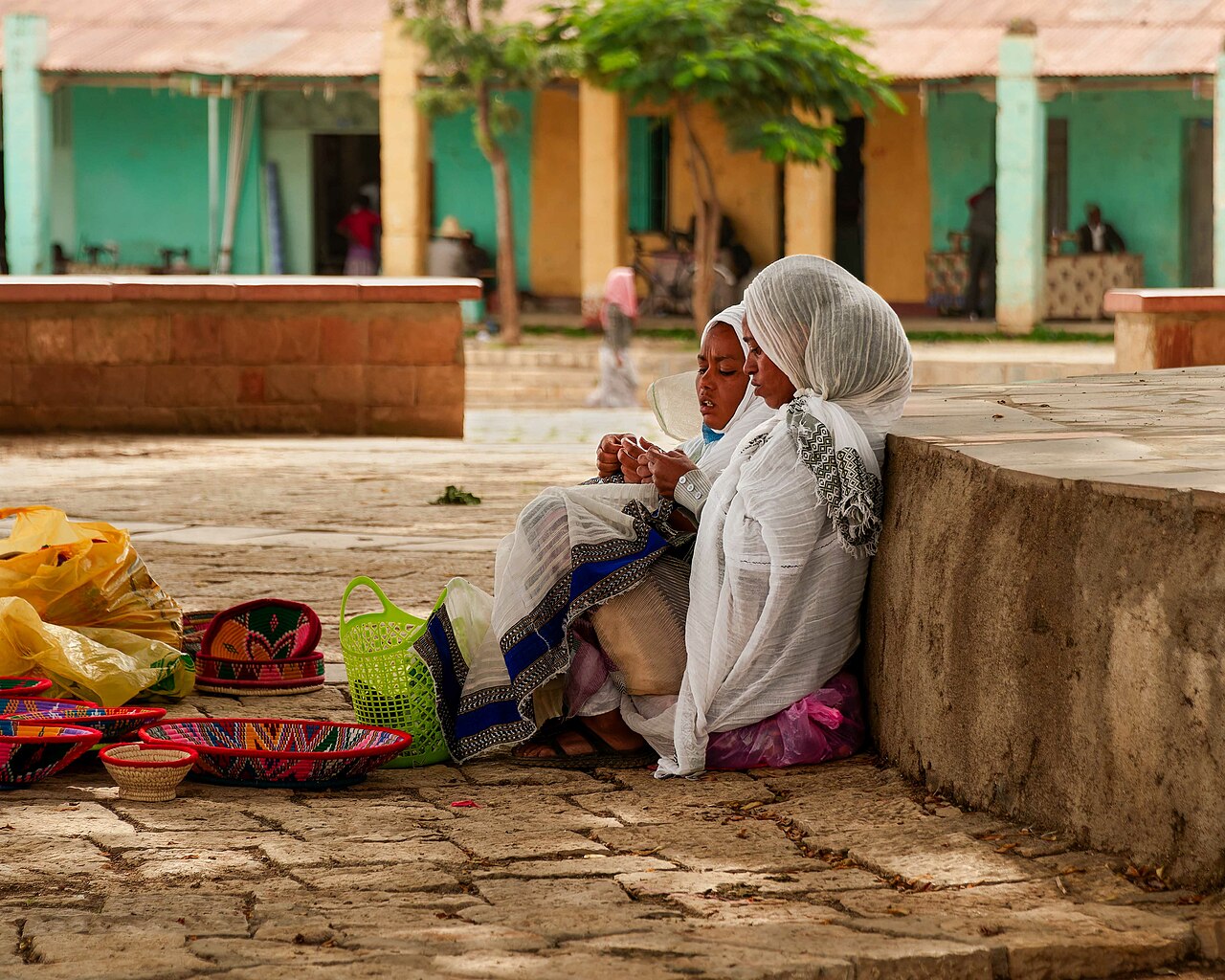
Woman sitting on ground, Aksum, Ethiopia
The Food You Can’t Miss
Ethiopian cuisine is built around injera—a spongy, slightly sour flatbread made from teff flour—and Aksum is its northern stronghold. You’ll eat nearly everything with your right hand, tearing off pieces of injera to scoop up stews. The best introduction is a vegetarian combo at a local tukul (round, thatched-roof restaurant) where a generous platter for 150 ETB includes yellow split peas (kik wat), lentils (misir wat), and collard greens (gomen). Travelers often discover that the spiciness here is more subtle than in Addis, with berbere used as an accent rather than a punch.
For street food, seek out the women near the market selling shiro—a thick, mild chickpea stew eaten with bits of raw injera—from aluminium pots. A small plate costs 30 ETB and is the breakfast of many locals. For a sit-down splurge, Mekuria Restaurant (on the main road toward the airport) serves a legendary tibs with fresh rosemary from their garden. The owner, an elderly man named Tesfaye, will tell you that his grandmother served the same dish to Emperor Haile Selassie in 1956. Prices are around 250 ETB for a generous portion.
Don’t leave without trying tej—a honey wine that’s served in flasks. It can be sweet or dry; you’ll find it in most restaurants for 30–60 ETB per glass. Be warned: the homemade versions can be deceptively strong.

Selective focus photography of crowd walking beside displayed vegteables, Aksum, Ethiopia
Where to Stay for the Weekend
The town is small enough that location hardly matters—most hotels are within walking distance of the stelae park. For a reliable mix of comfort and local character, try Hotel Sabean (on the road to the airport). Double rooms start around $45 (2,500 ETB) including breakfast. The staff arrange tours and the rooftop patio offers views of the ancient obelisks at sunset. A cheaper option is Axum Hotel (right next to the stelae park), where basic but clean rooms go for $25 (1,400 ETB). You’ll hear the morning call to prayer from the mosque across the street.
If you prefer a more boutique experience, Gheralta Lodge is a 45-minute drive south in the Tigray mountains—it’s pricier (around $120 per night) but offers rock-hewn church excursions and stunning escarpment views. For a short weekend, staying in town is more practical. You can secure advance bookings via Booking.com or find small private apartments on Airbnb, though the latter is limited in Aksum.
Before You Go: Practical Tips
- Getting Around: Walking covers the main sites—stellae, churches, museum, market—within 30 minutes of each other. For longer trips (airport or outlying tombs), negotiate a taxi: expect 150–250 ETB per ride. Blue three-wheeled bajaj are cheaper (50 ETB for short hops).
- What to Pack: A wide-brimmed hat (the highland sun is fierce even at 20°C), a light scarf for covering shoulders when entering churches, comfortable walking shoes (ground is uneven around stelae), and a reusable water bottle (fill at your hotel—avoid tap water).
- Common Tourist Mistakes: Not hiring a guide at the stelae park—interpretation is minimal, and local guides earn a small fee (300 ETB for a 1-hour tour). Another mistake: dressing too casually. Shorts and tank tops are frowned upon at religious sites; women especially should carry a long skirt and shawl.
- Money-Saving Tip: Skip the pricey tourist restaurants near the church. Walk 10 minutes to the market area where local eateries serve a full injera combo for 80 ETB—less than half the price of a “cultural” dinner. Also, buy bottled water at supermarkets (15 ETB) rather than hotel minibars (40 ETB).

