
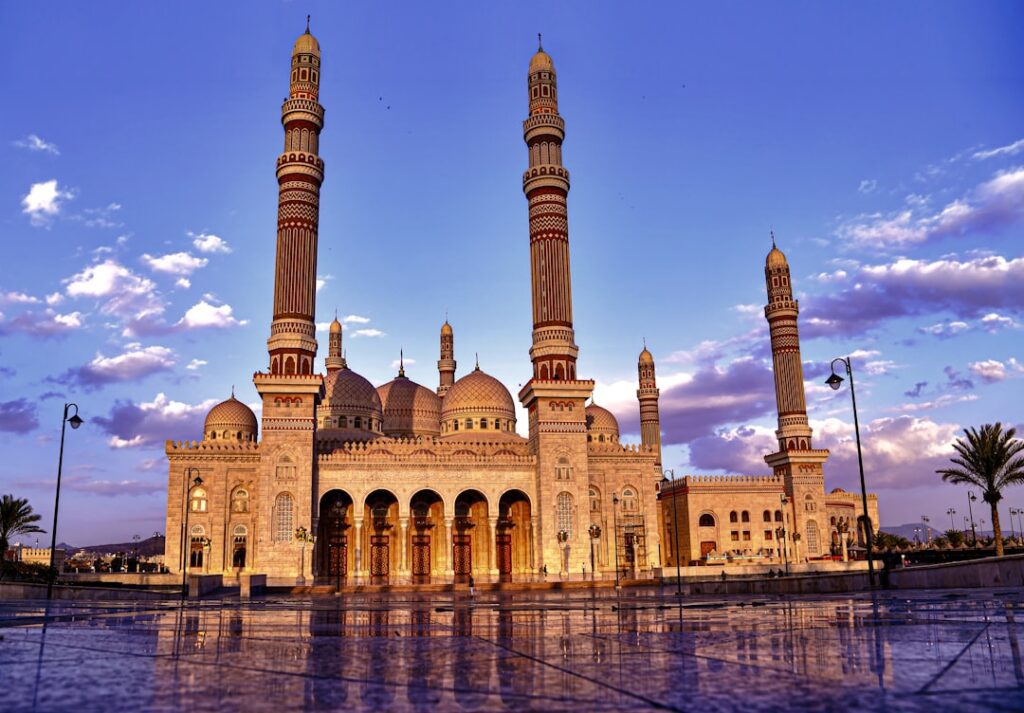
Sana’a’s Timeless Beauty, Yemen (2026)
In the year 670 AD, the Caliph Mu’awiyah, founder of the Umayyad dynasty, stood before the Great Mosque of Sana’a. He ordered its expansion, but with a specific decree: the existing structure, built atop the ruins of a Ghumdan Palace from the time of the Queen of Sheba, was to be preserved within the new walls. This act, layering history upon history, captures the essence of Sana’a—a city that has never erased its past, but has instead built its towering future directly upon it.
The Story Behind Sana’a, Yemen
Legend claims Sana’a was founded by Shem, the son of Noah, and walking its labyrinthine streets, you can believe it. This isn’t merely an old city; it’s a living archaeological layer cake. Its written history begins as a key hub on the ancient incense routes, where caravans laden with frankincense and myrrh would rest within its fortified walls. By the 6th century, it was the capital of the Himyarite Kingdom, and the magnificent Ghumdan Palace, said to have been twenty stories high, became a symbol of its power, its ruins still whispering beneath the Old City’s foundations.
The arrival of Islam in the 7th century transformed Sana’a into a major center of learning. The Great Mosque became one of the earliest and most important Islamic schools. For centuries, the city waxed and waned under a succession of rulers—the Rasulids, the Ottomans (who first conquered it in 1547), and the Zaydi Imams—each leaving an indelible mark on its architecture and culture. The Ottoman occupation, in particular, led to the construction of the Turkish Quarter with its distinct, more regimented style, a stark contrast to the organic growth of the ancient Yemeni towers. In 1962, Sana’a became the capital of the newly formed Yemen Arab Republic, setting the stage for its modern expansion, yet its ancient heart, the Old City, remained miraculously intact, a UNESCO World Heritage Site described as an “outstanding example of a homogeneous architectural ensemble.”
Neighborhood by Neighborhood
Al-Qaa’ (The Old City)
Step through the Bab al-Yaman gate as the morning sun gilds the sky, and you enter a world suspended in time. This is the iconic Sana’a of postcards and dreams. Your eyes are immediately drawn upward to the *skyscrapers* of the medieval world: tower houses of rammed earth and burnt brick, rising six to eight stories and decorated with exquisite *qamariya*—gypsum-framed stained glass windows that cast kaleidoscopic patterns on the floors within. The air is thick with the scent of baking bread, frankincense, and the subtle dampness of ancient stone. Your feet navigate narrow, shadowy alleyways where the sounds of the city are a muffled symphony—the tap-tap of a coppersmith in the Suq al-Milh (Salt Market), the murmur of men chewing qat in a *mafraj* (sitting room), and the call to prayer echoing from a thousand minarets. Your best bet is to get purposefully lost here, emerging into sudden, vibrant squares like Al-Madina, where life unfolds in its raw, daily beauty.
Bir al-Azab (The Turkish Quarter)
Just northwest of the Old City walls, you’ll find a distinct shift in atmosphere and architecture. Built during the first Ottoman occupation in the 16th century, Bir al-Azab feels more planned, more spacious. The houses here are lower, often only two or three stories, with wide, ornate wooden balconies and larger courtyards, reflecting Ottoman preferences. The streets are straighter, laid out in a grid that feels almost modern compared to the organic maze of Al-Qaa’. This was the administrative and military heart of Ottoman Sana’a. Today, it retains a slightly more residential and tranquil character. Travelers often discover beautiful, restored homes here that now function as cultural centers or boutique guesthouses, offering a different, more airy perspective on Sana’ani living. The neighborhood whispers of a different layer of conquest and influence, one of bureaucratic order imposed upon an ancient, chaotic beauty.
Haddah & As-Safia (The Southern Expanses)
Venture south from the historic core, and you witness Sana’a stretching into the 20th and 21st centuries. Haddah, a major road and district, is a bustling artery of modern Yemeni life. Here, you’ll find universities, hospitals, and a different pace. The architecture transitions to concrete and glass, but the Yemeni spirit is undimmed. This is where you’ll see the full scope of daily life—families shopping in modern supermarkets, students crowding cafes, and new commercial centers buzzing with activity. As-Safia and its surroundings represent the city’s growth as a national capital. While it lacks the fairy-tale towers of the Old City, savvy visitors come here to understand contemporary Sana’a, to sip tea in a modern *mafraj*, and to observe how ancient traditions seamlessly weave themselves into the fabric of a modern metropolis. The contrast is not a jarring clash, but a fascinating dialogue between epochs.
The Local Table: What Sana’anis Actually Eat
To eat in Sana’a is to participate in a deeply communal, sensory-rich ritual. The cuisine is a hearty reflection of the highland climate—warming, savory, and often centered around shared platters. The day might begin with *foul*, a stew of fava beans spiced with cumin and topped with fresh herbs and chili, scooped up with warm, flaky *malooga* bread. Lunch, the main meal, is an event. Locals recommend you seek out the quintessential *saltah*, a fiery, bubbling meat stew served in a stone pot called a *madara*. Its rich broth, often based on *hilba* (a fenugreek froth), and slow-cooked lamb or chicken, is crowned with a sharp *sahawiq* (chili-tomato relish) and eaten with fresh bread for dipping. The experience is as much about the sound of the stew bubbling at your table as it is about the taste.
For an authentic immersion, your best bet is to head to the labyrinthine Suq al-Milh in the Old City in the late morning. Follow your nose to small, family-run eateries tucked between spice stalls. One legendary spot known to every Sana’ani is **Bin Khalid Restaurant** near Bab al-Yaman, a no-frills institution where the *saltah* has been perfected over decades. For a sweet end, you must try *bint al-sahn*, a flaky, layered pastry drenched in honey and clarified butter—a celebratory dish that feels like a taste of golden hour itself. Dining here is never rushed; it’s an act of connection, a pause in the day’s rhythm to share not just food, but time.

Brown wooden pathway near green grass field during daytime, Sana’a, Yemen
Art, Music & Nightlife
Sana’a’s creative pulse beats in rhythms both ancient and contemporary. The most profound artistic expression is architectural—the intricate geometric patterns of the *qamariya* windows, the delicate stucco *qashani* friezes on building exteriors, and the vibrant colors used on wooden doors are a city-wide gallery. For traditional music, you’ll hear the soulful strains of the *oud* (lute) and the rhythmic beat of the *mizmar* (reed instrument) during weddings or in cultural centers like the **Dar al-Hajar Cultural Centre** in nearby Wadi Dhahr. The true “nightlife,” however, is found in the afternoon *qat* chew. While not for every traveler, this daily social ritual is central to Sana’ani life. From around 2 PM onwards, men (and, in separate gatherings, women) retreat to the *mafraj*, the highest room in a tower house with the best view. Here, they socialize for hours, discussing politics, poetry, and life, often accompanied by the gentle strumming of an *oud*. It’s a slow, contemplative, and deeply conversational form of gathering.
For more formal performances, travelers should inquire about events at the **Yemeni Heritage Museum** or the **National Museum**. During the month of Ramadan, the city transforms after sunset, with streets coming alive for *iftar* and special night markets. While Western-style bars and clubs are absent, the city’s “nightlife” is one of intellectual exchange, musical tradition, and starlit socializing on rooftop terraces, where the illuminated towers of the Old City become the grandest show in town.
Practical Guide
- Getting There: Sana’a is served by Sana’a International Airport (SAH). Due to the complex and fluid situation in Yemen, commercial flight access is extremely limited and changes frequently. Travelers must conduct exhaustive, up-to-date research on security conditions and entry requirements. Historically, airlines like Yemenia have connected it to regional hubs. For researching potential future routes, you can check Skyscanner.
- Getting Around: Within the city, yellow taxis are the primary mode of transport. Always negotiate the fare before getting in; a short trip within the city might cost 500-1000 YER. For longer excursions, hiring a car and driver for the day is the most practical option, costing approximately 15,000-25,000 YER depending on distance and negotiation.
- Where to Stay: For an unforgettable experience, stay in a restored tower house in the Old City (Al-Qaa’). Options like **Burj Al Salam** or **Arabian Nights Hotel** offer authentic charm. In Bir al-Azab, **Dawood Hotel** provides a different historical perspective. For modern amenities, look to the Haddah area. Check availability and reviews on Booking.com.
- Best Time: Visit between October and April. These months offer cool, sunny days and crisp nights, perfect for exploring. The summer months (May-September) can see afternoon rains and are generally warmer.
- Budget: Yemen is not a typical budget destination due to complexities, but historically, costs within the country were moderate. A realistic daily budget for a traveler, covering a basic hotel, meals, local transport, and guides, could range from $50-$100 USD, excluding international flights and special permits.

A city with many buildings, Sana’a, Yemen
What Surprises First-Time Visitors
Most travelers arrive expecting a museum-piece, a city frozen solely in its medieval past. The profound surprise is its vibrant, pulsing humanity. The ancient tower houses are not relics; they are lived-in homes, with satellite dishes perched playfully beside centuries-old *qamariya* windows. Children play football in shadowy alleys that have seen millennia of footsteps. The warmth of the people is staggering; you’ll be greeted with “Ahlan wa sahlan” (welcome) constantly, and invitations for tea are genuine and frequent. The city doesn’t feel like a preserved site, but a living, breathing organism that has simply chosen to wear its history on the outside.
Another surprise is the sheer verticality and architectural genius. Looking at the towers from the outside is one thing, but being inside one reveals their clever design: the ground floors for business and animals, the family quarters above, and the airy *mafraj* on top for socializing and catching the breeze. You realize these are masterpieces of pre-modern environmental design, built for community, privacy, and climate control. The city’s beauty is also unexpectedly delicate—the white gypsum tracery on buildings, the vivid primary colors of the window frames, and the intricate patterns everywhere soften the imposing, mud-brick fortresses into something approaching lace.
Your Sana’a, Yemen Questions
Is it safe to travel to Sana’a? This is the paramount question. As of my last knowledge update, Yemen is experiencing a severe and complex humanitarian and security crisis. Travel to Sana’a and anywhere in Yemen is considered extremely dangerous by all foreign governments due to ongoing conflict, terrorism, kidnapping risks, and a collapsed infrastructure. This article serves as a deep cultural and historical appreciation of the city. Any potential future travel would require expert, professional security advice, special visas, and an acknowledgment of extreme risk. It is currently not a destination for conventional tourism.
What should I wear as a visitor? Respect for local customs is paramount. For women, this means loose, long clothing that covers the arms and legs, and a headscarf is highly recommended. For men, long trousers and shirts are appropriate. Dressing modestly is a sign of respect and will greatly improve your interactions with locals, making you feel less conspicuous and more welcome in conservative neighborhoods and the Old City.
What is one unmissable day trip from Sana’a? If circumstances ever allow, locals will unanimously tell you to visit **Wadi Dhahr** and the **Rock Palace of Dar al-Hajar**. Located about 15km from the city center, this iconic palace is built atop a dramatic rock spire rising from the valley floor. It’s the photogenic symbol of Yemen. The drive itself, through terraced agricultural fields and fortified villages, offers a stunning glimpse into the rural life of the Yemeni highlands. Plan to spend a morning exploring the palace and enjoying the view from the surrounding orchards.

A night view of a city with green lights, Sana’a, Yemen
Frequently Asked Questions About Sana’a’s Timeless Beauty
Is Sana’a’s Timeless Beauty worth visiting?
Yes, Sana’a’s Timeless Beauty offers unique attractions and experiences for travelers.
How many days do I need in Sana’a’s Timeless Beauty?
2-4 days is ideal for first-time visitors to Sana’a’s Timeless Beauty.
What is the best time to visit Sana’a’s Timeless Beauty?
Spring and fall offer the best weather for visiting Sana’a’s Timeless Beauty.
{“@context”: “https://schema.org”, “@type”: “FAQPage”, “mainEntity”: [{“@type”: “Question”, “name”: “Is Sanau2019au2019s Timeless Beauty worth visiting?”, “acceptedAnswer”: {“@type”: “Answer”, “text”: “Yes, Sanau2019au2019s Timeless Beauty offers unique attractions and experiences for travelers.”}}, {“@type”: “Question”, “name”: “How many days in Sanau2019au2019s Timeless Beauty?”, “acceptedAnswer”: {“@type”: “Answer”, “text”: “2-4 days is ideal for first-time visitors to Sanau2019au2019s Timeless Beauty.”}}, {“@type”: “Question”, “name”: “Best time to visit Sanau2019au2019s Timeless Beauty?”, “acceptedAnswer”: {“@type”: “Answer”, “text”: “Spring and fall offer the best weather for visiting Sanau2019au2019s Timeless Beauty.”}}]}
Explore More Destinations
Ready to Visit Sana’a’s Timeless Beauty?
Start planning your trip today. Compare hotels, find the best tours, and get insider tips.
Your adventure in Sana’a’s Timeless Beauty starts here →
Related Guides
Explore more destinations similar to Sana’a’s Timeless Beauty:


Pingback: Gorongosa's Wildlife, Mozambique: Epic Rewilding, Rare Species & Raw African Wilderness (2026) - tangyOcean