
Omo, Ethiopia on a Budget: Ancient Traditions for $45/Day (2026)
While a guided tour of the highlands of Papua New Guinea to see the Huli Wigmen will set you back $120 a day for permits, transport, and a guide, Omo’s Mursi Tribe offers an equally profound cultural encounter for just $45 per day. You’ll get up close with one of Africa’s last lip‑plate wearing communities, trek through acacia‑studded savannah, and share meals with villagers who’ve barely changed in centuries – all without breaking the bank. Travelers often discover that the real value isn’t in luxury lodges, but in the authenticity of the experience.
7 Free Things to Do in Omo’s Mursi Tribe, Ethiopia
- Explore Jinka’s Saturday Market: Every Saturday morning, the town of Jinka (the gateway to Mursi territory) turns into a massive open‑air market. You’ll see Mursi, Ari, and Banna tribespeople bartering livestock, vegetables, and handmade ceramics. Locals recommend arriving by 7 a.m. to catch the best energy – it’s free to wander, and the people‑watching is world‑class.
- Hike to the Omo River Overlook: A short, free 20‑minute walk from the village of Mago brings you to a cliff above the Omo River. You can watch crocodiles basking on sandbars and see hippos surfacing in the shallows. No guide is needed, but carry water – the sun is fierce by 10 a.m.
- Visit the South Omo Research Museum: Located in Jinka, this small museum displays artefacts from the 18 ethnic groups of the Omo Valley. Entrance is officially free, though a donation of 50 birr (about $1) is appreciated. You’ll learn about the history of the Mursi lip plates – a tradition dating back to the 19th century when women wore them as a sign of beauty and identity.
- Photograph the Acacia Dot Landscape: The drive or walk from Jinka to Mursi village passes through a vast, flat plain dotted with gigantic acacia trees. Travelers often stop at the viewpoint near the Mago National Park boundary (no entry fee needed) to capture the golden light at sunset. Seasoned visitors say the best spot is just before the bridge over the Mago River.
- Attend a Informal Village Dance: If you befriend a Mursi guide or elder, you may be invited to an impromptu dance on a Saturday evening. The rhythmic chanting and stomping – known as ukuli – is a celebration of a good harvest or a marriage. There is no set fee, but it’s polite to bring a small gift of coffee or sugar (around $2).
- Watch the Mursi Women at Their Daily Tasks: In the early morning (6:30–8 a.m.), women from the Mursi village gather at the river to fetch water and wash clothes. You can sit on the bank and observe quietly. Locals recommend keeping a respectful distance of at least 10 metres. No payment required, but if you take a photo, offer a small tip (10‑20 birr).
- Discover the Mago National Park (on foot, from the boundary): You don’t need to pay the park entry fee ($20) to get a taste of the wilderness. The road that runs along the park’s northern edge is free, and you’ll often see zebras, baboons, and warthogs from the roadside without a guide. Take binoculars and walk slowly during the cool hours – it’s your best bet for genuine bush sightings.
Cheap Eats: Where Locals Actually Eat
For true budget dining, you must eat where the bus drivers and market traders eat. Abeba’s Café – a hole‑in‑the‑wall on the corner of Jinka’s main road opposite the bus station – serves a massive plate of injera with shiro (spiced chickpea paste) and two hard‑boiled eggs for just 50 birr ($0.95). Your best bet for lunch is Tsiyon Tibs House, also in Jinka, where a portion of fried beef tibs with onions and fresh injera costs 80 birr ($1.50). For a quick breakfast, buy a bag of roasted peanuts (20 birr) and a cup of spicy Ethiopian coffee (10 birr) from the women who set up charcoal stoves outside the market at 5 a.m. Travelers often discover that the most memorable meal is a simple bowl of kita (sourdough flatbread) with honey at the Mursi village itself – a family will share theirs with you for a smile and a small bag of salt, which you can buy in Jinka for 30 birr.

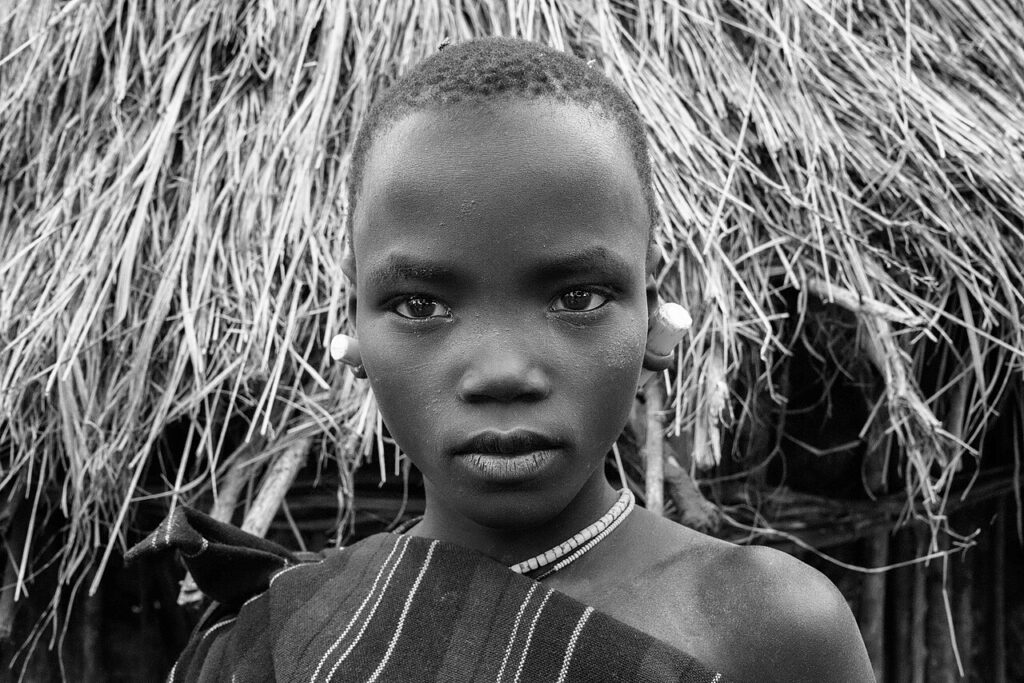
Portraits Black & White Ethiopia, Omo’s Mursi Tribe, Ethiopia
Getting There Without Going Broke
- Cheapest Route: From Addis Ababa, take the Selam Bus Line coach from Meskel Square (departure 5 a.m. Tuesday, Thursday, Saturday) to Jinka. The 15‑hour journey costs 900 birr (about $17) and includes a comfort stop in Arba Minch. Bus schedules are seasonal – check at the Selam terminal a day before.
- Pro Tip: For the bus, book your ticket 48 hours in advance via the Selam Bus website or through a local agent. During Ethiopian holidays (e.g., Timket in January), seats sell out days early. Savvy visitors also save by buying a one‑way ticket: a return from Jinka to Addis costs no extra – local buses from Jinka back to Arba Minch are 200 birr cheaper than the reverse.
- From the Airport: There is no commercial airport in Jinka. If you fly into Arba Minch (the nearest city with an airport), the cheapest transfer is the shared minibus from Arba Minch’s central taxi rank to Jinka: 400 birr ($7.50) per person, departing hourly until 3 p.m. A taxi from Arba Minch airport to the minibus stand is 150 birr ($2.80) – negotiate before you get in.
Compare flights to Arba Minch at Skyscanner

Woman sitting on ground, Omo’s Mursi Tribe, Ethiopia
Budget Accommodation Guide
Your best bet for cheap stays is in Jinka town, the most practical base for visiting Mursi villages. Jinka Backpackers (on the hill behind the bus station) offers dorm beds for $10 and private singles for $15 – simple but clean, with shared bucket showers. Locals recommend Mago Guesthouse (just off the main road) for $20 a night; you get a private room with a fan and a western toilet. For a little more comfort, Owo Lodge (5 km out of town) has tents on raised platforms overlooking the savannah from $30, but the $50 “splurge” tent includes a balcony and dinner. Avoid the overpriced “tourist lodges” near the Mursi villages – you pay $40 for a mattress in a thatched hut. Instead, reserve your accommodation at Booking.com or check for guesthouse listings on Airbnb (keyword “Jinka rooms”). The cheapest area is the streets east of the bus station; it’s safe, but you’ll hear early morning prayers from the mosque – bring earplugs.

Woman in purple and white dress sitting on brown wooden seat, Omo’s Mursi Tribe, Ethiopia
Money-Saving Tips Specific to Omo’s Mursi Tribe, Ethiopia
- Negotiate the guide fee in advance: Most visitors pay a Mursi elder 200‑300 birr ($3.50‑$5) for a two‑hour village walk. Insist on a fixed price before entering the village to avoid a surprise demand of 500 birr. Savvy travelers agree on “two rounds of coffee” as a cultural exchange instead of cash – a bag of Ethiopian coffee beans (100 birr) is a highly respected gift.
- Buy a reusable water bottle and purification tablets: Bottled water in Jinka costs 25 birr (50 cents) per 1.5 litres. Over three days, that adds up to $3. A pack of purification tablets ($2) will treat 20 litres – a saving of $8. You can refill at any guesthouse tap; just use the tablets.
- Walk between Mursi villages: Instead of paying $10 for a jeep ride between two Mursi hamlets (which are only 2‑3 km apart), you can walk the dirt paths. Seasoned visitors report that walking lets you see more wildlife and meet shepherds along the way. Carry plenty of water and a hat – the heat is intense.
- Eat at the Mursi village kitchen: If you’re invited into a Mursi home, offering 50 birr ($0.90) for a meal of boiled maize and beans is far cheaper than eating at a tourist café in Jinka – plus, the food is fresh and the experience genuine. Always confirm the price beforehand by pointing to the bowl and asking “sint newe?” (how much?).
- Travel with a group of four: Guides, transport, and village entry fees are often priced per group, not per person. A group of four can split the cost of a day guide (600 birr total = 150 birr each) and a shared 4×4 (1,000 birr total = 250 birr each). Budget travellers who team up at Jinka Backpackers can easily find travel mates – the notice board there is a goldmine for group‑up offers.
Is Omo’s Mursi Tribe, Ethiopia Worth It on a Budget?
Honestly? Yes – but with two caveats. You will miss out on the “canned” safari‑style experience of a luxury lodge that drives you straight to the “photo‑ready” village. On a budget, you’ll sleep in a simple guesthouse, eat street food, and maybe walk an extra hour to find a less touristy settlement. What you still get, however, is an intimate, respectful encounter with a culture that few foreigners see. Travelers often discover that the Mursi are genuinely welcoming when you arrive without a hired driver – they’ll usher you into their huts, let you hold a baby goat, and share stories through a translator for the price of a bag of sugar. Compare this to the nearby Hamer or Karo tribes, where budget access is similar but the villages are smaller and less photogenic. The Mursi experience, at $45 a day (or even $28 if you rough it), offers a ratio of authenticity to cost that’s hard to beat. Your best bet is to go with an open mind, a small stash of gifts (coffee, sugar, salt – not candy), and a willingness to embrace the dust. You’ll leave with memories far richer than any souvenir you could buy.

