
Isfana, Kyrgyzstan Weekend: Minarets (2026)
The 5 a.m. call to prayer curls over tin roofs and peach orchards as you step into the cool, dusty morning. From a clay-oven tandoor at the edge of the bazaar, the first samsa crackles, releasing a puff of onion-and-lamb perfume that mixes with the tang of cooking apricots. This, you realize, is the heartbeat of Isfana – a tiny, fierce, silk-road town that most travelers skip entirely. Over the next 48 hours, you’ll hear the whistle of wind across the Turkestan Range, taste fermented mare’s milk that wrinkles your nose, and meet a shopkeeper who insists you sit for chai as if you were family. Welcome to the edge of Kyrgyzstan, where the map curls like a battered page and every heartbeat feels like legend.
Quick Facts Before You Go
- Best Months: May through September, when the Fergana Valley turns emerald, apricots ripen on the trees, and daytime temperatures hover around 28°C. October brings dramatic golden leaves but chillier nights; winter is grim – heavy snow and occasional road closures.
- Currency: Kyrgyzstani som (KGS). As of late 2025, $1 equals roughly 85 KGS. Som notes come in bright denominations, and the 200-som note features an eagle – locals call it “the bird of freedom.”
- Language: Kyrgyz and Russian are the working languages. English is almost nonexistent – savvy visitors load a translator app and learn the phrase “tamak okush” (delicious food). A smile and a nod go a long way.
- Budget: Expect to spend $25–40 per day if you stick to local tea houses, shared taxis, and budget guesthouses. Add another $10–15 if you want private rooms and a full plov meal every night.
- Getting There: The nearest reliable hub is Osh International Airport (OSS), about a 4.5-hour shared taxi drive northeast. From Osh, a seat in a shared minivan costs ~$7, or you can charter a private car for $40. Less frequent flight options exist from Bishkek to Isfana’s local airstrip, but they change seasonally. Book your main flights at Skyscanner.
Day 1: The Bazaar, the Legend, and the Call to Chai
You start the morning not with a checklist but with a scent – the smoky, irresistible smell of fresh tandoori bread wafting from the central square. Isfana’s bazaar is a living organism, a jostle of colorful fabric, heaped spices, and grandmothers selling cow’s milk in repurposed soda bottles. The pavement is still damp from a morning hosing, and sunbeams bounce off tin roofs, illuminating the dust that dances in lazy spirals. This is where you’ll begin to understand the town’s delicate rhythm – one part high-adventure outpost, three parts warm village hospitality.

A British Aerospace 146 operated by Avia Traffic at Isfana Airport, Isfana, Kyrgyzstan
- Morning (8–11am): Head to the Central Bazaar (free entry) and wander the alleyways shop by shop. Bargain for a felt hat (5–10 minutes of good-natured haggling brings a $8 kalpak down to $5), try fresh apricots grown in the surrounding orchards – $0.50 for a heavy bag – and watch a baker slide dough into a clay tandoor. Don’t miss the small prayer room behind the spice stalls, a blue-tiled sanctuary that smells of cooling bread and myrrh.
- Lunch: At the bazaar’s shaded corner, find the tea house Chai Khana Altyn Too (Golden Mountain). Order a bowl of shurpa, the beef-and-carrot broth with hunks of potato and a hunk of lamb that arrives like a treasure chest – $2.50. Pair it with the house-special manty (steamed dumplings) at 5 pieces for $2, served with sour cream and a spray of fresh coriander. The owner, Umar, will likely refuse payment for your second bowl of green tea. Let him win.
- Afternoon (1–5pm): Visit the famed mausoleum of Asaf ibn Burhiyya (open 9am–5pm, entry is free but a 1.50 donation is appreciated). Legend holds this is the tomb of the vizier to King Solomon – locals call him “the wise one” and say the mound grew after a single tear from the king. The modest brick building has a prayer hall with a single window, and the caretaker will recount the story in Kyrgyz, gesturing at the distant mountains. Afterwards, hike 20 minutes to the northern rocky ridge (follow the path from the mausoleum) for a panoramic view of the town and the distant snow-flecked Pamir peaks. Bring water; the climb is gentle but sun-baked.
- Evening: As dusk paints the sky in peach and violet, head to Kebab House Asia, a family-run grill on Sovetskaya Street. Order six lamb shashlik skewers ($4.50) grilled over apricot wood – the resulting smoke smells sweet enough to bottle. Sit outside on plastic chairs and watch the town to make its evening rounds: kids kicking a football, elders strolling hand in hand, and the muezzin again, this time sending the last prayer over the darkening hills.
Day 2: Mines, Mountain Trails & A Final Feast Near the Border
The second day begins with a different rhythm – slower, more deliberate, as if the town is holding its breath before your departure. This is when the travelers in Isfana discover the living history: the miners of the 1950s, the Soviet-era pyramids of coal, and the jagged frontier just a few kilometers away where Kyrgyzstan slips into Tajikistan. Today you’ll explore beyond the bazaar, chase a handful of local legends, and tip your hat to the wind that can carry a whisper from three valleys away.
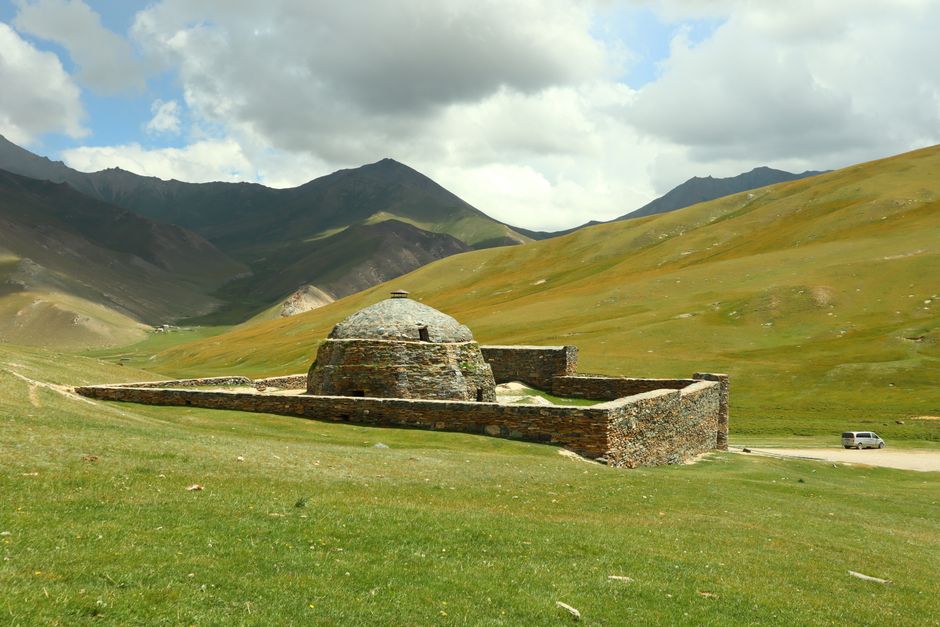
Tash Rabat caravanserai amidst lush Kyrgyz mountains under a cloudy sky., Isfana, Kyrgyzstan
- Morning (8–10am): Start at Café Bishkek on the main road, a utilitarian room with checkered tablecloths. Order the local breakfast of honor: kattama, a flaky, pan-fried pastry layered with onion – $1.50 – along with a glass of yogurt-thick kymyz (fermented mare’s milk, $1) if you’re brave. First-timers will grimace at its sour fizz; locals swear it cures everything from indigestion to melancholy.
- Midday (10am–1pm): Take a shared taxi (ask for “Batken konyush” – about $5 round trip) to the abandoned coal mines of the Sulukta Basin, just southwest of town. This is the district’s quiet industrial ghost land – rusted conveyor belts, collapsed wooden sheds, and slate mountainsides that gleam like black graphite. A local driver named Edil, who waits at the taxi stand, will narrate the area’s Soviet heyday when 2,000 miners worked the seams. Insider tip: go at 11am, before the tour groups (there are some, surprisingly) arrive, and you’ll have the whole valley to yourself. Wear closed-toe shoes; the slag is sharp.
- Afternoon (1–5pm): Return to town and wander the quiet residential lanes off Mamatayev Street, where white-washed houses hide behind wooden gates hung with drying chili and garlic. You’ll find a tiny bakery – no sign, just a stack of fresh lepioshka (flatbread) cooling on a shelf – where a warm loaf costs $0.30. Stop by the small municipal museum (open until 5pm, $1 entry) in a former Soviet kindergarten: there’s a surprising collection of Bronze Age bronze axes, a 10th-century Koran, and faded photographs of Isfana’s founding in 1951 as a settlement for geologists.
- Final Evening: Dinner is an event at Restaurant Dolon, a large courtyard under grape vines on the edge of town. Order the beshbarmak (“five fingers” – boiled horse meat sliced over flat noodles and onion sauce) – $5.50 per person, and it’s enough for two. The owner, Aisulu, will cheerfully describe the dish as “the national hug.” As the sky goes dark, she’ll light lanterns and someone may bring out a komuz (three-stringed lute). The music is melancholy and hopping at once, and by the end you’ll be clapping, if only to cover the lump in your throat.
The Food You Can’t Miss
Food in Isfana is a glorious, unpretentious celebration of the Fergana Valley’s farmstead riches. Because the town is not yet a tourist destination, everything is made for locals – which means real, honest cooking at prices that feel like a gift from another century. You’ll find lagman, the egg-noodle soup with peppers and beef, served at every tea house for about $2, and there is no better version than the one at Osh Naryn, a hole-in-the-wall near the mosque, where the cook has been pulling noodle dough since 1992.
Street food is the game-changer. Around 5pm, watch for the samsa cart outside the main post office – a steel cabinet above a smoldering grill where the owner, a woman everyone calls “Gramy,” sells fist-sized pastries stuffed with minced lamb and pumpkin. For $0.80 each, they burn your fingertips just enough to make them unforgettable. Pair this with a glass of kompot (fruit compote) from a nearby stall for $0.25, and you’ve had a feast the locals would approve.
For a slower meal, Restaurant Dolon remains the crown jewel, but the best plov in town is served at noon on

Stunning aerial view of the Central Mosque in Bishkek showcasing Ottoman ar…, Isfana, Kyrgyzstan

