
Gobi-Altai, Mongolia (2026)
You step off the prop plane and the first thing that hits you isn’t the heat—it’s the silence. A deep, ancient quiet that settles into your bones as the wind carries the faint clank of yak bells across the steppe. The air smells of wormwood and sun-baked stone, and somewhere in the distance, a horse whinnies. This is Gobi-Altai, where the desert meets the mountains and time moves at the pace of a camel’s stride.
Quick Facts Before You Go
- Best Months: June through September, when daytime temperatures hover around 20-25°C (68-77°F) and the wildflowers bloom on the mountain slopes. July and August are peak season—book ahead. May and October are possible but cold at night.
- Currency: Mongolian Tugrik (MNT). As of 2025, roughly 3,400 MNT to 1 USD. Bring cash—ATMs are rare outside Ulaanbaatar.
- Language: Mongolian (Khalkha dialect). English is limited outside of tourist-focused guides. Download Google Translate with Mongolian offline—you’ll rely on it.
- Budget: Expect to spend 80,000–150,000 MNT ($25–$45 USD) per day including meals, transport, and a basic ger camp stay. Add 50,000–100,000 MNT for guided excursions.
- Getting There: Fly from Ulaanbaatar (UB) to Altai Airport (LTI) on Hunnu Air. Flight time is about 2 hours. Book ahead in summer. Check flights at Skyscanner
Day 1: The Road to the Edge of the World
You wake early in your ger camp on the outskirts of Altai town—the provincial capital—to the sound of a herder’s radio crackling with Mongolian folk songs. The sun spills over the distant Altai Mountains, painting the felt walls of your ger in shades of amber. Today will be about getting deep into the landscape that makes this corner of Mongolia feel like the last place on Earth.
- Morning (8-11am): Head to the Gobi-Altai Museum in Altai town (500 MNT entry, opens 9am). It’s small but packs a punch with sections on paleontology, geology, and local nomad culture. You’ll see dinosaur fossils discovered in the region—some from the late Cretaceous period, around 70 million years old. Travelers often spend an hour here before a driver takes you north toward the foothills of the Altai Mountains. Arrange a driver and guide through your ger camp or guesthouse—expect 80,000 MNT for a half-day trip including fuel.
- Lunch: Stop at the roadside canteen run by the Enkhbayar family on the Altai-Uliastai road, about 15 km north of town. It’s a white-painted wooden building with no sign, but locals know it. The only dish you need: *khushuur*—deep-fried meat pastries stuffed with minced goat and onion. A plate of four costs 4,000 MNT. You wash it down with *süütei tsai* (salted milk tea) that’s richer than any latte you’ve had.
- Afternoon (1-5pm): First stop: the Ikh Bogd Uul massif, the highest peak in the Altai range in this region at 3,957 meters. You won’t climb it in a weekend, but you’ll hike the lower slopes (about 90 minutes, easy grade) to see wild ibex and, if you’re lucky, a golden eagle circling overhead. Your guide will point out the ancient petroglyphs scattered on boulders near the base—some date to the Bronze Age, around 3,000 years old. You’ll trace your fingers over carvings of ibex and hunters with bows. Then, a 20-minute drive to the Chiger Waterfall—a narrow, 20-meter cascade plunging into a pool of startlingly clear water. You can dip your hands in, but the water is glacier-cold even in August. Cost for the hike and guide: 30,000 MNT per person.
- Evening: Dinner at the Gobi Steppe Restaurant in Altai town (ул. Энхтайван, building 12). It’s the best sit-down option in the region—a family-run spot with felt-lined walls and a woodstove. Order the *boodog*—goat meat slow-cooked with hot stones placed inside the carcass, a traditional Mongolian barbecue method. It’s served with steamed vegetables and flatbread. A full meal with a local beer (try the Sengur brand) runs about 15,000 MNT. After dinner, walk to the small hill behind the town (locals call it “Salsan Tolgoi”) for a view of the Milky Way. The lack of light pollution here is unreal—you’ll see stars you never knew existed.

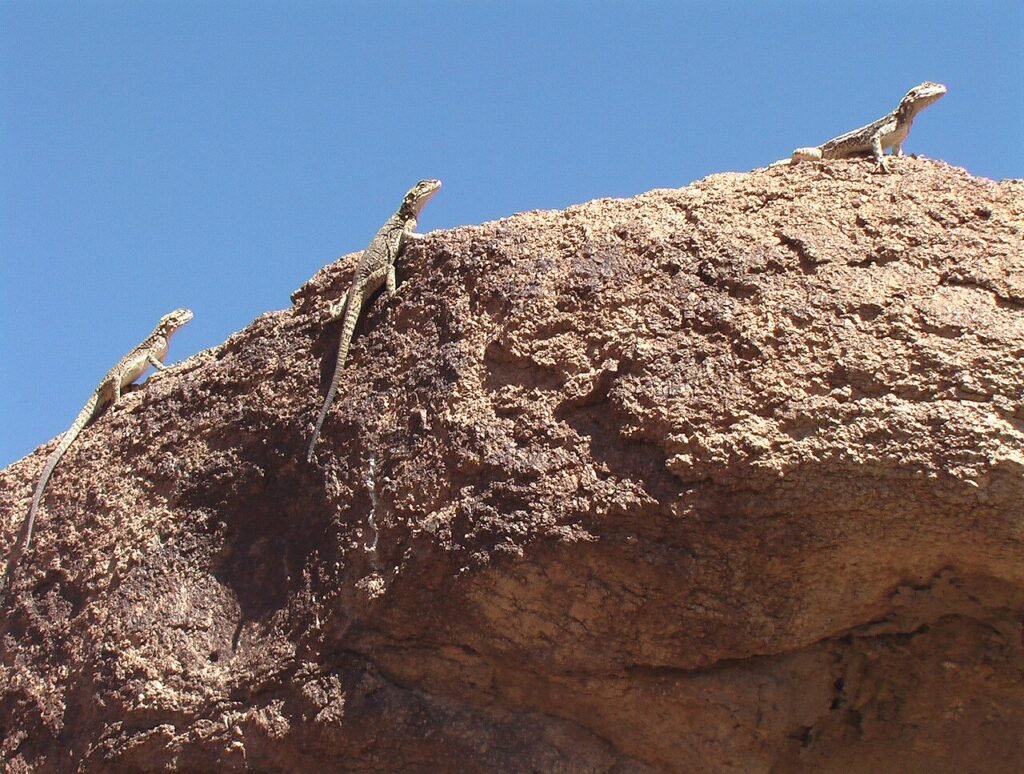
Laudakia stoliczkana, Gobi-Altai, Mongolia
Day 2: Desert Silence and Nomad Hospitality
The second day pulls you south into the true Gobi landscape—where the mountains give way to arid steppe and dunes. You feel the shift in the air: drier, lighter. The engine of your Soviet-era UAZ van chugs as the driver navigates rutted tracks. Travelers often describe this as the day that changes them.
- Morning (7-10am): Start early with breakfast at your ger camp—typically *guriltai shöl* (noodle soup with mutton broth) and fresh fried bread with butter and jam. Then drive 90 minutes south to the Bayanzag region, known as the “Flaming Cliffs” for the red sandstone that glows at sunrise and sunset. Paleontologist Roy Chapman Andrews discovered the first known dinosaur eggs here in 1923. You’ll walk the ridge (free entry, but a local guide is recommended—tip 5,000 MNT) and see the Protoceratops fossils embedded in the rock. The key to avoiding crowds: arrive before 9:30am. Most tourists come from Ulaanbaatar on day trips and don’t arrive until 11am.
- Midday (11am-1pm): Your best bet is to drive 40 minutes to the Khongoryn Els sand dunes—the “Singing Dunes” that stretch 180 km north to south and rise up to 300 meters. You’ll climb the nearest dune (about 40 minutes up, 10 minutes down running through the sand). On windless days, the sand “sings” as it shifts—a low, droning hum that sounds like a cello. The silence between the notes is what travelers remember most.
- Afternoon (1-5pm): You’ll have lunch at a ger camp at the dunes: a simple spread of *khuushuur* (again, but it’s better here), salad of cucumber and tomato, and *airag*—fermented mare’s milk that’s sour, slightly fizzy, and 2-3% alcohol. A bowl costs 1,000 MNT. Then visit a nomad family in their ger, arranged through your guide. You’ll sit on sheepskin rugs, drink salted milk tea, and watch the matriarch make butter in a goatskin bag. Children may shyly show you their schoolwork. Offer a small gift—a bag of candy or a pack of biscuits (buy them in Altai town the day before for 2,000 MNT). This isn’t a show; it’s genuine hospitality.
- Final Evening: For your farewell dinner, the Gobi Steppe Restaurant again—but this time try the *tsuivan* (hand-pulled noodles stir-fried with mutton and vegetables, 6,000 MNT) and finish with *boortsog* (fried pastries drizzled with honey, 2,000 MNT). The family who runs it will likely come out to chat if business is slow. You’ll end the evening walking the dirt streets, watching the last light fade over the Altai Mountains.

Green trees on brown field during daytime, Gobi-Altai, Mongolia
The Food You Can’t Miss
Mongolian cuisine is not subtle—it’s honest, hearty, and built for survival. In Gobi-Altai, the food reflects the landscape: meat, dairy, and little else. Travelers often find the simplicity refreshing, especially after the endless fusion menus of bigger cities. The star is *boodog*, a method of cooking goat or marmot by placing fire-heated stones inside the animal’s cavity through a slit in the skin. The meat steams from within, absorbing a subtle smokiness. You’ll find it at the Gobi Steppe Restaurant (order 24 hours ahead for 18,000 MNT a portion). Street food is simpler: *khushuur*—the fried meat pastries sold from cauldrons outside the Altai market on Saturday mornings (5,000 MNT for three). Locals recommend the stall run by Mrs. Naran, a grandmother who’s been frying them at the market for 14 years. You’ll find her in the southeast corner under a blue awning. For adventurous palates, ask for *aaruul*—dried curds that range from rock-hard lumps flavored with sea buckthorn to softer, sweetened versions. They’re sold at the market for 3,000 MNT per kilo. Your best bet is to buy a few pieces and experiment; travelers either love them or use them as teething toys.

Majestic aerial view of red cliffs in empty desert valley under bright sky …, Gobi-Altai, Mongolia
Where to Stay for the Weekend
Your base for a weekend break is Altai town, but the real experience lies in the ger camps scattered in the foothills. For budget travelers, Gobi-Altai Guesthouse (ул. Энхтайван, building 7) offers dorm beds for 15,000 MNT a night and private rooms for 35,000 MNT. It’s run by a retired teacher named Mr. Batbayar who speaks decent English and can arrange drivers and guides. The shared bathroom is clean by Mongolian standards. For a mid-range stay, Altai Ger Camp (3 km north of town, near the Chiger Waterfall road) charges 50,000 MNT per person per night in a traditional ger with a woodstove, thick felt blankets, and a shared toilet block with solar-heated showers. You fall asleep to the sound of wind in the grass. For luxury—by Gobi-Altai standards—Khovd Ger Camp (50 km west of town, closer to the dunes) charges 95,000 MNT per person all-inclusive of meals and horseback riding. Spring for the “family ger” which has a private attached bathroom. The owner, Tsendsuren, is a former ranger who knows every trail within a 50-km radius. Book on Booking.com or find local listings on Airbnb.
Before You Go: Practical Tips
- Getting Around: Your best bet is to hire a driver with a UAZ van or Russian 4×4 through your guesthouse or ger camp. Expect 80,000–120,000 MNT per day including fuel and driver’s meals. Roads are unpaved tracks—travelers describe the ride as “bone-rattling but worth it.” Buses run sporadically between Altai and Ulaanbaatar (12 hours, 25,000 MNT), but a weekend break is too short to waste on roads. Flying is the only practical option.
- What to Pack: A down jacket or warm fleece—nights drop to 5°C (41°F) even in August. Lip balm and moisturizer; the Gobi air is brutally dry. A reusable water bottle with a filter (no tap water is safe). And a headlamp—your ger camp may not have electricity after midnight, and you’ll want to see the path to the toilet.
- Common Tourist Mistakes: Photographing nomads without asking first. Always ask—in Mongolian, “Zurag avch bolokh uu?” (“May I take a photo?”)—and offer a small gift after if they agree. Another mistake: expecting all ger camps to have Wi-Fi. Most don’t. Prepare to be offline; that’s the point.
- Money-Saving Tip: Eat at the Altai town market instead of the airport or tourist-oriented stops. A full meal of *khuushuur* and *süütei tsai* costs 5,000 MNT—about $1.50. You’ll save 10,000 MNT per meal compared to the Gobi Steppe Restaurant, and the food is often better. Buy snacks and bottled water here too (1,500 MNT per 1.5L bottle versus 3,000 MNT at the airport).

