
Beyond the Resort Signboards: Why Digos, Philippines, Rewards the Curious Traveler (2026)
In 1949, President Elpidio Quirino signed Executive Order No. 236, carving a new municipality from the forested foothills of Mount Apo. The place was called Digos—a name born from the Cebuano word padigos, meaning “to bathe.” According to local lore, early Spanish missionaries found settlers bathing in the cool, clear waters of the Digos River and asked for the settlement’s name. The bathers, misunderstanding, pointed to the river and said “Digos.” That accidental christening stuck, and today you’ll find that the city still revolves around that river—and the warm, unhurried hospitality of its people.
The Story Behind Digos, Philippines
Long before the Spanish arrived, the area around Digos was home to the Bagobo and Manobo peoples, who lived in harmony with the dense jungles and the towering presence of Mount Apo, the Philippines’ highest peak (2,954 meters). When American colonizers established a settlement here in the early 1900s, they brought with them migrants from Luzon and the Visayas—Ilocanos, Cebuanos, and Ilonggos—who cleared land for abaca, coconut, and rice. These waves of settlement shaped Digos into a cultural mosaic that you’ll still feel today: hear Visayan languages mix with Tagalog, taste Ilocano bagnet alongside Cebuano lechon, and watch people greet each other with a warmth that transcends dialects.
The town grew steadily, but its real turning point came in 2000, when Republic Act 8798 elevated Digos from a municipality to a component city of Davao del Sur. That status unlocked infrastructure projects, and you’ll notice the results in the smooth roads, the bustling public market, and the growing skyline of the Poblacion. Yet the city has resisted the sort of mass tourism that has reshaped places like Davao City. Locals still run most businesses, and when you ask for directions, you’ll often get not just instructions but a story. Travelers often discover that Digos is a city that values paghilom—a quiet, almost meditative pace—even as it modernizes.
One figure you’ll hear mentioned with pride is Governor Douglas Cagas, who championed Digos’s cityhood and later became its first city mayor. His legacy is visible in the clean streets and the strong sense of civic identity. But the true heartbeat of Digos is its river: every August, during the Padigos Festival (now officially the Kadagatan Festival, celebrated from August 14–18), residents release lanterns and flowers into the Digos River to honor the city’s name origin. You’ll see children playing in the shallows, old men fishing with bamboo poles, and vendors selling grilled corn and turon along the banks. It’s a scene that hasn’t changed much in seventy years.
Neighborhood by Neighborhood

The City Hall in Digos City, Davao del Sur, Philippines., Digos, Philippines
Poblacion – The City’s Beating Heart
Downtown Digos—officially Barangay Poblacion—is where you’ll want to spend your first morning. The main thoroughfare, Rizal Avenue, runs past the Digos City Hall, a modern building with a distinctly Filipino flourish of red-tiled roofs and a large sunburst clock tower. On any given day, you’ll find jeepneys clattering by with passengers hanging off the back, while vendors sell bibingka (rice cakes) and puto bumbong (purple rice cakes) from portable carts. The air smells of charcoal smoke, fried garlic, and the faint sweetness of ripe mangoes. Just off Rizal, the Digos Public Market (open 5:00 AM to 6:00 PM) is a sensory overload: piles of fresh tuna, mackerel, and kilawin (raw fish cured in vinegar) sit next to mounds of durian, mangosteen, and lanzones. Locals recommend visiting early—around 6:30 AM—to catch the freshest catch and avoid the midday heat. You’ll also find a cluster of sari-sari stores selling everything from shampoo to roasted peanuts. Stop by the “Market Café,” a no-frills eatery at the north edge of the market, for a bowl of arroz caldo (chicken ginger porridge) with a hard-boiled egg—just PHP 25 (about 50 cents).
Barangay San Jose – Coastal Calm
Fifteen minutes by tricycle from Poblacion, San Jose is where Digos meets the Davao Gulf. Unlike the frantic resorts of Samal Island, San Jose offers quiet beachfront villages and a laid-back vibe that savvy visitors cherish. The main strip, San Jose Beach Road, is lined with cottages (thatched-roof huts) that you can rent for the day (PHP 300–500). Families swim in the gentle waters, and local kids will often try to sell you freshly picked coconuts for PHP 15. For a proper lunch, head to “D’Ley’s Place,” a family-run seafood restaurant on the beach. Your best bet is the kinilaw na tanigue (Spanish mackerel ceviche) made with coconut vinegar, ginger, and siling labuyo (tiny chili peppers)—PHP 180 per order. The sunsets here are the sort that make you forget your phone: orange and magenta bleeding into the sea, with the silhouette of fishing bancas rocking at anchor. If you’re feeling adventurous, ask a local boatman for a short ride (PHP 100) to the nearby fish sanctuary, where you can snorkel over coral gardens—no equipment available, so bring your own mask.
Barangay Aplaya – Where Fishermen Still Rule
Just south of San Jose, Barangay Aplaya feels like a different world. This is a working fishing community, not a tourist zone. You’ll see women mending nets under the shade of acacia trees, and men hauling in baskets of blue marlin and yellowfin tuna at the small fish landing area (most active between 4:00 and 6:00 AM). The streets are unpaved in parts, and the houses are weathered wooden shanties with corrugated iron roofs. But the charm is genuine. You can walk the entire length of Aplaya in about twenty minutes, passing the local chapel (St. Michael the Archangel, built in 1968) and a row of carinderias (small eateries) that serve the fishermen’s breakfast. At “Mama Nene’s Carinderia,” you’ll get a plate of sinuglaw (grilled pork belly with raw fish ceviche) for PHP 50, plus a scoop of steaming rice. Travelers often discover that Aplaya is the best place to taste raw Digos—no pretensions, just honest food and hardworking people. If you strike up a conversation, you might hear stories about the great typhoons of the 1980s that flattened the coast, or about the recent mangrove restoration project (ask for Mr. Ronnie, the barangay captain’s son, who leads tours for PHP 50 per person).
The Local Table: What Denizens Actually Eat
Digos is not a culinary destination in the glossy, magazine-cover sense. But its food culture is fiercely local and deeply satisfying. Meals here revolve around the sea and the mountain. You’ll find kinilaw at every carinderia, made with whatever fish was caught that morning—tuna, tanigue, or even lapu-lapu (grouper). The secret is in the vinegar: locals prefer tuba (fermented coconut sap) vinegar, which gives the dish a mild sweetness that you won’t find in Manila. To eat like a true Digoseño, start your day with a bowl of lugaw (rice porridge) topped with tokwa’t baboy (fried tofu and pork bits) and a side of salted egg—available at “Big Mamang’s” on Rizal Avenue for PHP 35.

A unique pyramid-shaped building in a green outdoor landscape under a cloudy sky, Digos, Philippines
For lunch, you can’t miss the lechon stalls near the public market. One family-run spot, “Liga Lechon,” has been operating since 1992. Their roasted pig is skin-crackling crispy, and they serve it with a gravy made from liver and star anise—PHP 150 per quarter kilo. But the true signature dish of Digos is bulalo, a slow-cooked beef shank soup with marrow, corn, and cabbage. The best version you’ll find is at “Kusina ni Lola Puring” on San Jose Beach Road, where the broth simmers for six hours and the meat falls off the bone. Dinner is usually simple: grilled fish, rice, and a plate of ensaladang mangga (green mango salad with bagoong—fermented shrimp paste). If you’re lucky, a neighbor might invite you to a salo-salo (shared feast) during a fiesta—accept without hesitation.
Art, Music & Nightlife
Digos doesn’t have a thriving gallery scene or a club district, but its creative energy bubbles up in unexpected places. Every third Saturday of the month, the “Tatak Digos” art market takes over the plaza in front of City Hall, from 4:00 PM to 10:00 PM. Local painters, woodcarvers, and weavers sell their work: you’ll see intricate hablon textiles woven by Manobo women, and hand-carved okir patterns on wooden bowls. Live acoustic acts perform cover songs of OPM (Original Pilipino Music) hits, and children dance tinikling (bamboo dance) on the stone pavers. For contemporary art, visit “Kape San Miguel” on Aplaya’s shoreline—a coffee shop that doubles as a gallery, showcasing photography of Mount Apo and portraits of local fishermen. Owner Miguel Sabay opens his doors from 7:00 AM to 9:00 PM; order a barako coffee (strong, earthy) and ask him about the annual “Apo Maharlika” photo contest in February.
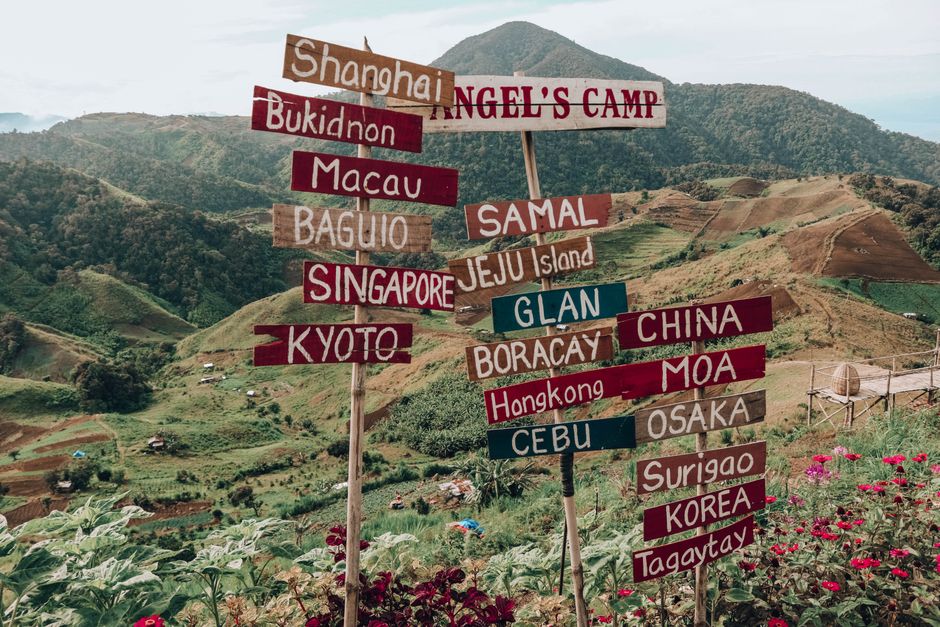
Vibrant signpost with global city names set against Digos City’s lush green…, Digos, Philippines
Nightlife is low-key. The go-to spot is “Tambayan Bar” on the corner of Quezon and Mabini streets, a wooden shack with colored lights and a karaoke machine. Most nights, locals gather from 8:00 PM onward to sing 90s love songs and drink pulutan (bar snacks)—think grilled pork intestines and salted peanuts. Cover charge is PHP 20, and a bottle of San Miguel Pale Pilsen costs PHP 45. For a slightly more polished evening, try “The View Deck” on the third floor of Digos Grand Hotel, where you can sip a mango shake (PHP 80) and watch the lights of Davao City twinkle across the gulf. The annual Kadagatan Festival in August is the city’s biggest cultural event, featuring a fluvial parade, street dancing, and a food fair that takes over Rizal Avenue. Mark your calendar for August 15–18; the festivities culminate in a fireworks display over the Digos River at 8:00 PM.
Practical Guide
- Getting There: Fly into Francisco Bangoy International Airport (Davao City). Airlines like Cebu Pacific and Philippine Airlines offer daily flights from Manila and Cebu. From Davao, take a van from the Ecoland Terminal (PHP 120, 1.5 hours) or a bus operated by Mindanao Star (PHP 150, 2 hours). Book flights at Skyscanner.
- Getting Around: Tricycles are the main mode. A ride within Poblacion costs PHP 10–20 per person; to San Jose or Aplaya, PHP 30–50 (negotiate before boarding). Jeepneys run Rizal Avenue to the beach for PHP 8. No ride-hailing apps operate here.
- Where to Stay: In Poblacion, try “Digos City Inn” (PHP 800/night, basic but clean). For beachfront, “The Farm at San Jose” offers cottages with air-con (PHP 1,500/night). Budget travelers prefer “Aplaya Lodge” (PHP 400/night, shared bath). Check Booking.com for advance bookings.
- Best Time: December to May—dry season, cool mornings, and sea conditions calm for swimming. August is festive but rainy; January offers the clearest views of Mount Apo.
- Budget: PHP 1,500–2,500 per day (US$30–50) covers a mid-range room, three meals, transport, and a couple of beers. You can stretch it to PHP 800 if you eat at carinderias and stay at budget inns.
What Surprises First-Time Visitors
Most travelers arrive expecting Digos to be a sleepy, forgettable provincial town. Instead, they are struck by the city’s unexpected energy—especially around the public market, where the barter economy is alive and well. You’ll see people trade a basket of okra for a kilo of dried fish, and the noise of haggling fills the air until noon. Another surprise is the presence of Mount Apo. Digos sits almost at the foot of the mountain, and on a clear morning you can see its green slopes rising abruptly behind the city. Locals point to it with quiet pride; many have climbed it at least once in their youth. Travelers often remark that the mountain gives Digos a sense of scale—a reminder that this small city is just the threshold to something much wilder.

