
Beyond the Perfect Barrel: Why Mentawai’s Waves Call Every Surfer Home (2026)
In August 1993, Australian surfers John Gisel and Mark Webb stepped onto a boat in Padang with little more than a hand-drawn map and a rumor whispered among Sumatran fishermen—that beyond the jungle-clad islands to the west, waves broke in perfect, uncrowded lines for miles. What they found would change surfing forever: a constellation of reef breaks so flawless that when footage reached the outside world, a pilgrimage began that continues to this day, drawing you into a vortex of tube-riding obsession unlike anywhere on earth.
The Story Behind Mentawai Islands’ Surf, Indonesia
Long before the first surfboard ever touched Mentawai water, these islands existed in a world apart. Geographically, the Mentawai chain stretches like a fractured spine 150 kilometers west of Sumatra, sitting at the precise latitude where the Indian Ocean’s powerful swells collide with a labyrinth of coral reefs. The islands themselves have been inhabited for at least 2,000 years by the Mentawai people, whose animist traditions and tattooed bodies marked them as distinct from mainland Sumatra—a culture that remained largely undisturbed until the twentieth century because the open ocean passages were simply too dangerous for traditional sailing craft.
The Dutch claimed the islands in the 1800s, but it was Christianity and Indonesian independence that truly changed Mentawai society. By the 1970s, missionaries had converted most of the population, and the traditional “uma” longhouses began to disappear. Then came the surfers. After Gisel and Webb’s 1993 expedition, word spread like wildfire through the global surf community. By 1995, charter boats had established routes, and by the early 2000s, the Mentawai Islands had become the holy grail of surf travel—a place where you could score perfect, uncrowded waves in a tropical paradise that felt like the end of the earth.
Today, the islands sit at a crossroads. The surf industry has brought money and infrastructure, but also environmental pressure and cultural disruption. Local Mentawai people, who once lived entirely off the forest and sea, now navigate a world of surf resorts and tourist boats. You’ll see this tension everywhere—in the way a traditional healer in a remote village might wear a faded Billabong T-shirt, and in the careful negotiations between surf camp operators and local communities over access to waves. The soul of these islands remains, but it’s evolving, and the smart traveler learns to understand this complexity rather than just chasing waves.
Neighborhood by Neighborhood
North Pagai to Siberut: The Rugged Frontier
The southern and central islands—North Pagai, South Pagai, and Sipora—hold most of the legendary surf breaks, but Siberut to the north offers something different entirely. Here, the jungle pushes right to the water’s edge, and the breaks are fewer but wilder. Your best bet for uncrowded sessions is the area around Karangmajat, where a series of reef passes create waves that peel for 200 meters on a good south swell. The vibe is raw and unpolished: you’ll share the water with sea turtles, watch monitor lizards sunning on the rocks between sets, and sleep in simple wooden bungalows where the generator cuts out at 10 PM. Travelers often discover that this is where you feel most disconnected from the modern world—there’s no WiFi, no phone signal, just the sound of waves and the rustle of palm fronds in the trade wind.
Katiet and Nyang Nyang: The Surf Camp Corridor
On the western coast of Sipora, the village of Katiet has transformed into the epicenter of land-based surf tourism. You’ll find a cluster of resorts and camps strung along a kilometer of coastline, each with its own dock and fleet of speedboats. The energy here is convivial and focused: guests gather on verandas at dawn with coffee, watching the swell charts and arguing over which break to hit that day. Locals recommend the family-run camp at Katiet Paradise, where the owner, a Mentawai elder named Pak Ridwan, still performs traditional blessings before the big swell arrives each year. The architecture is functional but charming—raised wooden buildings with thatch roofs, open-air dining pavilions, and hammocks strung between coconut palms. You’ll spend your mornings surfing, your afternoons napping or reading, and your evenings eating grilled fish while swapping stories with surfers from Brazil, Australia, and Japan.
Playgrounds and Rifles: The Offshore World
But here’s the secret that seasoned travelers understand: the real “neighborhoods” of Mentawai are not on land at all. They are the reefs and islands that dot the ocean between the main landmasses—places like the legendary Playgrounds, where the swell wraps around a shallow reef to create a wave that barrels for 150 meters on its best days. Or Rifles, the most famous break in Mentawai, which you’ll reach by boat from the island of North Pagai. The offshore world operates on its own geography: clusters of breaks within 30 minutes of each other, each with its own character. The Greenbush section is faster and hollower; Burger World is heavier and more dangerous; Lance’s Left is the forgiving beginner-friendly wave that families love. Your surf guide will read the tide charts and swell direction each morning and decide which “neighborhood” to visit. It’s a floating existence—you sleep on land, but you live on the water.
The Local Table: What Mentawai Natives Actually Eat

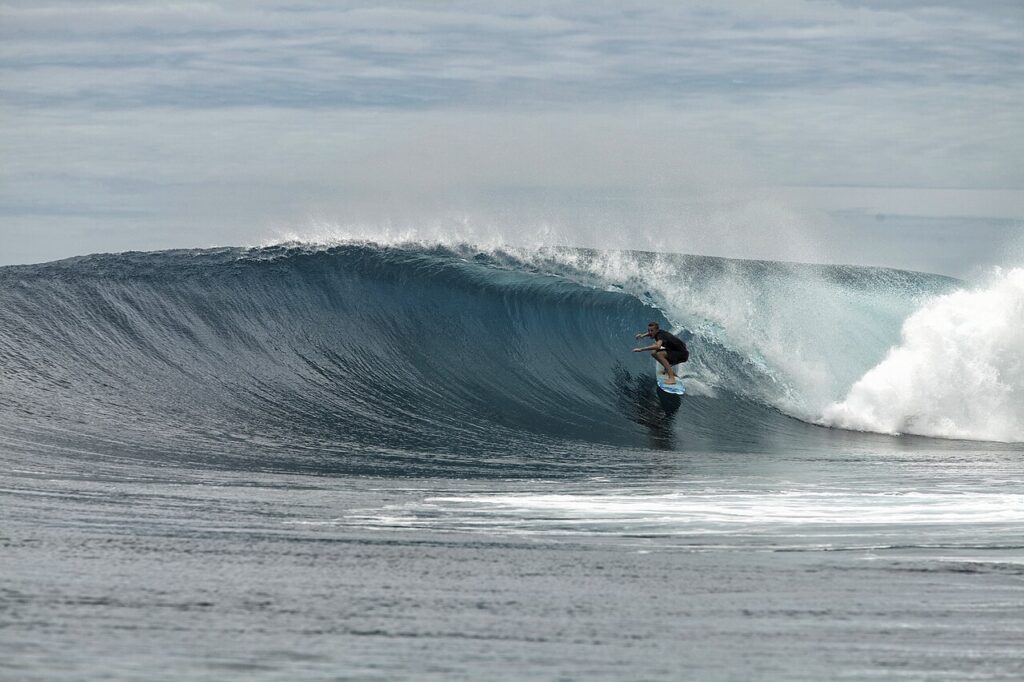
Surfers explore the Mentawai islands, West Sumatra, Indonesia, Mentawai Islands’ Surf, Indonesia
The food culture in Mentawai is simple, direct, and deeply connected to the surrounding environment. You won’t find elaborate spice blends or complex sauces—instead, the cuisine revolves around what can be caught, gathered, or grown within a few kilometers. Sago, harvested from the palm trees that dominate the lowland forests, is the traditional starch. Locals pound the pith into flour, then shape it into a sticky, neutral-tasting paste called “sagu” that forms the base of most meals. To this, they add fish—grilled over coconut husk coals, or simmered in coconut milk with turmeric and ginger. Travelers often discover that the most memorable meal they eat in Mentawai is not at a resort but at a village home, where a family might offer you “ikan bakar” (grilled reef fish) with sago and a side of wild ferns sautéed with chili.
One specific dish you must seek out is “sagu tumis,” which you’ll find at the weekly market in Sikakap, the main town on Sipora. Every Saturday morning, villagers paddle in from surrounding settlements to sell produce, smoked fish, and handicrafts. At a stall run by Ibu Dewi, a small woman with a bright smile and traditional arm tattoos, you can buy sagu that’s been stir-fried with shredded coconut, chili, and a squeeze of lime. It costs about 10,000 IDR (roughly 65 cents) and comes wrapped in a banana leaf. Eat it while standing at the market, watching the bustle of boats and the exchange of news from across the islands. This is the real Mentawai—not the curated surf camp experience, but the daily life of people who have lived on these islands for millennia.
Most surf resorts have adapted local ingredients for international palates, and you’ll find excellent versions of “nasi goreng” (fried rice) and “ikan bakar” on camp menus. But savvy visitors know to ask their guides to take them to a “warung” (family-run food stall) in one of the villages. The warung in Katiet, run by Pak Sugi’s wife, serves a “gulai ikan” (fish curry in turmeric-coconut broth) that is so good you’ll dream about it weeks after you leave. She starts cooking at 6 AM, and by noon, everything is gone. Show up early, bring cash (small bills), and be prepared to eat with your hands—it’s how locals do it, and it tastes better that way.
Art, Music & Nightlife
The creative life of Mentawai is subtle but profound. There are no nightclubs, no art galleries, no concert halls. Instead, the artistry is woven into everyday existence. Traditional Mentawai tattoo art, called “titi,” is among the most sophisticated body art in the world, with patterns that signify social status, life achievements, and spiritual protection. You can still find elders in remote villages who practice this ancient tattooing method, using a wooden mallet and needle to tap pigment into the skin by hand. If you’re respectful and genuinely interested, some families will allow you to watch—but don’t ask to be tattooed yourself, as this is considered appropriative by many community leaders.
The music of Mentawai follows the same organic rhythm. At night, in villages far from any surf resort, you might hear the pulse of “gong” drums and the chanting that accompanies traditional ceremonies. The most accessible performance you’ll experience happens at the surf camps themselves, where local staff sometimes play guitar and sing Indonesian pop songs late into the evening. The real magic, though, happens during the festival of “Pakkat” in July, when communities gather for days of music, dance, and ritual. Travelers who time their visit for this festival—and who arrange permission through a local guide—witness something extraordinary: the full spectrum of Mentawai cultural expression, from mask dances to epic oral storytelling, all against the backdrop of the jungle night.
Practical Guide
- Getting There: Fly into Minangkabau International Airport (PDG) in Padang, West Sumatra. Airlines like Garuda Indonesia, Lion Air, and AirAsia connect from Jakarta, Kuala Lumpur, and Singapore. Book at Skyscanner. From Padang, you take a ferry to Sikakap (12-14 hours, economy around 150,000 IDR / $10 USD) or charter a speedboat (2-3 hours, $300-500 USD per boat depending on group size). Most surf camps include transfer packages that handle all logistics.
- Getting Around: Your primary transport will be speedboat from your camp to the surf breaks, usually included in your package. For travel between islands, you can charter a local “ombek” boat (a wooden outrigger) for about 500,000 IDR per day ($35 USD). On land, motorcycle taxis called “ojek” cost around 20,000 IDR per short trip in villages.
- Where to Stay: For the full experience, stay at a land-based camp like Katiet Paradise (from $100/night including meals and boat transfers) or one of the luxury liveaboard charters like the AWAKA (from $350/night all-inclusive). Check Booking.com for lodge options in Sikakap and Muara Siberut.
- Best Time: April through October is prime surf season, with the most consistent south swells from May to August. The waves are biggest in June and July, but the trade winds are strongest and the water clearest in April and May. Avoid November through February when monsoon rains and onshore winds make most breaks unsurfable.
- Budget: Expect $150-400 per day all-inclusive for a surf camp, $50-100 per day for budget travel staying in village homestays, or $500+ per day for luxury liveaboard charters. Bring cash—ATMs are essentially nonexistent in the islands.

Man bodyboarding on a large ocean wave, Mentawai Islands’ Surf, Indonesia
What Surprises First-Time Visitors
The first surprise is the sheer power of the waves. You’ve watched videos of Mentawai barrels a hundred times, but nothing prepares you for the physical reality of a swell that has traveled uninterrupted for thousands of kilometers before detonating on a shallow reef. First-timers often discover that the waves are heavier and faster than they look on film—that perfect tube you dreamed of can also be a terrifying washing machine if you get caught inside. Respect the ocean here. Surfers who came expecting mellow intermediate waves have left humbled; the breaks here are world-class for a reason, and that means they demand a certain level of fitness, confidence, and respect.
The second surprise is the warmth of the local people. Travelers often arrive expecting a place where the surf industry has soured relationships, but instead you’ll find that most Mentawai people are genuinely curious and welcoming—provided you approach them with respect. The key is to learn a few phrases in the Mentawai language (not Indonesian), to ask permission before taking photos, and to support local businesses rather than just staying inside the gated surf resorts. When you make the effort, you’ll be invited into homes, offered betel nut to chew, and shown the secrets of the jungle.
The third surprise is the silence. After a week in Mentawai, you’ll realize how loud your normal life was. There is no traffic noise, no humming appliances, no distant sirens. At night, the soundscape reduces to the crash of waves, the chirping of geckos, and the occasional cry of a fruit bat. Many visitors find this disorienting at first—their brains keep waiting for the background hum of civilization. But by the end of your trip, you’ll be listening differently, and you’ll carry that quiet back with you like a secret gift.
Your Mentawai Islands’ Surf, Indonesia Questions

Surfer riding a large wave on a sunny day, Mentawai Islands’ Surf, Indonesia
Is Mentawai only for advanced surfers? The reputation of Mentawai as an expert-only destination is somewhat exaggerated, but there’s truth beneath it. The major breaks—Rifles, Macaronis, Playgrounds—are indeed advanced, with hollow barrels and sharp reefs that can punish mistakes. However, fewer travelers know that there are excellent intermediate waves here too. The break called “Telescopes” in the south has a more forgiving section, and “Pistols” offers a long, mellow right-hander on smaller days. If you’re a confident intermediate surfer who can paddle into unbroken waves and read a reef, you’ll find waves to enjoy. Complete beginners should look elsewhere—the currents and reef dangers make this a poor place to learn. Most camps will be honest about conditions; trust their judgment and don’t push beyond your comfort zone.
What should you know about reef safety in Mentawai? This is the most serious question any surfer asks, and the answer requires honesty. The reefs here are shallow, sharp, and merciless. A cut on the reef can take weeks to heal in the tropical climate and easily becomes infected. Every surf camp provides reef booties, but many experienced surfers prefer to go without them for better board feel—that’s a personal choice, but know that a broken fin cut on coral is one of the most painful injuries you can sustain at sea. The smartest thing you can do: pack a quality first aid kit with antiseptic, sterile gauze, and medical tape. Treat every cut immediately, no matter how small. And if you feel you need stitches, get to a hospital in Padang—the clinic in Sikakap can handle minor injuries but not serious ones. The waves are worth the risk. But calculate that risk carefully before you paddle out.
How do you choose between a land camp and a liveaboard boat? This decision defines your entire Mentawai experience, so choose according to your travel style. Land camps on Sipora like Katiet and Nyang Nyang offer stability: you sleep in the same bed every night, eat regular meals, and build a community with other guests. You’re also closer to villages and cultural interactions. The trade-off is that you’re limited to breaks within 30-45 minutes of camp, and on crowded days, you’ll share the water with other camps. Liveaboards, by contrast, are mobile—you chase the swell, surfing remote breaks that land-based surfers rarely see, and you pull up to waves first in the morning. They’re more expensive, the cabins are compact, and you spend most of your life on the ocean. Seasoned travelers often do both: a week on a liveaboard to explore, followed by a week at a land camp to settle into a rhythm. Your budget and your hunger for exploration will guide you.

