
Beyond the Mud Walls: The Living Soul of Djenné’s Great Mosque (2026)
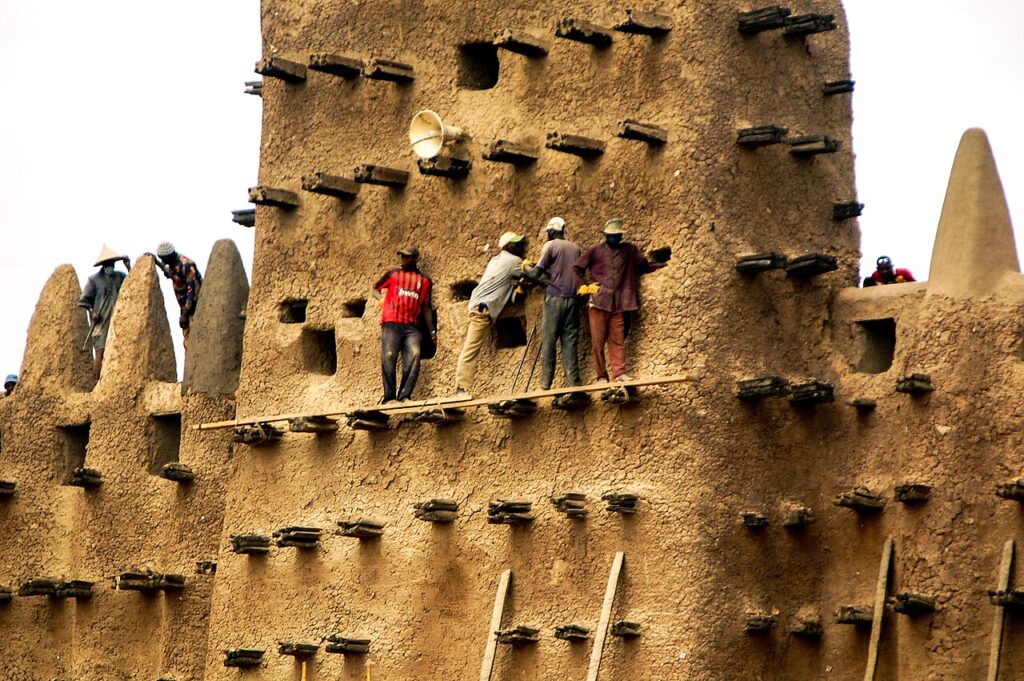
In April 1907, the French governor of French Sudan looked on as the last palm-wood scaffolding was removed from Djenné’s rebuilt Great Mosque. What he saw—and what you will see today—was not merely a monument but a covenant: a structure that the people of Djenné had rebuilt themselves, refusing foreign stone and cement, insisting on the same sun-dried mud their ancestors had used since the 13th century. That single act of architectural defiance defines everything you will experience here.
The Story Behind Djenné’s Great Mosque
Your understanding of Djenné’s Great Mosque begins not in 1907, but in the 13th century, when King Koi Konboro—Djenné’s first Muslim ruler—ordered the original mosque constructed on the site of his own palace. He had converted to Islam and wanted a place of worship that would rival any in the Islamic world. But that first structure, built of mud and palm wood, was constantly eroded by the annual rains, and by the early 19th century it had fallen into ruins. What you see today owes its form to a single visionary: Ismaila Traoré, the master mason who designed the 1907 rebuilding.
Traoré’s genius lies in what travelers often discover only upon close inspection: those distinctive protruding wooden beams—about a hundred of them studding the facade—are not decorative. They are permanent scaffolding, left in place so that masons can climb and replaster the walls every year. This is the secret of the mosque’s survival. Every April or May, during the festival of crépissage, the entire community of Djenné—men, women, and children—climbs the walls with buckets of mud, smoothing and patting the fresh clay by hand. You will witness a living tradition that has not changed in eight centuries.
The mosque’s three towering minarets, each topped with ostrich eggs symbolizing fertility and purity, are built on a rectangular plan that predates Islam itself—a shape borrowed from earlier Berber mosques of North Africa. The interior, which you can explore only with a guide and during designated hours, is surprisingly dark and cavernous. There are 90 wooden pillars supporting the roof, each roughly hewn, and the only light filters through small openings in the eastern wall. The hushed, dusty atmosphere inside feels less like a cathedral and more like a sacred cave. Locals will tell you that the mosque’s walls “breathe”—expanding and contracting with humidity—and they are not speaking figuratively.
Neighborhood by Neighborhood
Djenné-Djeno: The Ancient City Ruins
Three kilometers southeast of the modern town lies Djenné-Djeno—”ancient Djenné”—where the city’s story began around 250 BCE. You will walk through mounds of broken pottery and the faint outlines of collapsed mud walls, a UNESCO World Heritage site that remains largely unexcavated. The ground beneath your feet holds the remains of an urban civilization that traded gold, salt, and slaves across the Sahara before the Great Mosque was even imagined. Locals recommend visiting early in the morning, around 7 a.m., when the low sun casts long shadows across the rubble and the heat has not yet driven you to the shade of the few acacia trees. A guide from the Djenné Cultural Mission—Mamadou Touré is the most knowledgeable—can show you the ritual burial sites and explain how the Niger River, which once flowed past these ruins, shifted course and left the city stranded, forcing its people to found the modern Djenné you know today.
Quartier Marché: The Market Quarter
Your best bet for experiencing Djenné’s pulse is the Quartier Marché, the neighborhood that wraps around the Grand Marché, just north of the mosque. You will find it most alive on Mondays, when the weekly market draws Fulani herders, Bozo fishermen, and Songhai merchants from villages throughout the Inner Niger Delta. The air thickens with the smell of smoked fish, shea butter, and the sharp tang of sun-dried tomatoes. Stalls overflow with indigo-dyed cloth from Timbuktu, silver Tuareg crosses, and leather sandals hammered by hand. Locals recommend Youma’s stall at the northeastern corner of the market for woven blankets—she has been selling there for 40 years and will tell you which weavers made the finest pieces. The street called Rue de la Mosquée, which runs directly from the market to the mosque’s main entrance, fills with children selling plastic bags of fried dough called beignets for 50 CFA (about 8 US cents). The energy here is overwhelming, and seasoned travelers know to arrive by 8 a.m. before the crowds and the heat peak at midday.
Quartier Peulh: The Herders’ Enclave
On the western edge of town lies Quartier Peulh, the neighborhood of the Fulani herders—the Peulh people who bring their cattle to Djenné during the dry season. You will notice the difference immediately: the streets are wider here, laid out to accommodate livestock, and the houses are set farther apart, each with a small corral attached. The architecture changes too—the walls are lower and thicker, and the rooftops are often used as sleeping platforms during the hot months. Travelers often discover that this is the quietest part of Djenné, especially in the late afternoon, when the herders have taken their animals to the river and only the women remain, pounding millet in wooden mortars with a rhythm that sounds like distant drumming. The small mosque at the corner of Rue du Bétail and Rue du Niger is worth a pause—its minaret is a simple, unplastered mud tower that lacks the ostentation of the Great Mosque but possesses a rough, honest beauty. Locals say that if you want to understand how most Malians actually practice Islam, you should sit here during the sunset prayer.
The Local Table: What Djenné’s Denizens Actually Eat

Great Mud Mosque, Djenné, Mali, Djenné’s Great Mosque, Mali
You will not find Djenné’s cuisine on any restaurant menu in Bamako. The food here is defined by what the Niger River provides and what the millet fields yield: fish, rice, okra, and a staggering variety of sauces. The staple is riz gras—a one-pot dish of rice cooked in tomato, onion, and fish stock, often topped with Nile perch caught that morning. But the dish you must seek out is fakoye, a fermented baobab leaf sauce that tastes like a tangy, earthy spinach and is served over millet couscous. Locals will tell you that real fakoye takes three days to prepare—the leaves must be sun-dried, then soaked in tamarind water, then cooked for hours with dried fish and chili.
Your best bet for tasting authentic Djenné home cooking is at Chez Oumou, a family-run eatery on Rue du Niger, a five-minute walk from the mosque. Oumou Diallo has been serving lunch here for 22 years, and there is no menu—she cooks whatever came fresh from the market that morning. You will sit on wooden benches, eat from a communal bowl with your right hand, and pay about 1,500 CFA (roughly $2.50) for a meal that includes rice, sauce, fish, and a portion of the sweet, tangy tamarind juice called jus de ditax. She opens at noon, and by 12:45 the benches are full. Savvy visitors arrive at 11:30 to secure a spot and watch her cook over the open fire in the courtyard.
The Monday market is also where you should eat street food. Find the woman frying beignets near the northern gate of the market—she is always there by 7 a.m., and the dough is light, crisp, and slightly sweet. A stack of five costs 100 CFA (about 16 cents). Locals recommend buying a bag and eating them while walking along the riverbank, watching the pirogues unload their catch.
Art, Music & Nightlife
Djenné’s creative life is rooted in oral tradition rather than galleries or concert halls. The art you will see is woven, dyed, and hammered by hand. The indigo-dyed cloth produced in Djenné is among the finest in West Africa—the dye comes from fermented indigo leaves that have been used for centuries, and the patterns tell stories of lineage, marriage, and harvest. Visit the small workshop of Fatoumata Traoré on Rue de l’Indigo, a narrow lane off the market square. She learned the craft from her grandmother and works seven days a week. You can buy a hand-dyed wrap for 8,000 CFA ($13), and she will show you how the pattern changes meaning depending on the number of folds dipped in the dye vat.
Music in Djenné means griot storytelling—praise singers who accompany themselves on the kora (a 21-string harp-lute) or the balafon (a wooden xylophone). During the annual Festival de la Mosquée de Djenné—held in April, coinciding with the crépissage—the town erupts in three days of music, dance, and recitation. The festival culminates on the Sunday evening before the plastering begins, when griots from across the Niger Delta gather at the Grand Place in front of the mosque and compete in all-night song battles. There is no formal venue—you simply wander, following the sound of drums and voices. Nightlife in Djenné ends early: by 9 p.m., the streets are dark and quiet, save for the occasional prayer call from a minaret. Your best bet for an evening activity is to sit on a rooftop terrace—many guesthouses offer this—and watch the stars emerge over the silhouetted mosque.
Practical Guide
- Getting There: You will fly into Bamako’s Modibo Keita International Airport (BKO) on a carrier like Air France, Ethiopian Airlines, or Royal Air Maroc. From Bamako, you have two options: a 6-hour bush taxi from the Bamako bus station (Sogoniko) to Djenné for about 10,000 CFA ($16)—rough, crowded, but authentic—or a chartered 4×4 for around 150,000 CFA ($245) that makes the journey in 5 hours. Book flights at Skyscanner
- Getting Around: Djenné is small enough to walk everywhere. The mosque, market, and main neighborhoods are all within a 20-minute walk of each other. For trips to Djenné-Djeno, hire a motorbike taxi (moto-taxi) for 1,000 CFA ($1.60) each way—negotiate the price before you mount.
- Where to Stay: Your best bet is Campement de Djenné, a hotel run by the Djenné Cultural Mission on Rue de la Mosquée. Rooms are simple but clean, with fans and mosquito nets, and cost 15,000 CFA ($24) per night. For a more local stay, the family-run Gîte Chez Baba on Rue du Niger offers rooftop sleeping in the dry season for 8,000 CFA ($13). Check availability at Booking.com
- Best Time: November through February, when temperatures hover between 25°C and 32°C (77-90°F) and the air is dry. Avoid April-October for the intense heat and June-September for rains that can make roads impassable. If you want to see the crépissage, plan for mid-April—dates vary annually, so check with the Djenné Cultural Mission.
- Budget: A realistic daily budget for a mid-range traveler is 30,000 CFA ($49)—including accommodation, three meals, a moto-taxi ride, and a small souvenir. Budget travelers can survive on 15,000 CFA ($24) if they eat street food and sleep in a basic room.
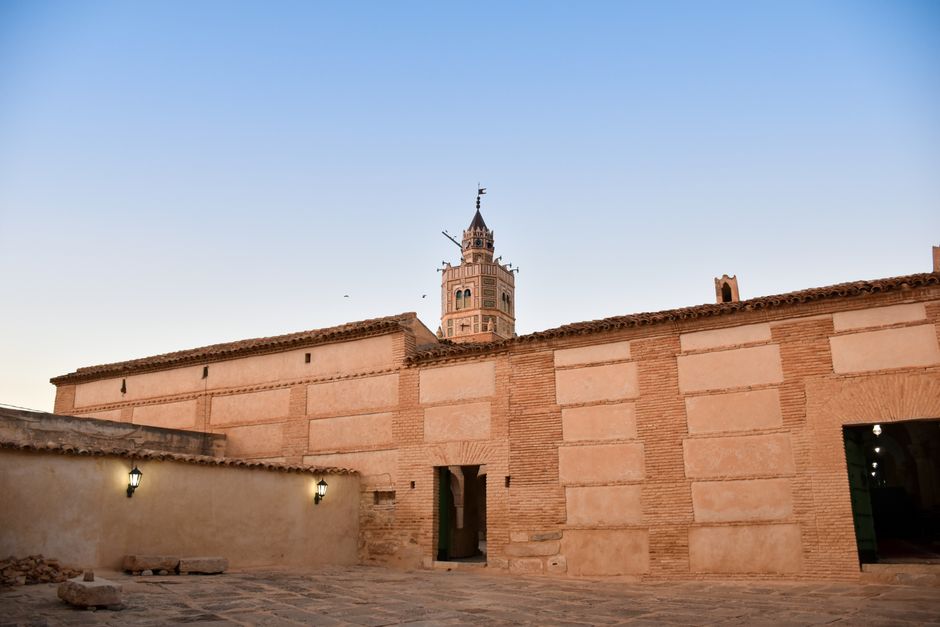
Beautiful view of a historic minaret and mosque wall in Testour, Djenné’s Great Mosque, Mali
What Surprises First-Time Visitors
The first surprise that strikes every traveler is the silence. For a town of 30,000 people, Djenné is hushed. The mud walls absorb sound—there is no echo, no reverberation—and the streets are sand, not asphalt, so footsteps are muffled. You will hear the call to prayer from the Great Mosque as a deep, resonant hum rather than a piercing cry, as if the mosque itself is singing from inside its clay belly. This acoustic quality changes the way you experience the place entirely; you begin to move more slowly, speak more softly, listen more carefully.
The second surprise is how small the Great Mosque feels when you stand next to it. Photographs make it look like a towering fortress, but at 16 meters (52 feet) tall, it is roughly the height of a four-story building. What overwhelms you is not its height but its mass—the walls are nearly a meter thick at the base, giving the building a squat, immovable presence. You will find yourself touching the walls repeatedly, expecting them to feel like stone, but they are warm, slightly yielding, and faintly dusty. The sensation is unsettling and strangely intimate, like shaking hands with a person who is alive.
The third surprise is the quiet dignity of everyday life. Travelers often arrive expecting a dusty historical relic, but Djenné is a working town where goats wander into the mosque courtyard, women balance water pots on their heads at dawn, and children kick a deflated soccer ball in the market square. The Great Mosque is not roped off or guarded—it is used five times daily for prayer, and you will hear the muezzin’s call from a scratchy loudspeaker rigged to a minaret. Locals will wave at you, children will ask for your pen, and the imam might invite you to sit with him after the Friday sermon and drink sweet mint tea. It is the most honest welcome you will ever receive as a visitor.
Your Djenné’s Great Mosque Questions
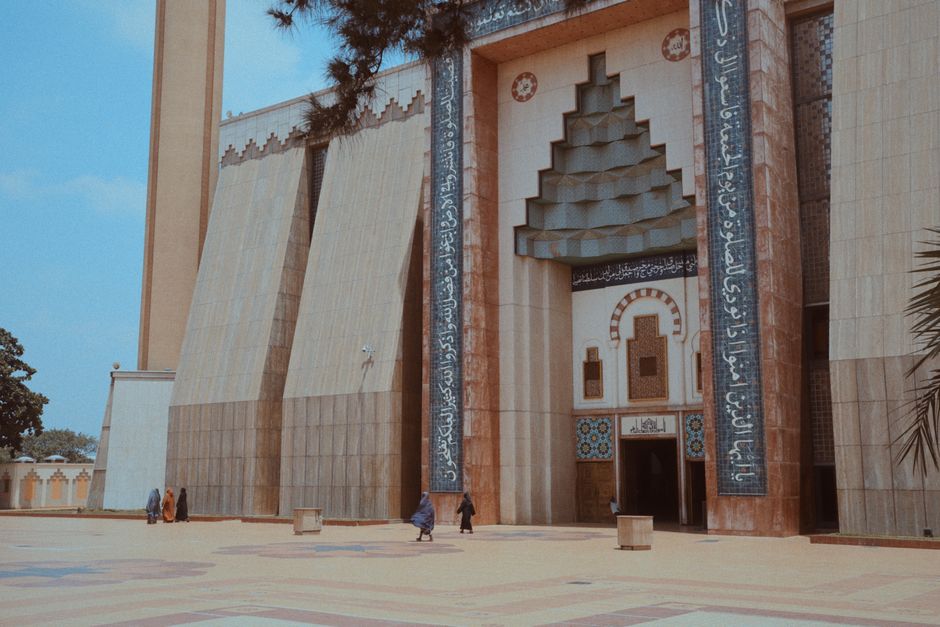
Exterior of a grand mosque with intricate calligraphy and a few people walking., Djenné’s Great Mosque, Mali
Can non-Muslims enter the Great Mosque? Yes, but only during specific hours—typically 8:30 a.m. to 11 a.m., and again from 3 p.m. to 4:30 p.m., avoiding the five daily prayer times. You must enter with a guide from the Djenné Cultural Mission (arrange at their office on Rue de la Mosquée, cost 5,000 CFA/$8 per group). Women must cover their heads and arms; men should wear long pants. Inside, you may not take photographs—a rule strictly enforced by the imam, who considers the interior sacred. The exterior, of course, you may photograph from any angle, and the best light for photos is at sunrise from the roof of Campement de Djenné.
Is it safe to travel to Djenné given the security situation in Mali? This is the question every traveler must face honestly. The Malian government and the UN peacekeeping mission (MINUSMA) maintain a visible presence in Djenné, and the town itself has not experienced terrorist incidents. The risk lies in the journey: the road from Bamako passes through areas where banditry and roadblocks are possible, and the route is not recommended for solo travelers without reliable information. Your best bet is to travel with a reputable tour operator who coordinates with local security services. If you are an independent traveler, check with your embassy and the Djenné Cultural Mission for up-to-date advice before you travel. Many seasoned travelers consider Djenné a once-in-a-lifetime destination that the risk profile, while real, should not deter if approached with caution.
How does the annual plastering festival work, and can I participate? The crépissage typically takes place on the last Friday of April or the first Friday of May, depending on the end of the rainy season. The entire town participates: men mix the mud with straw and shea butter in the streets, women carry buckets of water from the river, and children climb the scaffolding to pass mud to the masons. As a visitor, you are welcome to watch, but you will not be allowed on the scaffolding—this is a safety and cultural protocol. The best viewing spot is from the rooftop of Campement de Djenné, where you can see the entire

