
Beyond the Border: The Quiet Resilience of Abyei, South Sudan (2026)
In 1905, a British colonial officer drew a diagonal line across a map of the Sudan, separating the Dinka cattle camps from the Misseriya grazing routes without ever stepping foot on the soil. That line became the 1956 boundary between North and South, and decades later—after the 2005 Comprehensive Peace Agreement—the long-neglected town of Abyei found itself at the heart of a still-unresolved dispute. You arrive here not to see a headline, but to understand what it means to call a place home while the world argues over its name.
The Story Behind Abyei, South Sudan
To grasp Abyei, you must first visit the Ngok Dinka’s deep-rooted connection to this land. Oral histories speak of a great migration centuries ago, when the ancestors of the Ngok crossed the Nile and settled along the seasonal rivers—the *khors*—that turn the savanna green after the rains. By the 19th century, the region became a crossroads. The Mahdist forces swept through in the 1880s, but the Ngok remained fiercely independent, their chiefs negotiating with Ottoman governors and later with British administrators who arrived after the Battle of Omdurman in 1898.
The redrawing of borders by colonial powers left Abyei in a legal limbo. In 1956, when Sudan gained independence, the area was assigned to the North, but the Ngok Dinka—culturally and politically aligned with the South—felt betrayed. The subsequent civil wars saw Abyei become a frontline. Massacres, forced displacement, and the burning of villages defined the 1980s and 1990s. When the Comprehensive Peace Agreement was signed in 2005, a special protocol promised a referendum for Abyei to decide its own fate—a vote that has never been held. Travelers often discover that the town’s silence is not emptiness; it is the weight of deferred promises. The latest violent clashes in May 2013, when Misseriya militias backed by Sudanese forces attacked, left hundreds dead and rebuilt the very walls of fear. Yet, walking through the market today, you will hear laughter, and that resilience is what locals recommend you respect above all.
Neighborhood by Neighborhood
Abyei Town Center
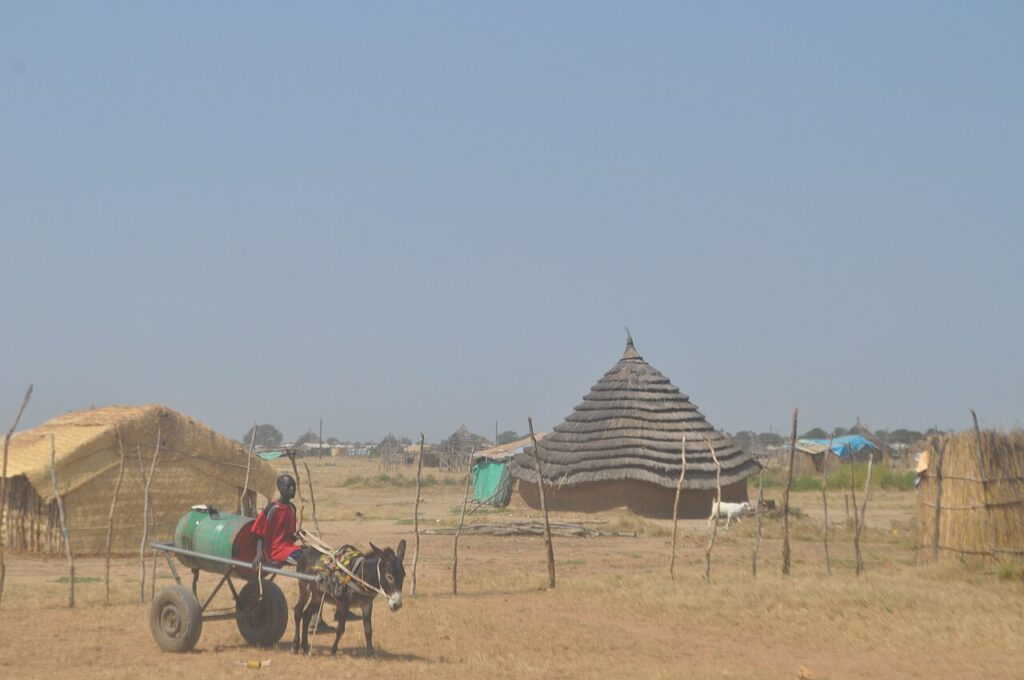
The heart of Abyei is a dusty grid of dirt roads, corrugated-metal roofs, and the odd concrete building. You will start at the main intersection—the only spot with paved streets—where the UNMISS (United Nations Mission in South Sudan) maintains a small compound. Here, the market bustles from sunrise to around sunset, with stalls selling flip-flops from China, bolts of colorful cotton, and bundles of okra. The most dominant structure is the old Abyei primary school, its walls pockmarked with bullet holes now softened by a fresh coat of white paint. You will smell charcoal smoke mingling with the sweet, nutty aroma of ground peanuts—the base for many local sauces. Most tourists overlook the small whitewashed mosque at the east end of the market road; its bare interior offers a cool stillness in the midday heat. Locals gather under the shade of a giant neem tree by the water borehole, where you can sit and listen to conversations in Dinka that rise and fall like the wind.
Ameth
Seven kilometers southwest of the town center lies Ameth, a village that feels like a step into a past era. Travelers who venture here—usually as guests of a Ngok Dinka family—find wide compounds of round thatched huts (*tukuls*) encircled by thorn fences. The sandy paths are swept clean each morning. In Ameth, you will see the *luak*: the sacred cattle byre where men gather to discuss disputes, history, and the price of bride-wealth. Your best bet for understanding Dinka cosmology is to ask an elder to tell you the story of the sacred spear of the Ngok—the *manyok*—which is said to be hidden somewhere in these villages. Seasonal rivers carve through the landscape, and in the dry season, the women dig shallow wells in the sand beds for water. Meals are communal; you will be offered a bowl of *asida* (a stiff porridge) with a clear soup of okra and dried fish. The hospitality is overwhelming—plan to spend at least two hours accepting cups of sweet milky tea.
Agok
Fifteen kilometers north, along a road that turns into a muddy nightmare after any rain, sits Agok—the de facto capital of the Ngok Dinka during the civil war years. This is where the chief’s court convenes under a canopy of mango trees. Agok’s character is more rural than Abyei town, with larger cattle camps that migrate with the seasons. You will recognize the Misseriya presence here too: their Arabic greetings, the occasional white-turbanned trader selling livestock, and the distinctive hum of a *tambour* (stringed instrument) played at night. Agok’s market is smaller but offers smoked meats and wild honey collected from the acacia forests. Seasoned travelers prefer Agok for its genuine sense of peace—the constant whir of UNISFA helicopters is a hum of security, not a threat. Stay overnight if you can arrange it through a local contact; the stars are impossibly bright, and the quiet gives you time to reflect on the weight of history.
The Local Table: What Denizens Actually Eat
Food in Abyei is not a matter of choice but of resourcefulness. You will not find a restaurant with a menu. Instead, your best bet is to be invited to a home. The staple is *asida*, a thick dough made from sorghum flour, cooked into a stiff, smooth ball that you tear and dip into stews. *Mullah*—the clear, thin sauce—is the most common accompaniment, usually made with okra (*bamia*), onions, dried fish, and a generous amount of red oil (palm oil). On special occasions, a cow is slaughtered, and you will eat the liver raw, dipped in chili and salt—a delicacy that travelers either love or politely endure.
The only public food gathering point is the early-morning market at Abyei town center, where women roast ground peanuts on charcoal braziers. Around 7:30 AM, you can buy sweetened tea brewed with ginger and clove—ask for *shai kashkash*—alongside a calebash of fermented sorghum drink (*marissa*). Midday meals are rare; instead, people snack on roasted maize or sunflower seeds. The dinner tradition is the day’s main event, usually served when the sun drops low. Locals recommend you seek out *kisra*, a thin sorghum pancake served with a spicy peanut soup (*waragat*). To eat like a local, you will sit on a mat, wash your right hand from a pitcher, and dip with everyone else—making sure to only use the first three fingers, never your palm.

A view of Abyei from the UN helicopter., Abyei, South Sudan
Art, Music & Nightlife
The heart of Abyei’s creative soul beats in its oral traditions. Nighttime gatherings—*lamba*—turn into impromptu recitals where men compete in poetic praise songs for their cattle, their loves, and their ancestors. The *nyatiti* (a type of lyre) and *tambour* accompany these verses. If you are visiting in December or January, try to attend the *Wrestling Festival* held near Ameth, where men in beaded necklaces and red sandals take turns grappling under the impartial gaze of a referee. The real art, however, is the scarification patterns on their faces and the intricate beadwork on their chests—each line tells a story of lineage.
There is no true nightlife in the Western sense; by 8 PM, the streets are empty and dark. But inside homes, the singing continues. Female choir groups (like the *Azande* tradition from South Sudan, but adapted) sing in call-and-response while clapping rhythms that syncopate like the rain. Travelers are often invited to a *khor dance*—a slow, hypnotic movement where dancers mimic the grazing of cattle with their arms. Do not miss it. There are no galleries or museums; the entire neighborhood of Abyei town is a living gallery of resilience, with political murals painted by UN personnel on the walls of the health center and messages in Arabic and English promising peace.
Practical Guide
- Getting There: The nearest commercial airport is in Wau, South Sudan (WUU), served by UNMISS flights and sometimes South Sudan Airlines. From Wau, you need to arrange a car (often through a trusted driver or a humanitarian contact) for the 7–10 hour drive along the dusty, unpaved road. Book flights to Juba (JUB) and then onward to Wau via Skyscanner. Entry into Abyei itself is restricted; you must apply for permission from the local Abyei Administration (usually through a contact) and may need a letter from the UNISFA office in Abyei town.
- Getting Around: In town, you walk or hire a bicycle taxi for about 300 South Sudanese pounds (roughly $1 USD) per ride. For trips to Ameth, Agok, or surrounding villages, you will want a 4×4 vehicle—hire one for $80–$120 per day from Wau. Public transport is essentially nonexistent; offer a ride to a local and you will make a friend.
- Where to Stay: Accommodation is extremely limited. Your best bet is a guesthouse affiliated with an NGO, or the Abyei Administration’s simple rest house near the hospital (book through the commissioner’s office). Expect a basic room with a foam mattress and a bucket shower. Check Booking.com for hotels in Wau if you cannot secure a stay in Abyei.
- Best Time: November through April. These are the dry months, when roads are passable and the threat of disease is lower. The rainy season from May to October turns everything to black mud, and malaria risk spikes. Avoid the March–April dust storms that bring oppressive heat.
- Budget: Plan for $50–$100 per day including transport hire and per diem for food (mostly bought from market or cooked). Cash is king; bring enough United States dollars (clean, crisp bills) or South Sudanese pounds. No ATMs exist in Abyei town.
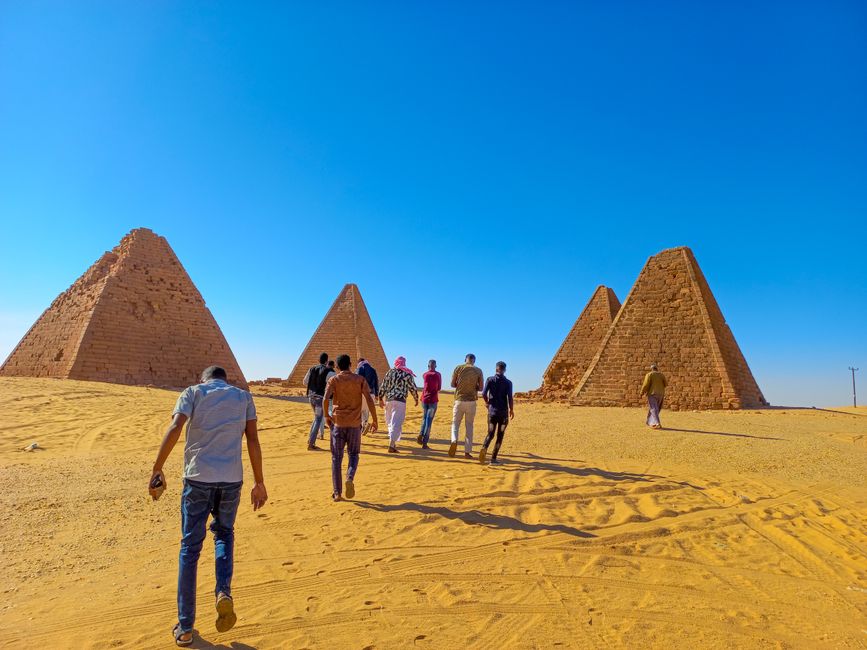
Tourists walk towards ancient pyramids in the Sudanese desert under a clear…, Abyei, South Sudan
What Surprises First-Time Visitors
You will not find a single tourist office or signpost. The absence of commerce shocks most people. There is no souvenir shop, no cafe, no Wi-Fi. Yet you will also discover an unexpected ease: children will wave and shout “*Musing*!” (friend) as you pass, and elders will invite you to share their shade. The silence of the landscape is another surprise—other than the rattling of a UNISFA convoy, the only sounds are birdsong and the lowing of cattle. You forget that this is a disputed territory. Travelers often remark how fast you lose your sense of time here; without electricity after dark, you adjust to the rhythm of sunrise and sunset.
The second surprise is the visible presence of the border. You may walk across the line without realizing it, and suddenly a man in uniform from the Sudanese Armed Forces will ask for your papers. The line is not marked by a fence but by a subtle change in the color of the earth. Locals know it intimately—they used to cross freely for grazing or trade, but now checkpoints have appeared. You learn that peace here is fragile, and it changes how you look at every conversation.
Your Abyei, South Sudan Questions
Is it safe to travel to Abyei as a solo tourist?
Safety is relative. The United Nations classifies Abyei as a dangerous area due to periodic clashes between Ngok Dinka and Misseriya armed groups, plus unexploded ordinances from past conflicts. Travelers who visit typically go with humanitarian missions, journalists, or as part of an organized delegation. If you insist on going independently, you must register with the Abyei Administration, hire a local guide and driver with knowledge of the local politics, and stay in regular contact with UNISFA’s field office. Your best bet is to go with a reputable tour company that deals in “off-grid” destinations—though none advertise it. Consider that the reward is an intimate encounter with a living history most people never see.
Do I need a visa for Abyei?
Abyei is a contested territory, so the entry requirements are complicated. For most foreigners, you need a South Sudan visa (obtainable at Juba Airport or from an embassy) and, in practice, a separate permission letter from the Abyei Area Administration. The letter is often issued only if you have a contact within the administration. Additionally, if you plan to cross into Sudan proper from Abyei, you need a Sudan visa—which is almost impossible to get in Abyei itself. Travelers recommend sorting out both visas before arrival, and always carrying copies of your permit and passport. Rules change quickly; a local fixer (often a UN employee or experienced journalist) is worth their weight in gold.
What language should I speak?
The primary local language is Dinka (specifically the Ngok dialect). Arabic is widely spoken, especially in markets, and many people under 40 know some English because of the UN presence. Your best approach is to learn a few Dinka greetings: “*Yin cïït ku*” (good morning) and “*Cïït niec*” (thank you). Speaking slowly and with a smile is far more effective than fluency. In Ameth and the villages, few people speak English, so a Dinka interpreter is essential for deeper conversations. If you speak Arabic, you will get by easily in Abyei town.

Explore the magnificent ancient ruins of Naqa, Abyei, South Sudan

