
Balkanabat, Turkmenistan Weekend: Markets (2026)
The first thing you notice is the light—a pale, silvery haze off the Caspian that softens everything, from the Soviet-era apartment blocks to the gold-tipped minaret of the central mosque. Then comes the smell: fresh flatbread from a tandyr oven, mixed with the unmistakable tang of camel milk and the dry, mineral dust of the Karakum Desert. It’s a Saturday morning, and you’ve just landed in Balkanabat, the quiet capital of Turkmenistan’s western province. Over the next 48 hours, you’ll discover a frontier town where ancient Silk Road echoes meet Soviet concrete, and where the hospitality is as immense as the surrounding desert.
Quick Facts Before You Go
- Best Months: April–May and September–October. Spring brings wild tulips to the surrounding foothills; autumn offers clear skies and comfortable temperatures around 22–28°C (72–82°F). Summer heat (40°C+) is fierce, and winter winds off the Caspian bite hard.
- Currency: Turkmen manat (TMT). The official exchange rate hovers around 3.5 TMT to 1 USD, though black-market rates (unofficial but widely used) can push closer to 19–20 TMT per USD. Bring crisp, new $100 bills for the best unofficial rates—locals will discreetly help you exchange.
- Language: Turkmen (Turkic language), with Russian widely spoken among those over 40. English is almost nonexistent outside Ashgabat. Your best bet is to learn a handful of phrases: Salam (hello), Sag boluň (thank you). A smile and a printed Google Translate screen will carry you far.
- Budget: $50–$80 per day per person, including accommodation, three meals, and local transport. Splurge on the Caspian-fresh sturgeon; save on street food where a filling shashlik and bread costs barely $3.
- Getting There: Fly into Ashgabat International Airport (ASB) from Dubai (3 hours) or Istanbul (4.5 hours). From Ashgabat, you can take a shared taxi or minibus for the 5-hour drive west along the M37 highway. Book flights at Skyscanner. Alternatively, a domestic flight from Ashgabat to Balkanabat (45 minutes) operates a few times weekly on Turkmenistan Airlines.
Day 1: Concrete, Carpets & Caspian Sunsets
You start the morning at the Balkanabat Bazaar, a sprawling open-air market that has been the town’s beating heart since the 1960s. The air hums with bargaining in Turkmen and Russian, the clatter of metal scales weighing dried apricots, and the percussive thwack of a butcher cleaving lamb. This is where locals stock up for the week, and where you’ll begin to understand Balkanabat—not as a stopover, but as a place that pulses with its own quiet, stubborn life.
- Morning (8–11am): Head to the Balkanabat Bazaar (open daily, busiest Sat–Sun, free entry). Spend an hour weaving through the alleys of spices, nuts, and handwoven Turkmen carpets. The carpet sellers in the covered section welcome haggling—a small 60x100cm wool rug costs around 200–300 TMT (official rate), and you’ll see patterns that date back to the Tekke and Yomut tribes. At 9:30am, find the çörek bread stall (the one with the queue of white-bearded men) and buy a warm, sesame-crusted loaf for 2 TMT.
- Lunch: Walk five minutes to Café Hazar (10 Balkan Avenue, open 11am–9pm). This no-frills spot is where government workers and taxi drivers converge for lunch. Order the plov (lamb and carrot rice, 15 TMT) and a side of shurpa (mutton soup with chickpeas, 10 TMT). The kitchen opens at noon, but arrive by 12:15 to snag a seat by the window overlooking the street.
- Afternoon (1–5pm): From the bazaar, take a taxi (10 TMT, 5 minutes) to the Balkanabat Central Mosque (officially the Türkmenbaşy Ruhy Mosque, built 2004). Its turquoise-tiled dome is visible from across the city. Inside, you’ll find a vast prayer hall with 81 carpets—one for each year of the first president’s life. Non-Muslims can enter outside prayer times; remove your shoes and women should bring a headscarf. Afterward, walk east along Magtymguly Street to the Balkanabat History Museum (Köne Street, open 9am–5pm, closed Monday, entry 10 TMT). The small collection includes Bronze Age pottery from the Dehistan ruins and Soviet-era photographs of the city’s construction. The English labels are sparse, but the 1950s black-and-white photos of workers building the oil refinery are worth the detour.
- Evening: At 6pm, hire a taxi (50 TMT round trip, negotiate upfront) for the 15-minute drive to the Caspian Sea coast at the village of Kuwwat. The beach is rocky, the water is a murky turquoise, but the sunset is extraordinary—sheets of orange and pink spreading over a sea that meets Iran on the horizon. Locals recommend bringing a flask of green tea and a cushion to sit on. Back in town, have dinner at Restoran Altyn Asyr (Bitarap Turkmenistan Avenue, open 7pm–11pm). This is Balkanabat’s most upscale dining option, with white tablecloths and a menu heavy on Caspian fish. Order the balyk shashlyk (grilled sturgeon skewers, 45 TMT) and a bottle of local çay (tea with mint, 5 TMT). The atmosphere is formal but warm—the owner may stop by your table to ask where you’re from.

Sand Storm on the Highway Entering Balkanabat, Balkanabat, Turkmenistan
Day 2: Desert Valleys, Soviet Ghosts & the Farewell Feast
Day two is about escape—out of the city, into the landscape that surrounds Balkanabat like a great, silent exhale. You’ll trade the bazaar’s chaos for the eroded cliffs of Yangykala Canyon and the echoing hallways of a Soviet geological institute. Travelers often find that this second day changes their understanding of Turkmenistan entirely: it’s not just a country of gas fields and marble palaces, but a place of profound, ancient emptiness.
- Morning (6:30am–12pm): Start early with a pre-arranged private taxi or tour (ask at your hotel or book via Balkanabat Travel Services, +993 12 34 56 78, ~250 TMT for a half-day). Drive 90 minutes northeast to Yangykala Canyon, a 60-kilometre-long series of limestone and sandstone cliffs that range from pale ochre to deep crimson. The road is unpaved for the last 15 kilometres—expect a bone-rattling ride. Arrive by 8am, before the sun bleaches the colours. Walk along the canyon rim for a half-hour (no official trail, but the rock formations are easy to navigate). The silence is absolute, broken only by the wind. For breakfast, your driver will likely stop at a roadside stall near the village of Gyzylarbat where a woman named Gülsenem sells gözleme (stuffed flatbreads with spinach and feta, 5 TMT each). Eat them hot, wrapped in newspaper.
- Midday (1–2pm): Back in Balkanabat, grab lunch at Çaýhana Bagtyýar (Nursaý Street, open 11am–6pm, 12 TMT for a full meal). This teahouse is frequented by local truck drivers and has no English menu—just point at the steaming pots of manti (steamed dumplings stuffed with lamb and onion, 8 TMT for six). The secret is to arrive before 1pm to avoid the lunch rush; by 1:30, every seat is taken. Pair your manti with a glass of ayran (salty yogurt drink, 2 TMT).
- Afternoon (3–5pm): Spend your final hours exploring the Geological Exploration Institute on Gurbansoltan Eje Avenue. The building—a three-storey 1960s concrete block with a faded bas-relief of a drill rig—is now abandoned and fenced off, but visitors can peer through the gaps in the gate to see Soviet-era trucks rusting in the courtyard. This is Balkanabat’s quiet heart: a town built on oil and gas, now reduced to a whisper of its industrial past. If you prefer something more active, walk to the City Park (entrance off Magtymguly Street, free). It’s a small, dusty rectangle of trees and benches where elderly Turkmen men play chess under a statue of Magtymguly Pyragy, the 18th-century poet. Join a bench and watch the slow pace of provincial life.
- Final Evening (7–10pm): For your last dinner, go to Restoran Hazar Kenary (on the road out of town toward the Caspian, 10 minutes by taxi, 30 TMT one-way, open 6pm–midnight). This is a local institution—a sprawling open-air terrace overlooking the sea, with fairy lights strung between tamarisk trees. The signature dish is balyk çorbasy (Caspian fish soup, thick with tomatoes and herbs, 25 TMT), followed by sturgeon kebabs (50 TMT). Order the house-made nar şerbeti (pomegranate syrup diluted with water, 5 TMT). Arrive at 7pm to watch the sun set over the water. The owner, a former oil worker named Azat, often recites poetry in Turkmen after dinner. Savour this moment—it’s the kind of farewell that makes you want to cancel your morning flight.

Elegant white government building with ornate lamp posts in Ashgabat., Balkanabat, Turkmenistan
The Food You Can’t Miss
Balkanabat’s food is a direct conversation with its landscape: dry, desert-hardened, but touched by the Caspian’s bounty. You’ll find the most authentic version of this at the bazaar, where a charcoal grill known as mangal sends up columns of smoke from dawn until dusk. The street food star is shashlyk (skewered lamb) sold at the bazaar’s eastern gate by a man named **Berdi**, whose stall has been operating since 1987. For 4 TMT per skewer, he grills fatty chunks of lamb over coals of saxaul wood—a desert shrub that burns hot and clean. The secret, you’ll notice, is the brief soak in pomegranate molasses mixed with wild garlic. Locals recommend buying three skewers and wrapping them in a fresh çörek bread. Eat standing at the counter; there are no chairs.
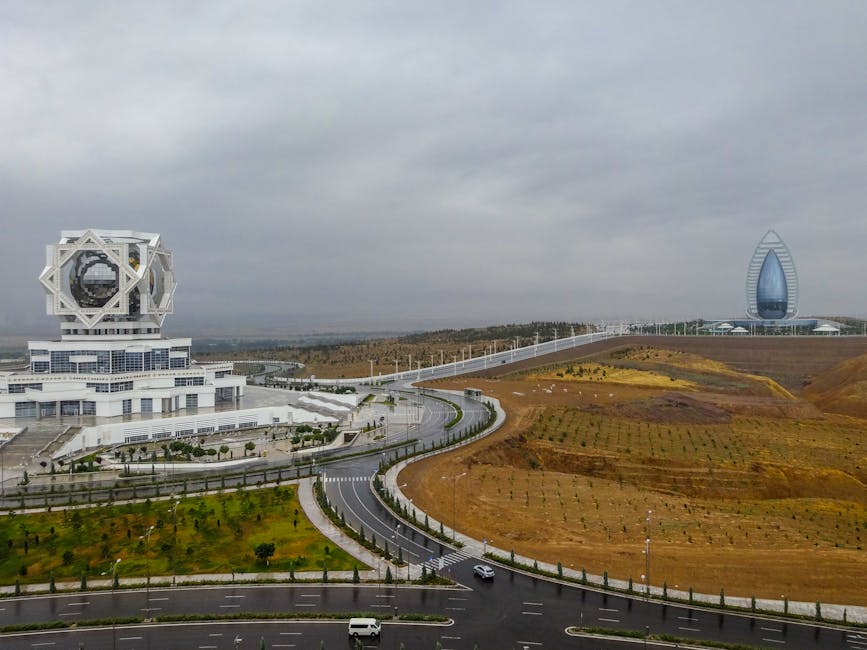
Aerial view of the Wedding Palace and Yyldyz Hotel in Ashgabat, Turkmenistan., Balkanabat, Turkmenistan
For a sit-down meal that captures the city’s culinary soul, head to Restoran Şatlyk (106 Magtymguly Street, open 10am–10pm). This is the kind of place where the Soviet-era chandelier still hangs, and the waitstaff wear matching polyester vests. The must-order dish is dograma—a Turkmen specialty of shredded flatbread soaked in mutton broth, topped with chunks of slow-cooked lamb and dried yogurt. It’s hearty, ancient, and costs 18 TMT. The restaurant’s pishme (fried dough with honey) makes a perfect dessert for 5 TMT. You’ll find that the best meals in Balkanabat have no Instagram-friendly plating—they have the dense, honest texture of a place that feeds people who work hard.
Where to Stay for the Weekend
Balkanabat has limited accommodation options, and most visitors end up in one of two main areas. For convenience, stay near the city center along Gurbansoltan Eje Avenue. The Hotel Balkan (47 Gurbansoltan Eje, +993 12 34 56 89, rooms from $30–$50 per night via Booking.com) is a Soviet-era relic with high ceilings, creaky lifts, and unexpectedly clean sheets. The front desk staff speak basic Russian, not English, but they are unfailingly helpful. Check availability at Booking.com.
For more character, consider the Kuwwat Sea House, a collection of three guest cabins on the Caspian coast, 15 minutes from downtown. The owner, a retired geologist named Maral, rents them on Airbnb for $35–$55 per night. Each cabin has a small kitchenette and a porch overlooking the water. It’s rustic—no Wi-Fi, shared bathroom—but the experience of waking to the sound of waves and drinking tea with Maral’s homemade preserves is worth the trade-off. The third option, the Hotel Nebitçi (10 Bitarap Turkmenistan Avenue, $25–$40), is a budget Soviet-holdover popular with oil workers. It’s basic but clean and central. For under $40, you get a private room with a fan (no AC) and a shared Soviet-era bathroom down the hall. Book both hotels through Booking.com or by calling directly.
Before You Go: Practical Tips
- Getting Around: Balkanabat is small and walkable—most of the central grid (Magtymguly Street to Gurbansoltan Eje Avenue) takes 20 minutes on foot from end to end. For trips to the Caspian coast or the canyon, hire a private taxi. Negotiate a flat rate before you start: 50 TMT for a 30-minute trip, 250 TMT for a half-day to Yangykala. Make sure the driver fills the tank before you head into the desert—there are no petrol stations on the canyon road.
- What to Pack: (1) A headscarf—not just for mosques, but for respect at local homes and tea houses. (2) Sturdy, closed-toe shoes for the bazaar’s dusty floors and the canyon’s sharp rocks. (3) A reusable water bottle and purification tablets—tap water is drinkable but heavily chlorinated. (4) A SIM card from TM-Cell (available at the airport for $10–$15 with 5GB data) for offline maps and translation apps.

