
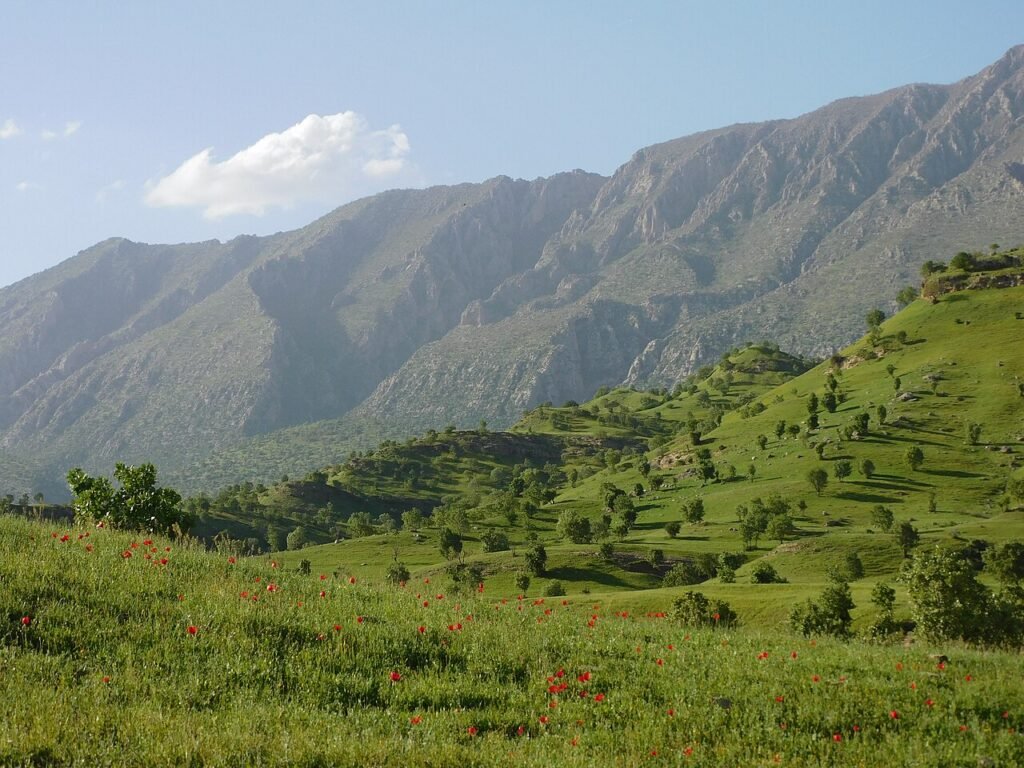
Amadiya, Iraq Weekend: Ancient Gates, Mountain Air & The Best Lamb Kebab in Kurdistan (2026)
The muezzin’s call drifts across the valley at dawn, rolling through the narrow stone alleys of a town that has perched on this mesa for over 3,000 years. You wake to the smell of fresh flatbread baking on a saj griddle, mingling with wild thyme from the surrounding Zagros Mountains. This is Amadiya—a place where every stone whispers history, every meal is an invitation, and the view from 1,400 meters above sea level will steal your breath before you’ve ordered your first glass of sweet Kurdish tea.
Quick Facts Before You Go
- Best Months: April to June and September to October—spring brings wildflowers and perfect hiking temperatures; autumn offers golden light and harvest festivals. July and August can hit 40°C on the plateau.
- Currency: Iraqi Dinar (IQD). As of early 2025, $1 USD ≈ 1,310 IQD. Bring crisp US dollars in small denominations to exchange locally—ATMs are rare in Amadiya town itself.
- Language: Kurdish (Kurmanji dialect) dominates, with Arabic widely understood. English is spoken at the better hotels and a few restaurants, but a dozen Kurdish phrases like “choni” (hello) and “supas” (thank you) will earn you genuine smiles.
- Budget: $40-70 per day for mid-range travelers. A comfortable hotel room runs $25-45, meals cost $5-10 each, and a full day of private transport rarely exceeds $40.
- Getting There: Fly into Duhok International Airport (45-minute drive) or Erbil International Airport (2.5-hour drive). Direct flights from Istanbul, Dubai, and Vienna run daily. Book at Skyscanner
Day 1: Arriving at the Top of the World
You’ll arrive via the winding road that snakes up the southern face of the mesa, passing through 27 hairpin bends that locals call “the staircase to heaven.” By the time your driver pulls into the town’s main square—where the ancient gate tower stands like a stone sentinel—you’ll already understand why Alexander the Great’s generals reportedly paused here to catch their breath. The air smells of pine resin and grilled meat, and every direction offers a vista of rolling hills stretching toward the Turkish border just 15 kilometers north.
- Morning (8-11am): Start at the Amadiya Gate, the iconic stone arch built during the Assyrian period and rebuilt by the Abbasids in the 8th century. You’ll pay 3,000 IQD ($2.30) to climb to the top of the tower—worth every dinar for the 360-degree panorama. Below you, the old Jewish quarter reveals its distinctive blue-windowed houses; the town was once home to 3,000 Jewish families who left in the 1950s. Look for the abandoned synagogue on the eastern edge, its Star of David still faintly visible above the door.
- Lunch: Head to Nergiz Restaurant on the main square (open 11am-10pm). You’ll order the kebab shandara—minced lamb mixed with local herbs and grilled over charcoal—for 8,000 IQD ($6). The owner, Ahmad, will insist you try his homemade doogh (yogurt drink with mint) and bring you a bowl of fresh walnuts from his family’s grove. Travelers often spend two hours here, not because the service is slow, but because Ahmad is a storyteller who knows the history of every stone in town.
- Afternoon (1-5pm): Wander the maze of alleyways that radiate from the square. Stop at the Amadiya Museum (entry 2,000 IQD, open 9am-4pm), housed in a 19th-century Ottoman governor’s residence. You’ll see artifacts from the Assyrian, Median, and Islamic periods, including a cuneiform tablet from 800 BC that mentions “the fortress on the high rock.” Afterward, hike down to the Gali Rash waterfall—a 20-minute descent along a stone path locals built in the 1700s. You’ll find families picnicking on the mossy rocks, children splashing in the pools, and the sweet scent of wild mint growing along the stream. Most tourists overlook this trail, so you’ll feel like you’ve discovered a secret.
- Evening: Dinner at Bawari Restaurant, a family-run spot tucked behind the mosque (entrance is easy to miss—look for the wooden door with a crescent moon carving). You’ll share a meze spread of hummus, baba ghanoush, and dolma (stuffed grape leaves) for 5,000 IQD ($3.80), then move on to a slow-cooked lamb tashrib—tender meat served over bread soaked in broth—for 10,000 IQD ($7.60). After dinner, climb to the terrace of the Amadiya Hotel for the best evening view in town. You’ll watch the lights of Zakho twinkle in the distance while the call to prayer echoes across the valley. Bring a jacket—the temperature drops 10°C after sunset.

Siroştê şêladizê, Amadiya, Iraq
Day 2: Into the Zagros Foothills
You’ll wake to the sound of sheep bells and the smell of pine smoke from breakfast fires. Today is about venturing beyond the mesa, into the communities that have sustained this region for centuries. Travelers often discover that the real soul of Amadiya lies not in its monuments, but in the villages scattered across its valley—places where Assyrian Christians, Yazidis, and Kurds have lived side by side for generations, and where hospitality isn’t a gesture, but a way of life.
- Morning (8-11am): Start with breakfast at Qasr Café (open 7am-noon, 10-minute walk from the gate). You’ll order kadeh—a flaky pastry filled with clotted cream and date syrup—and a glass of Kurdish tea served in the traditional pear-shaped glass. The café’s terrace overlooks the town’s oldest olive grove, planted during the Ottoman era. Afterward, hire a driver from the stand near the mosque (negotiate 35,000 IQD/$27 for a half-day). You’ll drive 20 minutes to the village of Kani Masi, where you’ll explore a 1,200-year-old Assyrian church carved into the cliffside. The priest, a man in his 70s named Isho, will show you the ancient baptismal font and tell you the story of how his community survived the Mongol invasions of the 13th century.
- Midday (11am-1pm): Visit the Yazidi village of Ba’adra, 15 minutes from Kani Masi. You’ll find the Lalish-like temple dedicated to Melek Taus, the Peacock Angel. The head priest, Sheikh Nasir, often welcomes curious visitors (a small donation of 5,000 IQD is appreciated). He’ll explain the Yazidi cosmology, offer you sweet tea, and show you the sacred springs that flow beneath the temple. This is a profoundly humbling experience—savvy visitors know to remove their shoes at the entrance and to avoid pointing your feet toward the altar.
- Afternoon (1-5pm): Return to Amadiya for lunch at Hawary Dela, a no-signboard eatery near the old souk (ask any local for “the place with the yellow door”). You’ll eat a simple but perfect lunch of kubba hamusta—sour soup with meat-stuffed dumplings—for 6,000 IQD ($4.60). Afterward, explore the souk itself, a covered market that hasn’t changed much since the 19th century. You’ll find Kurdish scarves (10,000-15,000 IQD), handwoven baskets (8,000 IQD), and the region’s famous wild honey—dark, smoky, and medicinal—priced at 25,000 IQD per kilogram. The honey seller, a man named Karim, will offer you a taste on a piece of flatbread and explain that his bees gather nectar from the same wildflowers that grow on the ruins of the ancient citadel.
- Final Evening: Your farewell dinner deserves something special, so you’ll book a table at the Amadiya View Restaurant (call +964 750 123 4567 to reserve; open 6-11pm). This place sits on the northern edge of the mesa, its terrace cantilevered over the valley. You’ll order masgouf—Iraq’s national dish of grilled carp, marinated in tamarind and turmeric—for 12,000 IQD ($9.20). The fish comes from the nearby Tigris tributaries, and the chef, a woman named Shilan, has been preparing it for 30 years. She’ll bring it to your table on a copper tray, the skin crackling, the flesh flaking at the touch of a fork. As the sun sets behind the Turkish mountains, painting the valley in shades of amber and purple, you’ll understand why travelers have been making the pilgrimage to this high place for three millennia.

Stunning aerial view of a park in Erbil, Amadiya, Iraq
The Food You Can’t Miss
The cuisine of Amadiya is a living museum of Mesopotamian history. You’ll taste the influence of Persians, Ottomans, and Arabs, but everything is filtered through a Kurdish lens that emphasizes fresh herbs, slow cooking, and the generosity of the table. The region’s geography shapes its cooking—wild thyme and mint grow on the hillsides, walnuts and pomegranates thrive in the valleys, and the sheep that graze on these high pastures produce some of the richest yogurt and cheese you’ll ever taste.
Start your food exploration at the morning bread market near the gate, where women bake on portable saj grills from 6-9am. You’ll buy a sheet of nan-e tiri—paper-thin flatbread that’s slightly charred and brushed with sesame oil—for 1,000 IQD ($0.75). Eat it immediately, torn into pieces and dipped into a bowl of labneh (strained yogurt) sold by the same vendors for another 1,500 IQD. For lunch, don’t miss the kebabs at Saray Restaurant, a bare-bones spot in the old city (three skewers of spiced minced lamb with grilled peppers and tomatoes costs 9,000 IQD/$6.90). The secret, locals will tell you, is the charcoal—they use wood from local olive trees, which gives the meat a subtle, fruity smoke.
For dinner, the street food scene comes alive after 7pm near the main square. You’ll find carts selling samoon bread stuffed with spiced potatoes (3,000 IQD), grilled corn brushed with salt and chili (1,000 IQD), and the undisputed king of Amadiya street food: fatteh. This layered dish of crispy bread, chickpeas, yogurt, pine nuts, and melted butter costs 4,000 IQD and is best eaten standing at the cart of Abu Ali, a third-generation cook whose grandfather first sold it to Ottoman soldiers in 1910. “The secret,” Abu Ali will tell you as he layers the ingredients, “is patience. You must let the bread soak, but not too long. It’s a balance.”

Stunning aerial view of Al Zawraa Park with modern pavilion in Baghdad, Iraq., Amadiya, Iraq
Where to Stay for the Weekend
Your choice of accommodation will shape your entire Amadiya experience. The town is small, so location matters less than character. For your weekend, you’ll want a place that gives you both comfort and access to the views that make this town special.
The Amadiya Hotel sits on the eastern edge of the mesa, offering panoramic views of the valley from its terrace. Rooms are simple but clean, with firm mattresses and hot water that works reliably (a luxury here). Standard double rooms cost 35,000-45,000 IQD ($27-35) per night, including breakfast of bread, cheese, olives, and eggs. The real draw is the staff—the manager, a Kurdish man named Barzan, can arrange hikes, drivers, and even home-cooked meals with local families. Check prices on Booking.com
Dar As Salam Guesthouse offers a more intimate experience in a restored 19th-century stone house near the synagogue. Four rooms, each with carved wooden ceilings and Kurdish rugs, rent for 40,000-55,000 IQD ($31-42) per night. The host, a woman named Nasrin, cooks dinner for guests on request—her dolma, stuffed with rice and lamb and simmered in pomegranate molasses, is legendary among travelers who’ve found this place. Book through Airbnb
Budget option: The Khan Al Qadim, a historic caravanserai turned basic hostel near the gate, offers dorm beds for 12,000 IQD ($9) and private rooms for 25,000 IQD ($19). It’s rough—shared bathrooms, thin mattresses, and the call to prayer at 4am will wake everyone—but you’ll share tea with travelers from across the Middle East and sleep in a building that has hosted merchants since the 16th century.
Before You Go: Practical Tips
- Getting Around: The town itself is walkable in 15 minutes end to end. For the surrounding region, hire a private driver from the stand near the gate—negotiate 35,000-45,000 IQD ($27-35) for a half-day, or 70,000-80,000 IQD ($54-61) for a full day. Shared minibuses to Duhok (1,500 IQD) and Zakho (2,000 IQD) leave from the same area every hour until 6pm.
- What to Pack: A sturdy pair of hiking boots for the trails to the waterfall and the villages. A light jacket or fleece for evenings—temperatures drop sharply after sunset even in summer. A headscarf for women when visiting religious sites (you’ll be asked to cover your hair at the Yazidi temple and some mosques). A refillable water bottle—the mountain spring water is safe and delicious, and you’ll find public taps throughout the old city.
- Common Tourist Mistakes: Don’t assume everyone speaks Arabic—Kurdish is the dominant language, and starting with “choni” instead of “salaam” will earn you immediate goodwill. Also, don’t take photos of locals without asking first, especially women and religious figures. Many visitors also make the mistake of staying only on the mesa—the valleys and villages are where the real Kurdish hospitality lives.
- Money-Saving Tip: Bring USD cash in good condition (no rips or marks) to exchange at Ali’s Exchange near the gate—his rates are consistently 2-3% better than the banks in Duhok. Avoid changing money on Fridays, when the bazaar is closed and the remaining open exchanges charge a premium. Daily costs for a budget traveler can drop to $25-30 by eating at street carts and sleeping at the caravanserai.

