
Where the Sasando Sings: Rote Island’s Timeless Rhythm at Indonesia’s Edge (2026)
In 1513, Portuguese explorer Alvaro de Mello first set foot on Rote Island, mistaking its distinctive red cliffs for a forbidden fortress. He wrote in his logbook of “a land where the wind speaks through palm leaves and the people play music on a stringed basket.” That basket—the sasando—would become the island’s soul, and the red cliffs its eternal trademark. You can still hear that wind-swept melody if you arrive at dawn, when the fishermen’s boats cut through the Turquoise Sea and the island’s ancient heartbeat stirs.
The Story Behind Rote Island, Indonesia
Rote’s history is a tapestry woven from trade winds and colonial ambitions. Long before Europeans arrived, the island was a vital stop for the spice route, with the powerful kingdom of Ba’a controlling trade between Timor and Java. The first European contact came in 1613 when the Dutch East India Company (VOC) arrived, seeking sandalwood and slave labor. Dutch records from 1669 describe Rote as a “mild and agriculturally productive place,” but the reality was far more turbulent. Once the Portuguese were expelled, the Dutch imposed a feudal system with local rajas who collected taxes in the form of corn, cotton, and woven ikat cloth. By the 1800s, the island had become a center for Christian missionary work—the first church was built in Ba’a in 1834, using woven palm mats for walls.
The turning point came in 1949, when Indonesia declared independence, and the rajas were gradually abolished. Yet the old social structures persisted: the mufakat (consensus) system still governs village decisions today. In 1999, East Timor’s separation sent shockwaves across the island, as thousands of refugees fled to Rote. You’ll still see their legacy in the bustling market of Papela, where Timorese-style woven cloth mixes with local ikat. The most profound change, however, came in 2018 when the island was designated a national tourism priority zone. Locals will tell you the secret is to watch how they build their traditional meo houses—homes raised on stilts with thatched roofs, designed to withstand the fierce dry-season winds that sweep from the Arafura Sea.
Neighborhood by Neighborhood
Ba’a: The Colonial Heart
Ba’a, the island’s administrative capital, feels like a sleepy Portuguese village transplanted to the tropics. You’ll enter along Jalan Eltari, a dusty main road lined with faded Dutch-era storehouses now converted into family-run warung. The heart of Ba’a is Lapangan Merdeka, a grassy town square where you’ll find the weathered whitewashed church of Gereja Hati Kudus, built in 1887. The market here, Pasar Ba’a, bursts to life every Saturday morning, with women balancing baskets of lontar palm fruits, live chickens, and handwoven ikat. You might notice the sasando craftsmen at work under the shade of a tamarind tree—they shape the bamboo tubes and palm leaves into the instrument’s iconic half-basket form. Plan to linger here for an hour, sipping freshly tapped sopi (palm wine) from a hollowed coconut shell.
Papela: The Weaving Village
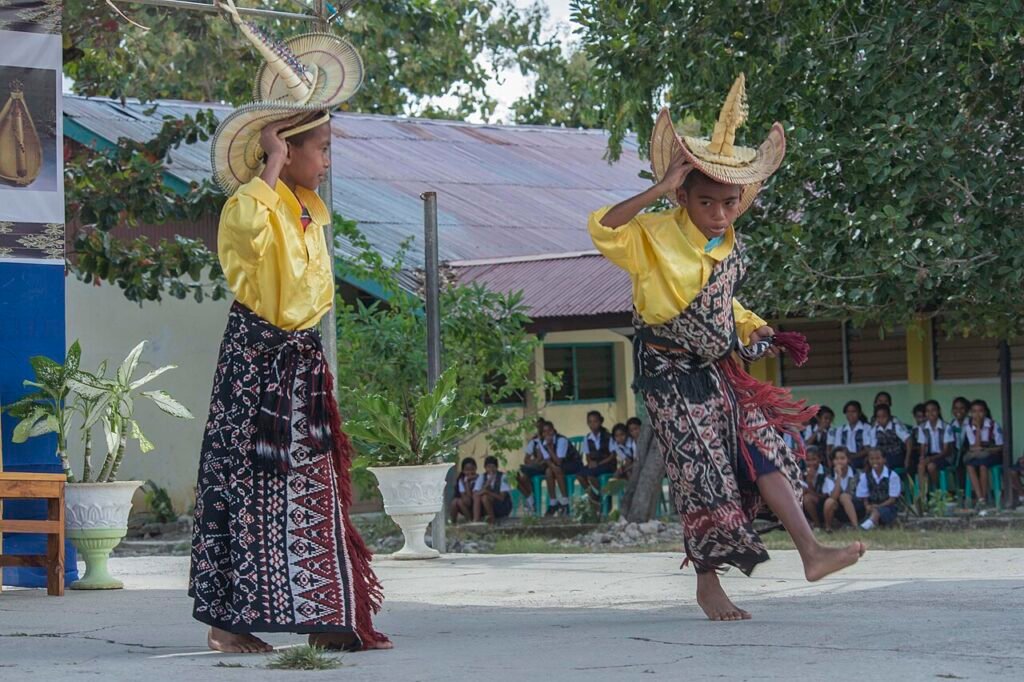
Twenty minutes east by bemo, you’ll find Papela, where every second house is a weaving workshop. The air smells of indigo and turmeric as women sit on raised porches, their fingers working intricate patterns into warp threads using backstrap looms. Papela’s ikat is distinctive: bold diamond motifs in dark blue, rust red, and ivory, representing the patterns of fish scales and palm fronds. Head to Desa Tenun Ikat Papela, a cooperative run by Mama Yuliana, who will let you try the loom for a few minutes (fee: 20,000 IDR). The secret is to visit in the late morning, after the sun has burned off the sea mist but before the midday heat drives everyone indoors. You can buy a sarong directly from the weaver for around 150,000 IDR—a tenth of what you’d pay in Kupang.
Nembrala: The Surfer’s Sanctuary
On the island’s southwestern tip, Nembrala has become a pilgrimage destination for wave hunters from Australia and Europe. The village itself is a single sand track between coconut groves and thatched bungalows, ending at a crescent-shaped beach with a perfect left-hand reef break. Here, the sea is the real neighborhood. You’ll wake to the sound of the swell, and by 7 a.m., local surf instructors like Koko will be paddling out with guests. But don’t mistake Nembrala for a party spot; the vibe is pure, unpretentious surf culture. The beachside warung, Warung Bu Ati, serves fresh grilled fish with rice for 30,000 IDR. After sunset, locals gather for impromptu sasando sessions under a banyan tree. Travelers often discover that the real Nembrala isn’t the wave—it’s the profound quiet that settles over the village when the wind drops.
The Local Table: What Rote Natives Actually Eat
Rote’s cuisine is shaped by its isolation and its lontar palm. The palm isn’t just for thatching; every part of it becomes food or drink. The sopi you’ll taste is a sweet, cloudy wine tapped from the male palm flower—locals recommend drinking it early in the morning, before the fermentation turns it sharp. The true star, however, is lontong Rote: steamed rice cakes cooked inside a lontar leaf tube, served with a fiery chili paste called sambal lu’at (made from dried shrimp, lime, and local chilies). You’ll find the best version at Warung Lontong Mama Ina on Jalan Mangga in Ba’a—a tiny bamboo shack where the queue starts at 11 a.m. sharp.
But the dish that defines Rote for most visitors is se’i babi—smoked pork slow-cooked over lontar wood until it’s blackened and fragrant. Unlike the wetter versions on Timor, Rote’s se’i is dry and intensely smoky, often served with young papaya salad. Ask for it at Pasar Ba’a’s night market, where Mama Sarlina fires up her grill at 5 p.m. daily. She’ll serve you a plate with rice, pickles, and a side of boiled cassava for 25,000 IDR. The secret is to come earlier than 6:30 p.m. because the pork sells out fast. For seafood lovers, head to Pantai Termanu on any Sunday afternoon, where families gather for barbecued sotong (squid) and fresh ikan bakar (grilled fish) caught that morning—expect to pay around 50,000 IDR for a feast grilled over coconut husks right on the beach sand.
Aerial tramway Rote Nase (“The red nose”) in Zermatt near Matterhorn, Rote Island, Indonesia
Art, Music & Nightlife
The sasando is Rote’s greatest gift to the world, and you cannot leave without hearing it played live. The instrument’s 28 bamboo strings are stretched across a palm-leaf resonator, and skilled players can evoke sounds that range from a gentle harp to a percussive gamelan. Every August, the Sasando Festival in Ba’a draws contestants from across the island, with performances that stretch past midnight. But for a more intimate experience, visit the village of Busalangga, where Pak Herman, a master craftsman in his 70s, builds sasandos by hand in his front yard. He’ll let you try a beginner’s tune—a simple five-note melody called “Lagu Rote”—and his workshop is open daily from 3 p.m. to sunset. No admission fee, but a small donation (around 50,000 IDR) is appreciated.
Nightlife here isn’t about clubs—it’s about lesehan (sit-on-the-floor) gatherings where locals share stories and sopi under the stars. In Papela, the weavers sometimes hold impromptu music sessions at a communal lopo (open-sided pavilion) on Friday nights. You’ll hear the sasando joined by the rabab (a two-stringed fiddle) and voices harmonizing in the Tetun language. Travelers often find themselves invited to join the circle, offered a clay cup of palm wine, and guided through the simple steps of a bidu dance. The only rule is to keep the palm wine flowing and the laughter honest. For a taste of more modern culture, check if the Nembrala surf camp is hosting a beach bonfire—these happen spontaneously during the June–September surf season, with reggae and acoustic guitar replacing the traditional instruments, but the same open-hearted warmth.
Practical Guide
- Getting There: Fly into Kupang’s El Tari Airport (KOE) on a domestic flight from Bali or Jakarta, then take a short 30-minute Wings Air or Susi Air flight to Rote’s Lekunik Airport (RTI). Book at Skyscanner
- Getting Around: Bemos (shared minivans) run along the main roads between villages—fare 5,000–10,000 IDR per trip. For flexibility, hire an ojek (motorcycle taxi) for about 200,000 IDR per day, or rent a scooter from any guesthouse for 100,000–150,000 IDR daily. Full-day car with driver: 400,000 IDR.
- Where to Stay: In Ba’a, try Wisma Alam Rote (simple, clean rooms from 150,000 IDR/night). For Nembrala, book a bungalow at Mari’s Surf Camp (from 200,000 IDR/night with breakfast). For an eco-luxury option, Rote Island Eco Lodge near Papela offers traditional-style huts from 350,000 IDR. Check Booking.com
- Best Time: April through October (dry season) delivers vibrant blue skies and manageable heat. June–September sees the best surf swells and the Sasando Festival. Avoid December–March when monsoon rain makes roads muddy and mosquitoes thick.
- Budget: You can experience Rote on 250,000–400,000 IDR per day (including accommodation, meals, and transport). A more comfortable budget with guided tours and better lodging runs 600,000–800,000 IDR daily. Cash is king—there are no ATMs outside Ba’a.

A tranquil view of Kukusan Island in Komodo National Park during sunset., Rote Island, Indonesia
What Surprises First-Time Visitors
The first thing that catches travelers off guard is how much trace of Dutch and Portuguese heritage remains—not in grand buildings, but in the everyday. You’ll hear elders greet each other with a soft “Salam” from the Portuguese salve, and the administration still uses a land registry system introduced in 1867. The Catholic church in Ba’a conducts two services a week in Portuguese. Most surprising, though, is the island’s profound quiet. There are no buzzing neon signs, no traffic jams. The loudest sound at dusk is the rustle of lontar palms in the trade wind. Visitors accustomed to Bali’s bedlam often find this unnerving at first—but by the third day, they’re canceling their return flight.
Another surprise: the depth of the weaving culture. You might expect a few souvenir stalls, but Papela is a living textile workshop where patterns encode family histories, marital status, and even local folktales. A simple sarong can take six months to weave. Don’t be shy about asking weavers about their designs; they will delight in telling you that the funa (lizard) pattern is a charm for safe childbirth, or that the liu (rainbow) stripes represent a bridge between the living and ancestors. Also, prepare for the sopi—it’s far stronger and sweeter than you imagine, with an alcohol content of around 20-30 percent. Locals joke that a cup in the morning keeps the heart warm, but two cups will keep you on the floor.
Finally, first-time visitors are struck by the absence of mass tourism. You will likely be the only foreigner on a given beach. This means no hard-sell vendors, no inflated prices, but also very limited infrastructure. Don’t expect Wi-Fi in many places (Nembrala has sporadic data), and certainly no banks. This isolation is Rote’s superpower: it offers an authentic Indonesia that has resisted the glossy overlay of international beach resorts. Travelers often discover that the real Rote isn’t found in a guidebook but in a shared bowl of lontong and a conversation that turns into an invitation to a family celebration.
Your Rote Island, Indonesia Questions
Is it safe to travel solo on Rote Island? Absolutely—Rote is one of the safest destinations in Indonesia for solo travelers, including women. Violent crime is virtually nonexistent. The primary concerns are health-related: drink only bottled water, wear sunscreen, and watch your step on coral reef paths. Solo travelers will find locals exceptionally helpful; if you look lost in Ba’a, someone will likely stop their motorbike and ask where you need to go. You’ll want to download offline maps before arriving, as data is spotty when you leave the main towns.
How long should you spend on Rote Island? Most travelers plan for four to six days, and that’s a sweet spot. Two days for Ba’a and Papela (to soak in the weaving and market scenes), two days for Nembrala (surfing or swimming), and an extra day for exploring the eastern beaches like Osilana or Sotimori, where sea turtles come to nest from August to November. If you’re a serious surfer, add three to four days for Nembrala alone—the break works best on an incoming tide. Budget travelers can see the highlights in three days, but you’ll feel rushed.
What should you pack for Rote? Light cotton clothing, a sarong (for temple visits and markets), reef-safe sunscreen, a waterproof phone pouch, and a headlamp for evening lesehan gatherings. Don’t forget a refillable water bottle—the tap water is non-potable, and plastic litter is an issue. If you plan to weave or take a sasando lesson, bring small gifts to offer your hosts: a packet of good coffee or a box of cookies is perfect. Most importantly, bring cash—there’s only one ATM in Ba’a, and it’s often empty by 10 a.m.

Stunning aerial shot of Maluku Islands’ vibrant greenery and blue waters., Rote Island, Indonesia

