
Beyond the Blue Horizon: Why the Togian Islands Captivate Every Traveler Who Ventures There (2026)
In 1999, a small group of Bajau fishermen paddled their lepa-lepa outriggers toward a pod of sperm whales off the coast of Pulau Malenge, their chants carrying across the glassy water—a tradition they had followed for centuries. That same year, the Indonesian government declared the Togian Islands a marine protected area, setting in motion a quiet transformation that would preserve one of the most biodiverse coral reefs on Earth while keeping the ancient rhythms of sea nomad life largely unchanged. Today, travelers who make the arduous journey here find themselves stepping into a world where time slows to the gentle pulse of the tide.
The Story Behind the Togian Islands, Indonesia
The Togian Islands were never a seat of empires or a crossroads of colonial ambition. Their history is written not in stone palaces or battlefields, but in the silent drift of Bajau houseboats and the coral skeletons that built these fifty-six islands over millennia. The Bajau people—often called “sea gypsies”—have lived here for at least 1,000 years, their entire existence shaped by the ocean. They were a stateless people, owing allegiance to no sultan or governor, moving between the islands of Central Sulawesi with the seasons, trading dried fish for rice and cloth from Bugis sailors who passed through the Gulf of Tomini.
European maps began to sketch the archipelago in the 17th century, when Dutch spice traders referred to it as “Togian” or “Togean” — likely a corruption of the local word togia, meaning “sea current that flows between islands.” But the Dutch never established a significant presence here; the islands were too remote, the currents too treacherous, and the local population too mobile to control. In 1915, a Dutch colonial report described the Togians as “inhabited by nomadic sea people of fierce independence who cannot be taxed and who disappear into the mist as quickly as they appear.” That independence remains central to the character of the islands today. So when you step off a boat onto a white-sand beach in the Togians, you are not following a well-worn colonial path — you are entering a place that has remained deliberately, proudly apart from the mainstream of Indonesian history.
The most significant turning point came in 2004, when the Togian Islands were designated a UNESCO World Biosphere Reserve. Travelers often discover that this protected status has been a double-edged sword: it has kept the reefs pristine and the development low-rise, but it has also meant that infrastructure remains stubbornly basic. There are no luxury resorts of the kind you’d find in Bali or the Gili Islands, no ATM machines on most islands, and electricity is still limited to evening hours in many villages. For the traveler seeking authenticity, this is the very reason to come.
Neighborhood by Neighborhood
Katupat Village: The Gateway
Katupat is not beautiful in any postcard sense, but it is where your journey begins, and locals recommend you spend a day here to orient yourself. The village straggles along the eastern shore of Pulau Batudaka, its stilted wooden houses painted in fading shades of turquoise and coral pink. The main “street” is a sandy path that runs parallel to the beach, lined with warungs (food stalls) selling instant noodles, sweet tea, and the occasional fresh fish. You’ll find the pasar tradisional (traditional market) operating from 6:00 AM to 9:00 AM every morning, where Bajau women trade sea cucumbers, dried anchovies, and woven pandanus mats. The surprise of Katupat is the Catholic church at the northern end of the village — a plain wooden structure with a crucifix made of driftwood and shell, a quiet testament to the missionaries who reached even this remote outpost. Your best bet for a meal here is Warung Mak Ida, directly on the waterfront, where for IDR 30,000 (about $2 USD), you get a plate of ikan bakar (grilled fish) with sambal and rice, served on a plastic table as the sun sets over the island.
Bomba Village: The Backpacker Beach
Twenty minutes by speedboat from Katupat, Bomba is the unofficial capital of the Togian backpacker scene, but don’t let that word fool you. Bomba is not party central; it is four homestays nestled between coconut palms on a beach of such blinding white sand that you’ll squint even with sunglasses. The beach curves gently for two kilometers, and at low tide, you can walk out to the reef flats where children play football on the exposed sandbars. The character of Bomba is defined by the Bajau families who have settled here — they live in houses on stilts over the water, connected by wooden walkways, and their children paddle canoes to school each morning. Locals recommend staying at the Lestari Homestay, run by Pak Amir, a Bajau elder who speaks a little English and can arrange a day trip to the nearby coral gardens and the famous Bomba Reef drop-off. The real treat comes after dark: if you walk to the far southern end of the beach, you’ll find the sea lit by bioluminescent plankton, which sparkles with every footstep in the shallows.
Pulau Malenge: The Traditional Village
Malenge is the island that most exemplifies what travelers imagine when they think of “Togian.” It is small — you can walk its entire circumference in an hour — and its village of thirty houses sits in a sheltered bay where the water is the color of transparent jade. The people of Malenge are among the most traditional Bajau in the archipelago; many still live primarily on the water in houseboats called lepa-lepa, only coming ashore to trade or attend the weekly Muslim prayers at the tiny white mosque that sits at the water’s edge. The experience of visiting Malenge is one of profound quiet: the only sounds are the slap of water against wood, the call to prayer, and the occasional outboard motor. Savvy visitors know to bring small gifts for the children — pencils, notebooks, or fishing hooks — as there is no shop on the island. You can arrange a homestay here for around IDR 150,000 ($10 USD) per night including meals, and your host family will likely take you out to fish with a handline at dawn. The coral reef directly in front of the village is among the healthiest you will ever snorkel, with sea turtles, reef sharks, and clouds of sergeant major fish.
The Local Table: What Denizens Actually Eat

A stilt house in the bajau village of Kabalutan (Togian islands, Sulawesi), Togian Islands, Indonesia
The Bajau are a seafaring people, and their diet reflects their environment with an honesty that surprises first-time visitors. There is little imported food here, and certainly no Western-style restaurants. You will eat what the sea provides, prepared in ways that have barely changed in centuries. The staple meal is ikan bakar — whole fish grilled over coconut husk charcoal, served with steamed rice, a bowl of clear fish broth, and sambal colo-colo, a tomato-based chili sauce with shallots, lime, and bird’s eye chilies that delivers a sharp, fruity heat. The most common fish you’ll encounter is cakalang (skipjack tuna), kakap merah (red snapper), or ikan baronang (rabbitfish), all caught that morning within sight of your table.
But the dish that defines Bajau cuisine is tinorangsak, a fish stew with a peculiar and unforgettable flavor. To make it, locals simmer chunks of fresh fish in coconut milk with turmeric, lemongrass, and dozens of small green buah runjung — a sour, unripe fruit that grows wild on the islands and tastes like a cross between a green mango and a lime. The result is a dish that is simultaneously creamy, sour, and slightly bitter, eaten with your hands over a banana leaf. At Warung Mama Nani in Katupat, you can order tinorangsak for IDR 25,000 ($1.70 USD), but you must arrive before 10:00 AM, as the stew is made fresh each morning and sold out by midday. Mama Nani herself will bring the pot to your table, lift the lid, and say simply, “Makan!” — Eat!
Travelers often discover that the real food culture of the Togian Islands happens not in restaurants but in the homes of the Bajau themselves. If you are invited to eat with a local family — and you likely will be, if you stay in a village homestay — you will be offered putu bambu, a steamed cassava cake made by grinding cassava root with coconut and palm sugar, stuffing the mixture into bamboo tubes, and steaming it over a fire. The sweetness is earthy, the texture dense and satisfying. It is not for sale; it is a gift. And that, perhaps more than any dish, tells you everything about how the people of these islands live.
Art, Music & Nightlife
There is no nightlife in the Togian Islands in any conventional sense — no bars, no clubs, no loud music after sunset. What exists instead is something far more memorable. On most nights, especially during the dry season from April to November, Bajau families gather on the beach or on their houseboat decks around a kerosene lamp, and someone begins to sing. The pantun is a form of call-and-response poetry sung in a nasal, rhythmic style, often accompanied by a kecapi (a two-stringed lute) made from a coconut shell and fishing line. The verses are improvised, full of humor and double entendres, and even if you cannot understand the Bajau language — which is distinct from Indonesian — you will feel the laughter and the joy of collective storytelling. If you are welcomed into one of these circles, the travelers who have come before you will tell you that it is the most authentic cultural experience you can have in all of Indonesia.
The only regular event that approaches a festival is the Pasar Apung (Floating Market) of Pulau Kadidiri, which occurs on the last Saturday of each month from May to October. Local families paddle their canoes laden with coconuts, bananas, dried fish, and woven bags to a sandbar that emerges at low tide, and for three hours, the shallow water becomes a bazaar of shouting, bargaining, and laughing. It is a replicable event — the fishermen’s cooperative started it in 2013 to attract tourists — but it feels entirely organic, and you can buy a handwoven atap (pandanus leaf mat) for IDR 50,000 ($3.50 USD) or a fresh coconut for IDR 5,000 ($0.35 USD). After the market disperses, the older men sometimes stay to play sepak takraw with a rattan ball on the sandbar as the sun sinks below the water, and you will realize that you have never been to a party quite like this one.
Practical Guide
- Getting There: Fly to Bandar Udara Mutiara SIS Al-Jufri in Palu (Central Sulawesi) from Jakarta or Makassar via Garuda Indonesia, Lion Air, or Batik Air. From Palu, take a 4-hour minibus to Ampana (IDR 100,000 / $7 USD), then a 2-hour public speedboat to Katupat (IDR 150,000 / $10 USD). Alternatively, fly to Gorontalo and take a private charter (IDR 2,500,000 / $170 USD per boat). Book flights at Skyscanner
- Getting Around: Public speedboats connect Katupat, Bomba, Kadidiri, and Malenge daily between 7:00 AM and 2:00 PM, costing IDR 50,000–150,000 ($3.50–$10 USD) per leg. For remote islands, charter a private boat for IDR 600,000–1,000,000 ($40–$70 USD) per day. Always negotiate the price in advance.
- Where to Stay: In Katupat, try Losmen Togian Indah (IDR 200,000/$14 USD per night). In Bomba, Lestari Homestay (IDR 250,000/$17 USD with meals). For Malenge, contact Pak Haji via local homestay networks — you’ll pay IDR 150,000 ($10 USD) per night, all meals included. Check Booking.com for limited options
- Best Time: April through November is the dry season, with calm seas and sunny days. Avoid December through March when monsoon rains bring rough seas and unpredictable boat schedules. July and August see the most visitors, but it never feels crowded.
- Budget: You will need IDR 300,000–500,000 ($20–$35 USD) per day including accommodation, meals, one boat trip, and snorkeling gear rental. Cash is mandatory — there are no ATMs in the Togians. Withdraw enough in Palu or Ampana before you depart.
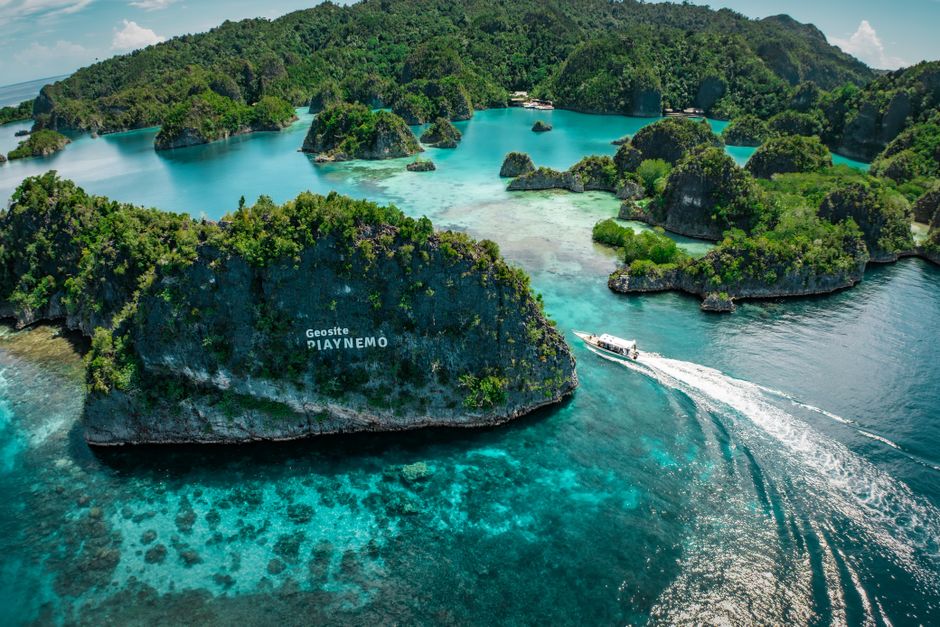
A stunning aerial view of Piaynemo Islands in Raja Ampat, Togian Islands, Indonesia
What Surprises First-Time Visitors
The first surprise is the silence. Travelers accustomed to the constant hum of motors, music, and conversation that defines most Indonesian destinations are unprepared for the acoustic environment of the Togian Islands. In villages like Malenge and Bomba, after 8:00 PM, the only sound is the lapping of water against the stilts of houses and the occasional splash of a flying fish. The lack of electricity — most villages have generators that run only from 6:00 PM to 10:00 PM — means no televisions, no humming refrigerators, no streetlights. You will lie in your bamboo-framed bed and hear your own heartbeat, and it will feel, for a time, like a kind of healing.
The second surprise is the work involved in paradise. Travelers often arrive expecting a resort-style vacation where everything is effortless, and they are quickly corrected. Here, you must negotiate your own boat transport, handle your own cash (there are no ATMs on any of the islands — the nearest is in Ampana on the mainland), and accept that your bungalow might have cold-water bucket showers and a squat toilet. Meals are served at set times — breakfast at 7:30 AM, lunch at 12:00 PM, dinner at 6:00 PM — and if you miss them, you will be hungry. The travelers who thrive here are the ones who embrace this simplicity as a feature, not a bug. Locals recommend you carry a book, a headlamp, and a willingness to be flexible.
The third surprise, and the most profound, is the warmth of the Bajau people. There is no “tourist fatigue” here — no hawking, no scams, no inflated prices for bule (foreigners). When you arrive in a village, children will run to the beach to greet your boat, not asking for money but simply curious, smiling, wanting to shake your hand. An elder will likely approach you, ask where you are from, and offer you a cup of sweet coffee. The Bajau have seen just enough visitors — perhaps a few hundred per year — to be friendly without being jaded. Seasoned travelers often say that the people of the Togian Islands are the real reason to come, and they are right.
Your Togian Islands, Indonesia Questions
Is it safe to travel to the Togian Islands as a solo traveler? How about as a woman?
Yes, it is very safe, and the Bajau community is protective of visitors. Solo travelers, including women traveling alone, report feeling entirely welcome. The main challenge is not security but logistics: you will need to navigate boat schedules and carry enough cash. Locals recommend you hire a guide for the first two days to help you orient yourself.

Stunning aerial shot of Maluku Islands’ vibrant greenery and blue waters., Togian Islands, Indonesia

