
Beyond the Fishing Nets: Why Taghazout Beckons Every Surfer and Dreamer (2026)
In 1960, when the earth shook beneath Agadir, leveling that city and killing thousands, the tiny Berber village of Taghazout, just twenty kilometers north, felt the tremors but held its ground. Its stone houses, clustered around a crescent bay, remained standing, and its fishing boats continued to slide into the Atlantic at dawn. You sense that resilience the moment you arrive—a place that has weathered more than storms. The wreckage of the past never defined it; the waves did.
The Story Behind Taghazout, Morocco
Taghazout’s story begins not with surfboards but with sardines. For centuries, the Aït Baâmarane Berbers lived off the sea and the argan forests that climb the nearby hills. They traded fish for dates with caravans passing from the Sahara, and their women pressed argan nuts into the liquid gold that now graces luxury shelves worldwide. You still see that ancient rhythm in the older quarter’s narrow alleys, where the scent of woodsmoke and drying fish competes with the fresh mint tea brewed in every home.
The real transformation came in the 1970s, when a small wave of Australian and American surfers, drawn by the consistent, powerful left-hand breaks they’d heard about from merchant sailors, began arriving. They camped on the beach, traded T-shirts for couscous, and slept under the stars. One of them, a legendary big-wave rider named Ken Bradshaw, is said to have paused here on his way to Hawaii and stayed for weeks. By the 1990s, word had spread: Taghazout offered some of the longest point breaks in the world—especially the formidable “Anchor Point,” which still draws pros every winter. Locals, adapting quickly, turned their spare rooms into guesthouses and their fishing boats into surf taxis. You benefit from that evolution today, but the village has not lost its soul. It remains a place where a fisherman can still outnumber a surfer before 6 a.m., and where the call to prayer rolls over the sea, mixing with the crash of waves.
Neighborhood by Neighborhood
The Harbour
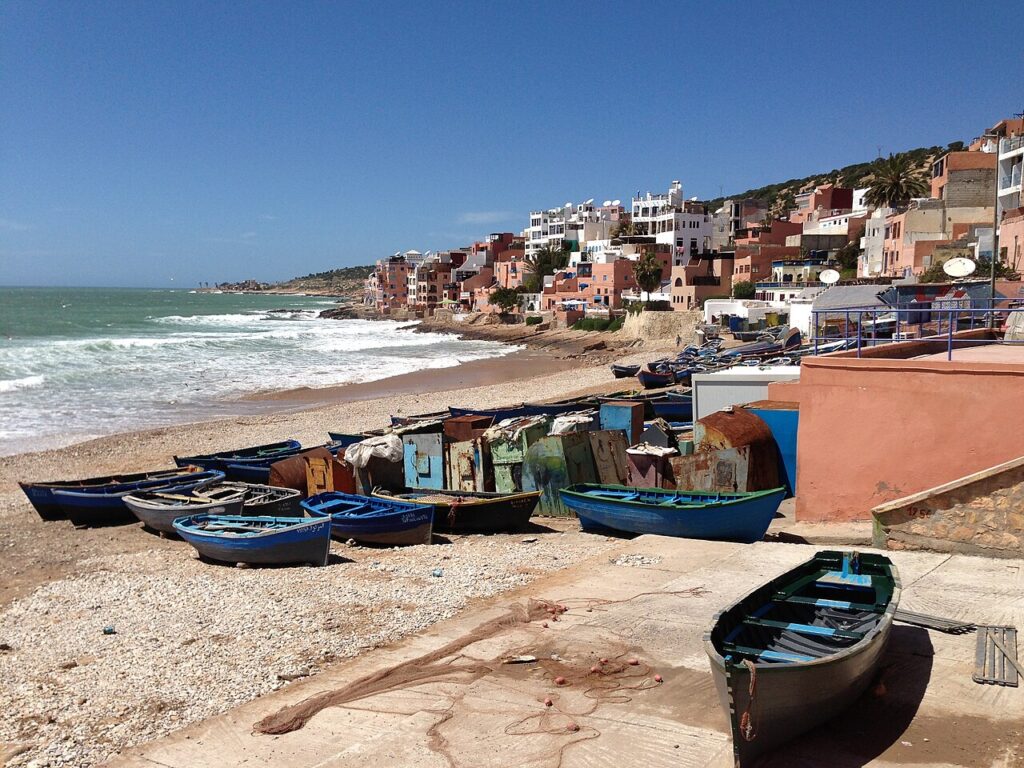
Start your day at the harbour, where a flotilla of blue-and-white boats bobs against the pier. Here, you will find the real backbone of Taghazout. Men in wool caps haul in nets shining with silver sardines, while women in striped djellabas squat on the sand, sorting the catch into plastic crates. The smell is pungent—a mix of brine, diesel, and the occasional whiff of grilling fish from a nearby cart. This is where you should buy your lunch: a few dirhams for a pile of sardines, which the grill masters at the row of open-air cafes will blacken over charcoal for you in minutes. Locals recommend the stall by the Association des Pêcheurs sign, where the owner, a man named Hassan, has been frying fish for three decades. Sit on a plastic stool, squeeze a lemon, and eat with your hands while the waves slap the seawall. The harbour is also your best bet for a grand taxi to Agadir—you’ll see the old Mercedes lined up, drivers shouting “Agadir! Agadir!” for 10 dirhams a seat.
The Old Village
A ten-minute walk up from the beach, the labyrinth of the old village (often called the medina, though it’s more a warren of family homes) offers a different rhythm. Its houses are painted in the local red-ochre and white, their doors low and wooden, with the occasional zellij tile protruding like a jewel. You’ll lose your way on purpose here, turning down alleys so narrow your shoulders might brush both walls. Around each corner, something catches you: a donkey loaded with butane tanks, a fountain where a boy is washing mint, a group of men playing cards under a bougainvillea vine. The village hammam, tucked behind the mosque, is a steaming, echoing chamber where you scrub off the day’s salt for 15 dirhams. Don’t miss the weekly souk on Tuesday mornings, set up on the main road near the cemetery. Farmers from the hills sell honeycomb, wild thyme, and argan oil in recycled water bottles. Travelers often discover that the best souvenir is not a trinket but a bag of just-picked dates or a hunk of soft jben cheese wrapped in banana leaves.
Aftas and the Surf Strip
Running parallel to the beach, the main drag—often called the surf strip—is where Taghazout wears its modern face. It’s a spine of guesthouses, surf schools, and cafes with names like “The Mandala” and “Sunrise Surf House.” The energy here is young and international; you’ll hear French, German, and Portuguese spoken alongside Tamazight and Darija. Most tourists overlook the hidden gem of this strip: the beach itself is just a five-minute walk through a sandy gap, but the real magic happens at dawn when the surfers paddle out. If you are a beginner, your best bet is to book with Hash Point Surf School (around 300 dirhams for a two-hour lesson, board and wetsuit included). The instructors have grown up in these waves, and they will push you into your first ride with patient encouragement. In the evenings, the strip transforms: the clubs stay quiet, but the cafes become open-air lounges, where travelers share photos and locals play gnawa rhythms on homemade percussion instruments. The Moonlight Surf Café is your spot for a hand-rolled cigarette and a glass of sweet mint tea while you watch the sun melt into the Atlantic.
The Local Table: What Taghazoutis Actually Eat
You will not find tagines piled high for tourists here. Instead, the Taghazouti kitchen is a humble, seasonal affair rooted in the sea and the hills. The defining ingredient is not couscous but msemen—the flaky, griddled flatbread that appears at every meal, often stuffed with sardines or fried onions and dusted with cumin and salt. For a true taste of the village, you must seek out Le Navigateur, a family-run eatery on the back street behind the mosque. It opens only for lunch, from noon to 2 p.m., and the menu is written on a chalkboard in French and Arabic. The dish you must order is poisson à la tagine—a whole sea bass or bream, cooked slowly in a clay pot with preserved lemons, olives, and a whisper of saffron. It arrives steaming, the fish falling off the bone, and you eat it with a stack of msemen and your fingers. The owner, Fatima, learned the recipe from her grandmother, who was a fisherwoman’s wife; she uses only what was caught that morning. You will also find harira on every street corner during Ramadan—a tomato-lentil soup thick with chickpeas and a dash of cinnamon. For the best version, head to the small stall near the harbour at sundown, where a man named Ali sells it in styrofoam cups for 5 dirhams, with a squeeze of lemon and a sprinkle of cilantro.

Taghazout, Morocco
To understand the local palate, you need to visit the covered market (just off Avenue Al Massira) early in the morning. Here, you will see vendors selling piles of tiny, dried shrimp; bundles of wild cactus pears; and pyramids of loubia (white beans) that will become the week’s soup. Most travelers overlook the pickled vegetables—horseradish red and turnip in brine—but locals recommend adding them to a sandwich of fresh khobz and a spoonful of harissa. If you ask nicely, a woman named Zahra at the corner stall will crack open an argan nut and let you taste the thick, toasty oil that she presses herself. It is the taste of this entire coast: smoky, nutty, and utterly unforgettable.
Art, Music & Nightlife
Taghazout does not have grand museums or concert halls. Its art is the sea: the ever-changing light on the waves, the graffiti on the concrete walls near the beach—salaam in Arabic and a cartoon wave painted by an Italian surfer last winter. The real creative pulse beats in the Regards sur la Mer gallery, a small whitewashed space on the main strip that opens its doors every Wednesday evening from 6 p.m. to 9 p.m. Local photographers and painters exhibit their work, often using materials found on the beach—driftwood frames, fish scales ground into pigment. On weekends, you might hear a gnawa troupe playing on the sand, their iron castanets and guembri lutes echoing off the cliffs during the annual Taghazout Surf Festival (usually the first weekend in October). The festival features film screenings, a “surf art” competition, and open-air concerts where the music mixes Berber rhythms with reggae.
As night falls, the village does not roar—it murmurs. The party crowd generally migrates to Agadir, twenty minutes away by taxi (around 40 dirhams per person, shared). But if you stay in Taghazout, you will find your pleasures more intimate. The Dune Surf Café hosts an acoustic jam every Thursday, where travelers swap songs with locals on stringed instruments. For something entirely unexpected, walk to the small bar Rock the Kasbah near the harbour, where the owner, a Moroccan who lived in Canada for a decade, mixes fresh blueberry mojitos and plays old funk records. It’s not a place you’d find in a guidebook, and that is precisely its charm.
Practical Guide
- Getting There: The closest airport is Agadir Al Massira (AGA), served by Royal Air Maroc, Ryanair, and EasyJet from major European hubs. Book at Skyscanner for the best deals.
- Getting Around: From Agadir airport, take a grand taxi (shared, about 30 dirhams per person to the Taghazout turnoff, then another 5 dirhams in a local taxi) or pre-book a private transfer for 250 dirhams. Within Taghazout, everything is walkable, but for short trips to nearby Tamraght or Aourir, hop on a local minibus (5 dirhams). Bicycle rentals are available at several surf shops for 50 dirhams a day.
- Where to Stay: For budget travelers, the Harbour area has simple guesthouses like Chez Aïcha (rooms from 200 dirhams). The surf strip offers mid-range comfort at Surf Hostel Taghazout (dorm beds from 120 dirhams, private from 350 dirhams). For a view, the hills above the old village have villas like Yazza Surf House. Check Booking.com for reviews and last-minute deals.
- Best Time: March to May and September to November offer the best balance of warm weather (25-30°C) and good swell. June to August is the busiest and hottest (up to 35°C); December to February sees fewer crowds, rougher waves for advanced surfers, and cooler evenings (down to 8°C).
- Budget: You can manage comfortably on 500-700 dirhams ($50-$70) per day: 200 dirhams for a shared room, 150 dirhams for meals, and the rest for activities, transport, and treats. A sit-down dinner with a drink runs about 80 dirhams; a surfboard rental is 150 dirhams per day.

Boatd docked near houses and body of water, Taghazout, Morocco
What Surprises First-Time Visitors
The biggest surprise is the quiet. Taghazout is not Marrakech—no touts, no thieves, no cacophony of mopeds. On a Tuesday evening, you can walk along the beach and hear only the waves and the distant chatter of fishermen mending nets. Travelers expecting a party town are often caught off guard when they realize they have to seek out the nightlife. But if you are looking for peace, you will find it everywhere: in the hush of the old village at dusk, in the way a woman smiles into her mint tea, in the patient rhythm of surfers waiting for a set.
Another delight is the warmth. Locals here have seen visitors for decades, and they are genuinely friendly, not performatively so. You will be greeted with “Salaam alaikum” and invited for tea more than once. The secret is that Taghazout is still a working-class fishing village at heart, and the tourist economy hasn’t broken that. The fish market is real; the horse carts clatter; the kids fly wooden kites on the beach. You feel that you are in a place that lives, not a stage set.
Finally, the wind surprises many. The strong chergui wind from the Sahara can gust in the afternoon, whipping sand into your eyes and cooling the air even in July. Experienced surfers know the wind direction is crucial: a north wind cleans the waves, while a south wind makes them messy. If the wind picks up, the best move is to hike into the hills behind the village, where the argan trees block the gusts and the view of the coast is breathtaking—a sweep of gold sand and turquoise water that makes you fall silent.
Your Taghazout, Morocco Questions
Is Taghazout

Assorted-color bowls, Taghazout, Morocco

