
Beyond the Red Chullo: Why Taquile Island Weaves Its Way Into Every Traveler Who Visits (2026)
In 1978, a young anthropologist named Elayne Zorn arrived on Taquile Island, expecting to study textile techniques for a few weeks. She stayed for years, eventually writing a seminal book on the island’s weaving traditions. What she discovered—and what you, too, will feel the moment you step off the boat—is that Taquile is not merely a place; it’s a living philosophy, where the rhythm of life is stitched into every thread, every fiesta, every shared meal overlooking the impossibly blue lake.
The Story Behind Taquile Island, Peru
Taquile Island has been inhabited for over a thousand years, but its modern character was forged in the 20th century. During the Spanish colonial era, the island was part of a land grant, but its remote location meant that indigenous Quechua traditions survived with remarkable resilience. The real turning point came in the 1930s, when the island’s population was displaced by a wealthy landowner who claimed the entire island as his private estate. For decades, the Taquileños were forced to work the land for him, living in near-feudal conditions.
Then, in 1945, something extraordinary happened. The islanders organized a peaceful rebellion, refusing to work until the landowner ceded control. It took years of legal battles, but by the 1970s, Taquile had become a self-governing, collectively owned community. Today, there is no private property on the island—every family has a plot of land to farm, and all decisions are made by community assembly. Travelers often discover that this spirit of cooperation extends to tourism: the island operates under a strict rotation system where families take turns hosting visitors, ensuring that everyone benefits equally. You’ll find no large resorts here, no international chains—just a community that has maintained its identity by controlling its own destiny.
Neighborhood by Neighborhood
El Pueblo (The Main Square)
Your journey begins at the central plaza, a stone-paved square dominated by a modest church built in the 1960s. This is the heart of Taquile, where families gather in the late afternoon to chat and children chase stray dogs through the fading light. The architecture here is deceptively simple: whitewashed adobe walls with blue doors and windows, each one adorned with geraniums spilling from clay pots. You’ll notice that there are no cars, no motorbikes, no electricity poles marring the view—the island banned motorized vehicles decades ago. The plaza is also where you’ll find the community’s administrative center, a low building where the island’s rotating council meets to discuss everything from water rights to tourism quotas. Here, you can also purchase entry tickets for the island’s cultural sites, a modest 10 soles that supports the community’s infrastructure.
La Costa (The Lakeside Path)
Descending from the plaza, you’ll follow a sinuous footpath that winds down to the lake’s edge. This is the most photographed stretch on Taquile, and for good reason: the view of Lake Titicaca from this angle, with its deep sapphire waters and the snow-capped Cordillera Real in the distance, is nothing short of breathtaking. The path passes through terraced fields where locals grow potatoes, quinoa, and oca (a sweet Andean tuber). You’ll also pass small stone corrals where sheep and llamas graze—their wool, of course, destined to become the famous Taquile textiles. Stop at the lookout point halfway down, where you can often spot fishermen in traditional reed boats casting nets. The hike takes about 20 minutes from the plaza, and you’ll want to take it slowly: the altitude sits at around 3,800 meters, and the thin air will remind you that you’re among the highest inhabited places on earth.
El Puerto (The Boat Dock)
This is where all travelers begin and end their Taquile experience. The dock is a simple stone-and-concrete structure, bustling with the comings and goings of speedboats and larger tourist launches from Puno. Here, you’ll find a dozen or so stalls run by local women selling handmade textiles—hats, belts, scarves, and gloves, all woven with the intricate geometric patterns that have made Taquile famous. The dock area also has a small plaza with benches where locals gather to socialize while waiting for boats. Don’t rush through this area; pause to watch the boats arrive, the passengers disembark with dazed expressions, and the community’s porters (usually young men) help carry luggage up the steep path. It’s a microcosm of island life, and you’ll quickly understand that everything here moves at the pace of foot traffic and boat schedules.
The Local Table: What Taquileños Actually Eat

Taquile Island, Taquile Island, Peru
The diet on Taquile is shaped entirely by what the island can grow and what the lake provides. There are no supermarkets, no delivery trucks, no imported ingredients. Breakfast almost always begins with a bowl of quinoa porridge, sweetened with a little sugar and sometimes mixed with fresh cheese from the island’s cows. Lunch, the main meal of the day, is built around potatoes—dozens of local varieties, each with its own name and flavor. You’ll find them boiled, mashed, or fried, served alongside a piece of fried trout fresh from the lake, and topped with a simple salsa of onions, tomatoes, and aji amarillo (a mild yellow chili).
One dish you absolutely must seek out is trucha frita con papas nativas—fried lake trout with native potatoes. The best version you’ll have is at a family-run eatery called La Cabaña de Irma, located about five minutes’ walk from the main plaza. Irma, a grandmother who has been cooking for visitors for 30 years, serves her trout with a side of quinoa soup and a glass of mate de coca (coca leaf tea) to help with the altitude. The cost for a full lunch is 15 soles (about $4 USD), and you’ll need to arrive before 1:00 PM because she only cooks a limited number of portions each day. Locals recommend you eat at Irma’s at least once—not just for the food, but for the chance to sit in her garden, where you can hear the wind rustling through the eucalyptus trees while she tells you stories about her childhood on the island.
Art, Music & Nightlife
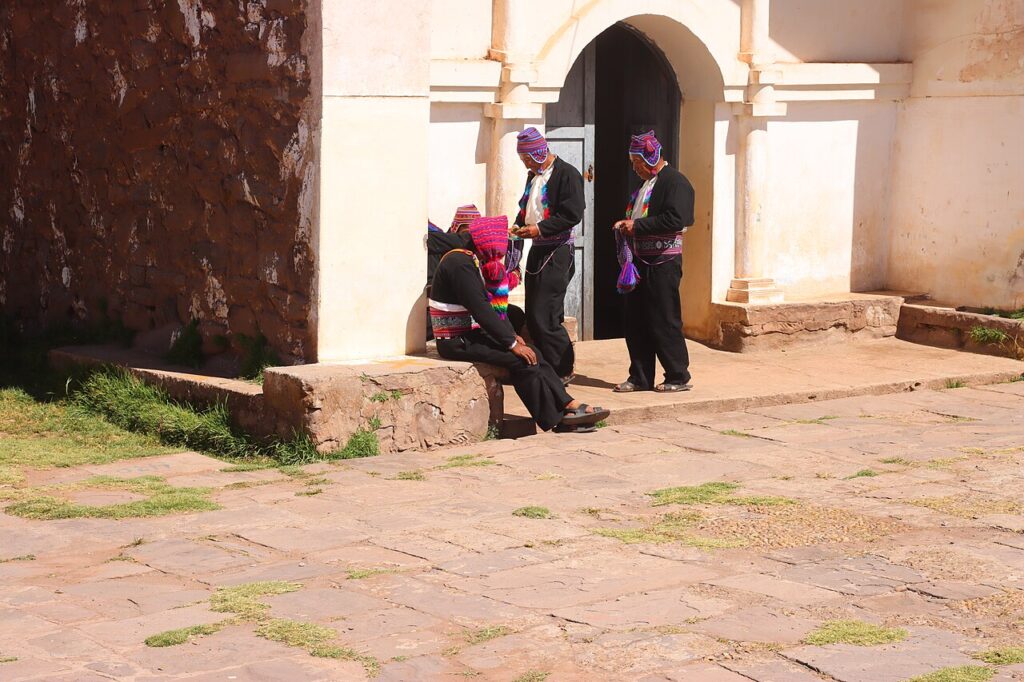
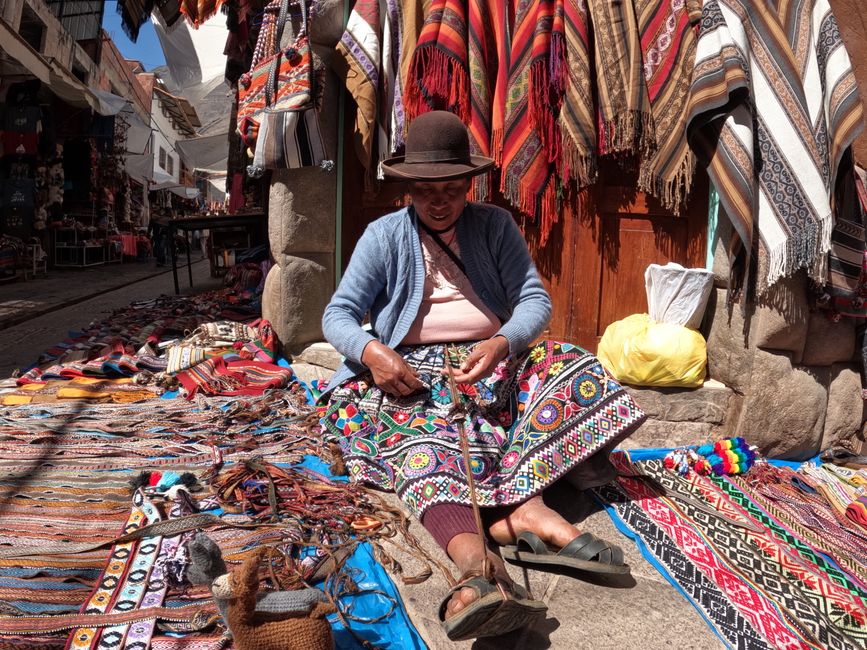
Taquile’s artistic heart is its textile tradition, recognized by UNESCO as part of the Intangible Cultural Heritage of Humanity. The island’s men and women both weave, though each specializes in different items: men typically knit the distinctive red chullos (knitted hats with earflaps), while women weave belts and shawls on backstrap looms. The patterns are not merely decorative—they are a form of coded language. A chullo worn with the earflaps up signals that the man is married; flaps down means he is single. The colors also carry meaning: red for the earth, blue for the lake, white for the Andes. You can watch weaving demonstrations at the Centro de Interpretación Textil, a small museum near the plaza where artisans work daily from 10:00 AM to 4:00 PM. The entrance is included in your island ticket.
As for nightlife, well, you’ll need to adjust your expectations: there are no bars, no discos, no live music venues on Taquile. The island is dark by 8:00 PM, and the only sounds you’ll hear are the wind and the occasional dog barking. But this is precisely what makes the experience magical. On clear nights, travelers often gather on the terraces of their guesthouses, wrapped in alpaca blankets, staring up at a sky so dense with stars that it seems to pulse. Some families organize veladas culturales (cultural evenings) where they invite visitors to join them in traditional dances like the huayno, accompanied by charango (a small Andean stringed instrument) and zampoñas (panpipes). Ask your host if they offer this—it’s usually 20 soles per person and includes a glass of warm, spiced ponche de quinua (quinoa punch). The next festival to plan for is the Fiesta de la Virgen del Carmen on July 16, when the island explodes with processions, music, and dance.
Practical Guide
Woman weaving traditional textiles in a colorful outdoor market setting., Taquile Island, Peru
- Getting There: Fly into Juliaca (JUL) from Lima or Cusco. From Juliaca, take a taxi (30–40 soles) to Puno’s main port. From Puno, you’ll catch a speedboat to Taquile; the journey takes about 3 hours. Book flights at Skyscanner
- Getting Around: There are no roads or vehicles. You walk everywhere. The main paths are well-trodden but steep; wear sturdy shoes and bring a headlamp for nighttime. If you have luggage, porters can carry it for a tip of 5–10 soles.
- Where to Stay: Homestays are the only option, and they’re wonderful. Stay in the upper village near the main plaza for easier access to restaurants and views. Family-run guesthouses like Hospedaje La Casa de los Tejedores offer clean rooms with shared bathrooms. Check availability at Booking.com
- Best Time: Visit during the dry season, April to November. The clearest days are June through August, when the skies are brilliant blue and the wind is calm. Avoid January and February, when heavy rains can cancel boat crossings.
- Budget: Expect to spend about 80–100 soles ($20–25 USD) per day, including homestay (40–50 soles), meals (15–20 soles each), and site entries. Bring cash—there are no ATMs.
What Surprises First-Time Visitors
The first surprise is the altitude. At 3,800 meters, Taquile is higher than Cusco, and you will feel it. Travelers often arrive expecting a gentle island stroll and instead find themselves huffing up steep stone paths after just a few steps. Plan to take the first hour or two of your visit slowly, sipping coca tea and sitting on a plaza bench to acclimate. Your homestay host will likely offer you mate de coca upon arrival—accept it. It’s not a cure, but it helps. Locals recommend you also bring altitude sickness pills just in case, and avoid heavy meals on the first day.
The second surprise is the silence. Taquile is one of the quietest places you’ll ever visit. Without cars, without generators, without the hum of electricity, the island settles into a profound stillness after sunset. You’ll hear the wind in the eucalyptus, the distant sound of a dog, the clatter of a pot in a neighbor’s kitchen. For travelers accustomed to constant noise, this silence can feel disorienting at first—even a little unsettling. But by the second night, you’ll find yourself craving it. Many visitors say that the silence is what they miss most after leaving—a kind of inner peace that no app or playlist can replicate.
Finally, visitors are surprised by the warmth and openness of the Taquileños. In many tourist destinations, locals can be weary of visitors. Not here. Because the community controls tourism, you’re welcomed as a guest, not a commodity. You’ll be invited into family kitchens, taught to weave a few stitches, and asked to join in a game of cards after dinner. The Taquileños are genuinely curious about where you’re from and why you’ve come. Be ready to share your own stories—and to leave with a few of theirs.
Your Taquile Island, Peru Questions
Tranquil scene of an island surrounded by Lake Titicaca’s blue waters, Taquile Island, Peru
How long should I stay on Taquile Island?
Most travelers visit on a day trip from Puno, but this is a mistake. The island’s magic reveals itself only after the day-trippers leave at 3:00 PM. You’ll have the paths and viewpoints mostly to yourselves, and you’ll experience the island’s quiet evening rhythm. Stay at least two nights. This gives you a full day to explore the island’s two main villages, visit the textile museum, hike down to the lake, and—most importantly—sit still long enough to let the place seep in. Three nights is ideal if you want to join a cultural evening or take a weaving workshop.
Is it safe to drink the water on Taquile?
The answer, frankly, is no. The island’s water comes from springs and is not treated. Travelers should drink only bottled water, which you can buy at the small shops near the dock for about 2 soles per liter. Many homestays provide a jug of boiled water for drinking and tea. You can also bring a portable water filter or purification tablets, but avoid drinking from taps or streams. On the positive side, the food is exceptionally safe because it’s cooked fresh daily with local ingredients; you don’t need to worry about street food hygiene here, because there is no street food.
What should I buy on Taquile?
You’ll be tempted by the textiles, and you should buy them—but buy wisely. The island’s weavers are renowned for their skill, and a genuine Taquile chullo or belt can last a lifetime. Look for items made from alpaca or sheep’s wool, with patterns that show both sides clearly (the finest weaving is reversible). A quality chullo costs between 40 and 60 soles; a woven belt, 30 to 50 soles. Avoid the cheap, machine-made imitations sold by vendors on the dock—they’re often synthetics. The best place to buy is directly from a weaver’s home, where you can see them working and ask about the patterns. And remember: bargaining is not customary here. The prices are set by the community, and the money goes directly to the artisan’s family. Pay what they ask; it’s an investment in a tradition that has survived centuries.

