
Whispers of the Wigmen: Immersion in the Living Traditions of Tari, Papua New Guinea (2026)
In 1935, Australian gold prospector Michael Leahy, the first European to enter the Tari Basin, stood bewildered before a Huli Wigman. The man’s elaborate headdress of human hair, ochre-painted face, and fierce demeanor defied all of Leahy’s understanding. He later wrote in his diary of the encounter, not with fear, but with a dawning realization: he had not discovered a “primitive” people, but a complex, sovereign culture whose customs were as rich and deliberate as any cathedral. That moment of awe still defines every traveler’s first step into Tari.
The Story Behind Tari’s Customs, Papua New Guinea
To understand Tari is to understand that its history is not written in stone, but woven into wigs, sung in ritual chants, and danced into the mud of ceremonial grounds. For over a thousand years, the Huli people have cultivated the highland valleys, their society intricately structured around clans, ancestral spirits, and a profound connection to the land. The arrival of Europeans in the 1930s was a ripple, not a wave; while missionaries and government patrols established a presence, the core of Huli identity—their *pasin* (customs)—remained fiercely intact, flowing like an underground river beneath the new surface of airstrips and trade stores.
The true turning points in Tari’s story are not battles or treaties, but cyclical events: the start of the *Yam* harvest, the initiation of a new generation of Wigmen, or the resolution of a long-standing dispute through the *Tee* ceremonial pig exchange. The 1975 independence of Papua New Guinea solidified a national framework, but in Tari, authority has always been dual. You’ll see the uniformed policeman and, walking beside him, a *man of influence* adorned with feathers and shell valuables, his power derived from oratory, wealth in pigs, and deep knowledge of *dindi gamu* (the ancestral law). This is a place where history is worn on the body and performed, not merely remembered.
Neighborhood by Neighborhood
Tari Station
This is the administrative and logistical heart, a single, dusty main road lined with corrugated iron trade stores, the police station, and the market. Don’t mistake its functional appearance for a lack of character. Here, the modern and ancient worlds engage in a daily, fascinating dance. You’ll see men in business shirts buying betel nut next to clansmen carrying bush knives, their faces still smeared with ceremonial clay. The buzz of generators mixes with the chatter of Tok Pisin and Huli. Your best bet for essentials is here, but the real magic happens at dawn at the Tari Market, where women from surrounding villages lay out brilliant displays of produce: mounds of kaukau (sweet potato), bundles of pitpit, and the essential greens for a *mumu* feast. The air is thick with the scent of earth, smoke, and the peppery sting of fresh ginger.
The Village Clusters of Koroba Road
Venture just a kilometer or two from the station along the winding Koroba Road, and you enter a different realm. This isn’t a formal neighborhood but a tapestry of scattered hamlets and clan territories, each centered on a men’s house (*anda*). The architecture is purely organic: round houses with towering thatched roofs, built from forest materials, seeming to grow from the ground itself. The character is defined by quiet, communal life and preparation. You might hear the rhythmic chopping of firewood or see boys practicing with handmade bows. This is where travelers often discover the pace of true Huli life, where the social fabric is woven through shared labor and the constant, low hum of tradition. The key spots are the cleared ceremonial grounds adjacent to each anda, often marked by a lone *Cordyline* plant, a sacred symbol.
The Cultural Enclave of Ambua Lodge
Perched on the rim of the Tari Basin at about 2,100 meters, Ambua Lodge offers a contrasting, immersive perspective. While it is a lodge, it functions as a cultural enclave, staffed almost entirely by Huli people from local villages. The character here is one of curated, deep engagement. The architecture is traditional-style lodges with breathtaking views over the mist-filled valleys. The key activity is connection: local guides, many of them former Wigmen, share stories on the lodge’s nature trails. In the evenings, you’ll gather around the fireplace, not for generic entertainment, but for intimate, firsthand accounts of Huli cosmology from the staff. It’s a bridge between comfort and authenticity, where the sensory detail is the cool, clean mountain air and the distant, haunting call of a bird of paradise at dawn.
The Local Table: What Huli People Actually Eat
Huli cuisine is a testament to the earth and fire. The diet is built on the triumvirate of the garden: kaukau (sweet potato), taro, and yams, supplemented by lush greens like *kumu* (spinach) and pitpit (a local asparagus-like shoot). Meat is a celebratory food, almost exclusively pork, reserved for significant *mumu* feasts. Forget restaurants with menus; eating here is about experiencing the process. Locals recommend you seek out an invitation to a mumu, where you’ll witness food being cooked in an earth oven—layers of hot stones, banana leaves, meat, and vegetables steaming for hours, infusing everything with a smoky, profound sweetness.
For the daily meal, your best bet is to sample what’s available at the Tari Market or from a roadside stall. Look for simple, nourishing meals like boiled kaukau with greens, or a packet of roasted peanuts. A specific dish travelers must try is *saksak*, a dense, pudding-like staple made from sago palm pith. It’s often served with a simple, savory broth. For a truly local experience, visit the small, family-run cookhouses near the market. Ask for “Meri Blong Kaikai” (literally “woman who owns food”)—these informal spots serve hearty plates of rice, tinned fish, and kumu for about 15-20 PGK ($4-6 USD). The flavor is humble, honest, and deeply satisfying after a day of exploration.

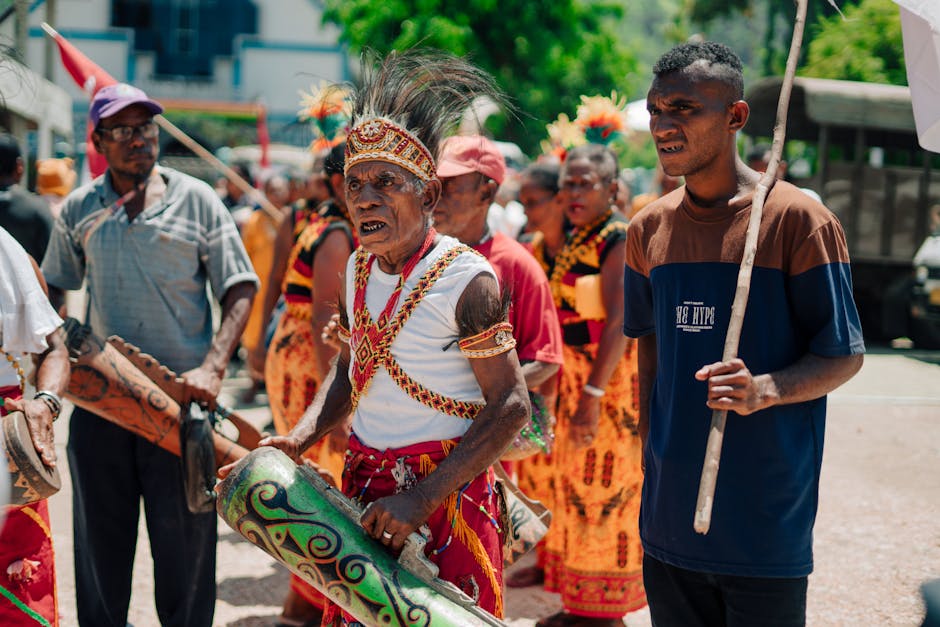
Colorful festival parade featuring participants in traditional attire and h…, Tari’s Customs, Papua New Guinea
Art, Music & Nightlife
The creative scene in Tari is inseparable from ceremony and daily life. Art is not hung on walls; it is worn. The most stunning visual art is the Huli Wigman’s headdress (*Harambe*), a masterpiece of human hair, ochre, feathers from birds of paradise and parrots, and cuscus fur. The wigs are grown and maintained by bachelor clans in secluded *wig schools*, a process taking up to 18 months. Music is predominantly vocal and rhythmic, centered around *singsing* performances. The deep, resonant chanting of men, accompanied by the thump of kundu drums and the rustle of grass skirts, tells stories of ancestors, battles, and the spirit world. There are no conventional galleries or music venues; the performance space is the mud of the ceremonial ground.
For nightlife, adjust your expectations. There is no bar-hopping scene. Evenings in Tari Station are quiet, with perhaps a few trade stores playing local radio. The real “nightlife” for visitors happens at places like Ambua Lodge, where cultural storytelling fills the evening. However, if you are invited to an overnight singsing preparation, you’ll witness a powerful, immersive creative process. Men and women practice their dances and songs for hours under the stars, their bodies painted with intricate designs of yellow ochre, white clay, and charcoal. The major festival to plan for is the annual Huli Wigmen Festival, usually held in August, where dozens of clans gather in a spectacular, competitive display of regalia, dance, and song—a living gallery in motion.
Practical Guide
- Getting There: Fly into Port Moresby (POM), then take an Air Niugini or PNG Air domestic flight to Tari (TIZ). Flights are daily but weather-dependent. Book connections at Skyscanner.
- Getting Around: On foot in Tari Station. For villages, you must hire a 4WD vehicle with a local driver/guide (essential and non-negotiable). Expect to pay 200-400 PGK ($55-110 USD) per day, including fuel and guide fees.
- Where to Stay: For full cultural immersion and comfort, Ambua Lodge is unparalleled. In Tari Station, the very basic Tari Gap Lodge or Tari Country Lodge offer budget options. Check availability at Booking.com for the station lodges; book Ambua directly through their website.
- Best Time: The dry season, from May to October. Days are sunny, trails are passable, and major festivals like the Wigmen Festival (August) occur. The rainy season (Nov-Apr) brings stunning greenery but can make travel and trekking difficult.
- Budget: A realistic daily budget, excluding international flights, is 500-800 PGK ($140-225 USD). This covers a guided tour, basic lodging, meals, and domestic flights. Tari is not a budget backpacker destination due to the necessity of guides and logistics.
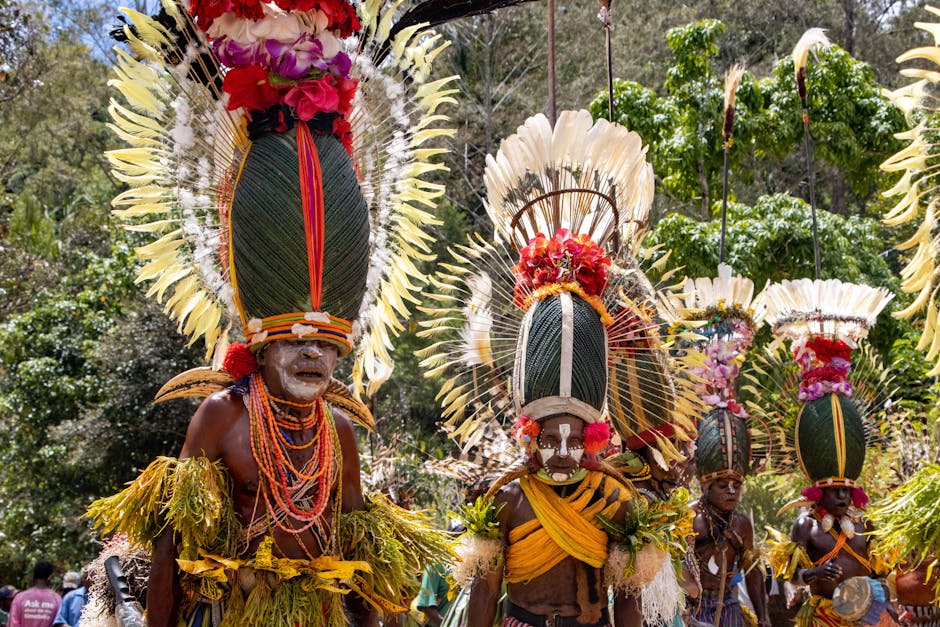
Colorful tribal dancers in traditional attire at a cultural festival in Pap…, Tari’s Customs, Papua New Guinea
What Surprises First-Time Visitors
Most travelers are surprised by the sheer intensity of the gaze. Huli people, particularly in remote areas, may look at visitors with a direct, unabashed curiosity that mirrors your own. This isn’t hostility; it’s an assessment, an engagement. You are as much a subject of study as they are to you. The initial formality often melts quickly into warm smiles, especially if you’ve learned a simple greeting in Huli (“*A*” for hello) or Tok Pisin (“*Apinun*” for good afternoon).
The other profound surprise is the intellectual and social sophistication underlying what outsiders might hastily call “traditional” life. You’ll discover that Huli clansmen are master negotiators, botanists, and historians. Their knowledge of the forest ecosystem is encyclopedic, and their system of justice and dispute resolution through compensation (often in shells and pigs) is highly complex. The misconception of simplicity is quickly corrected when you listen to a *man of influence* debate land rights; his oratory is as sharp and strategic as any corporate lawyer’s. The beauty here is not just in the feathers and paint, but in the vibrant, functioning intellect of a culture that has chosen its own path.
Your Tari Questions
Is it safe to travel to Tari? Safety in Tari, as in much of PNG, is highly context-dependent and requires careful management. The primary risks are not crime against tourists but tribal tensions between local groups. This is why hiring a reputable, local guide from a respected tour operator is not a suggestion—it is an absolute requirement. Your guide navigates the complex social landscape, ensures permissions are sought from clan leaders before entering areas, and keeps you informed. By respecting this protocol, savvy visitors find Tari to be a profoundly welcoming place.
How do I respectfully photograph the Huli Wigmen? This is paramount. Never point a camera without explicit, prior permission, usually negotiated through your guide with a small fee (20-50 PGK per person is standard). This fee is a form of respect and compensation for their time and culture. Once permission is granted, be respectful in your approach. Some Wigmen may pose, while others prefer candid shots during a dance. Always follow your guide’s lead. Remember, you are not at a zoo; you are a guest observing a proud man’s sacred adornment.
What should I absolutely pack? Beyond standard trekking gear, pack for cool, wet, and muddy conditions. Essentials include: sturdy, broken-in waterproof hiking boots, quality rain gear, warm layers for the highland evenings (temperatures can drop to 10°C/50°F), a headlamp, a power bank (electricity is unreliable), and small denomination kina notes for market purchases and photographic fees. Crucially, pack a gift of *buai* (betel nut) to present to a village chief upon invitation—your guide will help you purchase and present this important token of respect.

Tribal warrior with body paint and bow in Jayapura’s lush jungle., Tari’s Customs, Papua New Guinea

