
Where the Rainforest Walks into the Coral Sea: Why Port Douglas Captivates Every Traveler Who Visits (2026)
The Story Behind Port Douglas, Australia
To understand Port Douglas, you first need to picture the sheer ambition of the late 19th century. In 1877, the Hodgkinson goldfield was discovered inland, and the colonial government needed a port to ship the ore out. A surveyor named George Collinson marked a site at the mouth of Dickson Inlet, and within months, tents gave way to timber buildings, and timber gave way to the grand two-storey Queenslanders that still shade the town today. By 1889, a railway connected Port Douglas to the goldfields of Thornborough, and goods from tea to timber flowed through the wharves. Locals will tell you that the town’s decline began in 1893, when a cyclone flattened half the structures, but the real blow came in 1901 when the railway line was rerouted to Cairns. For much of the 20th century, Port Douglas drowsed as a sleepy fishing village, its grand hotels boarded up, its streets quiet—until the 1980s, when intrepid travellers from Europe and Japan rediscovered what Christie Palmerston had seen: a place where the mountain meets the sea in a tangle of green and blue.
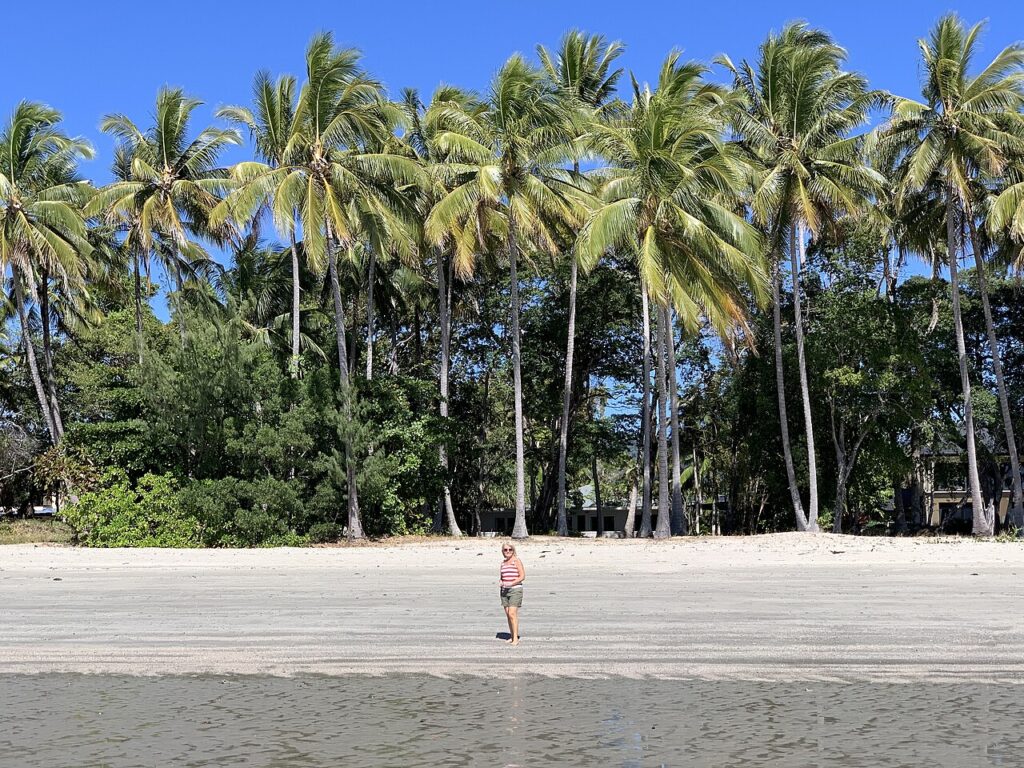
The revival has been deliberate and restrained. Unlike the high-rise towers of Surfers Paradise or the sprawling resorts of the Gold Coast, Port Douglas has capped building heights at three storeys, and the result is a low-rise, palm-fringed elegance that feels more like a Caribbean plantation town than a Queensland beach destination. You’ll notice it the moment you arrive: the sky is big, but so are the trees. Travelers often discover that the town’s charm lies not in grand monuments but in the quiet persistence of its natural setting—the way the Daintree Rainforest shoves vines and fig trees right up to the back fences, and how the Coral Sea slaps gently against Four Mile Beach, its water as warm as bathwater from November to April.
Neighborhood by Neighborhood
Macrossan Street & The Town Centre
This is Port Douglas’s spine, a two-kilometre strip of boutique galleries, al fresco cafes, and souvenir shops that feels both touristy and unapologetically charming. You’ll walk it at least twice a day because everything—from the post office to the ice-cream parlour—is here. The architecture is classic tropical North Queensland: wide verandahs, corrugated iron roofs, pastel-painted timber, and ceiling fans whirring lazily overhead. Locals recommend starting your morning at The Little Larder on Macrossan, where you’ll queue for banana bread with caramelised white chocolate and a flat white so good you’ll order a second. The street comes alive at dusk, when the fairy lights strung between trees flick on and the sound of clinking glasses spills from The Court House Hotel, a restored 1880s pub where you can sip a mango daiquiri on the verandah and watch the parade of holidaymakers drift by. Don’t miss the Sunday market at the southern end of Macrossan Street (8 am to 2 pm), where you’ll find local honey, handmade jewellery, and a young couple selling coconut water straight from the husk—$5, and worth every cent.
Port Douglas Marina & Wharf Area
A five-minute walk from Macrossan Street, the marina feels like a separate world—cleaner, newer, and buzzing with the energy of departing reef trips. This is where you’ll board your catamaran for the Great Barrier Reef at 8 am sharp, and where you’ll return at 4 pm, sunburned and salt-crusted, to find cold beers waiting at The Tin Shed, a no-fuss waterfront bar that’s been serving fishermen and tourists since 1988. The marina boardwalk is lined with upscale seafood restaurants—Salsa Bar & Grill, Nautilus Restaurant (the town’s most romantic dinner spot, set in a rainforest garden with a 5-course tasting menu for $145 per person)—but your best bet for a casual meal is The Lure Bar & Grill, where the Moreton Bay bug tacos ($24) are served on a corn tortilla with pickled watermelon rind. Seasoned travelers know to book dinner at Nautilus at least two weeks in advance, especially during the dry season (May to October). The marina is also where you’ll spot the superyachts of the ultra-wealthy, a reminder that Port Douglas is a favourite escape for those who prefer their luxury understated.
Four Mile Beach & The Esplanade
Stretching from the northern headland to the southern point, Four Mile Beach is the town’s beating heart, though you’ll rarely find it crowded, even in peak season. The sand is pale, fine, and crunches underfoot, and the water is so clear you can see your toes at waist depth. Locals recommend arriving at 6:30 am for a dawn stroll, when the beach is empty except for a few joggers and a fisherman casting for whiting from the shore. The Esplanade itself is a paved walking path that runs parallel to the beach, lined with Norfolk Island pines and benches where you can sit and watch the tide roll in. This is the quietest part of town, a place for morning yoga, sunset picnics, and the kind of aimless wandering that defines a proper beach holiday. If you’re feeling energetic, walk the full length of the beach to the southern rock pool (about 40 minutes one way), where you can swim in a natural enclosure protected from stingers during the summer months. The surf is gentle here—rarely more than waist-high—so it’s ideal for families and those who prefer floating over fighting waves.
The Local Table: What Port Douglas Denizens Actually Eat
The food culture in Port Douglas is a direct reflection of what grows and swims nearby. You will find barramundi, mud crab, Moreton Bay bugs, prawns, and reef fish on almost every menu, but the real story is in the simplicity of preparation. Locals don’t mess with their seafood—they grill it over a wood fire, squeeze a native finger lime over the top, and call it done. The unexpected star ingredient is the Davidson’s plum, a tart, deep-purple fruit that grows wild in the Daintree and shows up in jams, sauces, and even gin. Travelers often discover that the best way to taste the region is not at a white-tablecloth restaurant but at the Port Douglas Community Hall on Wharf Street, where every Saturday morning from 8 am to noon, the Port Douglas Farmers’ Market takes over. Here you’ll find a young farmer named Tom selling rainforest honey harvested from hives he carries deep into the Daintree on foot—$18 a jar, and unlike anything you’ve tasted.

Lady Douglas River Cruise, Port Douglas, Queensland , 2020, Port Douglas, Australia
The dish you must seek out is the whole grilled reef fish at Zanzibar Restaurant on Macrossan Street. You’ll order it with a side of coconut rice and a glass of Queensland sauvignon blanc blanc, and watch as the waiter brings the entire fish—skin crispy, flesh flaking, eyes still intact—to your table. It costs $38, feeds one generously, and comes with a wedge of lime and a small bowl of chili and ginger dipping sauce that you will dream about for weeks. The secret is to use your fingers, pick the meat from the bone, and eat the cheek first (locals know this is the sweetest part). For dessert, cross the street to Gelatopia, a family-run gelato shop where the mango sorbet is made from Kensington Pride mangoes bought directly from a grower in Mareeba, an hour inland. One scoop ($5.50) is all you need, but you’ll want two.
Art, Music & Nightlife
The creative pulse of Port Douglas is quieter than you might expect, but it beats steadily, especially from May to September when the dry season brings a string of festivals. The Port Douglas Carnivale, held each year in late May, transforms Macrossan Street into a parade of lanterns, live music stages, and street performers, with a fireworks display over Dickson Inlet that draws the entire town. The arts scene centres on the Port Douglas Court House Gallery, a converted 1880s courthouse on Macrossan Street where you can view works by local Indigenous artists and landscape painters who capture the Daintree’s shifting light. Travelers often discover that the best gallery in town is actually Flames of the Forest, an outdoor dining-and-art experience set in the rainforest itself—you’ll dine under a canopy of paperbark trees while a local artist paints a canvas by torchlight. It costs $195 per person and includes a three-course dinner, but you’re paying for the atmosphere as much as the food.
Nightlife in Port Douglas is low-key and ends early. The Iron Bar on Macrossan Street is the closest thing to a club, with live music most nights from 8 pm until midnight, and a dance floor that’s usually full by 10 pm. If you prefer something quieter, head to The RSL Club on the Esplanade, where locals gather for cold beer, a game of pool, and a view of the moon rising over the sea. The cover charge is $2 for non-members, and you’ll find the most genuine conversation of your trip here, usually with a retired fisherman named Bob who’ll tell you about the time he caught a 50-kilogram tuna off the reef in 1993. Most visitors are surprised that the town’s nightlife revolves around the sunset rather than the sunrise—the ritual is to grab a bottle of wine and a blanket, walk to the northern end of Four Mile Beach by 5:30 pm, and watch the sun sink into the Coral Sea while a didgeridoo player performs on the sand.
Practical Guide
- Getting There: Fly into Cairns Airport (CNS) from most Australian capitals as well as direct flights from Tokyo, Singapore, and Auckland. From Cairns, it’s a one-hour drive north on the Captain Cook Highway. Book at Skyscanner. Airport transfers from Cairns to Port Douglas cost $45 per person by shuttle bus, or $130 for a taxi.
- Getting Around: The town is compact and walkable—you can comfortably cover Macrossan Street, the marina, and the Esplanade on foot. For day trips to the Daintree or Mossman Gorge, hire a car from Enterprise Rentals for $65 per day (book in advance during peak season). The local bus (Sunbus) runs between Port Douglas and Cairns hourly from 6 am to 7 pm, with a single ticket costing $8.20.
- Where to Stay: On Macrossan Street, the Port Douglas YHA offers clean dorms from $35 a night and a lively backpacker vibe. For midrange comfort, the Mantra On The Inlet overlooks the water and costs $180 per night in the dry season. For luxury, the Sea Temple Resort & Spa on the southern end of Four Mile Beach offers a lagoon pool, a day spa, and deluxe suites from $350 per night. Check Booking.com for availability and deals.
- Best Time: May to October (dry season) delivers low humidity, clear skies, and daytime temperatures around 27°C. November to April (wet season) brings humidity, rain, and stinger season, but the waterfalls and rainforest are at their lushest and accommodation is cheaper by 30%.
- Budget: Expect to spend $150–$200 per day for a midrange traveller (mid-range hotel, three meals, one reef trip), or $300+ for a luxury traveller. Backpackers can manage on $80 per day with hostel accommodation, supermarket meals, and free beach time.

Photo of brown, green, and white train near green leaf trees, Port Douglas, Australia
What Surprises First-Time Visitors
Most tourists arrive expecting Port Douglas to be a purely beach-and-reef destination, and they’re caught off guard by the raw power of the Daintree Rainforest that sits right behind the town. You might book a reef trip for your first day, but by the end of your second day, you’ll be driving 20 minutes north to Mossman Gorge, where the clear, tannin-stained water of the Mossman River runs over granite boulders the size of cars, and the air smells of wet earth and myrtle. The surprise is how quickly the landscape changes—from the open, sunny coastline to a dark, humid cathedral of ancient trees and ferns, all within a 15-minute drive. Seasoned travelers come prepared with a rain jacket and insect repellent, even on a sunny day, because the microclimate in the Daintree creates its own weather, often drizzling in the morning and clearing by noon.
Another thing that catches first-time visitors is the sheer cost of reef trips. You’ll see brochures everywhere offering “$99 reef trips,” but these are usually short, crowded, and include no food or snorkel gear. The reliable operators are Wavelength and Sailaway, both departing from the marina at 8 am and returning at 4 pm, with morning tea, lunch, afternoon tea, and all equipment included. The cost is $249 per adult, and you should book at least a week in advance during the dry season. Travelers often discover that the reef is not a single place but a series of sites, and that the best experience comes from visiting an outer reef platform where the coral is untouched by tourism. Your best bet is to take the 90-minute ride to Agincourt Reef, where you’ll swim alongside sea turtles, giant clams, and schools of parrotfish. The boat ride can be rough—take seasickness tablets an hour before departure, even if you think you don’t need them.
Finally, visitors are surprised by the wildlife that wanders into town. You’ll see rainbow lorikeets squabbling in the palm trees at sunset, fruit bats flying overhead at dusk like silent umbrellas, and sometimes a cassowary—the world’s second-largest bird—striding across a road near the Daintree River crossing. Locals will tell you to slow down for wildlife, but the real surprise is how close these creatures come to your daily existence. You might wake up in your hotel room to find a bush turkey pecking at your window, or you might step out of a restaurant on Macrossan Street and see a green tree frog clinging to the wall, its toes glowing under the streetlight. The message is clear: here, nature is not a backdrop; it’s a neighbour.
Your Port Douglas Questions
How many days do you need in Port Douglas to really experience it? Five days is the ideal minimum: one day for the reef, one day for the Daintree Rainforest (including Mossman Gorge and Cape Tribulation), one day to explore the town itself, one day for a workout at the Four Mile Beach and a sunset sail, and one day for the Mossman River crocodile cruise or a trip to the Atherton Tablelands. If you only have three days, you’ll need to choose between the reef and the rainforest, but savvy visitors know that you can combine both in a single day with a helicopter tour that lands on a reef platform ($599 per person) and then flies back over the Daintree. The reef is the showpiece, but the rainforest is the soul—do not leave Port Douglas without spending at least half a day in Mossman Gorge.

Close-up photography of Kangaroo, Port Douglas, Australia
Is Port

