
Where the Mountains Whisper Secrets: How Trashigang Transforms Every Traveler Who Ventures East (2026)
In 1659, a single arrow fired by the great unifier Zhabdrung Ngawang Namgyel’s envoy, Minjur Tempa, chose the site for what would become Trashigang Dzong—a fortress that would watch over the eastern gate of Bhutan for centuries. Local legend holds that the arrow landed precisely where a white scarf fluttered from a tree, marking the spot where the fierce guardian deity Khardung Yulgyal agreed to protect this valley. You stand at that same precipice today, and travelers often discover that the wind carries more than just prayer flags here.
The Story Behind Trashigang, Bhutan
Trashigang’s story stretches far beyond the 17th century. Archaeological evidence suggests the region was inhabited as early as 2000 BCE, but it was the arrival of the Zhabdrung’s forces in 1659 that truly reshaped its destiny. The dzong you see today—perched on a spur 1,100 meters above the Drangme Chhu river—was built as a bulwark against Tibetan invasions from the north and as a seat of power for the eastern regions. When you visit, you’ll notice its massive, sloping walls, which were designed to deflect cannon fire, a testament to the turbulent times that shaped its creation.
For centuries, Trashigang served as the administrative heart of eastern Bhutan, controlling trade routes that connected Tibet, Assam, and the rest of Bhutan. The town’s name itself means “Auspicious Fortress,” and it lived up to that name during the 1950s and 60s when it became a focal point for refugees fleeing the Chinese annexation of Tibet. Locals recommend visiting the dzong’s watchtower, now a museum, where you can see relics from this period, including Tibetan manuscripts and weapons that tell a story of survival and resilience that still echoes through the narrow alleyways of the old town.
The modern era brought paved roads in the 1960s, which connected Trashigang to the rest of Bhutan for the first time. This was a profound shift; previously, the 13-day journey from Thimphu was made on foot or by mule. You’ll still see the remnants of that old trail system weaving through the hills above town, and savvy visitors know that a morning hike along its path offers unparalleled views of the dzong framed by terraced rice paddies. Today, Trashigang is Bhutan’s second-largest town, but it retains a frontier feel that sets it apart from the polished capital.
Neighborhood by Neighborhood
The Old Market District
Descend from the dzong along the winding Lhakhang Karpo Road, and you’ll enter the pulsing heart of Trashigang. This is where the town’s raw energy lives—a tangle of corrugated-roof shops, open-air vegetable stalls, and tea houses where truck drivers gather over steaming mugs of butter tea. Your best bet is to arrive early, around 7:30 AM, when the Sunday market springs to life. You’ll see farmers from remote villages spread out their wares on tarps: fiery red chilies, baskets of organic red rice, and fresh cheese wrapped in banana leaves. The air is thick with the smell of dried fish, incense, and the earthy scent of cardamom. Most tourists overlook the small wooden bridge that crosses the river behind the market—cross it, and you’ll find a cluster of family-run inns where the owners still roast coffee beans by hand over open fires.
Rangjung Village
Eight kilometers east, a world away in spirit, lies Rangjung. This is where Trashigang’s soul shifts from commerce to contemplation. The village center is dominated by the Rangjung Woesel Chholing Monastery, a modern temple complex built in 1994, but whose roots trace back to the 8th-century visit of Guru Rinpoche. When you walk through the village lanes, you’ll notice the distinct absence of honking horns—instead, the only sounds are the rhythmic chanting of monks and the gentle rush of the Gamri River. Locals recommend visiting the monastery’s meditation center, where you can join a 15-minute guided visualization session, a rare opportunity for travelers seeking a genuine spiritual encounter. April is particularly special here, as the surrounding hills explode with rhododendron blossoms, and you can watch monks creating vibrant butter sculptures for the ongoing Tsechu festival.
Radhi Village
For a taste of Trashigang’s agricultural soul, head east another 10 kilometers to Radhi, often called the “Rice Bowl of Eastern Bhutan.” This cluster of hamlets spreads across a verdant valley floor, where women still wear the traditional kira—a floor-length handwoven garment—while working in the paddies. Your best time to visit is during the monsoon season, from June to August, when the rice terraces become a brilliant jade carpet. You’ll want to visit the village loom house, where master weavers produce the intricate kishuthara textiles that are famous throughout Bhutan. Expect to spend about 3,500 ngultrum (around $42) for a small scarf, but you’re paying for weeks of painstaking handiwork. Most visitors rush through Radhi in an hour—seasoned travelers stay the night at the farmstay run by Aum Deki, where you’ll eat dinner by lamplight and wake to the sound of roosters and temple bells.
The Local Table: What Locals Actually Eat
You haven’t truly experienced Trashigang until you’ve eaten the way its people do. The cuisine here is a fierier, more rustic cousin of what you’ll find in western Bhutan, driven by the region’s abundance of red rice, yak cheese, and the infamous ema datshi—chilies cooked in cheese sauce. Your best bet for an authentic meal is the Tashi Wangchuk Hotel, a modest restaurant near the bus station that has been serving the same family recipes since 1986. Order the phaksha paa (pork cooked with dried radish) and watch as the owner, a former monk who still bears the shaved head of his past life, prepares it over a wood-fired stove. The cost for a full meal: about 250 ngultrum ($3).

Trashigang – Frau am Webstuhl, Trashigang, Bhutan
The weekly market, held every Sunday in the open-sided structure near the dzong’s base, is where you’ll discover the true breadth of the local larder. Travelers often spend their entire morning here, sampling dried yak jerky (called shakam) and trying a taste of the potent ara, a grain-based liquor served warm in a brass bowl. Locals recommend pairing this with a piece of fried dough called buey jaam, which you’ll find at the stall run by a woman named Pema who has been selling them for 30 years. Her secret? A pinch of cardamom in the batter. Don’t leave without trying the ezay—a violently spicy condiment made of fermented chili, radish, and cheese that will test every traveler’s courage.
Art, Music & Nightlife
Trashigang’s creative pulse beats strongest during the autumn Tsechu festival, held at the dzong from the 10th to the 12th day of the 8th Bhutanese month (typically November). This is where you’ll witness the region’s most sacred traditions: masked dancers performing the Black Hat Dance, accompanied by the deep drone of long horns made from human thigh bones. But for a quieter encounter, visit the Zorig Chusum Institute, a school of traditional arts located in the lower town. Here, you can watch students—many from remote villages—painting thangka scrolls and carving woodblocks for prayer book printing. Admission is free, but a 200-ngultrum donation is appreciated.
Nightlife, as you might imagine, is a relative term here. Your best option is the Zimdra Hotel, where local musicians gather on Friday and Saturday evenings to play traditional dramyin (lute) and lingm (flute) music starting around 8 PM. The crowd is a mix of off-duty civil servants, monks who have slipped out of the monastery, and curious travelers. Order a bottle of Druk 11,000—a Bhutanese beer—for about 90 ngultrum, and you’ll likely find yourself invited to join a spontaneous dance circle. The scene is more community center than nightclub, and that’s precisely its charm. For something truly unique, check with your hotel about attending a village “moonlight session”—informal gatherings where elders sing traditional bardo songs meant to guide souls in the afterlife.
Practical Guide
- Getting There: Fly into Paro International Airport (PBH) on Drukair or Bhutan Airlines. From there, a domestic flight to Trashigang’s Yongphulla Airport costs around $100 and takes 45 minutes. Alternatively, a private taxi from Thimphu costs $120-150 for the 10-hour journey. Book flights at Skyscanner
- Getting Around: Local buses connect Trashigang town to Rangjung (45 ngultrum, 20 minutes) and Radhi (60 ngultrum, 40 minutes). Private taxis cost about 1,500 ngultrum for a half-day tour. Walking is your best bet within the old town.
- Where to Stay: In town, the Tashi Yangtsi Hotel offers clean rooms from 1,800 ngultrum/night. For a village experience, book the farmstay in Radhi through Khamsum Homestay. Check options at Booking.com
- Best Time: March to May (spring blossoms, pleasant temperatures) and September to November (clear skies, Tsechu festival). Avoid July and August unless you enjoy monsoon rain.
- Budget: Expect to spend 3,000-5,000 ngultrum ($36-60) per day, including accommodation, meals, and local transport. The daily tourism levy for international visitors is $100 per person per night.

A large white and yellow building surrounded by trees, Trashigang, Bhutan
What Surprises First-Time Visitors
Your first surprise in Trashigang will be the silence. After the urban hum of Thimphu, you’ll find a town where the loudest sound is often the prayer flags snapping in the wind. Travelers often remark how they can hear their own footsteps on the gravel paths, and how the dzong’s massive walls seem to swallow sound. This quiet is not emptiness—it’s a palpable presence that follows you through the streets.
Second, you will be struck by the warmth of the people in a way that defies the region’s reputation for reserve. Locals recommend arriving at the dzong’s entrance with a simple greeting—”Kuzuzangpo”—and you’ll find monks and government workers alike stopping to help you unfurl a prayer flag or point you toward a hidden mural. The stereotype of the “aloof Bhutanese” evaporates here, replaced by an earnest curiosity. A farmer in Radhi once spent an entire lunch break explaining to a traveler the difference between three varieties of red rice, using handfuls of grains to demonstrate.
Finally, you will be unprepared for the sacred geography. Trashigang is not a town you merely pass through—it’s a place where every hilltop holds a chorten, every river bend has a blessing site, and the mountains themselves are considered deities. Visitors often find themselves pausing on the road bridges to watch the Drangme Chhu’s turquoise water churn over rocks, unaware that they are standing above a serpent spirit’s dwelling. You’ll leave convinced that the landscape itself is alive, and you’ll be right.
Your Trashigang, Bhutan Questions
Can I visit Trashigang without a guide? Yes, but with significant caveats. While you can explore the town and nearby villages independently, entry to the dzong and all monasteries requires you to be accompanied by a licensed Bhutanese guide, as per national regulations. You can hire a guide for $30-50 per day, which covers both cultural context and permissions. For the Sunday market and Radhi’s farmstay, you can explore freely—just respect photography bans inside temples.
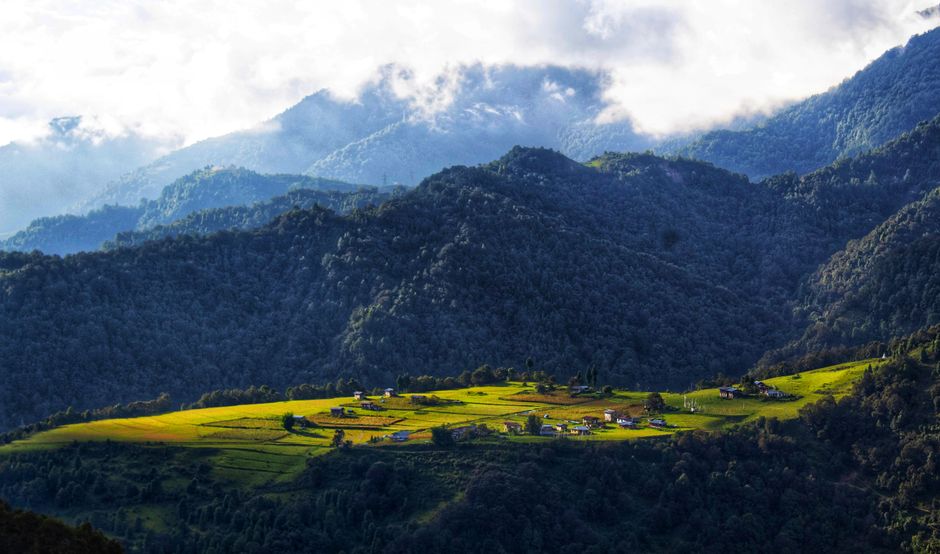
Breathtaking view of Khaling village nestled in Bhutan’s lush mountains and…, Trashigang, Bhutan
What should I pack for eastern Bhutan? Your key challenge is temperature variation. Days can reach 25°C (77°F) in early summer, but nights drop to 5°C (41°F) in the winter. Bring layers: a fleece jacket, waterproof shell, comfortable walking shoes for the steep alleys, and a torch for evening walks in villages with unreliable streetlights. Most importantly, pack a sense of patience—the buses run on “Bhutan time,” and the internet in town is notoriously slow, often dropping out entirely during rain.
Is the food safe for Western stomachs? Generally, yes, with one notable exception: the ezay chili condiment. Travelers often discover that this fermented paste, while delicious, can wreak havoc on unaccustomed digestive systems. Locals recommend trying it in small doses, mixed with rice rather than eaten straight. Tap water is not potable; stick to bottled water (20 ngultrum) or bring a reusable bottle and use purification tablets. The hotel restaurants and the Tashi Wangchuk Hotel follow good hygiene standards, but the market stalls are best approached with caution if you have a sensitive stomach.

