
Where the Mountains Meet the Sea: The Enduring Allure of Fort Dauphin, Madagascar (2026)
In 1643, a French colonial expedition led by Sieur Pronis landed on this southeastern coast, naming their settlement “Fort Dauphin” after the heir to the French throne. They built a wooden fort on a small peninsula, seeking to control the spice trade. Yet, the land resisted them. Within decades, hostile relations with the local Antanosy people, disease, and famine decimated the colony. The original fort is long gone, but its name—and the story of a precarious foothold in a majestic land—endures.
The Story Behind Fort Dauphin, Madagascar
Fort Dauphin, known locally as Taolagnaro, is a place where history is written in layers, each more complex than the last. Long before European sails appeared, it was a key node for the Antanosy kingdom, a people whose name means “people of the island,” deeply connected to the sacred mountains that loom over the town. The 17th-century French attempt at colonization was a brief, brutal episode that ultimately failed, but it left a linguistic and cultural imprint. The town later became a sleepy administrative outpost, its rhythm dictated by the sea and the surrounding sisal and coffee plantations.
The modern story of Fort Dauphin, however, is inextricably linked to the giant mining project at QMM (Qit Madagascar Minerals), which began operations in 2009. This brought new infrastructure, international workers, and economic shifts that both challenged and galvanized the local community. Travelers today discover a town in fascinating flux, where traditional zebu carts share potholed roads with 4×4 mining vehicles, and where the ancient *fady* (taboos) of the Antanosy are respected alongside global business practices. This tension between preservation and progress, between the deep past and the pressing present, is the true narrative you’ll feel humming in the air.
Neighborhood by Neighborhood
Le Vieux Port (The Old Port)
This is the historic heart, where Fort Dauphin’s story began. You’ll wander narrow streets lined with faded colonial-era buildings with wrought-iron balconies, their pastel paint peeling in the salty air. The energy here is maritime and mercantile. At dawn, your senses are awakened by the shouts of fishermen unloading their colorful wooden *pirogues* with the night’s catch—silvery sardines and glistening tuna—directly onto the quay. The air smells of salt, diesel, and drying nets. Your best bet for a morning coffee is at a simple kiosk overlooking the bustle. The focal point is Place Foch, a sleepy square with a few shade trees, where old men play *petanque* in the late afternoon. This neighborhood isn’t polished for tourists; it’s authentically, beautifully worn, offering a glimpse into the town’s working soul.
Libranona & Ambinanikely
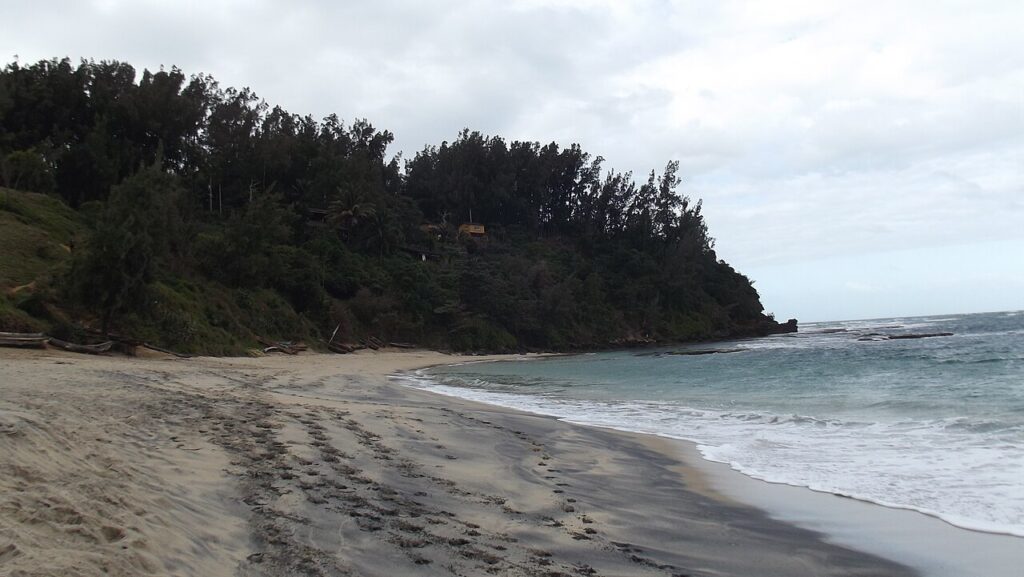
For a dramatic change of scenery, head to the Libranona peninsula. This is where Fort Dauphin reveals its breathtaking natural setting. The neighborhood climbs the slopes of Pic St. Louis, offering jaw-dropping, panoramic views of the Bay of Galions. Here, you’ll find a mix of older villas and newer guesthouses tucked among lush vegetation. The atmosphere is quieter, more residential, and defined by its proximity to some of Madagascar’s most stunning beaches. You can take a path down to the pristine, crescent-shaped Libranona Beach, a local favorite for swimming and sunset picnics. Just north, the area known as Ambinanikely is where many expatriates and well-to-do locals live, with a smattering of upscale restaurants and the town’s best supermarkets. It’s a place for leisurely strolls and contemplating the vast Indian Ocean horizon.
Tanambao & Le Marché
For pure, unadulterated local energy, you must dive into the commercial hive of Tanambao, centered around the sprawling main market. This is where Fort Dauphin gets loud, colorful, and utterly compelling. You’ll weave through a labyrinth of stalls selling everything from pyramids of fragrant vanilla pods and glittering piles of red *sakay* (chili pepper) to second-hand clothing, live chickens, and intricate basketry. The sounds are a symphony of haggling, laughter, and the hum of generators. Locals recommend visiting in the morning when it’s cool and the produce is freshest. A few blocks away, the streets are lined with small *hotelys* (local eateries) and shops selling hardware, school supplies, and phone credit. This neighborhood isn’t about sights; it’s about immersion. It’s where you feel the vibrant, pulsing lifeblood of the town.
The Local Table: What Antanosy Actually Eat
In Fort Dauphin, the cuisine is a direct reflection of its environment: the bounty of the sea and the produce of the hills. The foundation is *vary* (rice), served at nearly every meal. But here, it’s often accompanied by the incredible seafood hauled from the nearby waters. Locals eat simply but with incredible flavor. A typical lunch at a family home or a *hotely* might be a mound of rice with a side of *lasary*, a fresh, piquant condiment of tomatoes, onions, green mango, or peanuts, all chopped fine and dressed with lime and chili.
The one dish you must seek out is *Romazava*. While found across Madagascar, the Fort Dauphin version is distinct, often made with fresh crab or shrimp from the port, or tender zebu meat, stewed with the indigenous *brèdes mafana* (a leafy green with a slight peppery, numbing sensation) and other local greens like *anamamy* and *anandrano*. It’s a fragrant, hearty stew that speaks of the land. For the best market-fresh experience, savvy visitors head to the cluster of tiny eateries at the edge of **Le Marché**. Look for a place like **Hotely Mamy**—it’s just a bench and a tarp, but Mamy herself serves a *romazava* that will redefine the dish for you, for about 5,000 MGA (just over $1).

Strand bij Fort Dauphin, Fort Dauphin, Madagascar
Art, Music & Nightlife
The creative pulse of Fort Dauphin is subtle but deeply rooted. You won’t find flashy galleries, but you will find craftsmanship in the intricate **Antanosy tombs** carved from wood or stone in the surrounding villages, a sacred art form honoring the ancestors. In town, look for the delicate **paper *antaimoro***, a craft originating from the nearby Antaimoro people, made from beaten bark and decorated with pressed flowers, often sold as sheets or notebooks at the market or in hotel boutiques.
Music is the lifeblood of social gatherings. On weekends, especially Friday and Saturday nights, you might hear the driving rhythms of *salegy* or *tsapika* music spilling from local bars like **Le Pily-Pily** near the port or **La Bodega** in Ambinanikely. Live bands often play, and the dance floors get packed. For a more traditional experience, ask your guide about any local *famadihana* (turning of the bones) ceremonies you might respectfully witness—these are profound cultural events filled with specific music, dance, and community. The major festival is the **”Feria”** or **Donia**, a week-long cultural festival usually held in June or July, featuring canoe races, traditional dancing, music competitions, and a generally jubilant street party atmosphere.
Practical Guide
- Getting There: You’ll fly into **Tôlanaro Airport (FTU)**. Air Madagascar and Tsaradia offer regular flights from Antananarivo (TNR), the journey taking about 1.5 hours. There are no direct international flights. Book at Skyscanner
- Getting Around: Within town, your main options are *pousse-pousse* (rickshaws) for short trips (1,000-2,000 MGA) or taxis-brousses (shared minibuses) for set routes (500 MGA). For day trips to Berenty or the Lokaro Peninsula, you must hire a 4×4 with a driver. Expect to pay around 150,000-250,000 MGA ($35-$55) per day, depending on distance and negotiation.
- Where to Stay: In **Libranona** for views and beach access (Hotel Talinjoo, Miramar). Near **Le Vieux Port** for character and budget (Chez Jacqueline). In **Ambinanikely** for modern comfort (Hotel Mahavoky). Check Booking.com
- Best Time: April to November is the dry, cooler season. September and October are particularly lovely. Avoid January to March, the peak of the cyclone season.
- Budget: A realistic daily budget for a comfortable traveler (mid-range hotel, local meals, some tours) is $60-$100 per person. Budget travelers can manage on $30-$40 with guesthouses and street food.
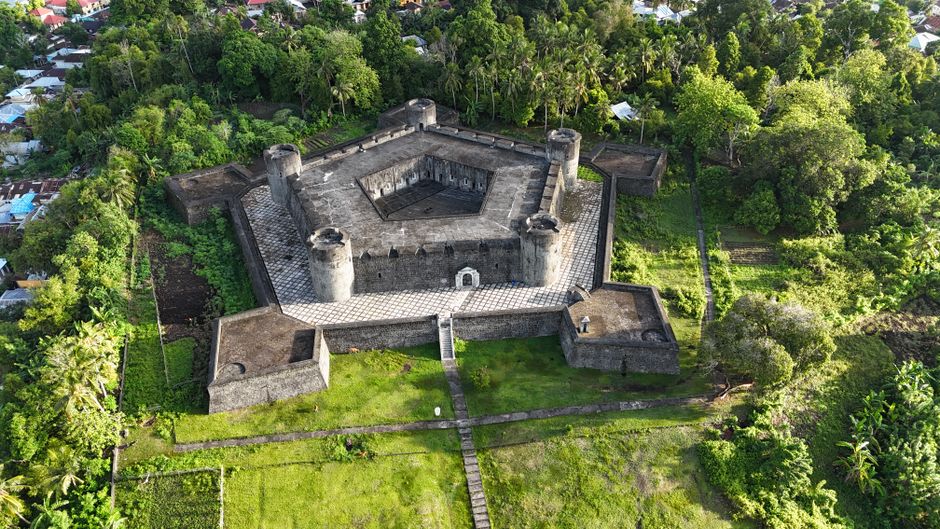
Stunning aerial view of the historic Fort Belgica surrounded by lush greene…, Fort Dauphin, Madagascar
What Surprises First-Time Visitors
Most travelers arrive expecting a sleepy beach town and are immediately stunned by the dramatic, almost cinematic geography. Fort Dauphin is cradled by three formidable granite massifs—Pic St. Louis, Pic Louis Vincent, and the even more imposing Peak Dauphin. These mountains don’t just sit in the distance; they dominate the skyline, changing color with the light and often cloaked in mysterious morning mist. You’ll find yourself constantly looking up, reoriented by their ancient presence.
The second surprise is the profound cultural depth that lies just beyond the town limits. A short drive reveals traditional Antanosy villages where life revolves around rice cultivation, zebu herding, and deep respect for ancestral customs. Visitors often discover that the real magic of Fort Dauphin isn’t just in its charmingly ramshackle streets, but in its role as a gateway to a world of spiny forests, sacred lakes like **Lake Anony**, and community-run reserves. The misconception that it’s merely a transit point is quickly corrected; it’s a destination with layers that reward those who stay a few days to peel them back.
Your Fort Dauphin Questions
Is Fort Dauphin safe for tourists? Generally, yes. Petty theft like pickpocketing can occur in crowded markets, so you should keep valuables secure and be discreet with cameras. Violent crime against tourists is rare. The standard precautions apply: don’t walk alone on isolated beaches at night, use registered taxi services for evening transport, and consult your hotel for local advice. The warmth and hospitality of the Antanosy people are far more defining of the experience than any security concerns.
What are the absolute must-do day trips? Your first priority should be the **Berenty Private Reserve**, about a 2.5-hour drive west. Here, you are guaranteed close encounters with troops of ring-tailed and dancing sifaka lemurs in a stunning spiny forest landscape. Secondly, you must take a boat trip to the **Lokaro Peninsula**. This involves a 4×4 ride and a local pirogue transfer to reach impossibly white sand beaches and turquoise lagoons, perfect for a deserted-island picnic. These two trips showcase the stunning biodiversity and pristine coastline that define the region.
How do I respectfully engage with local culture? Always ask permission before taking photos of people, especially elders. When visiting villages, a small gift for the village chief (like a bottle of rum or some sugar) is a respectful gesture—your guide will arrange this. Be aware of *fady* (taboos), which can vary by village; they might prohibit certain clothing colors or pointing at tombs. Your guide is your essential cultural translator. Learning a few phrases in Malagasy (“Manao ahoana” for hello, “Misaotra” for thank you) will earn you instant smiles and open doors more genuinely than any transaction.
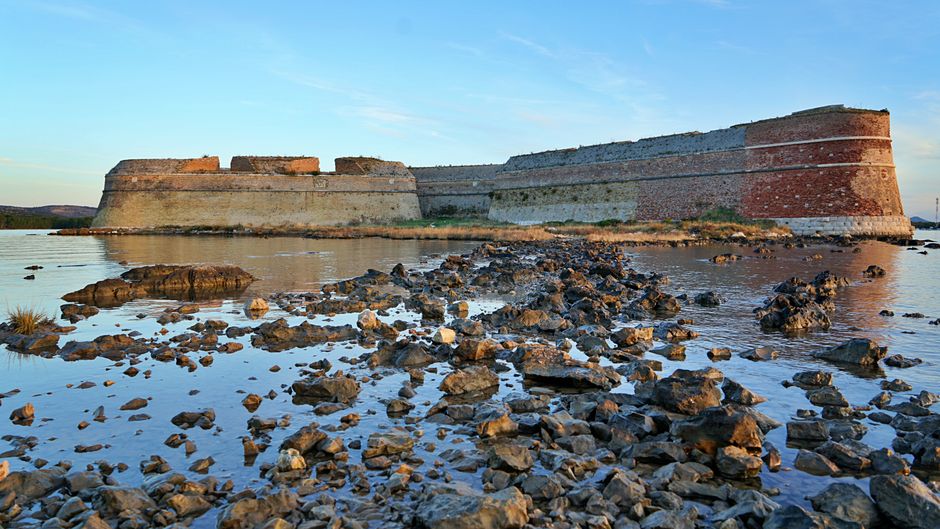
Serene view of an ancient coastal fort reflecting in the sunset waters with…, Fort Dauphin, Madagascar
Related Guides
Explore more destinations similar to Where the Mountains Meet the Sea: The Enduring Allure of Fort Dauphin:

