
Where the Kura River Remembers: Discovering the Quiet Soul of Kvemo Kartli (2026)
In 1776, when King Erekle II of the Kingdom of Kartli-Kakheti signed the Treaty of Georgievsk seeking Russian protection against Persian invasions, he likely stood on the banks of the Kura River in what is now Kvemo Kartli, contemplating the fate of his ancient realm. Two centuries later, you might find yourself in the same valley, watching the river’s glacial-blue waters flow past Soviet-era factory towns and 5th-century monasteries, connecting Georgia’s medieval glory to its complex modern identity. This region, whose name translates literally as “Lower Kartli,” holds the secrets of the country’s soul in its layered, complicated soil.
The Story Behind Kvemo Kartli, Georgia
The territory you’ll explore today has been a crossroads of civilizations since the Bronze Age. Archaeologists have unearthed remains at the Dmanisi archaeological site dating back 1.8 million years – you’ll stand where some of the oldest human ancestors outside Africa once walked, making this region a cradle of human history that predates Georgia itself. By the 4th century, when Christianity was declared the state religion of Iberia, Kvemo Kartli had already become a vital artery of the Silk Road, with caravans carrying silk from China and spices from India through the Kura River valley toward the Black Sea ports.
The medieval period shaped the region’s character with remarkable intensity. In the 12th century, during Georgia’s Golden Age under Queen Tamar, Kvemo Kartli flourished with fortified cities and trade routes. But the Mongols arrived in 1235 and transformed everything. You’ll see their legacy etched into the defensive architecture that dots the landscape – those thick-walled towers and strategically positioned fortresses weren’t decorative choices. When the Ottoman and Persian empires later carved up Georgia in the 16th and 17th centuries, Kvemo Kartli became the borderlands where empires collided, and locals learned to adapt, negotiate, and survive through remarkable resilience.
The 19th and 20th centuries brought equally dramatic transformations. Under Russian imperial rule, German colonists established prosperous agricultural settlements, and the region’s ethnic diversity deepened. Then came the Soviet industrialization of the 1940s and 1950s, which transformed the modest town of Rustavi into a metallurgical powerhouse that supplied steel to the entire USSR. Today, Kvemo Kartli is Georgia’s most ethnically diverse region, with a significant Azerbaijani population, Greek communities, Armenians, and Assyrians living alongside ethnic Georgians. This multi-layered history has created a destination where you’ll find a 12th-century Armenian monastery standing within sight of a Soviet workers’ district, where Azerbaijani-style kebab houses share streets with traditional Georgian wine cellars.
Neighborhood by Neighborhood
Rustavi: The Soviet Industrial Heart
Your first stop should be Rustavi, a city that didn’t exist before 1948 and was built entirely to house steelworkers during Stalin’s industrialization drive. You’ll immediately notice the brutalist apartment blocks and wide boulevards that feel like a time capsule of mid-20th-century urban planning. But what surprises most visitors is the city’s active pulse – locals will guide you to First Avenue, where stylish cafés and bakeries have sprouted within the concrete framework, serving excellent Georgian coffee alongside flaky kubdari pastries. The Rustavi International Football Stadium anchors the city’s social life, and you’ll find that soccer here is more than a game – it’s the community’s beating heart every weekend. Start your evening at Chika’s Bar, a beloved local haunt near the central square, where you’ll sip cheap wine among young artists who have transformed abandoned Soviet spaces into vibrant studios and galleries.
Marneuli: The Azerbaijani Cultural Capital
Just 30 kilometers south of Tbilisi, Marneuli presents a completely different world. This town, with its bustling bazaar and majority Azerbaijani population, feels like wandering into a Central Asian suq while still standing on Georgian soil. The Marneuli Bazaar is your essential introduction – arrive in the early morning when farmers from surrounding villages arrive with apricots, pomegranates, and fresh herbs piled high in handwoven baskets. You’ll hear a mix of Azerbaijani, Georgian, and Russian spoken as merchants haggle over prices. The town’s pièce de résistance is the Achkhoi-Moreni neighborhood, where you’ll discover traditional Azerbaijani courtyards with grapevines draped over wooden pergolas, women baking bread in clay tandoors, and the distinctive smell of saffron rice mingling with grilled lamb from backyard barbecue pits. Plan to spend at least half a day here, and let yourself get lost in the narrow lanes that never appear on tourist maps.
Bolnisi: Ancient Stones and Living Traditions
Bolnisi, the third anchor of your journey, holds Georgia’s most precious architectural treasure. Here you’ll find the Bolnisi Sioni – the oldest surviving church in Georgia, completed in 493 AD. As you approach its unadorned yellow-ochre stone walls, you’ll see the famous inscriptions carved in ancient Georgian script known as asomtavruli, which you can still decipher with minimal knowledge. The surrounding streets of this small mining town deserve an unhurried afternoon. Local residents will proudly show you the 19th-century German-style houses built by Swabian colonists, complete with their characteristic steep roofs and ornamental gables. For the best experience, visit during the Bolnisi Honey Festival each September, when the town erupts with tasting tables, folk performances, and the warmest hospitality you’ll encounter anywhere in Georgia.
The Local Table: What Locals Actually Eat

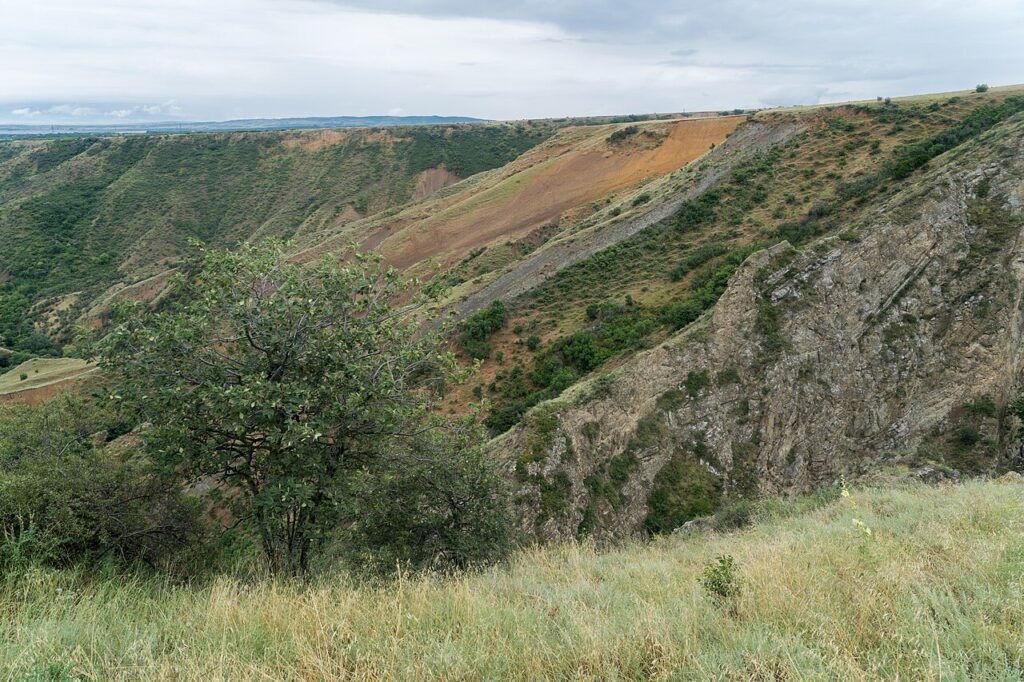
Mountains of Kvemo Kartli, Kvemo Kartli, Georgia
In Kvemo Kartli, the kitchen tells the story of the region’s diverse inhabitants. Unlike the wine-pairing, khachapuri-focused dining of Tbilisi that most tourists know, your table here spills over with Azerbaijani-influenced dishes that you’ll rarely find in other Georgian regions. The food culture revolves around the communal tandoor oven – a clay cylinder buried in the ground that produces a distinct type of bread called tandoori lavashi. You’ll find these ovens throughout Marneuli, and savvy visitors will stand and watch as dough is slapped against the oven’s hot clay walls, emerging in minutes with blistered, smoky surfaces that justify their legendary status.
For your essential culinary experience, seek out the family-run restaurant Aygul’s Garden in Marneuli, tucked behind the main market. Aygul and her sisters serve an extraordinary version of kəngal ash – a complex Azerbaijani noodle soup made with ground beef, chickpeas, dried sour plums, and a topping of crispy fried onions and dried mint. You’ll also encounter dushbara soup, impossibly tiny dumplings served in a clear broth that local women fold into existence with remarkable speed. Don’t miss the kebab here – the regional style skewers lamb with pieces of tail fat and charred tomatoes, best eaten wrapped in the aforementioned lavashi with raw onions and pomegranate molasses. Savvy travelers order the piti, a slow-cooked lamb and chickpea stew served in single clay pots, which requires a specific eating ritual: remove the bread, mash the meat and vegetables with the broth, and eat it all one glorious spoonful at a time.
Art, Music & Nightlife
The creative energy in Kvemo Kartli lives in unexpected spaces. In Rustavi, the former factory warehouses have become the improbable birthplace of a dynamic underground art scene. You’ll find the independent exhibition space Garage-4, an old canteen converted into a gallery by young Georgian artists, where month-end openings feature installation work, experimental film screenings, and electronic music that spills outside into the courtyard. Locals also speak proudly of the Rustavi Folk Music Conservatory, where you can catch performances of traditional Georgian polyphonic singing on Friday evenings – a haunting, drone-based vocal style that UNESCO recognizes as intangible cultural heritage. Plan to visit in late September, when the Rustavi International Arts Festival transforms the city with theater performances, dance shows, and symphonic concerts in the old swimming-pool complex.
For those who want deeper immersion, travel 20 minutes east to the village of Gardabani, where the Azerbaijani musical tradition of mugham continues to thrive. This poetic improvisational music, played on stringed instruments like the tar and kamancha, rarely surfaces in official tourist listings, but experienced travelers know to ask around at the local chai khana (tea house) for private performances. The best time to hear it is during Nowruz in March, when the entire region celebrates the Persian New Year with bonfires, music, and dancing that continues long into the night.
Practical Guide

Aerial view of Tbilisi showcasing iconic landmarks and vibrant cityscape un…, Kvemo Kartli, Georgia
- Getting There: Your most convenient gateway is Tbilisi International Airport (TBS), which receives direct flights from major European cities, Dubai, and Istanbul. From the airport, Kvemo Kartli’s main towns are only a 30-90 minute drive. Book your flights at Skyscanner for the best route options.
- Getting Around: Your most authentic option is the marshrutka (minibus) network. From Tbilisi’s Didube station, you’ll catch frequent departures to Rustavi (2 GEL, 40 minutes), Marneuli (3 GEL, 1 hour), and Bolnisi (4 GEL, 1.5 hours). Alternatively, renting a car gives you freedom to visit remote villages – expect to pay around 120 GEL per day including insurance. Taxis between major towns range from 30-70 GEL per trip.
- Where to Stay: Your best base remains Rustavi. The Hotel Aisi (rooms from 120 GEL) offers clean, comfortable accommodation in the city center. For an atmospheric stay near the historic church, Bolnisi’s Guesthouse Sioni offers traditional rooms with homemade breakfast for 100 GEL per night. You’ll find more budget options in Marneuli, where the family-run Guesthouse Alinya charges just 80 GEL including dinner. Check availability at Booking.com
- Best Time: May through early October delivers ideal conditions – May offers lush green landscapes and spring festivals, while September brings harvest celebrations, mild temperatures, and the distinctive honey and vintage festivals. July and August can be intensely hot, especially in Marneuli, but you’ll be rewarded with abundant fruit.
- Budget: Kvemo Kartli remains Georgia’s most affordable region. You’ll need approximately 150-200 GEL daily for mid-range travel – this includes accommodation, three meals, local transport, and entry fees to major sites. Budget travelers can manage on 100 GEL daily, while those seeking premium experiences might spend 350 GEL.
What Surprises First-Time Visitors
Every traveler arrives in Georgia expecting Tbilisi’s alleys and the mountains of Kazbegi, so the discovery of Kvemo Kartli’s deep ethnic diversity often catches people completely off guard. You’ll realize that Georgia’s identity is far more complex than the monoculture depicted in tourist brochures – you’ll hear Azerbaijani spoken at nearly the same frequency as Georgian in Marneuli, and the cultural practices, food, and music reflect a far older coexistence than the region’s borders suggest. Visitors frequently comment that they felt they’d traveled to Azerbaijan, Turkey, and Georgia all in one day, a sensation no other region in the country offers.
Another delightful surprise awaits at the Dmanisi archaeological site. Most visitors anticipate another museum full of pottery shards, but you’ll actually find yourself standing at the location of the oldest hominid fossils found outside Africa. The unassuming hilltop excavation site offers a profound, almost humbling moment as you gaze across the valley where creatures who would eventually become modern humans lived and died nearly two million years ago. In a region full of remarkable histories, this one humbles all others.
Finally, first-time visitors are constantly impressed by the hospitality of Kvemo Kartli’s rural communities. Unlike the faster pace of Tbilisi, life here unfolds more slowly, and locals who meet travelers often insist they join them for impromptu meals. You will find that a simple question about directions in a village square can result in being fed fresh bread and cheese, given a tour of a family’s vineyard, and gifted with homemade preserves as you leave. This generosity and openness is not staged for your benefit – it’s simply the way Kvemo Kartli has always worked.
Your Kvemo Kartli, Georgia Questions
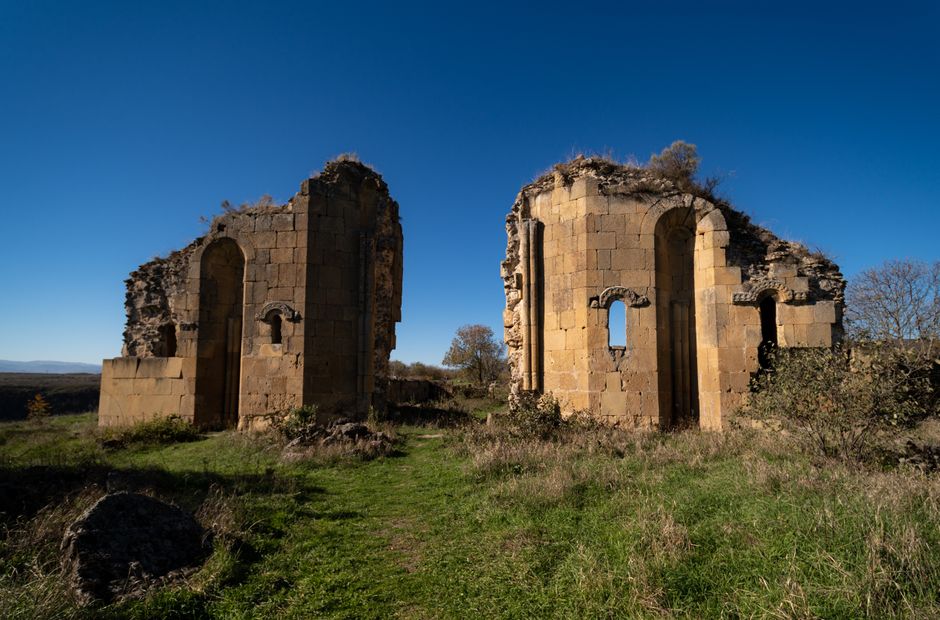
Ancient ruins of a church under a clear sky in Samshvilde, Georgia., Kvemo Kartli, Georgia
Is Kvemo Kartli safe for tourists? You’ll find this region remarkably safe, with low rates of violent crime and a strong tradition of hospitality toward visitors. That said, you should exercise standard precautions like leaving valuables in your hotel and being aware of your surroundings in markets. The region has fully recovered from any instability associated with the 2008 conflict, and travelers frequently report feeling more welcome here than in more tourist-saturated parts of Georgia.
Can I experience Kvemo Kartli without speaking Georgian? Absolutely. In Rustavi, you’ll find that many younger people speak English, and Azerbaijani speakers in Marneuli often have Russian as a common lingua franca. If you speak Turkish, you’ll be delighted to discover that you can communicate surprisingly well in many Azerbaijani households and restaurants. Learning a few words of Georgian (gamarjoba for hello, madloba for thank you) will always be warmly received.
How much time should you allocate for this region? Ideally, plan for 2-3 days to experience the highlights. A well-paced itinerary allows one day for Rustavi’s urban exploration, one day for Marneuli’s bazaar and cultural encounters, and a final day for Bolnisi’s historical treasures. Those with more time can extend into the Dmanisi region and the scenic Khrami River valley, where you’ll find pristine gorges and traditional mountain villages that see almost no international visitors, just daily life continuing as it has for centuries.

