
Where the Jungle Meets the Sea: The Quiet Magic of Koh Phangan’s Bottle Beach (2026)
In 1978, a young Swedish backpacker named Lars Eriksson stumbled onto a crescent of white sand on Koh Phangan’s northern coast after a sweaty two-hour hike through dense jungle. He found not a soul but a curious sight: dozens of glass bottles washed up along the tide line, remnants of a shipwreck or perhaps a lost fishing fleet. Lars camped there for three nights, drinking coconut water and watching the stars, and when he returned to the mainland, he told friends about “bottle beach.” The name stuck long before any road or bungalow existed, and today that same stretch of coast still whispers with the hushed mystery of a secret discovered by chance.
The Story Behind Koh Phangan’s Bottle Beach, Thailand
Bottle Beach, known locally as Haad Khuat (which literally means “bottle beach” in Thai), has never been a place of kings or battles. Its story is quieter—a tale of backpackers, fishermen, and the slow pulse of island time. In the 1980s, word spread through the Southeast Asian overland trail about a pristine beach on the north coast of Koh Phangan, reachable only by foot or by longtail boat. A handful of families from the nearby fishing village of Chaloklum built simple bamboo huts under the coconut palms, offering shelter for 20 baht a night. There was no electricity, no running water, and certainly no Wi-Fi. Travelers arrived with a hammock, a book, and a willingness to live with the tide.
The turning point came in the early 1990s, when the Koh Phangan Tourism Authority, eager to diversify beyond the legendary Full Moon Party, invested in a rough dirt road that connected Bottle Beach to the rest of the island. Even then, progress was slow. Locals resisted large resorts, preferring small, family-run bungalow operations that kept the beach’s character intact. By 2010, Bottle Beach had become a quiet refuge for travelers seeking to escape the neon chaos of Haad Rin. You’ll find no ATMs, no police station, and no 7-Eleven—just a handful of bamboo-and-thatch restaurants, a few dozen bungalows, and the sound of waves washing over coral sand. The real history of Bottle Beach is not written in textbooks but in the stories of every traveler who has sat on its shore, watching the sun sink into the Gulf of Thailand.
Neighborhood by Neighborhood
The Beachfront Strip
The heart of Bottle Beach is a 300-meter arc of powdery sand that curves between two rocky headlands. Here, you’ll find the main cluster of restaurants and bungalows, all set back just a few steps from the water. The architecture is deliberately humble: wooden decks, thatched roofs, and open-air dining pavilions where travelers lounge on cushions and sip Singha beers. The most recognizable spot is the Bottle Beach Bar & Restaurant, a family-run operation that has been serving pad thai and fresh snapper since 1992. You’ll notice the sand here is surprisingly fine—locals rake it every morning to clear fallen palm fronds and debris. It’s common to see children from the nearby village playing volleyball or building sandcastles alongside tourists. The vibe is relaxed but not sleepy; you’ll hear the clink of glasses and the strum of a guitar as the sun goes down. Most visitors spend their mornings swimming in the calm, clear water and their afternoons reading in a shaded hammock. Your best bet is to claim a spot near the southern end of the strip, where the trees provide natural shade and the crowd thins out.
The Jungle Hills
Rising steeply behind the beach, the jungle-covered hills hold a different kind of solitude. A narrow, rocky path leads up through a canopy of cashew trees, banana palms, and giant ferns to a handful of rustic bungalows—Smile Resort and the Blue Hill Bungalows are the most popular. These perches offer panoramic views of the bay and the distant islands of Ang Thong Marine Park. The climb takes about 15 minutes from the beach; you’ll work up a sweat, but the reward is a cool breeze and absolute quiet. Seasoned travelers prefer staying here because you can hear the waves but not the chatter of the restaurant crowds. Each bungalow has a simple porch with a hammock, and you’ll often wake to the calls of gibbons or the rustle of monitor lizards in the underbrush. The path is unlit after dark, so bring a headlamp. Locals recommend booking one of the three hillside bungalows at Smile Resort—they’re the furthest apart, offering the most privacy, and each has a private outdoor bathroom with a cold-water shower. Note that at higher elevations, the Wi-Fi signal becomes unreliable; but that, as many travelers discover, is part of the charm.
The Rocky Headlands
Flanking the main beach are two rocky headlands that most visitors overlook. The western headland, accessible via a short trail past the Bottle Beach Bar, leads to a small hidden cove where the water is deeper and the snorkeling is excellent. You’ll see parrotfish, butterflyfish, and occasionally a blacktip reef shark cruising the shallows. On quiet afternoons, you might have this spot entirely to yourself. The eastern headland is more dramatic: a steep, crumbly path climbs to a viewpoint known locally as “Sunset Point.” From here, you can see the entire curve of Bottle Beach and, on a clear day, the outline of Koh Tao on the horizon. Locals say that if you visit between November and January, you might spot the migrating humpback whales that occasionally pass through the channel. Savvy visitors bring a picnic and a sarong to spread on the rocks, settling in for the sunset—usually around 5:45 p.m. depending on the season. The path down is slippery after rain, so you’ll want to wear sturdy sandals and carry a flashlight for the return.
The Local Table: What Denizens Actually Eat
On Bottle Beach, food is a daily ritual that revolves around the catch of the morning. The fishermen from Chaloklum bring in their boats around 9 a.m., and by 10, the kitchens on the beachfront are preparing the day’s offerings. You won’t find fancy menus or fusion cuisine here—what you’ll get is simple, honest Thai cooking with a focus on fresh seafood and local produce. The defining ingredient is coconut milk, sourced from the palms that fringe the beach, along with lemongrass, galangal, and kaffir lime leaves grown in the hillside gardens of local families. Most travelers eat family-style, ordering a few dishes to share: a fragrant tom yam goong, a green papaya salad with crunchy peanuts, and a whole fish grilled over charcoal with a spicy tamarind dipping sauce.

Amazing little birding park, Koh Phangan’s Bottle Beach, Thailand
The place you must seek out is a tiny open-air stall run by a woman named Nok behind the Bottle Beach Bar. Nok has been cooking here for 25 years, and her specialty—moo ping (grilled pork skewers) with sticky rice and a side of nam jim jaew—is legendary among repeat visitors. She serves it only from 11 a.m. to 1 p.m., and she usually runs out by 12:30. The pork is marinated overnight in coconut cream, garlic, and coriander root, then grilled over smoldering coals until the edges are caramelized and smoky. You’ll eat it with your hands, dipping each bite into the tangy, spicy sauce. Locals recommend ordering two servings and washing it down with a fresh coconut from the cooler next to her stall. There are no tables—just a few plastic stools under a tarp—but that’s part of the experience. Nok doesn’t speak much English, but she’ll smile and wave as you eat. The cost? 30 baht for three skewers.
The evening meal is a different affair. Around 6:30 p.m., the beachfront restaurants light their kerosene lamps and set out platters of barbecued tiger prawns, whole snapper, and squid tossed in chili and lime. The Bottle Beach Bar hosts a nightly barbecue buffet for 200 baht per person that includes soup, salad, and your choice of grilled meats or fish. Travelers often gather at the long communal tables, sharing stories of island adventures while the waves lap a few feet away. Don’t expect rushed service—meals here take time, and that’s exactly the point. Dessert comes in the form of ripe mango with sticky rice, or simply a second coconut.
Art, Music & Nightlife
Bottle Beach’s creative scene is as laid-back as its atmosphere. You won’t find galleries or painted murals, but you will find impromptu fire-dancing lessons on the sand most evenings around 8 p.m. A small troupe of performers—mostly young Thais and a few expats—gather at the northern end of the beach, spinning poi and flaming staffs to the rhythm of a single djembe drum. The show is informal; anyone can join, and visitors are often invited to try a few simple moves under the watchful eye of a veteran spinner. Every Friday night from November to April, the Bottle Beach Bar hosts an acoustic open mic session starting at 9 p.m. Travelers bring guitars, harmonicas, and sometimes a ukulele; the music is mostly covers of Jack Johnson, Bob Marley, and Thai folk songs sung by a local fisherman named Prasert. The session often drifts into the early hours, fueled by sangsom and soda. There’s no cover charge—just buy a drink and enjoy the show.
For a more structured cultural experience, head to the “Koh Phangan Community Arts Festival” held every February at the nearby village of Chaloklum (a 20-minute walk or a 50-baht shared songthaew ride). The festival showcases local crafts, traditional Thai dance, and live music from the island’s small but passionate musician community. Bottle Beach acts as a quiet counterpoint to the festival’s energy; you’ll return from the festivities to a beach that seems to exhale in relief. Nightlife here ends no later than midnight, and the loudest sound after 10 p.m. is the rhythmic pulse of the ocean. If you’re looking for a DJ and a light show, you’ll want to head to Haad Rin—but if you crave starlit conversations and the glow of a bonfire, Bottle Beach delivers in spades.
Practical Guide
- Getting There: Fly into Koh Samui Airport (USM) from Bangkok (Bangkok Airways, 1 hour, 6,000–9,000 THB) or Surat Thani Airport (URT) via AirAsia or Nok Air (from 1,500 THB). From Samui, take a Lomprayah catamaran to Koh Phangan’s Thong Sala Pier (45 minutes, 600 THB). From Surat Thani, buses and ferries run to Thong Sala (3 hours total, 400 THB). From Thong Sala, take a shared songthaew to Chaloklum (30 minutes, 150 THB) and then a longtail boat to Bottle Beach (15 minutes, 100 THB per person). Alternatively, hike from Chaloklum (2 km trail, 45 minutes). Book flights at Skyscanner
- Getting Around: Once on Bottle Beach, everything is walkable. To explore the island, rent a scooter in Chaloklum (250 THB/day) but note that the road to Bottle Beach is steep, unpaved, and treacherous in rain—locals advise taking a taxi (500 THB one-way) or a boat (100 THB). Songthaews are rare here; your best bet is to hire a longtail for island hopping (1,500–2,000 THB for a half-day tour to Koh Ma or Mae Haad).
- Where to Stay: For beachfront simplicity, stay at Bottle Beach Resort (basic fan bungalows from 400 THB/night) or the slightly nicer Smile Resort (wooden bungalows with deck, from 800 THB/night). For hilltop seclusion, Blue Hill Bungalows (600 THB/night) offers amazing views and no Wi-Fi. Book ahead in high season (December–February) at Booking.com
- Best Time: December to February offers calm seas, clear skies, and temperatures around 28°C—the ideal window. May to September is low season: quieter, cheaper (bungalows drop to 300 THB/night), but expect daily rain squalls and rougher boat transfers. Avoid October–November, when the monsoon brings heavy rain and some bungalows close.
- Budget: A solo traveler can get by on 1,200–1,500 THB/day (600 THB for a fan bungalow, 200 THB for three meals, 100 THB for a longtail taxi, and the rest for drinks and snacks). Couples can expect 2,000–2,500 THB/day for a better bungalow and one seafood barbecue dinner. Bring cash—there are no ATMs on Bottle Beach.
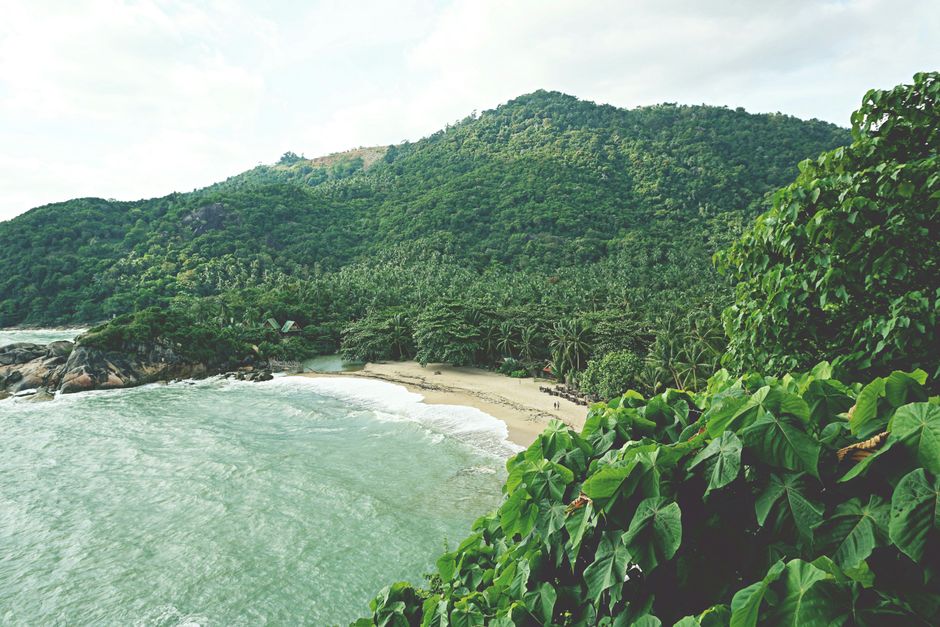
A picturesque tropical beach surrounded by lush green hills in Koh Phangan, Koh Phangan’s Bottle Beach, Thailand
What Surprises First-Time Visitors
The first surprise is the silence. After the rumble of longtail boats at Thong Sala and the constant hum of mopeds in Haad Rin, Bottle Beach feels like someone pressed a mute button. The loudest sounds are the rustle of palm fronds, the distant call of a rooster from the hills, and the soft crash of waves. Many travelers find themselves speaking in whispers for the first hour, as if in a library. The second surprise is the darkness. There are no streetlights; after sunset, the beach is lit only by the kerosene lamps of the restaurants and the stars overhead. Bring a headlamp or a flashlight, and you’ll quickly learn to navigate by the glow of the Milky Way.
The third surprise is the friendliness of the locals. Despite the beach’s growing popularity, the families who run the bungalows and restaurants remember returning guests by name. You’ll be greeted with wais and genuine smiles. On your second day, Nok might ask if you want your pork skewers “extra spicy” because she remembers your preference from the day before. It’s a level of personal care that you’d never find at a chain resort. And the final surprise—the one that catches everyone off guard—is how hard it is to leave. Travelers often book three nights and end up staying a week, canceling onward plans for the simple pleasure of waking up to the same view of turquoise water framed by limestone rocks. Bottle Beach has a way of rewiring your sense of time. What started as a destination becomes a state of mind.
Your Koh Phangan


Scenic tropical beach with palm trees and villas in Ko Pha-ngan, Thailand., Koh Phangan’s Bottle Beach, Thailand

