
Where Pearls & Coral Whisper: Unlocking the Soul of Saudi’s Farasan Islands (2026)
In 1911, a young pearl diver named Ahmed bin Zaid surfaced near Farasan al-Kabir with something that stopped the archipelago’s breath: a natural pearl the size of a pigeon’s egg, flawless enough to be deemed “worthy of a king.” The Ottoman governor of the Red Sea port of Jazan demanded it, and Ahmed was paid 1,000 rival gold pounds—enough to build his family a coral-stone house that still stands today. That single spark of fortune lit a pearl boom that transformed these quiet coral islands into a maritime trading crossroads, where smugglers, sheikhs, and merchants from Yemen, India, and Egypt jostled on the jetties.
The Story Behind the Farasan Islands
The Farasan archipelago—a scatter of 180 islands, reef flats, and sand cays about forty kilometers off Saudi Arabia’s southwestern coast—has played fortress, trading post, and oasis all at once. The ancient Sabaeans of Yemen were the first known seafarers to chart these waters around the 3rd century BCE, using the islands as a waypoint on the incense route. The name “Farasan” itself likely derives from the Arabic root for “knight” or the ancient southern Arabian word for “herdsmen,” a nod to the rugged, hardy people who made a life from fishing and pearl diving before living memory.
For centuries, the archipelago belonged, in practice, to no one. Its bays sheltered outlaws escaping Ottoman governors on the mainland; its reefs absorbed the hulls of unlucky monsoon ships. In 1843, the Ottomans reclaimed the islands and established a small garrison, but it wasn’t until 1900 that the Sultan Abdul Hamid II ordered the construction of the stone fortress, Al-Rami, that still watches over the harbor of Farasan town. The ottomans ruled with a light hand, but the pearl economy made Farasan wealthy enough to attract piracy. In 1912, the governor of Jazan, a ruthless tax-farmer named Abdel-Wahab, struck a deal with the island’s richest pearl merchants: military protection in exchange for a quarter of every pearl’s value.
The pearl bubble burst in the 1930s when Japanese inventor Kokichi Mikimoto introduced cultured pearls to the global market, sending Farasan’s economy into freefall. Many islanders abandoned the sea for work in the new Saudi state’s oil fields. When the Kingdom’s founder, King Abdulaziz, formally integrated Farasan into Saudi rule in 1926 (and again after the 1934 Saudi-Yemeni Treaty of Taif settled the border), the islands fell into a gentle obscurity. Now, a century later, travelers are rediscovering them: 2019 saw the opening of the Farasan Islands Marine Sanctuary, and the Saudi tourism push has brought a trickle of curious visitors looking for what the Arabian Peninsula lost—empty beaches, old coral architecture, and a pace of life set not by the clock but by the tide.
Neighborhood by Neighborhood

An Empty Coast in Farasan Island, SA, Farasan Islands, Saudi Arabia
Farasan City: The Island’s Living Heart
When your ferry glides into the port, the first thing you’ll notice is the color: the heat-bleached limestone walls of Farasan City’s waterfront houses are tilted like old chess pieces, their coral-brick façades washed white, ochre, and pale pink. The main street, Abdullah al-Sudairi Road, runs from the harbor past the bustling fish souq, where fishermen sell their morning catches—sardines, emperor bream, giant trevally—off the backs of battered pickups. You’ll find the older generations seated along the seawall, mending nets and arguing about football; they’ll wave you over for a cup of bitter qahwa if you linger.
Your first stop should be the Ottoman fortress of Al-Rami, a low, crenellated stone structure built in 1911 from quarried coral. It’s free to enter, and from its ramparts you’ll get the classic postcard view: the turquoise harbor, the stark islands, the white cube of the town spread at your feet. A five-minute walk west brings you to Al-Refai House, a pink-and-cream mansion from the 1920s with ornate gypsum reliefs of flowers, birds, and geometric stars carved by Yemeni master craftsmen. It now houses the Farasan Heritage Museum, where you’ll see pearl-diving weights (masabad), old navigation charts, and restored furniture that makes you feel like you’ve stepped into a wealthy pearl merchant’s double-drawing room. Plan for an hour here, and don’t be shy about asking the caretaker, who will eagerly tell you which carvings depict the peacock, an auspicious symbol for the merchant who built the house.
As evening falls, your best bet is the corniche promenade that curves along the southern shore. Families fly kites while boys ride bikes along the palm-lined path; food stalls fry fish and grill corn on the cob. At sunset, the light turns the calm Red Sea to liquid copper—a sight no photograph quite captures. Stay for the call to prayer from the town’s old minaret, a slender tower that offers one of the island’s most evocative soundtracks.
Al-Qassar: A Ghost Town of Pearl Merchants
Seven kilometers east of Farasan City, Al-Qassar (also spelled Al-Kassar) is the archipelago’s most atmospheric ruin—a deserted village whose grand mansions are slowly returning to sand. This was where the richest pearl merchants lived, building coral-stone palaces decorated with white gypsum, arched wooden wind-catchers, and imported Indian teak doors carved with Koranic verses. The most famous of these, Nashiri House, was built in 1905 for the pearl magnate Saleh bin Nashiri, who allegedly owned fifty dhows. Today, its walls lean, and fig trees sprout from the courtyards, but the intricate stucco work and carved plaster drips remain remarkably intact. Walking through Al-Qassar feels like exploring a Pompeii of the Arabian coast—especially when you peek into a room and see a section of hand-painted floral wallpaper still clinging to a wall, faded pink and gold.
The village’s quiet is hypnotic, but locals recommend you visit in the late afternoon when the low sun throws long, dramatic shadows across the crumbling façades. Your best bet is a taxi from Farasan City (around 30 SAR, ten minutes each way), or a bike if you’re feeling adventurous. The nearby cemetery, with its shadowy domed tombs of the pearling families, is worth a respectful pause. As you walk, you’ll notice a series of circular stone cisterns (sabal) carved into the ground—these collected rainwater, the island’s only fresh-water source before desalination. Al-Qassar is uninhabited, so bring water, sunscreen, and a sense of wonder—you will likely have the entire village to yourself.
Saqid Island: The Untamed Little Sister
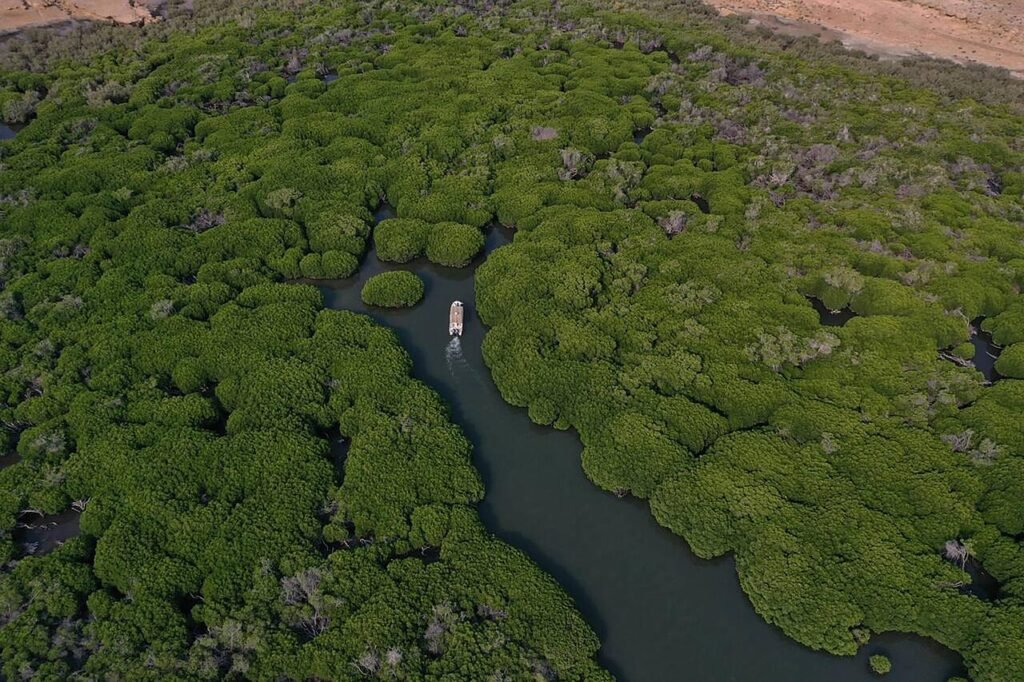
If you crave empty beaches and mangroves, take the twenty-minute ferry or hire a local boat (about 100 SAR round-trip) to Saqid, the archipelago’s second-largest island, connected by a sand spit at low tide. Saqid has no hotels, almost no restaurants, and only a handful of settled families, which is precisely its charm. The tiny village of Ghora on Saqid’s eastern shore is a cluster of low concrete homes, a few palm trees, and a seafront where fishing dhows lie tilted on the sand. Travelers often discover that Saqid’s real treasure is its quiet: you’ll hear only the lapping tide, the cry of ospreys, and the occasional phone ringing from a fisherman’s pocket.
The northern coast of Saqid gives way to the Farasan Islands Marine Sanctuary’s protected sea-grass beds, where the region’s famous dugongs—sea cows that local folklore calls “brides of the sea”—graze in the shallow, clear water. Sightings aren’t guaranteed, but between November and February you have a realistic chance. Your best bet is to join a guided kayak or paddleboard trip from Ghora early in the morning, before the sea breeze picks up. Seasoned travelers prefer packing a picnic and spending three hours exploring the mangrove channels, where juvenile reef sharks and turtles dart around the roots. Remember: no sunscreen with oxybenzone—locals are fierce protectors of the reefs, and the sanctuary patrols take fines seriously.
The Local Table: What Islanders Actually Eat

A sunset over a body of water, Farasan Islands, Saudi Arabia
Food in Farasan is a lesson in survival and generosity. With no agriculture to speak of, the island’s larder comes from the sea and the mainland—most families buy vegetables, bread, and dates that arrive daily on the ferry from Jazan. What defines the cuisine is freshness: fish is cooked within hours of being caught, and the islanders’ preferred preparation is refreshingly simple. The classic dish is samak al-farasan—a whole grouper or emperor bream, rubbed with turmeric, cumin, and chili, then grilled over mangrove charcoal and served on a mound of fragrant basmati rice cooked with tomatoes and onions. Locals eat it with their hands, squeezing fresh lemon and eating the crispy skin first, an etiquette you’ll quickly adopt once you try it.
Your best bet for an authentic meal is the fish souq in Farasan City, where small family-run shacks—look for one called Al-Bahr or the more famous Al-Samak ovens—will cook your market purchase for a small fee of about 10–15 SAR. Early morning is prime time: you buy your fish from the boats at 6:30 a.m., hand it to the grill master, and within twenty minutes you’re eating a breakfast that tastes like the Red Sea itself. For something more substantial, the town’s only sit-down restaurant, Marnat Farasan, does a lovely mandi with chicken or lamb, served with Yemeni-style honey and a sweet, thin roti called maalooj. Evenings bring the fishermen’s wives to the corniche with woven baskets of sambusas, fried dough, and sticky date sweets; travelers are always surprised by how often they get offered free samples.
One dish you must seek out is maraseh, a Farasan specialty you’ll rarely find elsewhere. It’s a kind of fish soup made with small, dried sardines simmered with onions, tomatoes, and copious fresh chili, thickened with a local dough called sahb. Locals swear it’s the only remedy for a cold, a hangover, or a broken heart. You’ll most likely be fed a bowl of it spontaneously by a friendly family on the beach—but if no invitation comes, ask any taxi driver to take you to “the house of Umm Saeed,” a legendary home cook who serves bowls of maraseh for 5 SAR from her front porch in the village of Zin.
Art, Music & Nightlife

A couple of birds standing on sand, Farasan Islands, Saudi Arabia
Don’t expect nightclubs or mega-galleries—the Farasan Islands’ creative scene is subtler and all the more rewarding for it. The living art here is the majlis

