
Where Mountains Meet the Sky: The Untold Story of Lake Sentani, Indonesia (2026)
In June 2008, just before dawn, a convoy of wooden fishing boats carrying elders from the villages of Ayapo and Yoboi drifted across Lake Sentani’s glassy surface. They were not fishing. They were reenacting a centuries-old peace ceremony that had once ended a bloody feud between their ancestors. The rising sun painted the Cyclops Mountains orange as the elders sang ancient verses in the air — a ritual that had not been performed in nearly seventy years. That morning, travelers who had come for the lake’s famous festival witnessed something far rarer than any tourist attraction: a living memory resurfacing from the deep.
The Story Behind Lake Sentani, Indonesia
Lake Sentani sits in the neck of Papua’s bird-head-shaped island, cradled by the foothills of the Cyclops Mountains — named by Dutch explorers in 1623 who thought the jagged peaks resembled a giant’s scowling face. But long before Dutch ships appeared, Lake Sentani was the heart of a sophisticated network of thirty or more shoreline villages united by a shared language, Sentani, and a complex system of hereditary chieftains. By the 1700s, the lake had become a crucial trade corridor linking the interior highlands to the coastal sultanates of Tidore and, later, to European spice traders. Lake Sentani was not a backwater — it was a crossroads.
The Dutch formally claimed western New Guinea in 1828, but it was not until 1901 that they established a permanent administrative post on Lake Sentani’s northern shore, near present-day Sentani town. The colonial era brought missionaries, who built the first schools and churches, and introduced the sago-eating lake communities to rice, coffee, and written script. But the deepest disruption came during World War II. In 1944, Allied forces built a landing strip on the lake’s flat terrain, today’s Sentani Airport, and used the lake as a staging ground for the invasion of Biak. Local elders still recall the roar of bombers skimming the water. After Indonesia took control in 1963 under the controversial Act of Free Choice, the lake became a symbol of integration and tension: a place where traditional clans, Javanese transmigrants, and a growing urban population learned to coexist.
Today, Lake Sentani is a place where layers of history sit quietly on the surface but churn beneath. The lake’s 96 square kilometers hold not only water but stories — of tribal warfare, missionary zeal, wartime sacrifice, and the slow, steady pulse of a culture that refuses to be erased. You’ll find that the people of Sentani do not call themselves “Papuan” first; they say, “I am from the lake.” And they mean it literally: your connection to this place is defined not by nationality but by the water you grew up navigating in a hollowed-out canoe.
Neighborhood by Neighborhood
Sentani Town — The Lake’s Front Door
Sentani Town, sprawling along the lake’s northern shore, is the administrative heart and the place where travelers almost always land first. Its main artery, Jalan Raya Sentani, runs parallel to the water and is lined with two-story shop-houses painted in faded pastels — mint green, salmon, powder blue — that feel more like a Sulawesi port town than a Papuan settlement. You’ll find the morning energy concentrated at Pasar Youtefa, a covered market that comes alive by 6:00 a.m. Here, women in woven noken bags sell bundles of fresh betel nut, bright purple yams, and whole freshwater fish glistening on banana leaves. The air smells of wood smoke, frying sago, and the faintly sweet, medicinal tang of pinang nut. On the lakeside promenade near the Sentani Lake Hotel, you’ll watch young men race motorized canoes while older men sit silently in dugouts, fishing with handlines. Sentani Town is not picturesque in a postcard way — it is raw, functional, and honest. Locals recommend taking a mid-morning break at Warung Mama Eti, a family-run stall behind the market, where you’ll get grilled tilapia (Rp 35,000) served with steamed sago and a fiery chili-dipping sauce called colo-colo.
Kampung Harapan — The Floating Village
Fifteen minutes by boat from Sentani Town, Kampung Harapan is a village built almost entirely on stilts over the lake’s southeastern shallows. The houses, constructed from ironwood and weathered corrugated metal, are connected by a network of narrow plank walkways that sway gently underfoot. This is a community of fishers and sago gatherers, and you’ll notice that nearly every home has a canoe tied beneath it, bobbing in the murky tea-colored water. The heart of the village is a small wooden mosque with a green dome, its call to prayer echoing across the lake five times a day. Travelers often discover that the people of Harapan are remarkably open — you may be invited into a home to share a meal of papeda (sago porridge) with yellow fish soup, eaten with bamboo chopsticks called gelas. The village has no electricity at night, and by 8:00 p.m., the only light comes from kerosene lamps and the stars reflected on the water. It is a place that asks you to slow down, to match your rhythm to the lapping of waves against wooden piles. The best way to visit is to hire a local guide from the Sentani Tourist Information Office (Rp 200,000 for a half-day tour, including boat hire).
Ayapo — The Weavers’ Hamlet
On the lake’s southern shore, Ayapo has earned a reputation far beyond Papua for its textile tradition. The women of Ayapo weave intricate bark-cloth blankets called kain timur, made from the inner bark of the cempedak tree, beaten, dyed with natural pigments, and embroidered with geometric patterns that tell clan stories. The village itself is a quiet cluster of houses hidden behind a fringe of coconut palms and banana groves. The main path leads to the communal weaving pavilion, where you’ll find three generations of women working under a thatched roof, their fingers moving with practiced precision. Locals recommend visiting during the dry season (June to September), when the bark is harvested and the dyeing vats are full of indigo, turmeric, and charcoal. You can buy a piece of kain timur directly from the weavers for around Rp 150,000 to Rp 300,000 depending on size and complexity — far better quality and price than anything sold in Jayapura’s souvenir shops. Ask for Mama Yuliana, the village’s senior weaver, who will show you how the bark is stripped, soaked, and beaten with a wooden mallet for hours until it softens into cloth. You’ll leave Ayapo with more than a souvenir — you’ll carry the feel of bark turning to fabric in your hands.
The Local Table: What Lake Sentani Dwellers Actually Eat

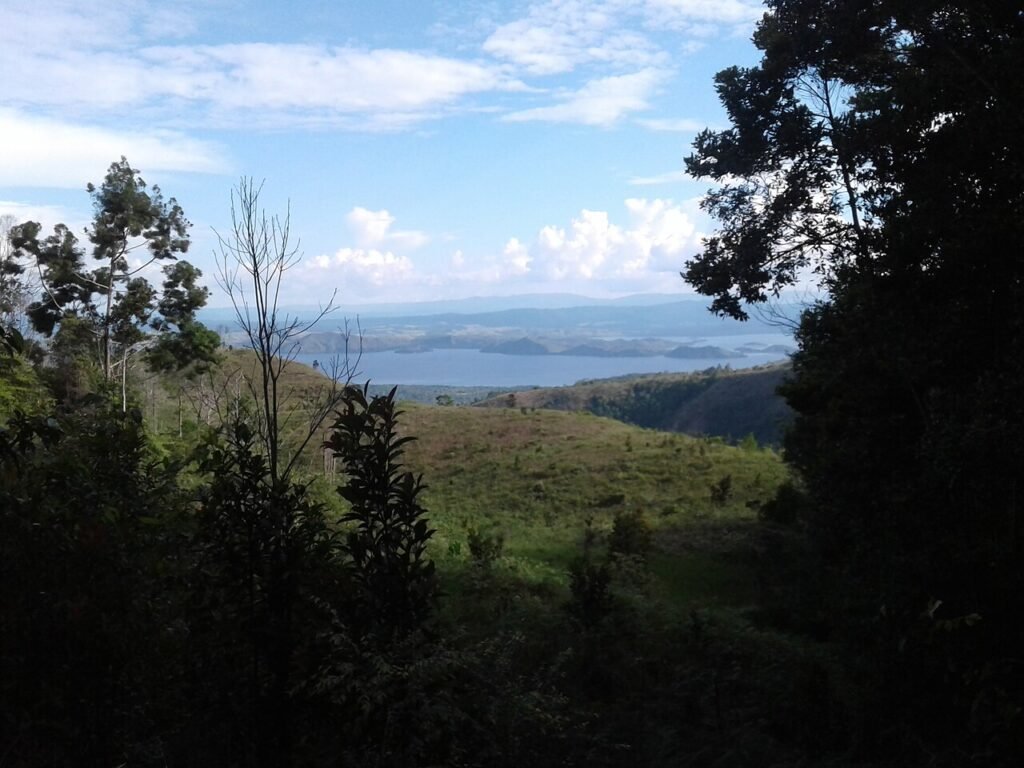
Pemandangan Danau Sentani dari ujung utara alang-alang di Kaki Pegunungan C…, Lake Sentani, Indonesia
Lake Sentani’s cuisine is built on three pillars: sago, fish, and the generosity of the forest. Most outsiders arrive expecting spicy Padang-style food or Javanese fried everything, but what you’ll find here is something far more elemental. Sago — the starchy pith extracted from the sago palm — is the backbone of every meal. It is processed into several forms: papeda, a glue-like porridge eaten with fish soup; sago lempeng, a grilled pancake stuffed with grated coconut; and sago bakso, a chewy dumpling served in broth. You cannot travel the lake without tasting it.
For the definitive Sentani culinary experience, make your way to Pasar Ramai in Sentani Town on a Sunday morning, when the market spills out onto the streets. Look for Ibu Maria’s stall near the back, identifiable by the cloud of steam rising from a massive aluminum pot. She serves ikan kuah kuning — freshwater fish (usually tilapia or mujair) simmered in a turmeric-coconut broth with lemongrass, ginger, and a generous handful of local lime basil. The fish is caught that morning from the lake. The sago porridge is made fresh. The chili condiment is ground from tiny bird’s eye chilies grown in her backyard garden. A full plate costs Rp 20,000. You’ll eat it with your hands, using your thumb to scoop the slippery sago and dip it into the golden broth. Travelers often discover that this simple meal — fish from the lake, sago from the swamp, chili from the red soil — is the most honest taste of Papua you’ll find anywhere.
Kampung Harapan holds another secret: a nocturnal dish called kahe-kake, a grilled freshwater eel that is skinned, marinated in lime and salt, and cooked over charcoal until the skin crisps to dark bronze. It is only prepared after sunset, and only on weekends. Locals say that the best version comes from Pak Dominggus, a fisherman who sets a small grill on his dock every Saturday evening. You’ll need to arrange a visit in advance through your guesthouse. The eel costs about Rp 50,000, and you’ll eat it with a side of steamed banana blossom salad drizzled with coconut cream. It is smoky, earthy, and utterly unlike anything you have tasted before.
Art, Music & Nightlife
Lake Sentani’s creative pulse beats strongest during the Lake Sentani Festival, held every June on the shores near Sentani Town. The event, inaugurated in 2008, is Papua’s largest cultural gathering and draws dance troupes from across the province. You’ll witness the tarian magaru, a warrior dance performed in elaborate feathered headdresses, and the tarian gatsi, where dancers balance on tall bamboo stilts while beating hourglass drums. The festival also features canoe races, traditional boat parades, and a juried competition for kain timur textiles. The dates shift annually, so check with the Jayapura tourism office; typically, it runs for four days in the third week of June. Accommodations in Sentani Town fill up months in advance, so book early via Booking.com — aim for at least three months ahead.
Beyond the festival, Lake Sentani’s nightlife is understated but authentic. In Kampung Yoboi, a twenty-minute boat ride from Sentani Town, you’ll find the only lakeside music venue of note: Asei Music House, a bamboo structure on the water where local bands play reggae and folk-rock covers on Friday and Saturday nights. The music starts around 9 p.m. and goes until midnight. Drinks are limited to cold Bintang beer and fresh young coconut water. There is no dance floor, no DJ, no cover charge — just a dozen people sitting on wooden benches, the lake lapping beneath the floorboards, and the Cyclops Mountains silhouetted against a star-filled sky. It is not exciting in the way Bali’s nightclubs are exciting, but savvy visitors recognize it as the real thing: a place where the community gathers, uninvented and unmediated.
Practical Guide

A body of water with mountains in the background, Lake Sentani, Indonesia
- Getting There: Sentani Airport (DJJ) receives flights from Jakarta, Surabaya, Makassar, and Denpasar. Garuda Indonesia, Lion Air, and Batik Air operate daily services. Book at Skyscanner. From the airport, it is a 20-minute taxi ride (Rp 100,000) to Sentani Town, or 45 minutes to Jayapura (Rp 250,000).
- Getting Around: The most practical way to explore the lake is by hiring a motorized canoe — costs around Rp 350,000 per day including a driver. For shorter hops between villages, you’ll pay Rp 50,000 to Rp 100,000 per ride. On land, use ojeks (motorcycle taxis, Rp 15,000 within town) or bemos (shared minibuses, Rp 10,000 per ride).
- Where to Stay: In Sentani Town, the Sentani Lake Hotel (Rp 450,000/night) offers clean rooms with lake views and reliable Wi-Fi. For a more immersive experience, stay in a homestay in Kampung Harapan (Rp 200,000/night, no electricity after 9 p.m., meals included). Check Booking.com for options and book early if visiting in June.
- Best Time: June to September for the dry season, clear skies, and the Lake Sentani Festival. Avoid December to March when heavy monsoon rains make boat travel difficult and the lake often floods the lower villages.
- Budget: A comfortable daily budget for one person is Rp 500,000 (about $32), including accommodation, three meals, transport, and a few small purchases. Budget travelers can get by on Rp 300,000/day by staying in homestays and eating at market stalls.
What Surprises First-Time Visitors
Most travelers arrive at Lake Sentani expecting a pristine, untouched paradise — and they find it, but not in the way they imagined. What surprises you first is the scale of human presence. The lake is not a wilderness; it is a living, working water body crossed by hundreds of motorized canoes every day, its shores dotted with stalls selling petrol in repurposed whiskey bottles and children swimming in water that is, frankly, not always clear. The beauty here is not one of postcard perfection but of daily life unfolding with the lake as its backdrop. You will see a woman washing clothes on a floating dock while a teenager speeds past on a jet ski rented from a tour operator. The juxtaposition is jarring at first, then charming.
Another surprise is how quiet the lake gets after dark. Because most villages have no electricity, and because the town shuts down by 9 p.m., the silence of Lake Sentani at night is profound. You can hear the water lapping against stilts, the distant call of a night bird, the soft murmur of voices from a neighboring house. For travelers accustomed to the constant hum of urban life, this quiet is both unsettling and deeply restorative. It forces you to sit with your own thoughts, or to talk with your host family by kerosene lamp. Locals are often amused by how quickly you adapt — within two days, you’ll find yourself yawning at 8 p.m. and waking naturally at dawn.
One last surprise: the warmth of the people. In many parts of Indonesia where tourism has become a transaction, the people of Lake Sentani retain a genuine curiosity about visitors. You are not a customer; you are a guest. You will be invited to eat, to watch a rehearsal, to sit in on a family conversation. Travelers often report being stopped on the street not for selling but for conversation. A man might ask where you are from, then tell you about his son studying in Jakarta. A woman might hand you a piece of fruit from her garden. It is a kind of hospitality that cannot be manufactured, and it leaves a lasting impression that no view or monument can match.
Your Lake Sentani, Indonesia Questions

A large body of water surrounded by mountains, Lake Sentani, Indonesia
Is Lake Sentani safe for tourists, especially solo travelers or women?
Yes, Lake Sentani is generally very safe, with low crime rates and a community that looks out for visitors. Violent crime is virtually unheard of in the villages, and Sentani Town has a visible police presence. That said, you should exercise the same caution you would anywhere in Indonesia: keep your valuables out of sight, avoid walking alone late at night on empty market streets, and respect local customs around dress, especially in the more conservative villages. Women traveling alone often report feeling comfortable and welcomed, but you may receive persistent attention from local men — a firm “tidak” (no) is usually respected. It is wise to arrange your boat tours through a registered guide rather than accepting offers from strangers at the dock.
How much time should I spend at Lake Sentani, and can I combine it with other Papuan destinations?
Four days is the ideal minimum:

