
Thiès, Senegal for Adventurers: Rock Climbing the Falaise de Thiès – Africa’s Best-Kept Vertical Secret (2026)
Your fingers grip the warm limestone as the wind whips from the Sahel across the tableland. Below you, the Falaise de Thiès drops 80 meters into a sea of baobabs and acacia. You breathe deep, taste dust mixed with lost centuries, and chalk up for the next move. This is not Yosemite. It’s better—it’s yours alone.
The Main Event: Scaling the Falaise de Thiès
Your best bet for an adrenaline-packed day starts 15 minutes south of Thiès town at the Falaise de Thiès, a 1.5‑kilometer limestone cliff that has been quietly drawing local climbers for decades. Travelers often discover that this crag offers over 30 bolted sport routes ranging from 5.6 to 5.13a, with vertical faces, sharp crimps, and tiny pockets that test your endurance in the dry Sahel heat. Start your session at the sector called “Le Baobab,” where the easiest lines run 20–25 meters. Head left for the steeper “Sénégalite” route (5.11d) if you’re looking for a pump. Plan to arrive by 7:30 a.m. when the rock is cool and the light rakes across the holds—by noon you’ll need shade and plenty of water.
Logistics are refreshingly simple. No permits required, no queues. Bring your own rope (60m), quickdraws (12–15), and a helmet—loose flakes exist, especially after rains. The approach is a 10‑minute walk from the parking area near the village of Ngoundiane. A local guide named Mamadou Diallo (reach him via the Facebook group Escalade Sénégal) charges 15,000 CFA (about $25) per half‑day for gear if you don’t have your own and will show you the best warm‑ups before the sun catches you. Insider tip: climb the two routes immediately left of the baobab tree at the base—those were retrofitted in 2022 and have the cleanest bolts. Don’t forget to tap every hold; the limestone can be deceivingly sharp. For a real test of nerve, finish with “L’Éperon du Guepard” (5.12a), a 35‑meter arete that you will remember for years.
Activity #1: Quad Biking the Bandia Reserve Perimeter
When your forearms need a break from crimping, quad biking around the Bandia Reserve delivers exactly the right kind of dusty, high‑speed rush. You’ll find operators at the reserve entrance (Route de Mbour, 25 kilometers southwest of Thiès) who rent 250cc quads for 25,000 CFA ($40) per hour, or 30,000 CFA ($50) for a two‑hour guided loop that skirts the fence line and plunges through baobab groves. The best time to go is 4 p.m.–6 p.m., when the heat softens and giraffes, zebras, and warthogs emerge from the shade. Guides from Bandia Quad Adventures (you can book via their Instagram @bandiaquad) will take you on a 15‑kilometer track that crosses dry riverbeds and climbs a small hill for panoramic views of the reserve. Locals recommend wearing a bandana—the dust gets into everything. Bring your own helment if you can; the rental ones are basic. This is the closest you’ll get to a rally stage without leaving West Africa.
Activity #2: Hiking the Montagne de Thiès Ridge
For a mid‑adventure break from the vertical world, the Montagne de Thiès ridge hike offers a satisfying scramble with a cultural twist. Trailhead is at the village of Pout, about 10 kilometers north of Thiès town. The full loop takes three to four hours over gentle slopes and two rocky summits (the highest point is 200 meters, but the views stretch to the Atlantic on a clear day). You’ll pass through ancient baobab trees that local Serer communities consider sacred—travelers often discover small offerings of millet and cloth tied to branches. The path is unmarked in sections, so download Maps.Me offline for the route, or hire a guide from the community co‑op at the village square (5,000 CFA / $8). Best in the early morning before 9 a.m. to avoid the midday heat. Pack two liters of water per person and some extra snacks for the summit—you’ll want to linger as a squadron of hornbills passes overhead.

Pictures taken during one of the Kiwix program (offline Wikipedia) presenta…, Thiès, Senegal
Refuel: Where Adventurers Eat
After a day of gripping limestone or dodging baobabs, your body craves protein and spice. Head to Chez Fatou on Rue de l’Indépendance in central Thiès. This local favorite serves a heaping plate of thiéboudienne (the national dish of fish, rice, and vegetables in a tomato‑onion sauce) for 2,500 CFA ($4). Travelers recommend asking for extra yassa sauce—it’s a punchy mix of onions, mustard, and lemon that will revive you. Second stop: Le Djembé, a courtyard restaurant near the train station, where you’ll find grilled lamb brochettes (1,500 CFA for four skewers) and a salad of mango and avocado. Owners often let you store your climbing gear in the back while you eat. For a sunset wind‑down, La Terrasse de la Falaise (at the base of the climbing area, open weekends only) serves cold Gazelle beer and fried plantains with spicy chili sauce – the perfect reward after sending a project.
Base Camp: Where to Stay
Active travelers need accommodations that understand early breakfasts and gear storage. Hôtel de la Paix (Avenue de la République) offers clean doubles from 35,000 CFA ($58) per night, with a restaurant that packs breakfast boxes if you leave before 6:30 a.m. They also have a locked room for bikes and climbing equipment. For a closer‑to‑nature experience, Campement de la Falaise, right at the base of the climbing sector, rents simple tents (5,000 CFA per night) and dorm beds (8,000 CFA). Locals recommend camping here to catch the first light on the cliffs and avoid the commute. If you prefer a mid‑range option with pool and Wi‑Fi, Relais de Thiès (Route de Dakar) charges 50,000 CFA for a double room and offers early‑morning coffee starting at 5 a.m. Book via Booking.com for the best rates, especially during the high season (December–February).

A vibrant street mural in Senegal depicting urban life and artistic expression., Thiès, Senegal
Gear & Prep Checklist
- Climbing shoes with aggressive downturn for sharp pockets; avoid high‑mileage rentals locally
- Helmet and personal quickdraws (12–15); local gear is available but limited
- Two‑liter hydration bladder or bottles with electrolyte tablets – Sahel heat dehydrates fast
- Good physical condition: be able to climb 5.10a on sight for the classic lines on the Falaise
- Safety consideration: limestone can be loose after rain; check the forecast and avoid climbing within 48 hours of a storm
Getting There & Around
- Flights: Fly into Dakar–Blaise Diagne International Airport (DSS). Book at Skyscanner. From there, it’s a 50‑minute drive east on the N1 highway to Thiès.
- Local Transport: The cheapest way is a sept‑place shared taxi (3,000 CFA per person) from Dakar’s Pompey garage to Thiès’ main gare routière. For the Falaise, take a taxi from Thiès centre to Ngoundiane village (5,000 CFA, 15 minutes). Walking from town is possible but hot.
- Best Season: November to April for dry, cool mornings and reliable climbing. May to October is wet and humid – climbing routes can be greasy and unsafe. Paragliding and quad biking are best in January‑February when winds are stable.
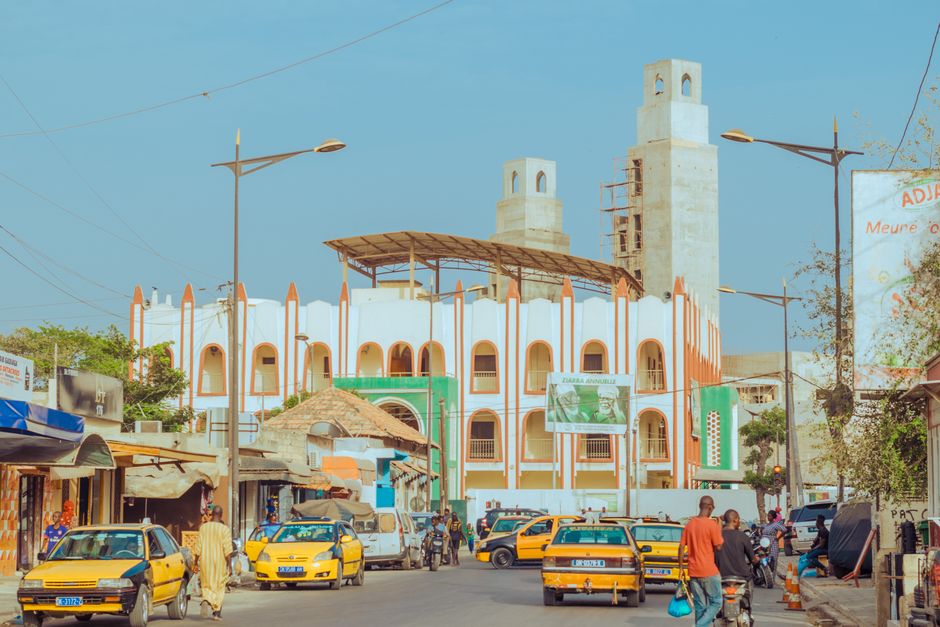
A vibrant street scene featuring an Islamic mosque with distinct architectu…, Thiès, Senegal
Is Thiès, Senegal Worth It?
Honest answer: if you’re a climber seeking crags without crowds, absolutely. The Falaise de Thiès offers quality limestone in a setting that feels undiscovered—you will often be the only party on a route. Travelers who love cultural immersion will appreciate the blend of adventure and Serer traditions. However, if you require polished infrastructure, restaurant variety, or nightlife after a climb, Thiès will disappoint. Compare it to the Atlas Mountains in Morocco: Thiès is less developed, less expensive, and far less touristy, but also has fewer routes and no alpine scale. The secret is that for $30 a day you can climb, quad, and eat like a king. This is for the traveler who values raw experience over comfort. End your day with a beer at the base of the cliff, watching the sunset turn the limestone gold, and you will know exactly why you came. Your adventure in Thiès isn’t just a trip—it’s a story you will tell for years.

