
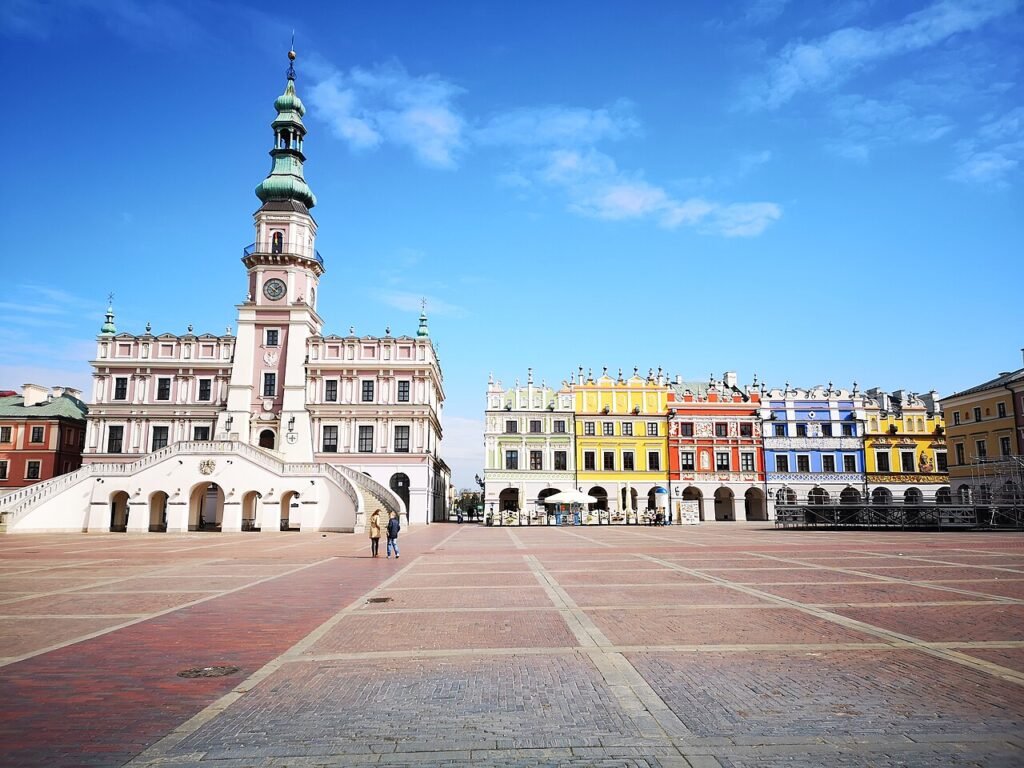
The Renaissance Jewel of Poland: Why Zamość Captivates Travelers Who Seek Authentic History (2026)
In 1580, Polish Chancellor Jan Zamoyski summoned Italian architect Bernardo Morando to a marshy plain in eastern Poland. Zamoyski handed him an audacious vision: build a utopian city of perfect Renaissance proportions, a “Padua of the North” that would rival the great Italian city-states. Morando, a student of the Venetian school, surveyed the wilderness and began laying out a geometric masterpiece—a fortress town woven from arcaded squares, defensive bastions, and humanist ideals. Today, you will find Zamość standing almost unchanged, a UNESCO World Heritage site that feels like a time capsule from the age of reason.
The Story Behind Zamość, Poland
Zamość was born from ambition and intellect. Jan Zamoyski, one of the most powerful men in the Polish–Lithuanian Commonwealth, envisioned a model city that would serve as both a fortified stronghold and a center of learning and trade. The city’s heart, the Grand Market Square, was designed with two rows of arcaded townhouses—one row for Italian-style loggias, the other for Polish-style attics—a blend that travelers still marvel at today. Construction began in 1580 and took nearly two decades; the first residents moved in around 1590, and the city was formally granted Magdeburg rights in 1591.
For two centuries, Zamość thrived as a melting pot of Poles, Jews, Armenians, Germans, and Italians. The Zamoyski family founded an academy here in 1594, attracting scholars from across Europe. But the city’s fortress walls were tested multiple times: the Cossack uprising of 1648, the Swedish Deluge of 1655–1660 (when the city’s defenses held firm against a siege), and later partitions that carved Poland off the map. In 1772, the First Partition of Poland placed Zamość under Austrian rule, and the city began a slow decline. During World War II, the Nazis established a transit camp and ghetto, decimating the large Jewish population that had shaped the city’s character for centuries. After the war, communist authorities left the Old Town untouched—they had no budget for redevelopment—and this neglect ironically preserved the Renaissance layout and a hundred original tenement houses. In 1992, UNESCO recognized Zamość as a monument of world heritage, and today locals proudly call it “the pearl of the Renaissance.”
Neighborhood by Neighborhood

Zamość, Partyzantów 3, Zamość, Poland
The Old Town (Stare Miasto) – The Grand Market Square and Arcades
Your journey begins at the Grand Market Square (Rynek Wielki), a 100-by-100-meter square that feels like an outdoor salon. The cobblestones still carry the ochre and terracotta tones of Morando’s palette. You’ll notice the asymmetrical Town Hall with its grand staircase and 52-meter tower—locals recommend climbing the 160 steps for a panoramic view at sunset, when the arcades cast deep shadows and the plane trees rustle. The surrounding tenements, each with a unique attic gable, house coffee shops, galleries, and small museums. On warm Saturday evenings in July, the entire square fills with visitors for the “Zamość Summer of Theatre” festival, where troupes perform on an outdoor stage. Don’t miss the tiny Armenian tenement at No. 10, where you can still see the original 17th-century wooden ceiling—a rarity in Poland. For a mid-morning break, seat yourself at Café Bohema (No. 15) and order a slice of sernik (Polish cheesecake) made with local Roztocze cheese and a shot of herbal liqueur.
The Jewish Quarter – Ulica Zamenhofa and the Synagogue
Head two blocks south of the square, and you enter what was once the heart of Zamość’s Jewish community. Before the war, Jews constituted over 40 percent of the population. Today, the restored 17th-century Zamość Synagogue at ulica Pereca 14 stands as a poignant reminder. It was saved from decay in the 1990s and now houses a museum dedicated to the city’s Jewish heritage. You’ll find detailed exhibits on daily life, religious traditions, and the tragic liquidation of the ghetto in 1942. Nearby on ulica Zamenhofa (named for the creator of Esperanto, who lived in Zamość as a young man), you’ll see the mikvah building and the remains of the Jewish cemetery, where fierce locals fought for decades to preserve the headstones. Travelers often remark that this quiet quarter feels heavier than the joyful square—a necessary pause for reflection. Try to visit on a Thursday morning when the small community-run “Kawiarnia Pamięci” opens for coffee and storytelling in the synagogue’s old study room.
The Bastion Fortifications – A Walk Around the Walls
Zamość’s defenses are as remarkable as its architecture. The city was designed as a “bastion fortress”—a star-shaped ring of seven massive earthen ramparts. Your best bet for a half-day walk is to start at the Lublin Gate (Brama Lubelska), a beautifully preserved Baroque arch, then follow the path along the moat, now a green park. You’ll pass the Lwów Gate (Brama Lwowska), the Arsenal, and the former barracks. The fortifications were so effective that the city was never captured by direct assault—only surrendered after prolonged sieges. At the southwestern tip, you’ll discover the New Town (Nowe Miasto), a 19th-century development with elegant villas and a leafy square called Plac Stefanidesa. Here, locals take their evening strolls past the Orthodox Church of St. Nicholas (built 1890) and the neo‑Gothic church of St. Catherine. It’s a world away from the Renaissance center—quieter, greener, and ideal for a lazy picnic with bread, cheese, and cold cuts from the Targowisko Miejskie (city market) held every Saturday morning on ulica Piłsudskiego.
The Local Table: What Zamość Natives Actually Eat
Zamość sits at the confluence of Polish, Ukrainian, and Jewish culinary traditions. Locals take pride in their use of buckwheat, root vegetables, and freshwater fish from the nearby Roztocze hills. The most iconic dish you must seek out is called “cebularz zamojski”—a yeasted flatbread topped with caramelized onions, poppy seeds, and sometimes a smear of lard. It’s sold fresh from street stalls and bakeries, best eaten warm. For a full meal, head to Restauracja Padwa at ulica Ormiańska 1, a family-run spot where the menu lists żurek (sour rye soup with egg and sausage) and pierogi ruskie filled with potato and farmer’s cheese from a local dairy. For something heartier, order the “kotlet schabowy” with boiled potatoes and a side of “mizeria” (cucumber salad in sour cream).
The real food culture, however, reveals itself at the Saturday market on ulica Piłsudskiego. From 7 a.m. to noon, farmers from the surrounding villages sell fresh curd cheese, honey, wild mushrooms in autumn, and jars of pickled cucumbers. You’ll notice the aroma of grilled kielbasa from a metal cart set up by Pani Halina—she’s been firing up the same charcoal grill for 25 years. Grab a Polish sausage in a fresh bun, add mustard, and wash it down with a cup of hot apple cider (if it’s winter) or cold kompot (a fruit compote drink) in summer. No meal in Zamość is complete without a small glass of “nalewka” (herbal liqueur) – try the plum or cherry variety offered by the staff at restaurant Stara Meldunek on ulica Staszica, where an unassuming door leads to a candlelit wooden cellar.

Beautiful Zamość, Poland scenery
Art, Music & Nightlife
Zamość’s cultural scene is small but vibrant, especially during the summer months. The city’s main event is the “Zamość Summer Theatre Festival” (usually the last two weeks of July), when the Grand Market Square transforms into an open-air stage for Polish and international theatre troupes, clown troupes, and puppet shows. You’ll also find the “Days of Zamość” festival in mid-June, celebrating the city’s founding with historical reenactments, a concert of classical music in the Town Hall courtyard, and food stalls. For visual art, visit the Galeria Rynek at ulica Rynek 10, a contemporary gallery inside a 16th-century tenement. They host rotating exhibitions of local painters—often featuring the Roztocze landscape in oils and watercolours.
After dark, the Old Town has a mellow but friendly vibe. Your best option for a drink is Klub 112 at ulica Przechodnia 1, a laid-back basement bar with exposed brick and live jazz on Thursday nights. They pour local craft beers from the Browar Zamkowy brewery in nearby Krasnystaw, and you can order a plate of cured meats to share. If you prefer something cozier, Café Bohema on the square stays open until midnight, serving wine and hot chocolate. Look for the few locals playing chess in the corner—they’re always happy to explain the city’s history in broken English. For a nightcap, step into the tiny whiskey bar “Stara Aptecka” at ulica Grodzka 7, built inside a former pharmacy with original wooden cabinets. One whiskey, one story, and you’ll feel part of the rhythm.

A row of multicolored buildings on a cloudy day, Zamość, Poland
Practical Guide
- Getting There: The nearest airport is Lublin (LZZ), about 75 km away. Flights from Warsaw, London, and Frankfurt operate seasonally. Alternatively, fly to Warsaw (WAW) and take a train (3.5 hours, costs about 50–80 PLN). Check connections at Skyscanner.
- Getting Around: The Old Town is compact and entirely walkable. For the fortifications and Jewish Quarter, you can rent a bike from “Zamość Bike” (15 PLN per hour) or take local buses (3.20 PLN per ride). Taxis start at 10 PLN within the city. A tourist tram (a small open car) does a 30-minute loop of the main sights for 15 PLN.
- Where to Stay: Stay in the Old Town for atmosphere: Hotel Renesans (ulica Rynek 10, rooms from 200 PLN) offers rooms with original arched ceilings. For budget option, Hostel Stary Ratusz (ulica Rynek 12) has dorms for 50 PLN. For quiet and green, choose Villa Nova in the New Town. Compare rates at Booking.com.
- Best Time: May to September. The weather is warm (20–28°C) and all the outdoor events happen. July and August are busier, but still far from crowded. For fewer tourists, late May or early September are ideal. Avoid January–February unless you want a frozen, quiet version.
- Budget: Mid-range travelers spend about 250 PLN (€55) per day, including accommodation, meals, and attractions. Budget backpackers can get by on 140 PLN. A three-course meal for two costs around 120 PLN. Museum entries are 10–20 PLN.
What Surprises First-Time Visitors
You might expect a city so historically important to be overrun with tourists, but Zamość remains gloriously calm. Travelers often discover that the Grand Market Square has only a handful of cafes and no chain restaurants—it feels like a living village square rather than a commercialized attraction. The second surprise is how well-preserved the Jewish Quarter is; the restored synagogue is among the finest in Poland, yet almost empty of visitors. You’ll have the space to yourself, which allows for quiet contemplation.
Another delight is the warmth of locals. In the evenings, families come out to the square to share ice cream and let children chase pigeons. Street musicians set up near the town hall steps, playing accordion covers of popular Polish songs. You’ll

