
The Island of Silence and Song: Why São Nicolau Whispers to Every Traveler Who Stays (2026)
In the year 1775, Portuguese settlers officially founded the settlement of Ribeira Brava in a deep, sheltered valley on the northern coast of São Nicolau, naming it after the fast-flowing stream that once ran through its heart. Today, you will find this town quiet, its cobblestone streets and colonial-era churches standing as gentle, stone witnesses to a history that few travelers pause to uncover. Locals still tell the story of the great flood of 1856 that reshaped the valley floor, a reminder of the island’s volcanic volatility and resilience.
The Story Behind São Nicolau, Cape Verde
Long before any European set foot on its black-sand shores, São Nicolau was a volcanic peak rising from the Atlantic, uninhabited and untouched. When Portuguese navigators first charted the island in the 15th century, they named it after Saint Nicholas, the patron saint of sailors and merchants. For centuries, the island remained a quiet outpost, overshadowed by the bustling slave ports of Santiago and the sugar plantations of Fogo. But by the mid-1700s, the Portuguese crown saw strategic value in its remote, defensible valleys and granted land concessions to settlers from Madeira and the Azores.
The island’s true character emerged in the 19th century when the town of Ribeira Brava became a refuge for literary and intellectual figures fleeing political turmoil in Portugal and the Americas. Among them was the poet and abolitionist José Lopes da Silva, who spent his final years on the island, writing verses about the stark beauty of its eroded peaks and the resilience of its people. Travelers often discover that this quiet intellectual tradition lives on in the island’s second-hand bookshops and the impromptu poetry readings that break out in local bars on Friday nights. By 1910, the island’s population had swelled to nearly 10,000, supported by subsistence farming and the export of salt from the now-abandoned salt pans in the north.
Independence in 1975 brought a new era of isolation as investment flowed to larger islands like Sal and Boavista. São Nicolau retreated into itself, preserving its cobblestone lanes, traditional stone houses with red-tiled roofs, and the slow rhythm of a life lived largely without tourists. Locals recommend that visitors understand this context: the island’s charm lies not in what it offers, but in what it withholds.
Neighborhood by Neighborhood
Ribeira Brava: The Colonial Heart
You will want to start your exploration in Ribeira Brava, the island’s main town and administrative center. The nucleus is the leafy Praça Dr. José Augusto Pinto, a plaza shaded by ancient ficus trees where elders play checkers under stone arcades that date to the 18th century. The square is anchored by the Igreja de São Nicolau, a severe white church built in 1777 with twin bell towers and an interior of simple wooden pews and a single, luminous blue ceiling panel. Wander north up Rua de Portugal, where pastel colonial mansions with decaying wrought-iron balconies stand cheek-by-jowl with small grocery stores selling Brazilian biscuits and Portuguese wine. The town’s quietness can feel eerie at midday, but savvy visitors know that life awakens here between 4 p.m. and 7 p.m., when the post-work crowd gathers at Café Central for Bica coffee and coconut pastéis.
Carriçal: The Fishermen’s Hamlet
Ten kilometers east along the coast, you will find Carriçal, a fishing village of no more than 200 souls. Travelers often describe the drive from Ribeira Brava as a meditation: the road snakes through volcanic landscapes of black lava flows and dry riverbeds, with the Atlantic crashing below. Carriçal itself is a single unpaved lane of brightly painted concrete houses, a dusty football field, and the small white chapel of Nossa Senhora do Mar, built in 1958 by a local fisherman after a storm spared his boat. Locals recommend arriving by 8 a.m., when the fishing boats return to the beach and you can buy fresh tuna, wahoo, and caco (a local grouper) directly from the catch, paying around 700 CVE (about €6) for a whole fish that you can have grilled at the single restaurant, O Pescador, for an additional 300 CVE.
Preguiça: The Sleeping Port Town
On the southwestern tip of the island, you will discover Preguiça, a near-ghost town that was once the island’s main port. The name translates to “laziness,” and you will find that the place lives up to its moniker. Narrow streets of crumbling 19th-century warehouses and abandoned customs buildings lead down to a pier where rusty container ships still call once a week. The centerpiece is the run-down but beautiful Câmara Municipal, a former governor’s residence with a faded blue facade and a courtyard of bougainvillea. Travelers who make the journey here are rewarded with an unvarnished view of Cape Verde’s economic challenges, but also with profound solitude: you can walk the entire length of the waterfront without seeing another soul, watching cargo vessels bob in the cobalt distance. The one hotel, a simple guesthouse called Pensão Preguiça, offers rooms for 30€ a night, but you will need to call ahead to make sure someone is there to let you in.
The Local Table: What Natives Actually Eat
You will find that the cuisine of São Nicolau is defined not by elaborate sauces or imported delicacies, but by what the island’s volcanic soil and surrounding ocean provide. The foundation is cachupa, the national dish of Cape Verde, a slow-cooked stew of hominy corn, beans, and sweet potato that, in São Nicolau, is often made with cured pork sausage and a heavy hand of bay leaves. Locals eat it for breakfast, lunch, and dinner, and every family has their own variation. Your best bet is to find a stall at the Monday morning market in Ribeira Brava, where women from the surrounding valleys sell homemade cachupa in clay pots for about 150 CVE (less than €1.50) per bowl.
Sailing ship “Le Ponant” at São Nicolau (Kap Verde), São Nicolau, Cape Verde
But the dish that defines this island, the one you must seek out, is tártaro de atum — a raw tuna preparation that reflects the island’s Portuguese heritage and its direct access to pristine fish. At the small family-run restaurant Restaurante Nicolau in Ribeira Brava, owned by Dona Helena, you will find a version that combines diced local tuna with red onion, coriander, and a squeeze of lime, served with boiled sweet potato wedges. The secret, locals will tell you, is in the quality of the fish, which Dona Helena buys directly from the Carriçal boats at dawn. Plan to pay 500 CVE (€4.50) for a generous portion.
You will also encounter grogue, the fiery sugarcane spirit also called “the white fire” on São Nicolau. Unlike the sweeter versions on other islands, the grogue here is distilled in homemade copper stills hidden in the interior’s volcanic ravines and sold out of plastic bottles from private homes. Locals advise tasting it first before buying a full bottle—it can be aggressive for the uninitiated. The ritual is to drink it neat from a shot glass at room temperature, saying “Saúde” loud enough for the whole bar to hear.
Art, Music & Nightlife
São Nicolau is the birthplace of morna, Cape Verde’s most expressive and melancholic musical tradition. You will hear it in the voice of B. Leza, a native of the island who, in the 1930s, composed some of the most enduring morna songs, including “Flor Morena” and “Ontem.” His house in Ribeira Brava, a modest two-room stone building on Rua Manuel de Novais, has been converted into a small museum that you can visit for free; just knock on the door of the neighbor, Dona Maria, who holds the key. The island’s musical soul lives on in the annual Festival de Morna e Jazz, held in the first week of August on the outdoor stage in the Praça Dr. José Augusto Pinto. You will find no cover charge and no ticket; you simply show up with a chair or stand under the ficus trees as local musicians and visiting artists from Praia and Lisbon play until 2 a.m.
Nightlife on São Nicolau is not a club scene but a community affair. The bar that matters most is Bar do Mário, a single room with a wooden counter, a pool table with half the balls missing, and a jukebox loaded with 1990s morna cassettes. You will find Mário himself there every night from 8 p.m. until midnight, serving grogue and Super Bock beer (130 CVE per bottle) to a rotating cast of fishermen, teachers, and retirees. The true spectacle happens around 10 p.m., when someone inevitably picks up a guitar or a cavaquinho, and the room breaks into spontaneous song. Locals will tell you that this is not a performance for tourists—this is how São Nicolau remembers itself at the end of every long, dry day.
Practical Guide
- Getting There: Fly into São Nicolau’s small Aeroporto de São Nicolau (VXE), served by TICV (Cape Verde Airlines) and Binter CV with daily flights from Praia (1 hour, from 8,000 CVE one way) and São Vicente (30 minutes, from 5,000 CVE). Book at Skyscanner
- Getting Around: Your best bet is to rent a car from Aluga Nicolau in Ribeira Brava (from 4,500 CVE per day, including insurance). Local minibuses, or carros de aluguer, run between Ribeira Brava and Carriçal (200 CVE, 30 minutes) and between Ribeira Brava and Preguiça (250 CVE, 40 minutes), but departures are unreliable. Taxis are unmetered; negotiate a half-day rate around 3,000 CVE.
- Where to Stay: In Ribeira Brava, the Hotel Ribeira Brava offers clean doubles with breakfast from 7,000 CVE/night. For a budget option, the Pensão Residencial Nicolau has basic rooms for 3,500 CVE. In Carriçal, the guesthouse Morabeza Carriçal has three simple rooms with ocean views for 4,000 CVE—book ahead. Check Booking.com
- Best Time: Visit between November and June, when daytime temperatures sit at a pleasant 24–28°C. Avoid August and September, when the bruma seca (dry fog) from the Sahara blankets the island in a dusty haze, limiting visibility to under 500 meters.
- Budget: Expect to spend around 5,000–6,000 CVE per day (about €50) for a moderate traveler including accommodation, three meals, transport, and one activity. This island is not cheap, but it is affordable for a volcanic paradise.
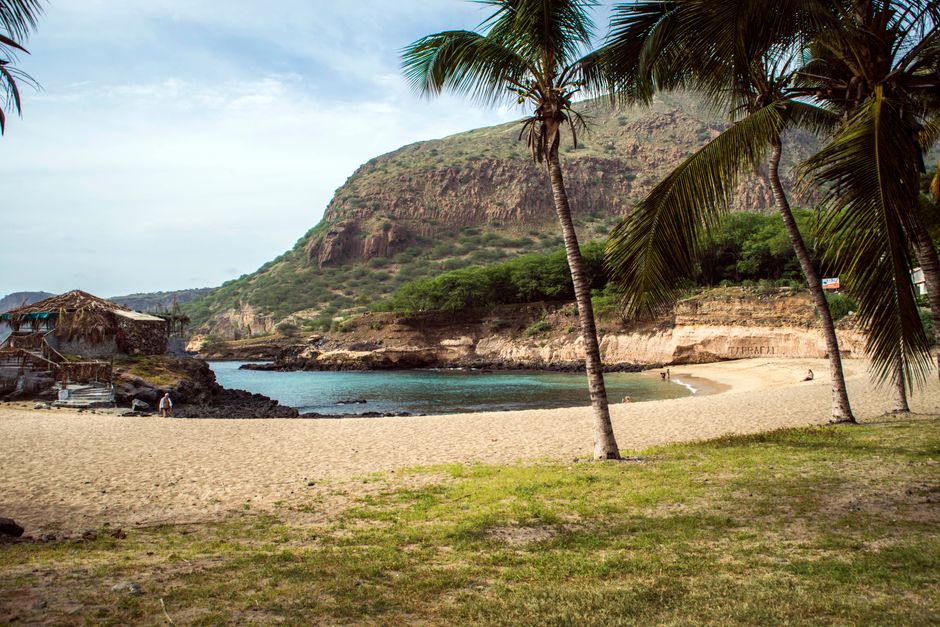
Discover the tranquil beauty of a tropical beach in São Lourenço dos Órgãos, São Nicolau, Cape Verde
What Surprises First-Time Visitors
Most visitors arrive expecting Cape Verde’s trademark white-sand beaches and are taken aback by São Nicolau’s stark, lunar interior. You will find no palm-fringed resorts here; instead, you are greeted by the raw visage of a volcano that has not erupted in 10,000 years, leaving behind rivers of black lava, crystalline pebbles, and an almost primeval quiet. The surprise is that this landscape is not barren but alive with a subtle beauty: the groves of dragon trees and the sudden flash of a kingfisher along the dry riverbeds.
Travelers also often misjudge the island’s pace. You cannot rush São Nicolau. Shops close for three-hour lunch breaks, the bank may open late without explanation, and the one key that opens the church is held by a woman who can’t be found until 4 p.m. Savvy visitors learn to surrender their itinerary to the island’s rhythm. Locals will nod approvingly when you do, and you will be rewarded with genuine invitations to share a bowl of cachupa or a glass of grogue in a home overlooking the valley.
The final surprise is the warmth of the island’s human connections. In a place with so few tourists, every foreign face is an event. You will be remembered, greeted by name on your second day, and asked about your plans by everyone from the baker to the police officer at the single roundabout. For travelers accustomed to anonymity, this can feel at first intrusive and later transformative. São Nicolau does not let you remain a stranger.
Your São Nicolau, Cape Verde Questions
Is São Nicolau safe for solo travelers, especially women? Yes, it is one of the safest islands in Cape Verde. Violent crime is virtually nonexistent, and the biggest risk you will face is the uneven cobblestones after dark. That said, you should exercise the usual precautions: avoid walking alone on unlit roads late at night, and keep valuables out of sight. Locals are protective of visitors and will often offer to walk you back to your accommodation.

A fisherman pushes a colorful boat towards the shore of Tarrafal Beach in C…, São Nicolau, Cape Verde
Can you hike on São Nicolau without a guide? Absolutely. The island’s interior is crisscrossed with old footpaths used by farmers and shepherds that make for excellent day hikes. Your best bet is to pick up a sketch map from the tourism office in Ribeira Brava. The most rewarding route is the three-hour walk from the village of Canto de Baixo up to the peak of Monte Gordo (1,312 meters), the island’s highest point, from which you can see the neighboring islands of São Vicente and Santa Luzia on a clear day. No guide is needed, but bring at least two liters of water and a hat—the sun is brutal even in December.

