
The Clay Citadel: Why Ait Benhaddou’s Ksar Beckons Every Traveler Who Wanders the Sahara’s Edge (2026)
In 1987, when UNESCO declared Ait Benhaddou a World Heritage site, the ten families still living within its mud-brick walls barely stirred. For centuries, this ksar had watched camel caravans clatter through its gates, carrying salt, gold, and slaves from Timbuktu to Marrakech. The French colonial officer who documented the site in 1930 wrote that its towers “rose from the earth like the fingers of a buried giant.” Today, you will find that same silent majesty waiting—unchanged, unpolished, utterly unforgettable.
The Story Behind Ait Benhaddou’s Ksar, Morocco
The ksar’s story begins in the 11th century, when the Almoravid dynasty carved a trade empire across North Africa. Ait Benhaddou sat at a strategic choke point on the old caravan route from the Niger River to the Atlantic. Merchants stopped here to rest, barter, and pay taxes to the local Berber chieftain. By the 17th century, the Alaouite sultans—the same dynasty that rules Morocco today—fortified the settlement, adding the defensive tower that still dominates the skyline. Locals will tell you that the ksar’s name comes from the Benhaddou tribe, who swore loyalty to the sultan in exchange for protection. You can still see their communal granary at the summit, a silent vault where families stored grain during sieges.
Travelers often discover that the ksar’s golden age faded when French colonial engineers built a new road through Ouarzazate in the 1930s, diverting trade away from the ancient pass. By the 1960s, nearly all families had moved across the river to a modern village with electricity and running water. But then came the movies. In 1962, David Lean shot scenes of Lawrence of Arabia at the ksar’s gates. You will recognize the tower from Gladiator (2000), where it stood in for a Roman outpost. Game of Thrones fans will spot it as the city of Yunkai in Season 3. The ksar has played everything from a Jerusalem market to a Saharan fortress. Yet somehow, it never lost its soul. When the film crews leave, the only sounds you will hear are wind scraping against clay and the distant bleat of goats.
Neighborhood by Neighborhood
The River Threshold
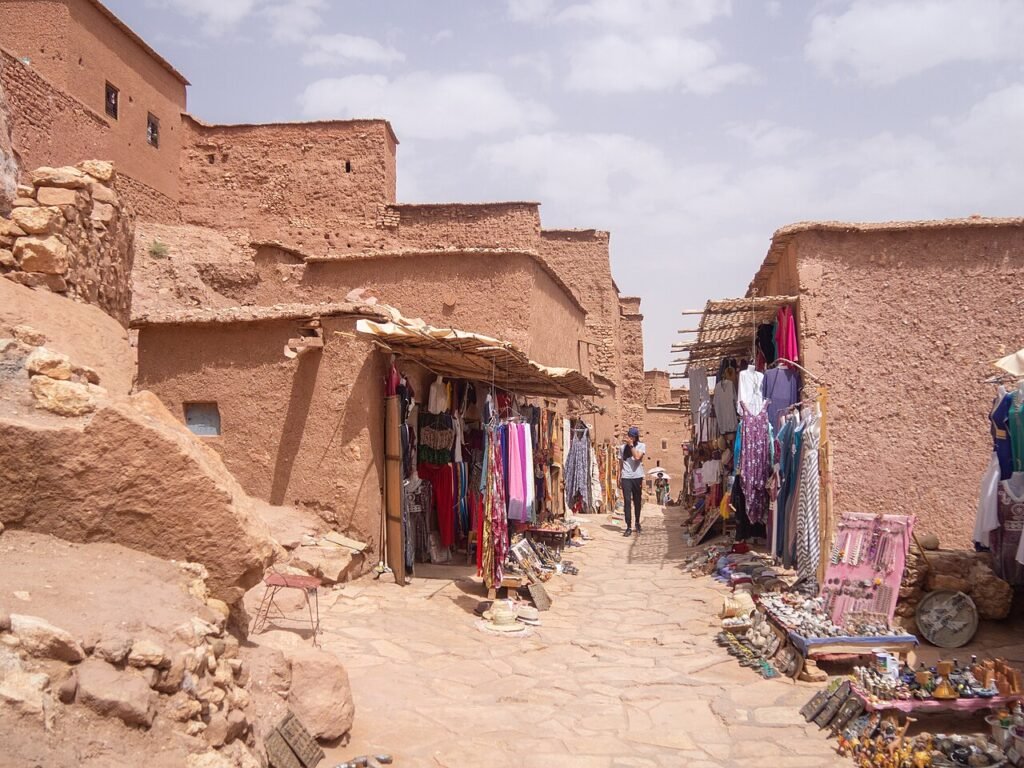
You will enter the ksar by crossing the Ouarzazate River—or what passes for it. Most of the year, the riverbed is a dry wash of sun-bleached stones. In spring, a shallow stream appears, and you will wade across or pay a local boy 5 dirhams to ferry you on his donkey. The gate you see ahead, known as Bab el-Khadra, was built in the 17th century and still bears the handprints of its original masons pressed into the clay. Immediately inside, you will find the Souk Alley, a narrow passage where three or four stalls sell Berber carpets, silver jewelry, and tagine pots. The vendors here are descendants of the families who never left. They will offer you mint tea and haggle with good-natured persistence. A small carpet costs about 300 dirhams; a tagine pot, 50. Do not rush. The first chamber of the ksar is meant to slow you down.
The Winding Passage
As you climb deeper into the ksar, the alley narrows to shoulder width. Your fingers will brush against walls made of rammed earth and straw—a technique called pisé that dates back 1,000 years. The sun vanishes. The temperature drops. Every 20 paces, a slit window appears, revealing a sliver of blue sky or a neighbor’s courtyard. This is the residential heart of the ksar, and you will notice that the houses are stacked like clay bricks, one atop another, connected by roof terraces. Locals will tell you that this design allowed families to move through the entire settlement without ever touching the ground—useful when enemies were at the gate. You can still enter some homes for a small fee (10 dirhams). Look for the Maison de la Famille Aït Benhaddou, a 300-year-old house where the current owner, a 78-year-old woman named Fatima, will show you her grandmother’s wedding chest and offer you dates from her palm tree. She speaks no English, but your guide will translate. Her smile needs no translation.
The Granary Summit
At the top of the ksar, after a steep 15-minute climb, you will reach the communal granary—the agadir. This is the oldest part of the settlement, built in the 11th century and expanded by later dynasties. The granary is a labyrinth of dark, windowless chambers where each family stored their harvest. You will need to bring a flashlight or use your phone’s light. The ceiling is so low that you will have to stoop. In the largest chamber, you will see the remains of an ancient olive press and grinding stones. From the roof terrace, you can see the entire Draa Valley unfurl below: palm groves, a thread of green where the river runs, and the modern village of Ait Benhaddou on the opposite bank. This is where you will sit and catch your breath. Sunset from here is a slow-motion explosion of amber and rose. Seasoned travelers prefer this spot at 6:00 PM in autumn, when the light turns the ksar’s walls the color of honey.
The Local Table: What Denizens Actually Eat
You will not find elaborate restaurants inside the ksar. There is one place only: Chez Mohamed, a three-table terrace run by Mohamed El-Haddaoui, whose great-grandfather was the ksar’s last qaid (chief). Mohamed cooks on a single charcoal brazier. His menu changes daily, but you will eat whatever he bought that morning at the Ouarzazate souk. Most likely, that means berber tagine: chicken or lamb slow-cooked with preserved lemon, olives, and saffron from nearby Taliouine. The tagine arrives bubbling in a clay pot, accompanied by fresh bread baked in a communal ferran (clay oven) at the river’s edge. You will eat with your right hand, tearing the bread and scooping the meat. Cost: 60 dirhams. No menu, no prices posted. That is the way it works here.
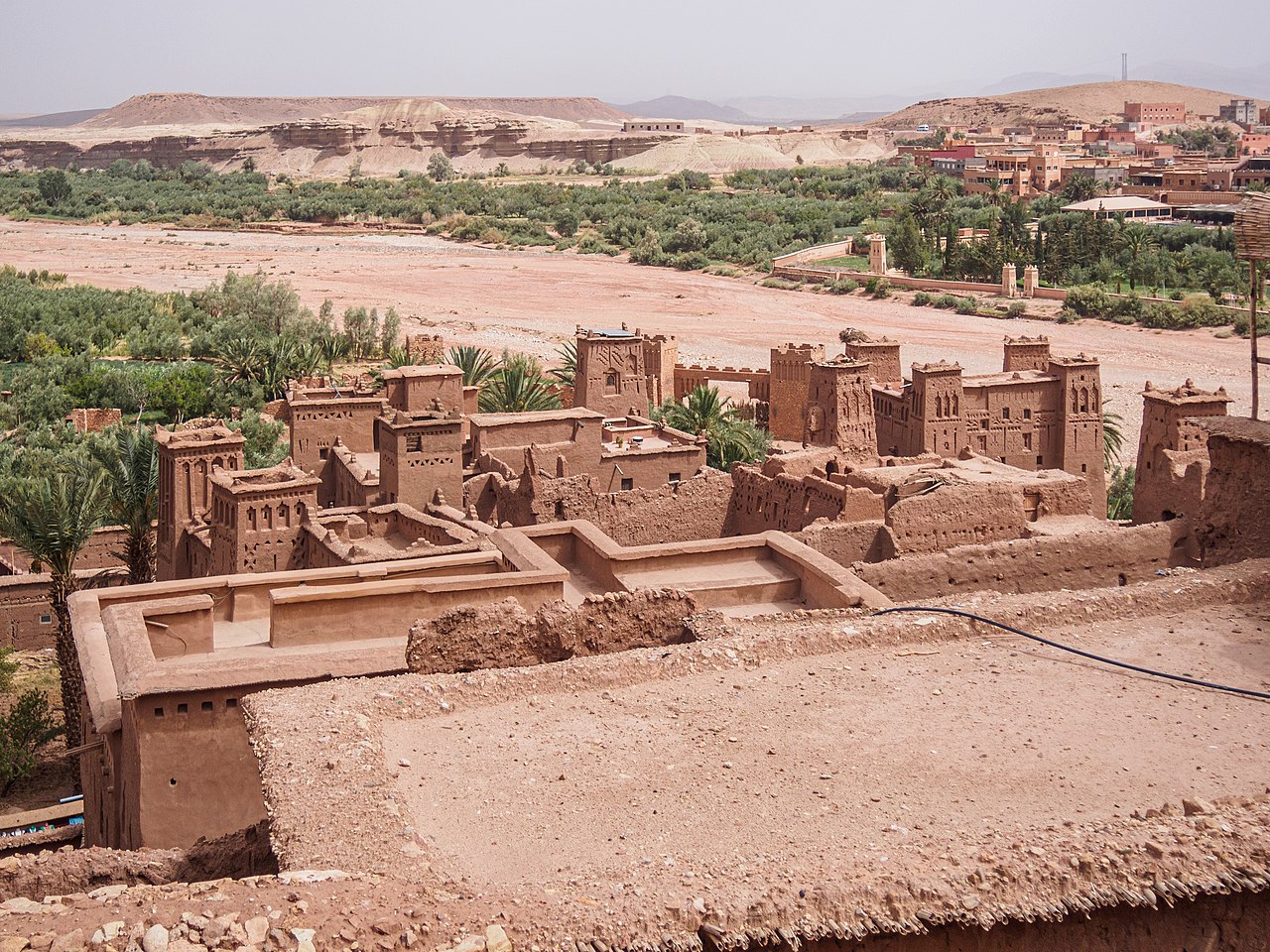
Ait Zineb, Ksar of Aït Benhaddou., Ait Benhaddou’s Ksar, Morocco
Locals recommend you also try rfissa, a dish you will almost never see in Marrakech restaurants. It is shredded msemen (flaky flatbread) topped with chicken, lentils, and a spice blend called ras el hanout. Mohamed’s wife, Khadija, makes it every Friday for the family. If you ask nicely a day in advance, she will make it for you too. The preparation takes four hours. You will know it is ready when the smell of cinnamon and ginger drifts down the alley. For dessert, there are chebakia—sesame cookies drenched in honey and rose water—often accompanied by a glass of scaldingly sweet mint tea. The tea ritual here is performed slowly: the host pours from a height of 30 centimeters to create a froth. You must accept at least three glasses. It is rude to refuse. It is also delicious.
Art, Music & Nightlife
Do not come to Ait Benhaddou for nightclubs. Come for silence. After the last day-trippers leave at 6:00 PM, the ksar belongs to you and the stars. Once a month, during the full moon, the local association Association Aït Benhaddou organizes an evening of Berber music in the main square. You will hear the guembri—a three-stringed lute—and the tbel, a drum made from goatskin. The musicians are farmers and shepherds by day. They play songs passed down orally for centuries, often about love, drought, or the bravery of ancestors. If you are lucky, the dancers will perform the ahouache, a communal dance where men and women form a circle and stamp their feet in hypnotic rhythm. There is no entrance fee, but you should leave a donation of 20–30 dirhams.
By day, you can visit the Galerie des Arts Berbères, a small cooperative in the modern village where local women sell woven blankets and djellaba (cloaks). The prices are fair—a handwoven wool blanket costs around 400 dirhams—and the quality is far better than the tourist shops in Marrakech. Every April, the ksar hosts the Festival des Ksars, a three-day celebration of dance, poetry, and food. You will see Berber horsemen called fantasia riders fire ancient muskets into the air, and local poets recite verses in Tamazight. The 2024 edition runs from April 12–14. Book your accommodation well in advance; the 20 guest rooms in the modern village fill up fast.
Practical Guide
- Getting There: Fly into Ouarzazate Airport (OZZ) from Casablanca or Marrakech on Royal Air Maroc or Air Arabia. From the airport, it is a 30-minute drive. Alternatively, take a grand taxi from Marrakech’s Bab Doukkala station—200 dirhams per person, three hours. Book cheap flights at Skyscanner
- Getting Around: No cars or buses enter the ksar. You will walk everywhere. A guide for a half-day tour of the ksar costs 150 dirhams. Hire one at the official Tourist Office at the entrance. Do not accept offers from unofficial guides who approach you on the street.
- Where to Stay: For maximum atmosphere, book Dar Mouna (from 350 dirhams/night), a guest house inside the ksar with rooftop views. In the modern village, Ksar Ighnda offers air-conditioned rooms from 400 dirhams. Check availability on Booking.com
- Best Time: March to May and September to November. The light is golden, the days warm (25°C), and the crowds are thin. Avoid July and August, when the temperature hits 45°C and the ksar becomes an oven. December to February are cool but pleasant, with daytime highs around 18°C.
- Budget: You can manage comfortably on 400 dirhams per day (about $40 USD). That covers a guest house, three meals, water, and a guide. Bring cash—there are no ATMs within 30 kilometers.

Green palm tree near brown rock formation during daytime, Ait Benhaddou’s Ksar, Morocco
What Surprises First-Time Visitors
Most travelers arrive expecting a sprawling maze like the medina of Fes. You will find something far more intimate. The entire ksar covers less than three hectares. You can walk from the main gate to the granary summit in 15 minutes. The surprise is not its size but its quiet. Unlike Morocco’s tourist cities, there is no touts shouting at you, no scooters weaving through the alleys. The only sounds are the scrape of your shoes on packed earth, the coo of doves, and the occasional call to prayer from a minaret that has stood for 400 years. Locals will greet you with salam alaikum and then leave you alone. That is rare in Morocco. Treasure it.
Another surprise: the ksar is not a museum. It is still a living village. You will see laundry drying on rooftops, chickens scratching in alleys, and children playing soccer in the riverbed. The ten families who remain inside the ksar go about their daily lives as they have for generations. You can watch a woman knead bread in her doorway or a man repair a wall with mud and straw. No one will stop you if you photograph them, but savvy visitors always ask first with a smile and a nod. The reward is often an invitation for tea. The other surprise is how quickly you adjust to the silence. After two days, the rumor of Marrakech will feel like a distant dream. You may not want to leave.
Your Ait Benhaddou’s Ksar, Morocco Questions
Is it safe to visit Ait Benhaddou, especially as a solo female traveler? Yes, absolutely. The ksar is one of the safest places in Morocco. Violent crime is virtually nonexistent. You will receive more attention than you might like from vendors and young men offering to “show you the way,” but a firm “la, shukran” (no, thank you) will suffice. Dress modestly
![Ait Benhaddou’s Ksar, Morocco - Unesco world heritage site Aït Benhaddou and filmset of filmset of following movies: Lawrence of Arabia (1962) Sodom and Gomorrah (1963) Oedipus Rex (1967) The Man Who Would Be King (1975) The Message (1976) Jesus of Nazareth (1977) Time Bandits (1981) Marco Polo (1982) The Jewel of the Nile (1985) The Living Daylights (1987) The Sheltering Sky (1990) Kundun (1997) The Mummy (1999) Gladiator (2000) [12] Alexander (2004) Kingdom of Heaven (2005) Babel (2006) One Night with the King (2006) Prince of Persia (2010) Son of God (2014) Queen of the Desert (2015) A Life On Our Planet (2020)](https://images.unsplash.com/photo-1680880482590-0f4b9b5258c7?crop=entropy&cs=tinysrgb&fit=max&fm=jpg&ixid=M3w3MTYyNTJ8MHwxfHNlYXJjaHwyfHxBaXQlMjBCZW5oYWRkb3UlRTIlODAlOTlzJTIwS3NhciUyQyUyME1vcm9jY298ZW58MHwwfDB8fDE3ODUyMjAwNTh8MA&ixlib=rb-4.1.0&q=80&w=1080)
A large brown building sitting on top of a hill, Ait Benhaddou’s Ksar, Morocco

