
Schwaz, Austria Weekend: Silver Mines, Gothic Splendor & The Best Kiachl in the Alps (2026)
You step off the train into the crisp Tyrolean air, and the first thing that hits you isn’t the sight of the imposing medieval towers or the jagged peaks of the Karwendel Alps—it’s the faint, metallic tang of history. Schwaz smells of silver, of centuries-old earth and ambition. For a town of just 14,000, its past is colossal: once the silver-mining capital of Europe, funding empires and attracting merchants from across the continent. Over 48 hours, you’ll unearth its glittering underground, walk its cobbled heart, and taste the hearty Alpine fare that fuels every adventure.
Quick Facts Before You Go
- Best Months: May to September for hiking and outdoor festivals; December for the enchanting Christmas market. Avoid November when many attractions close for maintenance.
- Currency: Euro (€). As of early 2025, €1 equals roughly $1.08 USD or £0.86 GBP.
- Language: German. English is widely spoken in hotels, restaurants, and tourist sites, but learning a few phrases like “Grüß Gott” (hello) wins smiles.
- Budget: €90–€140 per day for mid-range travel (includes meals, attractions, and accommodation). Budget travelers can manage on €60–€80 by cooking and using hostels.
- Getting There: Fly into Innsbruck Airport (INN) — just a 25-minute drive from Schwaz. Direct flights from London take about 2 hours. Book at Skyscanner for the best deals.
Day 1: Into the Belly of the Silver Mountain
You start the morning with the sun barely cresting the peaks, casting long shadows across the Rathausplatz. The cobblestones are damp from an overnight shower, and the only sound is the clatter of a baker’s shutter opening. Your mission today is to go deep—literally—into the earth that made Schwaz the second-largest city in the Habsburg Empire in the 16th century. Locals will tell you that without the silver from Schwaz, the Spanish Armada might never have sailed. You’re about to find out why.
- Morning (8–11am): Head straight to the Schwaz Silver Mine (Silberbergwerk) at Turmgasse 21. You’ll don a miner’s jacket and helmet before descending 800 meters into the mountain on a small train. The guided tour (€24.50 for adults) takes 90 minutes and includes a boat ride across an underground lake. Travelers often discover that the mine’s temperature stays a constant 8°C—bring a sweater even in summer. Book ahead online at silberbergwerk.at to skip the queue.
- Lunch: Walk five minutes to Gasthof Bräu on Franz-Josef-Straße. This 500-year-old inn serves a legendary Tiroler Gröstl (pan-fried potatoes with bacon, onion, and fried egg) for €12.50. Pair it with a half-liter of Zillertal Bier from the local brewery. The vaulted wooden ceiling and the hum of Austrian chatter make it feel like a medieval feast.
- Afternoon (1–5pm): First, climb the 148 steps of the Stadtpfarrkirche Schwaz tower (free, but donations welcome) for panoramic views of the Inn Valley. Then, wander to the Franziskanerkloster, a Franciscan monastery with a stunning Baroque library. The monks still live here, so visitors are asked to whisper. Finally, explore the Schloss Freundsberg, a 12th-century castle perched on a hill. Entry is €6, and the museum inside tells the story of the town’s silver boom and bust.
- Evening: Dinner at Gasthof zum Goldenen Adler on the main square. Order the Zillertaler Krapfen (cheese-filled dumplings) for €14.90. The atmosphere is warm and wood-paneled, with locals nursing mugs of Sturm (young wine) at the bar. Afterward, join a free walking tour of the historic center (April–October, 7pm at the Rathaus)—your guide will point out the 16th-century merchant houses with their ornate oriel windows, a reminder of when Schwaz was richer than Vienna.

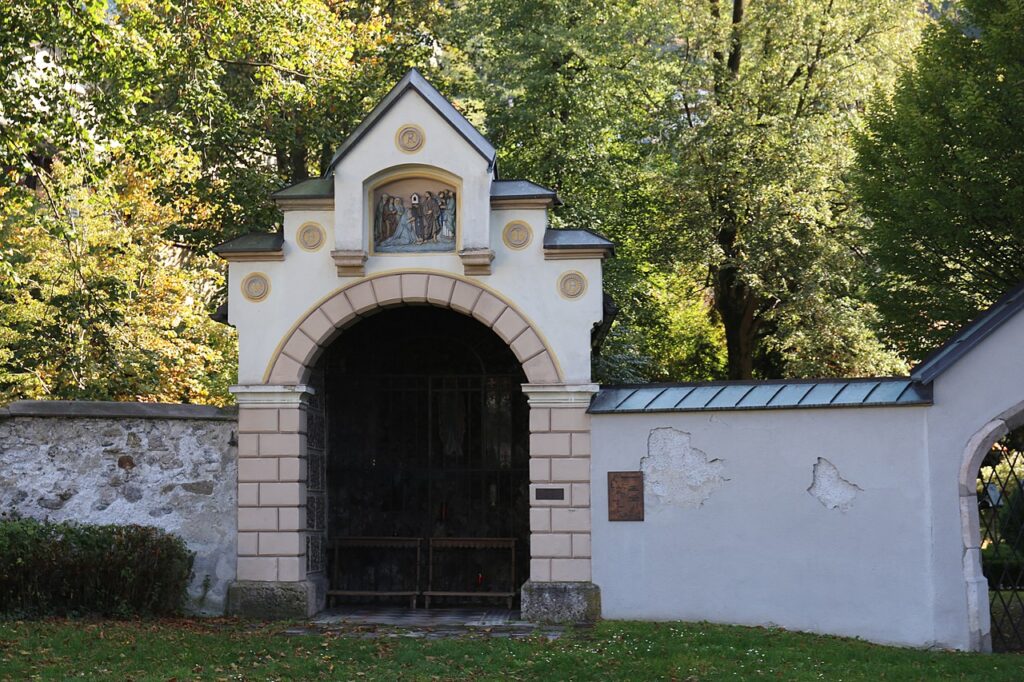
Gesamtanlage Franziskanerkloster Schwaz,
Blick von Südwest, Schwaz, Austria
Day 2: Alpine Heights & Local Flavors
Day two is about rising above it all—literally. You’ll trade the dim tunnels for sunlit peaks, then descend into the town’s culinary soul. Savvy visitors know that Schwaz is a gateway to the Zillertal Alps, but you don’t need to be a mountaineer to taste the heights. The morning air smells of pine and fresh bread, and your legs will thank you for the effort by the time you’re sipping coffee at 1,800 meters.
- Morning (8–11am): Start with breakfast at Bäckerei-Konditorei Ruetz on Münchner Straße. Their Kiachl (deep-fried dough dusted with powdered sugar) is a local specialty—€3.50 for two, and you’ll want a second order. Then, take the Kellerjochbahn cable car (€22 round trip) from the edge of town up to the Kellerjoch summit. The 15-minute ride lifts you from the valley floor to alpine meadows where cows wear bells and the views stretch to the Dolomites on a clear day.
- Midday (11am–1pm): Hike the 30-minute loop trail from the top station to the Kellerjochhütte, a rustic mountain hut. Order a bowl of Käsespätzle (cheese noodles with fried onions) for €11.50. The secret is to arrive before noon to snag a table on the sun-drenched terrace—tourists from Innsbruck flood in after 1pm. Tip: Bring cash; the hut has no card machine.
- Afternoon (1–5pm): Descend to Schwaz and explore the Burgfrieden neighborhood, a labyrinth of narrow lanes and pastel-colored houses. Stop at Kunsthandwerk Schwaz on Pfarrgasse, a workshop where you can watch a potter throw clay on a wheel (free to observe, €25 for a 2-hour class). Then, visit the Museum der Völker (€8), which houses an extraordinary collection of artifacts from Africa, Asia, and the Pacific—amassed by a local missionary in the 19th century. Most tourists overlook this gem, but it offers a surprising global lens on Tyrolean history.
- Final Evening (5–8pm): Your farewell dinner deserves the best. Book a table at Restaurant Schönegg, a 10-minute walk from the center at Schöneggstraße 20. The Tiroler Schlutzkrapfen (half-moon pasta filled with spinach and ricotta, in brown butter with sage) for €16.50 is the dish that haunts travelers’ dreams. The terrace overlooks the valley, and as the sun sets, the church bells ring—a perfect, resonant goodbye. End with a schnapps at Destillerie Lederer on the square, where the family distills pear and apricot brandies (tastings from €4).

Mountains with mist under clear sky, Schwaz, Austria
The Food You Can’t Miss
Schwaz’s cuisine is a love letter to Alpine sustenance. You’ll find hearty, no-nonsense dishes built for miners and mountaineers, but with a finesse that comes from centuries of innkeeping. The star is Kiachl, a deep-fried dough that locals eat savory or sweet. For the best, head to the Schwazer Bauernmarkt on Saturday mornings (8am–12pm at the Rathausplatz). A vendor named Frau Gruber sells hers with sauerkraut and bacon for €4—crisp, greasy, and unforgettable. Travelers often discover that the key is to eat them while walking, letting the steam escape into the cold air.
For a sit-down meal, Tiroler Gröstl is your benchmark. Every gasthof has its version, but Gasthof Bräu (mentioned above) does it with a perfectly runny yolk that binds the potatoes and bacon into a golden mess. For dessert, Kaiserschmarrn—shredded pancake with plum compote—is the ultimate comfort. The best is at Gasthof zum Goldenen Adler (€9.50), where the chef caramelizes it tableside. Budget €12–€18 for a main course at mid-range restaurants, and always carry cash—smaller spots often don’t accept cards.
Street food is minimal but mighty. Besides Kiachl, look for Bratwurst mit Kraut from the stand near the train station (€3.50). It’s nothing fancy, but after a day of hiking, it tastes like victory. For a drink, try Almdudler, an Austrian herbal lemonade that’s sweeter and more floral than Sprite—locals call it “the national soft drink.” A bottle costs €2 at any supermarket.

Bird’s eye view photo of cumulus clouds, Schwaz, Austria
Where to Stay for the Weekend
For atmosphere, stay in the Altstadt (Old Town). The cobbled streets and medieval buildings make you feel like you’ve stepped into a fairy tale. Hotel Schwazer Hof (on the main square) offers double rooms from €120 per night with a breakfast buffet of cold cuts, cheese, and fresh bread—the location is unbeatable. Book via Booking.com for cancellable rates.
If you prefer quiet, choose the Burgfrieden neighborhood, just a five-minute walk from the center. Gasthof zum Goldenen Adler (same as the restaurant) has charming rooms from €90 per night, with creaky wooden floors and views of the church tower. It’s less polished but far more authentic. For self-catering, an Airbnb in the Lahnbach area, near the cable car, costs around €70–€100 per night—ideal for families or hikers who want quick access to the trails.
Before You Go: Practical Tips
- Getting Around: Schwaz is walkable—you can cross the entire old town in 15 minutes. For the silver mine or cable car, take bus line 833 from the station (€2.80 single ticket). A Zillertal Aktiv Card (€39 for 48 hours) gives you free bus travel and discounts on the mine and cable car. Buy it at the tourist office on the Rathausplatz.
- What to Pack: (1) A warm layer—even summer evenings dip to 10°C. (2) Sturdy walking shoes for the mine’s damp tunnels and alpine trails. (3) A reusable water bottle; tap water is pristine and free. (4) Cash—many smaller shops and huts don’t accept cards.
- Common Tourist Mistakes: (1) Skipping the silver mine because it sounds “touristy”—it’s genuinely fascinating, and the underground lake is surreal. (2) Assuming everything closes early—Schwaz’s restaurants serve dinner until 9:30pm, and the bars stay open past midnight on weekends. Don’t rush back to your hotel.
- Money-Saving Tip: Buy the Schwaz City Card (€28) at the tourist office. It includes entry to the silver mine, the castle, the museum, and the cable car, plus a free guided tour. You’ll save at least €15 compared to buying individual tickets. Valid for 48 hours.
Explore More Destinations
- Jozani, Tanzania on a Budget: an Ancient Forest for $35/Day (2026)
- Nsumbu, Zambia on a Budget: Wild Africa for $40/Day (2026)
- Semporna, Malaysia on a Budget: Paradise for $35/Day (2026)
- Khuzestan, Iran on a Budget: Ancient Empires for $30/Day (2026)
- Ngerulmud, Palau on a Budget: Island Majesty for $45/Day (2026)
Ready to Visit Schwaz?
Start planning your trip today. Compare hotels, find the best tours, and get insider tips.
Your adventure in Schwaz starts here →
Related Guides
Explore more destinations similar to Schwaz:
- Jermuk, Armenia’s Ultimate Healing Waters, Soviet Grandeur & Alpine Serenity (2026)
- Bocaina, Brazil’s Best Coffee, Colonial Charm & Mountain Serenity (2026)
- Tübingen, Germany’s Essential Canals, Castles & Student Spirit (2026)
- Chiquitanía, Bolivia: Best Baroque Missions, Vast Savannahs & Living Traditions (2026)
{“@context”: “https://schema.org”, “@type”: “FAQPage”, “mainEntity”: [{“@type”: “Question”, “name”: “What is the best time to visit Schwaz?”, “acceptedAnswer”: {“@type”: “Answer”, “text”: “The best time to visit Schwaz depends on your preferences. Generally, the dry season offers the most pleasant weather for sightseeing and outdoor activities.”}}, {“@type”: “Question”, “name”: “How many days do I need in Schwaz?”, “acceptedAnswer”: {“@type”: “Answer”, “text”: “Most travelers spend 3-5 days in Schwaz to see the main attractions. A week allows for a more relaxed pace and day trips.”}}, {“@type”: “Question”, “name”: “Is Schwaz expensive to visit?”, “acceptedAnswer”: {“@type”: “Answer”, “text”: “Schwaz can be visited on various budgets. Accommodation ranges from hostels to luxury hotels, and local restaurants offer affordable dining.”}}]}

