
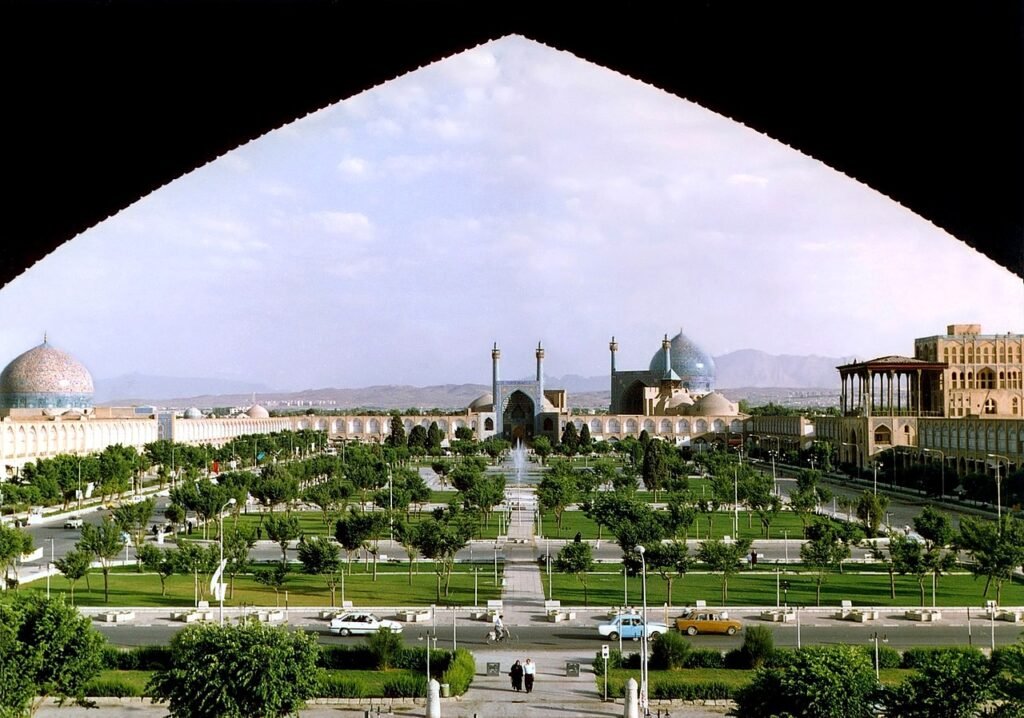
Naghsh-e Jahan Square, Iran Weekend: Markets, Mosques & The Best Kebabs East of Istanbul (2026)
You step through the arched entrance of the Qeysarieh Gate and the world opens. The first thing that hits you is the scent of rosewater and saffron drifting from a nearby tea stall, mixed with the faint echo of a na’val (Persian call to prayer) as it bounces off the turquoise domes. Before you stretches the second-largest square on earth—a 160-meter-wide expanse of pale stone where horse-drawn carriages clatter past families picnicking on the grass. In the distance, the Shah Mosque’s dazzling iwan shimmers through the afternoon haze. This is Naghsh-e Jahan, “Image of the World,” and you’re about to spend a weekend inside a living postcard.
Quick Facts Before You Go
- Best Months: March–May and September–November — mild days (20–28°C), low humidity, and fewer crowds. July–August can hit 40°C, making midday strolls exhausting.
- Currency: Iranian Rial (IRR), but prices are often quoted in Toman (1 Toman = 10 Rials). As of 2025, $1 USD ≈ 420,000 Rials (or 42,000 Tomans) on the unofficial market; carry cash — cards from outside Iran do not work.
- Language: Persian (Farsi). English is spoken at major hotels and some tourist shops, but not widely. Download Google Translate offline for Farsi.
- Budget: $30–$60 per person per day (mid-range) including meals, entrance fees, and local transport. A nice dinner for two costs about $15–$20.
- Getting There: Fly into Isfahan International Airport (IFN) — direct flights from Dubai (2 hours) and Istanbul (3 hours). From Tehran, a bus takes about 5 hours (less than $5). Book flights at Skyscanner.
Day 1: The Grand Introduction — Mosques, Palaces & Persian Carpets
You start the morning with your back to the Qeysarieh Bazaar, facing the square’s eastern edge. The sun casts long shadows from the arcades, and the call to prayer from the Shah Mosque drifts across the empty stone. Everything is calm — until around 9 a.m., when the first tour groups trickle in and the square begins to hum. Savvy visitors know to arrive early, before the heat and the crowds, to absorb the sheer scale of this Safavid masterpiece.
- Morning (8–11am): Walk to the Shah Mosque (Imam Mosque) on the south side. Entrance costs 500,000 Rials ($1.20). Step inside and tilt your head back — the 40-meter-high dome is covered in intricate geometric tilework that changes color from turquoise to deep blue depending on the light. Locals will point out the whispering gallery at the center: stand on the black marble stone and speak softly — the acoustics bounce your voice to the opposite wall. Plan to spend at least 45 minutes here. Then cross the square to the Sheikh Lotfollah Mosque (300,000 Rials, $0.70). Unlike the grand public mosque, this one was built for the royal family. The single-piece marble mihrab and the peacock-tail tiles inside the dome are a quiet masterpiece.
- Lunch: Head to Shahrzad Restaurant (just off the square’s northwest corner, on Sepah Street). This Isfahani institution has been serving Persian classics since the 1960s. Order the Khoresht-e Mast (a unique Isfahani lamb stew with yogurt, saffron, and egg — $4) or the Joojeh Kebab (saffron-marinated chicken, $5). The interior is covered in mirror-work and painted ceilings — you’ll feel like you’re dining inside a jewel box.
- Afternoon (1–5pm): After lunch, climb the Ali Qapu Palace (entrance 300,000 Rials) on the square’s west side. The six-story palace offers the best balcony view in Isfahan — from the 18-columned talar (porch), you can see the entire square laid out like a chessboard. Don’t miss the music room on the sixth floor: the intricate stucco carvings are shaped like musical instruments and urns, designed to create perfect acoustics. Then, emerge through the Qeysarieh Bazaar arcades (entrance on the square’s north side). Wander the vaulted alleyways for an hour. You’ll find hand-painted ghalamkar fabric (from $10 a yard), copper trays engraved with calligraphy (from $15), and — if you know where to look — genuine Persian carpets. Tip: go to Pardis Carpet Shop (Section 3, lane 7), run by Hossein, a fourth-generation weaver. He’ll show you the tribal patterns of Qashqai rugs without high-pressure sales; a 2×3 ft wool rug starts at $40.
- Evening: As the sun sets, make your way to Azadegan Tea House (at the northeast corner of the square, above the bazaar). Climb the narrow stairs, grab a cushion on the terrace, and order a pot of chai (10,000 Rials, $0.02) with a cube of nabat (saffron rock candy). The square below turns gold, then soft purple. For dinner, walk 10 minutes east to Bastani Traditional Restaurant (Masjed-e Ali Alley). Their Berenj Polo ba Tahdig (saffron rice with crispy crust, served with lamb shank — $6) is legendary. Locals recommend finishing with faloodeh — a frozen vermicelli-noodle dessert with rosewater and lime — at Faloodeh Homayouni (same street, $0.50 per bowl).

Aali Qapu Palace, Isfahan, Iran, Naghsh-e Jahan Square, Iran
Day 2: Behind the Facades — Bazaar Jewels & Riverside Evenings
Day two is about escaping the tourist trail that most visitors stick to around the square. Travelers often discover that Isfahan’s soul lies in the twisting lanes behind the monuments — where a carpet weaver’s hammer taps to an ancient rhythm and the scent of freshly baked taftoon bread wafts from tiny bakeries. You’ll start early, before the square fills with selfie sticks.
- Morning (8–10am): Walk south from the square for 10 minutes into the Jolfa neighborhood — the Armenian quarter. Stop at Haj Mahmoud Café (Khakzad Street) for a breakfast of barbari bread fresh from the clay oven, soft white cheese, and hot mint tea — all for about $1. Then visit the Vank Cathedral (entrance 500,000 Rials, $1.20). The painted frescoes inside are a startling blend of Islamic geometric patterns and Christian biblical scenes — a rare, peaceful hybrid.
- Midday (10am–1pm): Return to the square and join the guided tour of the Ali Qapu Palace’s rooftop (included with your ticket; ask for the English tour at 11 a.m.). The guide will explain how Shah Abbas II would watch polo matches — and sometimes executions — from this very spot. Insider tip: to avoid the midday crowd, go before 9:30 a.m. or after 2 p.m. The palace opens at 8 a.m.; you can have the music room all to yourself if you arrive at opening.
- Afternoon (2–5pm): Now is the time to get lost in the Grand Bazaar beyond the square. Start at Bazaar-e Bozorg (main entrance at the north side of the square) and head toward the Sheykh Bahai Street exit. This is where you’ll find the copper & metalware quarter — artisans hammer large copper pots into shape. At Haj Ali Naqi Caravanserai (a 400-year-old inn turned market), stop by Setareh’s Spice Stall (stand 42) for a bag of dried limes (limoo amani, $2) and Persian saffron ($8/gram — a fraction of Western prices). Haggling is expected; start at 60% of the asking price.
- Final Evening: For your farewell dinner, take a 15-minute walk south to the Si-o-se-pol Bridge (33 arches). Cross to the western bank and find Ghasr-e Monshi restaurant (No. 4, Khaghani Street). This hidden gem, set in a traditional khaneh (house), serves Mirza Ghasemi (grilled eggplant with tomato and garlic, $3) and Kalam Polo (Isfahan-style cabbage and herb rice with lamb, $4). After dinner, walk back across the bridge — locals recommend doing this at 8:30 p.m., when the bridge’s stone arches are lit with amber lights and the Zayandeh River reflects them like a string of pearls. You’ll see families picnicking on the riverbank, young couples sharing a qalyan (water pipe), and the city exhaling.

Gray and brown concrete cathedral, Naghsh-e Jahan Square, Iran
The Food You Can’t Miss
Isfahan’s food is a love letter to saffron, rosewater, and lamb. You’ll taste this most clearly in Khoresht-e Mast — a sweet-savory stew of lamb, yogurt, saffron, and a whisper of sugar. Travelers often find it surprising at first, but locals insist it’s the taste of the city. The best version is at Shahrzad Restaurant (day 1 lunch), but for a street-level experience, head to Haj Mohammad Javad in the Bazaar (near the Qeysarieh Gate). There, a grizzled cook ladles Khoresht-e Bademjan (eggplant and lamb stew) into bowls for $0.80.
Street food rules in Isfahan. At dusk, vendors set up carts around the square selling Berenj Aash — a thick rice and herb soup topped with fried mint and yogurt ($0.30). The true hidden gem is Koloocheh (soft butter cookies stuffed with ground nuts and cardamom, found at Shirini-e Haj Morteza on Chaharbagh Street — 50,000 Rials for a dozen). For a sit-down meal that captures the city’s soul, book a table at Mozafari Restaurant (off Naghsh-e Jahan’s east side). Their Bakhtiari Kebab (a skewer of lamb filet and fat, grilled over charcoal — $5) comes with grilled tomatoes, fresh sabzi (herb plate), and sheets of flatbread. Tip: ask for extra sumac to sprinkle over the meat; it cuts the richness perfectly.

Brown concrete building during night time, Naghsh-e Jahan Square, Iran
Where to Stay for the Weekend
You’ll want to stay within a 10-minute walk of the square to maximize your time. The best neighborhood is Chaharbagh-e Abbasi — the old tree-lined avenue that runs south from the square. It’s quieter than the arcades but still buzzing with cafes and carpet shops. Espadana Boutique Hotel (50 Chaharbagh St) is a restored 19th-century mansion with rooms around a central courtyard and a pool. Double rooms start at $50/night, including a huge Persian breakfast. Book via Booking.com.
For something more atmospheric, consider Ghasr-e Setareh (Star Palace) in the Jolfa Armenian quarter, about 20 minutes’ walk from the square. It’s a converted silk weaver’s house with high vaulted ceilings, brass lamps, and a rooftop café overlooking the Vank Cathedral. Doubles from $40/night. Check Airbnb for self-catering apartments in the same area — a two-bedroom place near the Si-o-se-pol Bridge runs about $60–$80 per night. Whichever you choose, your host will likely offer to organize a taxi to the square — take it, because the narrow alleys are easy to misread at night.
Before You Go: Practical Tips
- Getting Around: The square is pedestrian-only during the day, but you can take horse-drawn carriages for a loop around it ($2 for 15 minutes). For longer distances, use the Isfahan Metro (line 1 runs under Chaharbagh Avenue — a single ride costs $0.15). Taxis from the square to Jolfa cost about $1.50; agree on the price before getting in. Download the Snapp app (Iran’s Uber) — it works with a local SIM card (available at the airport for $3).
- What to Pack: A lightweight scarf or hijab (required for women in public — a silk pashmina works best in the heat). Comfortable walking shoes — the square’s stone paving can be uneven. A reusable water bottle (tap water is safe but heavily chlorinated; buy bottled for 10,000 Rials). Sunglasses and a sun hat — there is almost no shade in the square’s open area

