
Kwakwani, Guyana Weekend: Riverside Serenity (2026)
You step off the boat onto Kwakwani’s wooden landing at 9:15 a.m., and the first thing that hits you isn’t the heat—it’s the smell. A moist, mineral-rich breeze rolls off the Berbice River, tangled with wood smoke from a nearby cookshack and the sweet, faint hint of fried plantain. A rusty bicycle rings past you, its bell a cheerful punctuation to the low hum of a distant bauxite conveyor. This is no polished resort town; it’s a living, breathing riverside community where the river is the main street, mining is the heartbeat, and visitors are welcomed like rare, precious cargo.
Quick Facts Before You Go
- Best Months: February through April and September through October, when the rain eases and the river is calm. You’ll avoid the May-June and December floods that can stall river travel.
- Currency: Guyanese Dollar (GYD). Roughly 210 GYD to 1 USD. Locals quote prices in “dollars,” so always confirm—a 2,000 GYD fish dinner is about $9.50, not $2,000!
- Language: English is the official language, spoken with a warm, melodic Guyanese Creole twist. You’ll understand everything, though locals greet each other with “Yuh wah doh?”—meaning “What do you need?”—and you’ll pick it up fast.
- Budget: $45–$70 USD per day comfortably. Your big costs are the boat trip (3,000 GYD round-trip from Linden) and a few hearty meals. Accommodation is staggeringly cheap—guesthouses run 5,000–8,000 GYD a night.
- Getting There: Fly into Cheddi Jagan International Airport (GEO) near Georgetown (about 5.5 hours from Miami on Caribbean Airlines or American Airlines). From Georgetown, take a minibus to Linden (1.5 hours, 1,500 GYD), then a passenger boat or speedboat down the Berbice River to Kwakwani (2–3 hours, 2,000–3,000 GYD). Book your flight at Skyscanner and consider a charter floatplane from Georgetown’s Ogle Airport if you’re pressed for time—about $150 USD one-way for a scenic 45-minute flight.
Day 1: Arrival, River Breezes & The Rhythm of a Mining Town
You start your first morning not with an itinerary but with the sound of roosters and the low, steady thrum of the bauxite plant—a sound you’ll soon find oddly comforting. After dropping your bag at the Kwakwani Guest House, you walk along the riverfront road, where children wave and fishermen mend nets under flamboyant trees exploding with red blossoms. Your plan, shaped half by advice and half by curiosity, begins at the heart of it all: the landing dock and the river itself.
- Morning (8–11am): Take the self-guided Riverwalk & Mining Heritage Trail along the eastern bank. You’ll see the old steel pylons of the 1950s bauxite loader, still standing like rusted art. Head to the Kwakwani Community Center at 10 a.m., where a retired miner named Mr. Haynes (always eager to chat, free of charge) shares tales of the town’s heyday—when 3,000 workers lived here and the river carried ore-laden barges daily. You’ll feel the weight of that history as you watch the conveyor belt still moving, though quieter now.
- Lunch: Eat at Mavis’s Kitchen (Main Street, right across from the primary school). You need to try her pepperpot with cassava bread—a rich, dark, cinnamon-and-cassareep stew slow-cooked for hours, served with a slice of boiled plantain. A huge plate costs just 1,200 GYD ($5.50). Ask for extra wiri-wiri pepper if you want heat; Mavis will grin approvingly.
- Afternoon (1–5pm): Hire a local boatman, “Uncle Deryck,” from the dock (he’ll find you; just ask any fisherman). For 5,000 GYD ($23) for two hours, he takes you upriver to the Kwiak Creek inlet. You’ll glide through narrow channels lined with ite palm and hear howler monkeys groaning overhead. Bring your swimsuit—you can jump into the dark, tea-colored water at a wide spot locals call “The Bathing Hole,” refreshing and totally safe. At 3:30 p.m., return for a short visit to the Kwakwani Bauxite Plant viewpoint (just outside the fenced area; stay on the public road) to watch the massive shovels and trucks load ore barges. Your best bet is to stay back 50 meters; the dust is real.
- Evening: As the sun drops into the river at 6 p.m., you’ll find the docks quiet, and the River View Bar & Grill humming. Order the fried pakari (small river fish) with chips (1,500 GYD, $7) and a cold Banks beer (500 GYD). The bar has no walls—just a tin roof and a railing over the water. Fishermen will wave from their boats as they head out for night trawling. By 8:30 p.m., the night air turns cool enough that you’ll pull on a light jacket, and the stars over the river look impossibly close. Sleep comes easy with the gentle lapping of water against the dock.
Close-up of ocean waves meeting golden sand on a Guyanese beach., Kwakwani, Guyana
Day 2: Creek Adventures, Local Markets & A Sunset Farewell
You wake to a different sound on Day 2: the high, excited chatter of market day. The riverfront transforms into a colorful, chaotic bazaar, where stalls sell fresh cassava, golden pineapples, smoked fish, and hand-woven benab baskets. A woman called Auntie Delma hands you a slice of ripe mango off her table, and you immediately understand why travelers often discover that Kwakwani’s true treasure isn’t its industrial past—it’s the people and the river that feeds them.
- Morning: Start with breakfast at Junior’s Bake Shop (Upper Jibba Street) at 7:30 a.m. You’ll order a butterflap—a flaky, buttery bread—stuffed with salted fish and pepper, plus a steaming cup of local coffee brewed with powdered milk and nutmeg. The whole breakfast costs 800 GYD ($3.70). Then walk the Riverbank Market (runs Saturdays only; you’ll be in luck). Buy a small bag of dried cashews (700 GYD) for the boat ride home.
- Midday: The main attraction is a guided kayak or dugout trip to Cassava Island, a sandbar just 15 minutes downriver. Rent a wooden boat from Deryck’s nephew, Shane, for 3,000 GYD ($14) for the hour, or join a small group (max 8) with the Kwakwani Eco-Tours group at 11 a.m. (4,000 GYD per person). Insider tip: go at 11:30, right before the big lunch rush of local picnickers, so you’ll have the sandbar almost to yourself. You can wade in the shallows, spot river turtles sunning, and watch kingfishers dive. Don’t forget your water shoes—the sand is soft but scattered with broken shells.
- Afternoon: Spend 1–3 p.m. wandering the Back Streets of Kwakwani, specifically around the parish church and the old community hall. Here, you’ll find Miss B’s Craft Corner (a front yard with a small table), where an elderly Arawak woman sells coconut-shell spoons, woven finger grass mats, and hand-painted tourist bracelets for 200–1,000 GYD ($1–$4). This is where locals recommend you buy gifts; the quality is genuinely better than anything in Georgetown. Then, at 4 p.m., hike the short 20-minute trail from behind the sports ground to Lookout Hill—a small knoll of red bauxite soil with a panoramic view of the river bend. Bring a bottle of cold coconut water (300 GYD from a street seller) and simply sit. You’ll see why the word “Kwakwani” is said to mean “where the river bends.”
- Final Evening: For your farewell dinner, walk to The Big Pot, a family-run cook shed at the end of the concrete strip near the dock. You have to order the curry duck with roti (2,000 GYD, $9.50), a fiery, rich dish that arrives with a stack of soft, oiled roti and a side of chow mein noodles—a Guyanese-Chinese fusion that makes perfect sense after a weekend here. As you eat, old speakers on the porch play a mix of chutney music and reggae, and the entire neighborhood seems to drift toward the water for the 7:30 p.m. breeze. Your boat back to Linden will be waiting at the dock at 5:30 a.m., so keep this evening simple, sweet, and early—the stars will tell you when it’s time to sleep.
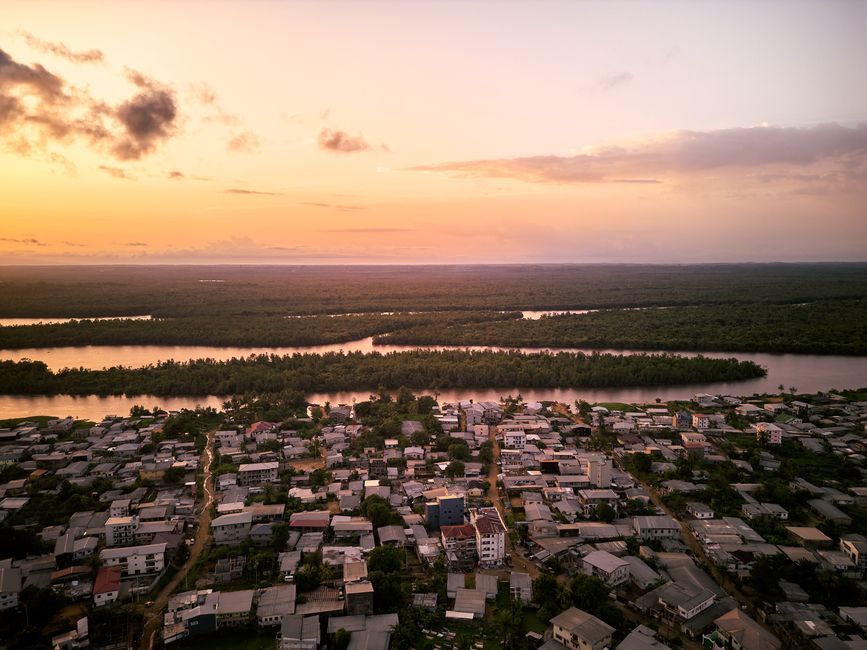
Stunning aerial view of Douala, Kwakwani, Guyana
The Food You Can’t Miss
You cannot visit Kwakwani without surrendering to the river’s generous table. The local cuisine is an Afro-Guyanese and indigenous blend, centered on fish, root vegetables, and slow-cooked stews. Travelers often discover that the pepperpot here—made with beef or pork, cassareep (a boiled cassava syrup), and a whisper of cinnamon and clove—is richer and deeper than anything in Georgetown, because Kwakwani families still use wood-fired pots and inherited “starter” cassareep that’s been passed down for generations. At Mavis’s Kitchen, a bowl with cassava bread and boiled green plantain costs just 1,200 GYD, and you’ll want seconds.
Street food is the secret to eating well on the cheap. Between 10 a.m. and 2 p.m., look for the woman with the aluminum foil-wrapped parcels near the health post. She sells fish cakes (fried balls of boneless pakari with onion, pepper, and thyme) for 100 GYD each—about 50 cents. Buy five. Then try metemgee, a thick, comforting soup of cassava, eddoes, sweet potato, and plantain simmered in coconut milk with a whole piece of salted fish. You’ll find it at Junior’s Bake Shop on Fridays, served in a giant enamel bowl for 1,000 GYD. Savvy visitors always order pine juice (fresh crushed pineapple with a touch of ginger) instead of soda; street vendors sell it for 300 GYD a glass, and it’s the perfect antidote to the heavy stews.
For one splurge, book a “riverside fry-up” dinner with Uncle Deryck (he’ll charge 5,000 GYD for two people, including a fire-cooked meal on a sandbar). He’ll catch the fish in front of you, season it with lime and green pepper, and fry it whole over a driftwood fire. This is not just a meal; it’s an experience of sitting on a cooler under the stars, listening to his stories of the “bauxite boom days,” and eating the freshest fish you’ll ever taste. You’ll be tempted to write a postcard about it, but no words will do it justice.
Futuristic monument in sunny urban square, Rio de Janeiro, Brazil., Kwakwani, Guyana
Where to Stay for the Weekend
The Kwakwani Guest House (Main Road, opposite the Community Center) is your best bet for convenience. It’s a simple, clean, two-storey wooden building run by the mining company’s former welfare office. Rooms come with a mosquito net, a desk fan, and a shared bathroom with solar-heated water. Expect to pay 5,000 GYD ($23) per night. The owner, Mrs. Persaud, will bring you a hot mug of herbal “bush tea” (lemongrass and lime) on request and knows exactly which boats leave for Linden in the morning. Book a similar guesthouse ahead of time on Booking.com if you can, though Kwakwani’s spots rarely show up online—a phone call through your guesthouse in Georgetown works best.
If you’re after a cozier, home-stay vibe, ask around for Ravi’s Riverside Rooms (just below the bar). Ravi rents out two breeze-block rooms with private entry, a hammock under a mango tree, and a grill for cooking your own catch. At 6,000 GYD ($28) per night, you’ll feel like a family guest. He also includes a simple breakfast of fried bake and fry egg. For those who prefer more amenities, the resourceful traveler can check Airbnb for nearby Linden or Ituni and do a day trip—but honestly, staying overnight in Kwakwani lets you experience the sunset river chorus, which is irreplaceable. Just bring earplugs: the roosters start at 4:45 a.m., and the bauxite conveyor hums all night.
Before You Go: Practical Tips
- Getting Around: Kwakwani is truly walkable—the entire town spans about 1.5 km along the river. Your only transport decisions are boats. A motorized boat to a nearby creek costs 2,000–3,000 GYD, always negotiable. Walking anywhere (including the plant viewpoint) takes less than 20 minutes. If you need a lift with your luggage, flag down a “taxi”—locals will point you to any pickup truck with a bench; a short ride costs 300 GYD. Street signs are nearly nonexistent, so be polite and ask; everyone loves to help.
- What to Pack: Bring a headlamp (evening power cuts are common and streets are unlit), strong insect repellent with DE

