
Kudahuvadhoo: The Island of Ancient Whispers and Living Coral (2026)
In the 1980s, a team of archaeologists arrived on Kudahuvadhoo, drawn by local legends of a “forbidden mosque.” What they uncovered in the island’s heart were the haunting, coral-stone ruins of a 12th-century Buddhist stupa, a silent testament to a faith that predated Islam in the Maldives by centuries. This discovery didn’t just rewrite history books; it whispered to every resident that their home was a sacred crossroads of ancient Indian Ocean civilizations.
The Story Behind Kudahuvadhoo, Maldives
To understand Kudahuvadhoo is to listen to the ocean’s memory. Long before it became the administrative capital of Dhaalu Atoll, this island was a significant spiritual and political center. The Maldivian oral history, the *Raadhavalhi*, suggests that Kudahuvadhoo was one of the early settlements after the great migration from Sri Lanka and Southern India around 500 BCE. For centuries, it thrived as a Buddhist kingdom, a fact physically anchored by the ancient *havitta* (stupa) that still stands today, its coral blocks meticulously carved and fitted without mortar.
The island’s conversion to Islam in the 12th century, following the decree of King Dhovemi, didn’t erase its past but built upon it. The famed Friday Mosque, **Hukuru Miskiy**, constructed with the same intricate coral stonework as the ancient *havitta*, symbolizes this layered history. Locals will tell you that the island’s deep-rooted knowledge of coral architecture, passed down through generations of *maalimey* (coral stone masons), directly links these two sacred sites. Kudahuvadhoo wasn’t just a dot on the map; it was a custodian of a unique building tradition that shaped the very aesthetic of the Maldivian archipelago.
Neighborhood by Neighborhood
Medhu Ganduvaru: The Historic Heart
Your exploration must begin in Medhu Ganduvaru, the central district that cradles the island’s soul. Here, narrow sandy lanes, shaded by sprawling *bodugas* (Indian almond trees) and fragrant *fiyala* (frangipani), weave between compact, whitewashed homes. The air is thick with the scent of salt and jasmine. The undisputed centerpiece is the 12th-century **Friday Mosque complex**. You’ll spend moments tracing your fingers over the stunningly intricate coral stone reliefs on its exterior, depicting floral patterns and Quranic inscriptions. Just a stone’s throw away, shrouded in quiet reverence, lie the Buddhist *havitta* ruins—a powerful, silent dialogue between faiths across a millennium. This isn’t an open museum; it’s a living neighborhood where children play football beside UNESCO-worthy heritage, and the call to prayer echoes over ancient stones.
Bodu Ganduvaru: The Village Square Pulse
Shift your pace to Bodu Ganduvaru, the island’s vibrant civic and social hub. This is where you feel the modern heartbeat of Kudahuvadhoo. The wide-open **Bodu Ganduvaru Magu** is the main thoroughfare, lined with small shops selling everything from textiles to mobile phones. The district centers around the bustling **Dhaalu Atoll Office** and the lively local market. Early mornings (from 6:00 AM to 9:00 AM) are the best time to visit the market, where fishermen haul in their pre-dawn catch and vendors sell pyramids of local produce like breadfruit, yams, and sweet bananas. The architecture here is more functional, with government buildings and newer homes, but the sense of community is palpable. You’ll find men chatting on *jolifathi* (traditional curved benches) and the rhythmic sound of *boduberu* (big drum) practice drifting from the community center in the evenings.
Kuda Ganduvaru & the Fisherman’s Wharf
For a sensory immersion into the island’s lifeblood, head to the Kuda Ganduvaru area and its extended coastline—the working fisherman’s wharf. This is where Kudahuvadhoo’s deep connection to the sea is most raw and beautiful. The neighborhood is a tapestry of boatyards, where skilled craftsmen repair traditional *dhonis* (fishing boats) by hand, and net-mending circles under the shade of palms. The wharf itself is a symphony of activity at dawn and dusk. You can watch as sleek, colorful fishing vessels unload their catch of yellowfin tuna, wahoo, and mahi-mahi, which is then swiftly auctioned on the spot. The air is briny and electric. Walking along the harbor wall at sunset, with the silhouettes of *dhonis* against an orange sky, you’ll understand that this isn’t a postcard scene for tourists; it’s the essential, daily rhythm of survival and community.
The Local Table: What Islanders Actually Eat
Forget the imported buffets of resort islands. In Kudahuvadhoo, the cuisine is a direct reflection of the sea and the palm grove. The day starts not with pastries, but with **mas huni**—a hearty breakfast of finely shredded smoked tuna, coconut, onion, and chili, mashed together and eaten with warm **roshi** (flatbread) and sweet black tea. This is the fuel that powers the island. Lunch and dinner revolve around **garudhiya**, a clear, fragrant fish broth made from freshly caught tuna, served with rice, lime, chili, and more onions. It’s deceptively simple and profoundly delicious.
Your mission is to seek out **Kudahuvadhoo Baiyya**, a no-frills, family-run “hotel” (local café) near the harbor. For about 50 MVR ($3.25), you can get a steaming bowl of the day’s garudhiya, which is often the best on the island. For a unique snack, look for small stalls selling **hedhikaa** (short eats) in the late afternoon. You must try **gulha**—deep-fried dough balls stuffed with a savory mix of tuna, coconut, and curry leaves. Dining here is communal and casual; you’ll often share a table with off-duty fishermen and schoolteachers, eating with your right hand, the true Maldivian way.

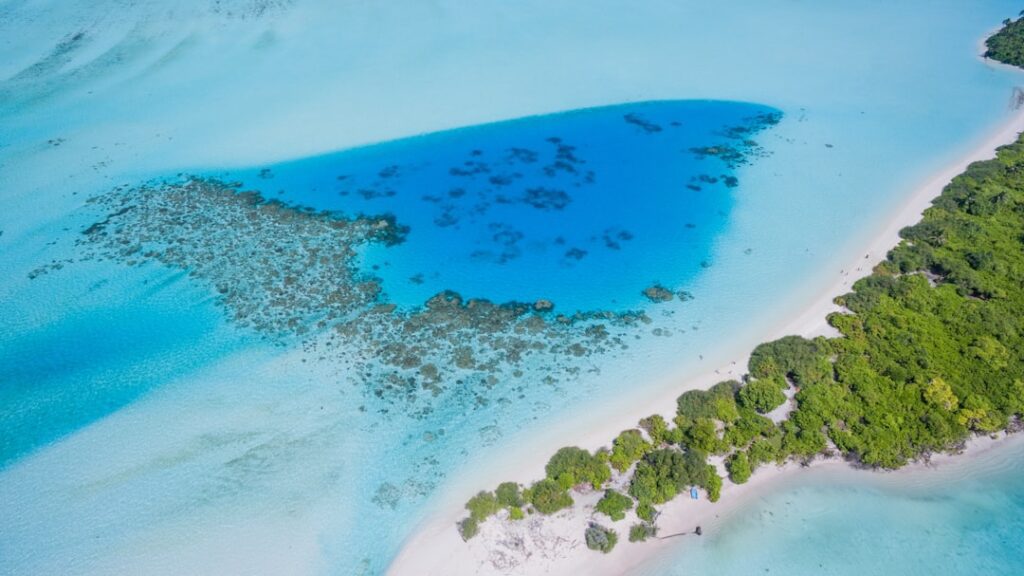
High-angle photography of white boat on blue ocean water near green leafed …, Kudahuvadhoo, Maldives
Art, Music & Nightlife
The creative pulse of Kudahuvadhoo is not found in galleries or bars, but in its living cultural traditions. The most powerful art form is **coral stone carving**, a skill specific to this island and a few others. While there’s no formal gallery, you can see modern masters at work in small workshops, patiently chiseling geometric and floral patterns that echo the mosque’s designs. The true “nightlife” is cultural performance. The thunderous, hypnotic rhythm of **boduberu** is the island’s soundtrack. Performances often happen during local festivals like Eid or the National Day (November 11), or you can ask at the island office if any community practices are open to respectful observers.
For a more contemporary vibe, you might find young locals gathering at the “viewpoint” or the harbor wall in the evenings, sharing stories and phone videos. There are no licensed bars or clubs—this is a dry, observant community—but the social energy is warm and genuine. The real spectacle is after dark, when you can walk to the eastern beach, lie on the sand, and witness a celestial performance: some of the clearest, most breathtaking stargazing in the Maldives, far from any resort light pollution.
Practical Guide
- Getting There: Fly into Velana International Airport (MLE) in Malé. From there, take a 35-minute domestic flight with Maldivian (https://maldivian.aero) to Dhaalu Airport (DDD), located on its own island. A short 10-minute speedboat transfer (approx. $25 per person, arranged by your guesthouse) will bring you to Kudahuvadhoo. Book connecting flights at Skyscanner
- Getting Around: The island is only about 1.5km long. Your feet are the best transport. Bicycles can be rented from guesthouses for $5-8 per day. For the wharf or farther beaches, local taxis (small motorcycles with sidecars) cost a flat 20 MVR ($1.30) per ride anywhere on the island.
- Where to Stay: Opt for a local guesthouse in Medhu Ganduvaru for heritage access, or near the harbor for sea views. **Keyodhoo Retreat** and **Maa Lodge** are excellent, locally-owned options offering clean rooms and authentic meals. Check Booking.com
- Best Time: December to April offers the driest, sunniest weather with calm seas. The shoulder months of November and May can have brief showers but fewer visitors.
- Budget: A realistic daily budget for a guesthouse stay, local meals, and basic activities is $60-80 per person. This is significantly less than resort atolls.

A night sky filled with lots of stars, Kudahuvadhoo, Maldives
What Surprises First-Time Visitors
Most travelers arrive in the Maldives expecting endless solitude on a private sandbank. In Kudahuvadhoo, you’re greeted instead by the vibrant, welcoming chaos of a real Maldivian village. The surprise is joyful: children waving and shouting “Hello!”, the constant greeting of “Assalaamu alaikum” from passersby, and the profound sense of being a guest in a close-knit community, not a customer in a resort. The depth of history is the second great surprise. Few places in the Maldives make their layered past so physically tangible, allowing you to stand in a single glance between a Buddhist ruin and an Islamic mosque.
Finally, the sheer natural beauty beyond the lagoon astonishes. While the island’s “Bikini Beach” (a designated area for tourists to swim in western attire) is lovely, savvy visitors take a local *dhoni* trip (approx. $40 per person) to the nearby **bandaas** (uninhabited islands) or the **Dhaalu Atoll house reef**. Here, just minutes from the harbor, you’ll find snorkeling and diving that rivals any resort location—pristine coral gardens, sea turtles, and reef sharks, often enjoyed without another soul in sight.
Your Kudahuvadhoo Questions
Is it appropriate for non-Muslim visitors to enter the Friday Mosque? Yes, but with deep respect. You must dress modestly (long pants/skirt, covered shoulders). It’s essential to ask permission first at the adjacent island office or from the caretaker (*mudhimu*). They will usually gladly show you around when prayers are not in session. Removing your shoes is mandatory, and women may be asked to cover their hair with a scarf provided at the entrance.
How do I handle the conservative dress code as a tourist? While on the local streets and in the village, both men and women should dress conservatively out of respect. This means covering shoulders and knees. Swimwear is strictly for the designated “Bikini Beach.” Pack light, loose-fitting clothing—linen shirts, maxi dresses, and sarongs are perfect. You’ll find locals appreciate this gesture immensely, and it leads to more positive interactions.
Can I visit as a day trip from a resort? Technically possible, but deeply discouraged and logistically very difficult. Resorts rarely organize such trips, and arranging private transport is prohibitively expensive. More importantly, Kudahuvadhoo deserves more than a few rushed hours. To truly absorb its rhythm, history, and warmth, you need to stay at least two nights in a local guesthouse. This allows you to experience the quiet mornings, the vibrant late afternoons, and the stunning night sky, transforming your visit from a sightseeing stop into a genuine cultural connection.

Stunning sunset view of luxury yachts sailing on the calm waters of the Maldives, Kudahuvadhoo, Maldives
Frequently Asked Questions About Kudahuvadhoo
Is Kudahuvadhoo worth visiting?
Yes, Kudahuvadhoo offers unique attractions and experiences for travelers.
How many days do I need in Kudahuvadhoo?
2-4 days is ideal for first-time visitors to Kudahuvadhoo.
What is the best time to visit Kudahuvadhoo?
Spring and fall offer the best weather for visiting Kudahuvadhoo.
{“@context”: “https://schema.org”, “@type”: “FAQPage”, “mainEntity”: [{“@type”: “Question”, “name”: “Is Kudahuvadhoo worth visiting?”, “acceptedAnswer”: {“@type”: “Answer”, “text”: “Yes, Kudahuvadhoo offers unique attractions and experiences for travelers.”}}, {“@type”: “Question”, “name”: “How many days in Kudahuvadhoo?”, “acceptedAnswer”: {“@type”: “Answer”, “text”: “2-4 days is ideal for first-time visitors to Kudahuvadhoo.”}}, {“@type”: “Question”, “name”: “Best time to visit Kudahuvadhoo?”, “acceptedAnswer”: {“@type”: “Answer”, “text”: “Spring and fall offer the best weather for visiting Kudahuvadhoo.”}}]}
Ready to Visit Kudahuvadhoo?
Start planning your trip today. Compare hotels, find the best tours, and get insider tips.
Your adventure in Kudahuvadhoo starts here →
Related Guides
Explore more destinations similar to Kudahuvadhoo:

