
Kintampo, Ghana Weekend: Waterfalls, Wild Green Markets & The Hidden Jewel of Bono East (2026)
You wake to the distant thunder of the Kintampo Waterfalls, a low rumble that vibrates through your chest, mingling with the smoky scent of charcoal fires and roasting plantains from the roadside stalls already crackling to life. The air is thick, sweet with overripe mangoes, and the morning light filters through the ancient kapok trees like gold through stained glass. This is not the Ghana you see on postcards—this is the real, beating heart of Bono East, and you have exactly 48 hours to fall in love with it.
Quick Facts Before You Go
- Best Months: November to March—the dry season makes the waterfalls accessible and the trails to them safe. July to October brings heavy rains that turn roads into rivers and swell the falls to a dangerous roar.
- Currency: Ghanaian Cedi (GHS). As of early 2025, roughly GHS 12-13 to US$1. Carry small bills—many market vendors and trotro drivers cannot break large notes.
- Language: Bono (also called Brong) is the local language, but English is widely spoken, especially by younger locals and in hotels. You will manage fine with English alone, though travelers who learn “Akwaaba” (welcome) earn immediate smiles.
- Budget: You can experience Kintampo well on US$30-50 per day including meals, transport, and entry fees. A more comfortable budget with nicer lodging and private transport runs US$60-80 per day.
- Getting There: Fly into Kotoka International Airport (ACC) in Accra, then take a domestic flight to Kumasi (45 minutes) followed by a 2.5-hour drive north on the N10 highway. Alternatively, book a direct bus from Accra (8-9 hours) on VIP buses like VIP Transport or Metro Mass. Book flights at Skyscanner
Day 1: The Falls, The Fabric & Finding Your Rhythm
You start the morning with the sound of water—not the gentle drip of a shower, but a full-throated cascade that has been carving rock for millennia. The Kintampo Waterfalls, known locally as Sanders Falls, demand your attention before you even see them. By 7 AM, you are already walking the 2-kilometer trail through the forest reserve, and the mist from the falls cools your skin before the sun fully clears the treeline. The path is uneven, worn smooth by centuries of feet, and locals recommend you wear sturdy sandals or trainers—not the flimsy flip-flops most tourists bring and regret.
- Morning (8-11am): Visit Kintampo Waterfalls (GHS 20 entry for foreigners, GHS 10 for locals). Arrive at 8 AM when the park opens and you will have the falls nearly to yourself. The 70-meter cascade drops into a wide pool where you are allowed to swim—the water is bracingly cool, a shock to the system that leaves you tingling and alive. Go with a guide (GHS 30 recommended tip) who will show you the hidden second cascade upstream where few visitors venture. The walk through the forest reserve reveals butterflies the size of your hand and the calls of unseen birds.
- Lunch: Head to Spot 77 Restaurant on the main Kumasi Road. Locals recommend the fufu with groundnut soup and goat meat (GHS 25). The fufu is pounded fresh each morning, and the soup has a slow-burning heat from local peppers that builds rather than overwhelms. Sit on the open-air terrace and watch the town tick by—motorbikes laden with yams, women balancing basins of oranges on their heads, children in school uniforms walking in tidy pairs.
- Afternoon (1-5pm): First, visit the Kintampo Market, one of the largest in the Bono East Region. It is chaotic, glorious, and overwhelming. You will find stalls selling vivid kente cloth woven in nearby villages, carved wooden masks, shea butter in rough blocks, and dried fish that smells like the sea even though you are hours from the coast. Seasoned travelers haggle with good humor—start at half the asking price and meet somewhere in the middle. Then, walk to the Kintampo Slave Route Memorial, a sobering but essential stop. This was a holding point on the trans-Atlantic slave trade, and the small museum (GHS 10) contains chains, shackles, and oral histories recorded from elders. The guide, usually a local historian, will show you the “door of no return”—a narrow stone passage that leads to a now-overgrown path toward the coast. Allow one hour here. Finally, visit the Kintampo Archaeological Site, where you can see pottery fragments and stone tools dating back to the 14th century Kintampo culture, one of West Africa’s earliest known civilizations.
- Evening: Dinner at Adom Restaurant, where you order the tilapia with banku and shito (GHS 35). The tilapia is grilled whole over charcoal, rubbed with a spice blend that includes ginger, garlic, and local pepper, then served with fermented corn dough (banku) and a dark, spicy sauce (shito) that locals spoon on with abandon. After dinner, walk to the Central Park area where a small open-air bar called The Palm Spot sets up speakers and plastic chairs. You will find locals drinking Club Lager and Star Beer (GHS 5 per bottle), and if you are lucky, someone will pull out a djembe drum and the night will dissolve into music under a sky thick with stars.

A landscape view of the famous Kintampo waterfall in Ghana, Kintampo, Ghana
Day 2: The Road to the Banda Hills & The Flavors That Stay
Day two takes you away from the town center and into the hills that roll like green waves toward the horizon. Travelers often discover that the real magic of Kintampo lies not in the town itself but in the villages that cling to the hillsides, where time moves at the pace of a farmer walking behind an ox-drawn plow. You will need to hire a driver for the day—your guesthouse can arrange one for about GHS 200 (US$16). It is money well spent.
- Morning: Depart by 7 AM for the Banda Hills, about 45 minutes northwest of Kintampo. Stop at a roadside stall near the village of Kawampe for breakfast: waakye (rice and beans cooked with sorghum leaves, served with spaghetti, fried plantain, and a hard-boiled egg—GHS 12). The woman who runs the stall has been making it for 22 years, and travelers say her shito is the best in the region. The view from the hills is staggering—you can see the Black Volta River snaking below, Ghana’s western border with Côte d’Ivoire.
- Midday (10am-1pm): Visit the Banda Cultural Centre (GHS 15 entry), a small but excellent museum housed in a restored colonial-era building. The exhibits focus on the Nafana people, whose history includes matrilineal inheritance, masked festivals, and a language unrelated to any other in Ghana. The guide, usually a local elder, will demonstrate how to play the balafon, a wooden xylophone. Insider tip: come on a Thursday—that is when the centre hosts a small craft market where you can buy authentic kente cloth woven in the village of Banda directly from the weavers, avoiding the tourist markup in town.
- Afternoon (1-4pm): Explore the village of Banda itself. Walk the main dirt road past mud-brick houses with painted geometric patterns, stop at the community cassava processing cooperative (they will show you how cassava is turned into gari—a staple grain—and let you taste fresh gari mixed with sugar and coconut), and hike up to the Catholic Mission (built 1921) for a panoramic view of the valley below. By 2 PM, you will be hot and hungry. Your driver will know a spot: Mama Grace’s in nearby Kwasi-Kwasi village serves groundnut soup with guinea fowl (GHS 20) and pounded yam so smooth and stretchy it looks like elastic.
- Final Evening: Your farewell dinner must be at Paradise Kitchen, a small family-run place on the outskirts of Kintampo. Order the jollof rice with grilled chicken and the special “Kintampo-style” kelewele—spicy fried plantains tossed with ginger, chili, and a whisper of nutmeg (GHS 30 for a full plate). The owner, Abena, learned the recipe from her mother, who learned it from hers. As you eat, she will tell you the story of how Kintampo got its name—legend says a hunter named Kintampo was the first to settle here, drawn by the falls and the fertile land. You leave full in every sense, carrying the weight of a place that has fed you not just food but stories.
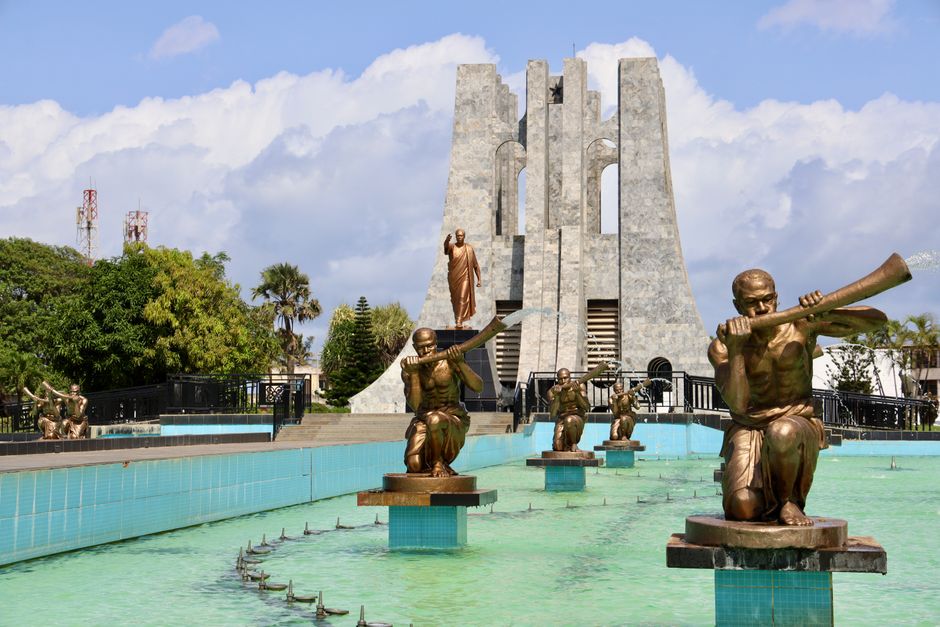
Stunning view of the Kwame Nkrumah Mausoleum and fountain statues in Accra., Kintampo, Ghana
The Food You Can’t Miss
You cannot leave Kintampo without tasting fufu—the pounded cassava and plantain dough that is the soul of Ghanaian cuisine—but here, it is made differently. Locals pound it with a mortar and pestle that is wider and heavier than in other regions, giving the fufu a uniquely dense, satisfying texture. At Spot 77 Restaurant, you watch the pounded fufu being made: two women, one pounding rhythmically with a wooden pestle while the other turns the dough by hand between each stroke, moving in perfect sync. The sound alone is a kind of music.
For street food, find the evening vendors near the Central Mosque around 6 PM. They sell fried yam with pepper sauce (GHS 10) and the local specialty, “kuli-kuli”—deep-fried groundnut cakes that are crunchy, savory, and dangerously addictive. The best vendor, Mama Ama’s, has been in the same spot for 14 years. Seasoned travelers buy a bag of kuli-kuli (GHS 5) and snack on it while watching the sunset from the hill behind the mosque, where the sound of the call to prayer mingles with the cries of fruit bats heading out for the night.
For a sit-down meal, locals recommend The Green Haven Restaurant near the main roundabout. Their specialty is “light soup” (nkatenkwan) with goat meat—a clear, peppery broth with tomatoes, onions, and garden eggs (local eggplants). It is served with either fufu or rice balls (GHS 25). The restaurant is known for its hospitality; if you cannot finish, they will pack it for you without asking and pat you on the arm with a knowing smile.
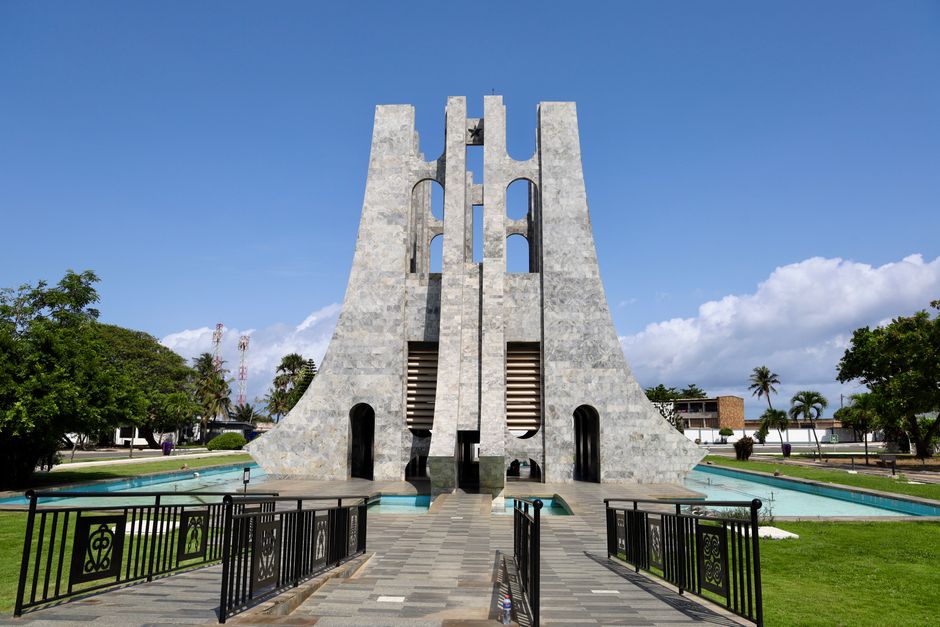
View of the striking Kwame Nkrumah Mausoleum in Accra on a clear day., Kintampo, Ghana
Where to Stay for the Weekend
Accommodation in Kintampo is functional rather than luxurious, but that is part of the charm. You are not here for pillow menus; you are here for the falls, the market, and the feeling of being somewhere real. Stay in the town center if you want to be walkable to the market and restaurants. The Kintampo Waterfalls Guesthouse (doubles from GHS 180, approx. US$14) is the most popular choice—simple rooms with mosquito nets, ceiling fans, and a shared veranda where guests gather to trade travel stories. Breakfast (bread, egg, instant coffee) is included, and the staff can arrange transport to the falls.
For a slightly quieter option, try the Full Life Hotel on the Kumasi Road (doubles from GHS 250, approx. US$19), which has air conditioning (rare in Kintampo) and a reliable generator—important because the power cuts out unpredictably. The attached restaurant serves decent Ghanaian food, though you should still venture out for the best meals. There is also a small swimming pool, a luxury in this part of Ghana, though it is rarely filled to the top.
For the adventurous, the Eco Lodge near the Banda Hills (doubles from GHS 300, approx. US$23) offers bamboo huts with solar lighting and outdoor bucket showers. You trade comfort for immersion: the lodge sits on a hillside overlooking the Black Volta, and at night, you fall asleep to the sound of frogs and the rustle of palm fronds. Book all options through Booking.com or Airbnb.
Before You Go: Practical Tips
- Getting Around: The town is small enough to walk. For longer distances, trotros (shared minibuses) cost GHS 5-10 per ride. For the Banda Hills trip, hire a private driver through your guesthouse (GHS 200-250 for a half-day). Motorbike taxis (called “okada”) are everywhere and cost GHS 5-10 within town—negotiate the price before you get on.
- What to Pack: A sturdy water bottle—the tap water is not safe to drink, but you can refill at hotels; insect repellent with DEET for the evening mosquitoes; a headlamp or small torch for the frequent power cuts; and a lightweight rain jacket even in the dry season—the falls create their own microclimate of mist and unexpected showers.
- Common Tourist Mistakes:
- Money-Saving Tip: Eat where the locals eat. The tourist-adjacent restaurants near the hotel charge GHS 15-20 more per dish for the same food you can get at Spot 77 or Paradise Kitchen. A plate of jollof rice at the roadside is GHS 15 versus GHS 35 at a hotel—and the roadside version is often better. Also, carry cash: no restaurant or market stall in Kintampo accepts cards, and the nearest ATM (in the main town) is unreliable and often empty.

