
Kausani, India Weekend: Himalayan Panoramas, Tea Gardens & The Place Where Gandhi Found Peace (2026)
The first thing that hits you at dawn is the silence—so deep it rings in your ears—before the birds begin their chorus and the first rays turn Nanda Devi’s peak a blushing pink. You’re standing on a ridge at 1,890 meters, and the entire Himalayan range unfurls before you like a 300-kilometer-long silk scroll. The air smells of pine, dew-soaked rhododendrons, and the faint, earthy promise of freshly brewed Kausani tea. This is where Mahatma Gandhi once declared the Himalayas “worth seeing,” and you’ll understand why within your first hour.
Quick Facts Before You Go
- Best Months: March through June for clear skies and blooming rhododendrons; September through November for crisp autumn air and unobstructed mountain views. Avoid July and August when monsoon clouds shroud everything and leeches haunt the trails.
- Currency: Indian Rupee (INR). As of early 2025, ₹100 is roughly $1.20 USD. ATMs are scarce in Kausani—bring enough cash for your stay.
- Language: Hindi and Kumaoni are the local tongues. English is understood at hotels and tourist spots, but travelers find that learning “Namaste” and “Dhanyavaad” (thank you) opens doors and smiles.
- Budget: ₹2,500–₹4,500 per day ($30–$55 USD) for a comfortable mid-range experience including meals, accommodation, and local transport. Budget travelers can manage on ₹1,500.
- Getting There: Pantnagar Airport (PGH) is the nearest, about 2.5 hours by road. Direct flights from Delhi take 50 minutes. Alternatively, take the overnight Shatabdi train from Delhi to Kathgodam (6 hours), then a taxi or shared jeep (3 hours). Book flights at Skyscanner and trains at IRCTC.
Day 1: The Ridge Walk & Gandhi’s Footsteps
You wake before sunrise—not because you set an alarm, but because the birds insist. From your window, the first light catches the summit of Trishul, painting it the color of burnt orange and honey. You pull on your fleece, grab your camera, and step outside into air so fresh it feels like a cold glass of water for your lungs. The day ahead is about settling into the rhythm of this ridge: slow walks, deep views, and the kind of quiet that lets you hear your own thoughts for the first time in months.
- Morning (5:30–8am): Sunrise at Lakshmi Ashram. Walk the 10-minute trail from the main road to this serene ashram perched on the ridge. The view eastward catches the first light on Nanda Devi, Trishul, and Panchachuli peaks. No entry fee. Arrive by 5:45am in summer or 6:30am in winter for the full show. Most tourists miss this spot and head straight to the crowded viewpoints—your secret is the ashram’s peaceful garden benches.
- Breakfast (8:30am): Kausani Tea Estate Café. Perched inside the working tea garden, this open-air spot serves steaming Kumaoni thali (₹350) with pahadi raita, mandua ki roti (finger millet bread), and a side of local aloo ke gutke (spiced potatoes). Pair it with a pot of their own First Flush tea, grown just meters away.
- Midday (10am–1pm): Visit Anashakti Ashram, where Mahatma Gandhi spent 12 days in 1929 writing his commentary on the Bhagavad Gita. The ashram’s small museum displays his original letters and photographs. Entry is free, but you’ll want to sit in the prayer hall for 15 minutes—the silence here feels different. Follow this with a walk along the 2-kilometer Ridge Walk, a paved path running parallel to the main road with uninterrupted Himalayan views. Savvy visitors go clockwise starting from the ashram to keep the mountains on their right for photos.
- Lunch (1pm): Krishna Bhojanalaya on Mall Road. This unassuming joint serves the best pahadi dham—a traditional Kumaoni feast of rice, dal, three types of vegetables, and a sweet rice dessert. ₹250 per person. You’ll share tables with locals, and the owner’s wife might teach you how to eat with your right hand proper-style if you ask nicely.
- Afternoon (2:30–5pm): Explore the Kausani Tea Gardens. Take the dirt path behind the tea estate factory (ask permission at the gate—they usually oblige). Wander between rows of emerald bushes while tea pluckers in bright saris work their way through the slopes. The estate manager sometimes offers impromptu tours of the processing facility if you catch him mid-shift. Photograph the workers at sunset light if you can, but always ask first—a smile and “Namaste” costs nothing.
- Evening (6–8pm): Dinner at Shan-e-Kausani Rooftop Restaurant. Order the mutton stew (₹400) that’s slow-cooked for six hours with local spices and served with steamed rice. The rooftop has only six tables, so arrive by 6:30pm to claim a corner spot with direct Nanda Devi views. After dinner, stroll along Mall Road as the stars emerge—the light pollution here is almost zero, and you’ll spot the Milky Way on a clear night.

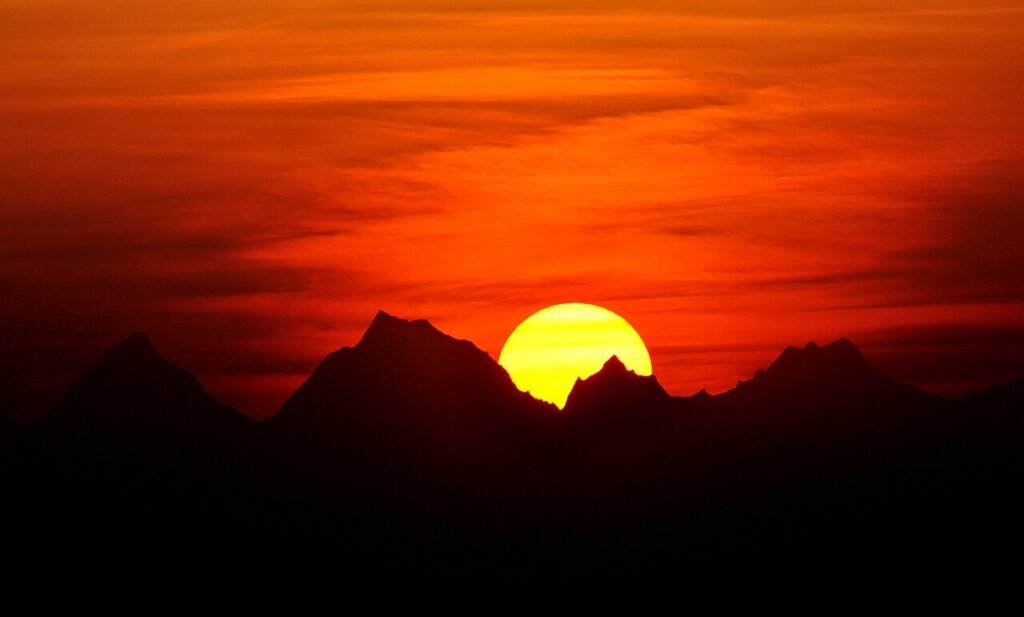
The yellow Sun emerges from behind the Panchchuli peaks of Kumayun Hikamaly…, Kausani, India
Day 2: Waterfalls, Villages & The Tea That Travels the World
Your second day trades the ridge for the valleys and villages below. After yesterday’s wide-open horizons, today is about intimacy: the sound of falling water, the smell of pine bark after rain, and the faces of women who have worked these tea gardens for generations. You’ll end where you began—on the ridge—but you’ll see it differently now, knowing what lies in the folds beneath.
- Morning (7–10:30am): Rudradhari Falls & Caves. It’s a 4-kilometer downhill trek from the village of Garur, about 25 minutes by shared jeep (₹50 per person) from Kausani. The trail winds through oak and rhododendron forests, and you’ll hear the falls long before you see them. The 60-meter cascade plunges into a pool where locals bathe—you can too, but the water will make you gasp. A stone staircase leads to the cave temple dedicated to Lord Shiva. Total time: 3 hours round trip with a swim break.
- Brunch (11am): Kausani Bakes & Brews near the bus stand. This tiny bakery run by a local couple serves outstanding apple cinnamon cake (₹80 per slice) and ginger chai (₹40). Grab a seat on the wooden bench outside and watch the shared jeeps rattle past, packed with passengers, chickens, and sacks of grain.
- Midday (12–2:30pm): Visit the Kausani Tea Factory for a guided tour (₹200 per person). You’ll learn how the leaves go from bush to box—the withering, rolling, oxidation, and firing process—and taste three grades of tea in the tasting room. The factory shop sells First Flush at ₹800 per kilo, almost half what you’d pay in city stores. Ask for the “Orthodox” grade if you want the leaf quality that international buyers seek out.
- Afternoon (3–5pm): Explore the village of Someshwar, 10 kilometers south. It’s a classic Kumaoni hill village with slate-roofed houses, a 200-year-old stone temple, and terraced fields that look like steps for giants. Wander the narrow lanes and watch women winnowing grain in courtyards. The village children will wave and ask for your name. No entry fees, no souvenir shops—just real life.
- Final Evening (6–8:30pm): Sunset at Baijnath Temple, about 45 minutes away by taxi (₹800 round trip). This 13th-century stone temple complex dedicated to Shiva sits in a meadow with the Himalayan range as its backdrop. The light at golden hour turns the grey stone to amber. Afterward, dinner at The Hideaway Resort’s restaurant—book ahead for their special Kumaoni thali (₹650) featuring 12 dishes, including the hard-to-find bal mithai (a local fudge) for dessert. The dining room has floor-to-ceiling windows facing the mountains, and if you sit from 6:30pm, you’ll watch the peaks turn from gold to purple to black.

A view of a valley with trees and mountains in the background, Kausani, India
The Food You Can’t Miss
Kumaoni food is the unsung hero of Uttarakhand—unlike the butter-heavy Punjabi or fiery South Indian cuisines you know, it’s subtle, earthy, and built around millets, lentils, and mountain greens. Your taste buds will discover that the region’s cuisine comes alive in the simple dishes locals have perfected over centuries. The star is bhatt ki dal—a black soybean preparation slow-cooked with cumin, garlic, and a hint of jaggery. You’ll find the best version at Neelkanth Restaurant on Mall Road (₹180 for a full dal with rice), where the owner’s mother still oversees the kitchen. She’s been cooking it for 40 years, and you’ll taste why.

A forest with trees and bushes, Kausani, India
For street food, nothing beats the singodi sold from woven baskets near the bus stand from 4pm onwards. These leaf-wrapped steamed dumplings are made from grated coconut, khoya (reduced milk), and cardamom, cooked inside a local leaf that infuses them with an herbal note. ₹20 each. Locals recommend eating them while still warm, leaning against the railing with the mountains in view. You should also try kandali ka saag, a stinging nettle preparation that tastes like a cross between spinach and kale—just don’t touch it raw unless you enjoy the burn.
Your one can’t-miss restaurant experience is Banjara Café, a family-run rooftop spot hidden behind the bus stand. No signboard, just a wooden staircase between two shops. The owner, Ramesh, cooks everything on a charcoal stove and serves a pahadi kadhai of vegetables and local cheese (₹300) that you’ll remember for months. He’ll likely join your table for chai after your meal and tell stories of guiding trekkers in the 1980s. Travelers often discover that the meal takes two hours, but that’s exactly the point.
Where to Stay for the Weekend
The Ridge Area (Best for views): This stretch along the main ridge between Anashakti Ashram and the bus stand offers the most dramatic Himalayan panoramas. Kausani Himalaya Resort (₹4,000–₹7,000 per night) has cottages with private sit-outs and telescopes for stargazing. Book through Booking.com. A more budget-friendly option is Himalayan Abode (₹1,800 per night), whose terrace views rival the five-star properties—ask for Room 4 on the top floor. For a more local experience, search Airbnb for homestays in the quiet lane behind the police station, where families rent rooms for ₹800 a night and serve home-cooked meals.
Tea Garden Area (Best for tranquility): If you’d rather wake to the scent of tea leaves, stay at Kausani Tea Estate’s Guest House (₹3,000 per night, book directly through their website). Three colonial-era rooms with creaking floors and verandas overlooking the gardens. The estate manager might invite you for morning tea in the factory. Club Mahindra Kausani (₹5,000–₹6,500) sits on the opposite slope with valley views and a small infinity-style pool, but it lacks the authenticity of the guest house. Seasoned travelers prefer the guest house for its old-world charm and the rare experience of falling asleep to the sound of the wind in the tea bushes.
Before You Go: Practical Tips
- Getting Around: Shared jeeps are your best bet for short distances—they run from the bus stand to nearby villages for ₹30–₹100 per ride. For the full weekend, hiring a taxi for two days costs ₹2,500–₹3,500 (negotiate at the stand near the bus station). Walking is practical for the main ridge and tea gardens; the entire ridge is only 2 kilometers end to end.
- What to Pack: (1) A quality fleece or down jacket—even in summer, evenings drop to 12°C, and the wind on the ridge is persistent. (2) Good walking shoes—the tea garden paths and Rudradhari trail get muddy and slippery. (3) A reusable water bottle—Kausani has clean mountain springs, and your hotel will refill it. Avoid buying single-use plastic. (4) Sunscreen and UV sunglasses—the mountain sun burns fast even when the air feels cool.
- Common Tourist Mistakes: Most visitors leave by noon on Sunday, missing the Baijnath sunset entirely. Stay until Monday morning if you can—the weekend crowds thin, and the mountains seem closer. Another mistake is believing the weather forecast: in Kausani, clouds can roll in within 20 minutes and clear just as fast. Savvy visitors keep a folded poncho in their daypack and never trust a “sunny all day” prediction. Also, several travelers arrive expecting manicured viewpoints only to discover that nature doesn’t come with entry gates. The unobstructed views along the Ridge Walk require no tickets, no permission, and no hassle.
- Money-Saving Tip: Skip the hotel breakfast buffet (₹500–₹800) and instead walk to any local chai stall on Mall Road. For ₹120, you’ll get two cups of ginger chai, two samosas, and a front-row seat to village life. Over two mornings, you save ₹1,200—enough for a dinner at Banjara Café with leftovers for lunch the next day. A welcome bonus: the chai wallahs know the best sunrise spots and will point you to hidden trails no guidebook mentions.

