
Hell-Ville, Madagascar Weekend: Markets, Mosques & The Best Kebabs East of Zanzibar (2026)
You step off the potholed Avenue de l’Indépendance into a swirl of vanilla, clove, and diesel fumes as a taxi-brousse horn blares somewhere behind the Grand Marché. The call to prayer drifts from the whitewashed mosque just as a vendor pushes a skewer of zebu kebab into your hand — charred, smoky, irresistible. This is Hell-Ville, Nosy Be’s chaotic, captivating port capital, where Malagasy, Swahili, French, and Comorian cultures collide in a weekend you won’t forget.
Quick Facts Before You Go
- Best Months: April to November (dry season, lower humidity, calm seas). Avoid January–March for cyclone risk and December for inflated prices.
- Currency: Malagasy Ariary (MGA). Roughly 4,600 MGA = 1 USD. Bring cash — ATMs are unreliable.
- Language: Malagasy and French. English is rare; savvy visitors learn “Salama” (hello) and “Veloma” (goodbye) before arrival.
- Budget: $40–80/day for mid-range comfort (meals, transport, activities). Budget travelers manage on $25; splurgers hit $120.
- Getting There: Fly into Fascene Airport (NOS) from Antananarivo (1.5 hours) or direct from Johannesburg and Nairobi. Book at Skyscanner
Day 1: Spice, Smoke & Swahili Soul
You start the morning at the Grand Marché just as the sun burns through the morning haze, weaving past pyramids of vanilla pods, cinnamon bark, and dried clove buds that scent the air so thick you can almost taste them. Women in colourful lamba wraps balance baskets of mangoes on their heads, while fishermen haul in the morning’s catch of grouper and red snapper at the waterfront. It’s loud, sticky, and absolutely electric — and you haven’t even had breakfast yet.
- Morning (8-11am): Explore the Grand Marché (free entry) yourself — haggle for vanilla, buy a bag of freshly roasted coffee for 5,000 MGA, and watch the spice auction at the northern end where exporters bid on tons of ylang-ylang blossoms. Don’t miss the fabric stalls for hand-dyed lamba hoany (traditional silk scarves, 15,000–30,000 MGA).
- Lunch: Head to Chez Luc (Rue du Commerce, 1 km from the market) for the best zebu steak on the island — a tender, grass-fed cut served with garlic butter and rice for 12,000 MGA. Follow it with the house special: fresh mango sorbet (3,000 MGA) made from fruit grown in Luc’s own garden. Arrive by 12:15 to beat the tour groups.
- Afternoon (1-5pm): Visit the Mahatsinjo Sacred Lake (30-minute walk or 5,000 MGA taxi from town) where travelers discover the crash site of a 1960s DC-3 plane submerged in the black water — locals say the wreck is cursed, but you’ll find the real magic in the giant banyan trees and the troop of friendly black lemurs that gather at the water’s edge. Then walk 15 minutes to the Mont Passot viewpoint (free; 4.5 km from town) — climb the wooden lookout tower for panoramic views of Nosy Be’s nine volcanic lakes. Arrive before 4pm for the golden light.
- Evening: Dinner at Le Bateau Ivre (Avenue de l’Indépendance) — a creaky wooden terrace hanging over the harbour where you order the romazava (Malagasy beef stew with shredded greens, 10,000 MGA) and a glass of local punch coco (rum infused with coconut and vanilla, 5,000 MGA). By 8pm, the terrace fills with expats and locals playing cards — pull up a chair and someone will deal you in.

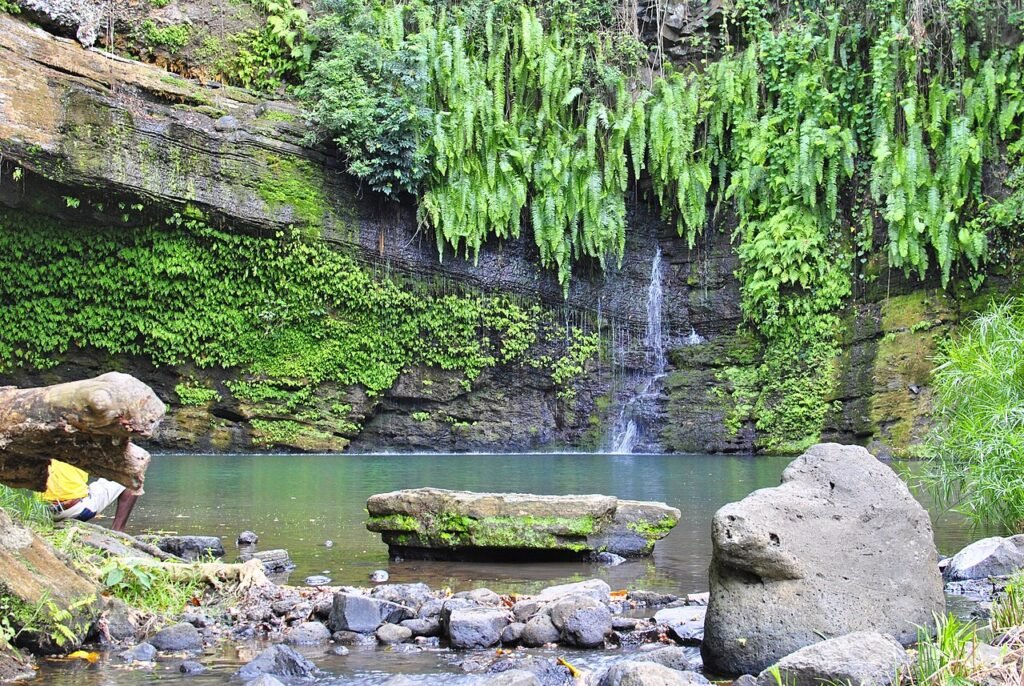
Cascade sacrée de Nosy Be Hell Ville, Hell-Ville, Madagascar
Day 2: Lemurs, Lémuriens & Last Light
Day two shifts gears entirely. You leave Hell-Ville’s urban hum behind for the wild heart of Nosy Be, where the road dissolves into red dirt tracks and the only soundtrack is the rustle of leaves and the strange, guttural call of indri lemurs echoing from the canopy. This is the Nosy you came for — raw, green, and utterly alive.
- Morning (7-10am): Take a taxi-brousse (shared minibus, 3,000 MGA, 45 minutes) to Lokobe National Park — Nosy Be’s last remnant of primary rainforest. Join the 8am guided walk (entry 10,000 MGA + mandatory guide 25,000 MGA per group) to spot the endemic black lemur, Nosy Be panther chameleon, and the rare leaf-tailed gecko. Savvy visitors bring closed-toe shoes and insect repellent — the trail gets muddy and the mosquitoes are fierce.
- Lunch (11:30am): At the park exit, find Mamy’s Beach Café — a thatched shack on the black sand beach where Mamy herself grills fresh barracuda with lime and ginger (8,000 MGA) served with coconut rice and a side of achard (pickled mango and carrot). Eat with your hands; travellers often discover the flavours hit harder that way.
- Afternoon (1-4pm): Take a pirogue (dugout canoe, 10,000 MGA per person, 30 minutes) from Lokobe’s beach to Nosy Komba — the “Lemur Island.” You’ll step ashore into a village where ring-tailed lemurs hop freely onto visitor’s shoulders for banana bribes (the locals sell them at 2,000 MGA per bunch). Walk the village’s single path past wood carvers selling miniature zebu statues and vanilla-infused rum bottles (15,000 MGA). Most tourists rush through in an hour; you’ll linger for two, chatting with the carvers about their craft.
- Final Evening (5-9pm): Return to Hell-Ville for a farewell dinner at Chez Tata Clémentine (Rue de l’Indépendance, opposite the post office) — a hidden courtyard restaurant that feels like someone’s home because it is. Tata herself takes your order: achard de légumes (pickled vegetables, 4,000 MGA), vary sosoa (rice cooked in broth with chicken, 8,000 MGA), and a pitcher of fresh lychee juice (3,000 MGA). Around 7pm, the courtyard fills with the smell of charcoal and laughter as families arrive for dinner — you’ll leave with Tata’s recipe scribbled on a napkin and her phone number in case you return.

A vibrant aerial view of Antananarivo, Hell-Ville, Madagascar
The Food You Can’t Miss
Hell-Ville’s food scene is a conversation between the Indian Ocean and the highlands of Madagascar. You’ll taste it most vividly in the street food stalls along Avenue de l’Indépendance, where vendors fan charcoal grills from 6pm until midnight. Your first move should be the koba akondro — a dense, sweet cake of ground peanuts, rice flour, and mashed banana, steamed in a banana leaf, sold for 1,000 MGA near the bus station. One bite and you’ll understand why locals queue for it after work.

Vibrant view of Antananarivo’s architectural blend during sunset, Hell-Ville, Madagascar
For a proper meal, travellers discover that the best achard (Malagasy pickled vegetables — shredded cabbage, carrot, green mango, and green beans in turmeric and chilli oil) comes from the Grand Marché’s southern meat aisle, where a woman named Bertille sells her family’s recipe in used jam jars for 4,000 MGA each. You’ll eat it alongside everything: rice, grilled fish, even stirred into your noodles at the night market.
Restaurant-wise, Le Chalet des Orchidées (500 m north of the port) serves the island’s finest zebu en sauce — braised for four hours in tomato, ginger, and local pepper until the meat falls apart at the touch of a fork (18,000 MGA). Book a table on the garden terrace by 7pm; the fairy lights among the frangipani trees make it the most romantic spot on the island.
Where to Stay for the Weekend
Your best bet is to stay in central Hell-Ville for convenience — you’ll save on transport and be minutes from the market and waterfront. The Quartier Antsatsaka (the old colonial grid behind the market) is your sweet spot: quiet enough for sleep, close enough to walk to everything. Try Hôtel de la Poste (Rue Flacourt, from $45/night) for its rooftop terrace overlooking the bay, clean rooms with mosquito nets, and a breakfast of fresh baguette and local jam that’ll set you up for the day. Check rates on Booking.com.
Before You Go: Practical Tips
- Getting Around: Taxi-brousse (shared minibus) is your cheapest option — 1,000–5,000 MGA for trips around the island. For private rides, negotiate a pousse-pousse (bicycle rickshaw, 2,000–5,000 MGA per trip in town) or hire a car with driver for the day (50,000–70,000 MGA, available at Fascene Airport). Walking Hell-Ville’s central grid takes 20 minutes end to end; you don’t need a car inside town.
- What to Pack: A headlamp for evening walks (streets are poorly lit), reef-safe sunscreen for beach trips, a sarong that doubles as a towel and cover-up for mosque visits, and a reusable water bottle with a filter — tap water is unsafe, but filtered refills cost 500 MGA at most guesthouses.
- Common Tourist Mistakes: The biggest error visitors make is assuming that “Hell-Ville” matches its name — it’s actually named after a 19th-century French admiral (Hell, pronounced “ell”), not infernal temperatures. Second, travellers often overpay for vanilla at the market: the real price is 20,000–30,000 MGA per kilo of cured beans; anything above 40,000 MGA is a tourist tax.
- Money-Saving Tip: Skip the pricey “spice tour” packages that hotels sell for 60,000 MGA. Instead, visit the Cooperative of Ylang-Ylang Producers (Av. de l’Indépendance, open Mon–Fri 9am–4pm) where you can tour the distillery for free and buy pure essential oils at 8,000 MGA per bottle — half the price of tourist shops.

