
Gobustan’s Mud Volcanoes, Azerbaijan Weekend: Bubbling Craters, Ancient Petroglyphs & The Best Kebab of Your Life (2026)
You step out of the car and the air hits you—a sharp mineral tang of sulfur mixed with warm earth, while a low *gloop-glub-glub* rises from the grey, moonlike terrain around you. A bubble the size of a dinner plate swells, shudders, and pops with a soft sigh, sending a cool spatter of mud across your ankle. You’re standing in the world’s largest concentration of mud volcanoes, and the ground is literally breathing beneath your feet. Far off, the Caspian Sea glitters like a mirage, and you realize you’ve just discovered one of Earth’s strangest, most spectacular landscapes.
Quick Facts Before You Go
- Best Months: April to June and September to October — the heat is manageable (25-30°C), the skies are clear, and the mud volcanoes are active without the summer crowds. Avoid July and August when temperatures hit 40°C and you’ll be baking on the exposed plateau.
- Currency: Azerbaijani Manat (AZN). Roughly 1 AZN = 0.59 USD / 0.55 EUR. Carry cash in Baku; only larger hotels and tour operators take cards out at the volcanoes.
- Language: Azerbaijani (Azeri). English is spoken in Baku hotels and tourist restaurants, but out at the mud volcanoes you’ll rely on your guide. Learn *salam* (hello) and *təşəkkür* (thank you).
- Budget: 150-250 AZN per day for a mid-range traveler ($90-150 USD) including private transport, meals, and entrance fees. You can go cheaper with shared tours, but a private car is your best bet for flexibility.
- Getting There: Fly into Heydar Aliyev International Airport (GYD) in Baku — about 4.5 hours from London, 3 hours from Istanbul. Book at Skyscanner
Day 1: The Lunar Surface & The Carpet City
You wake to the distant call to prayer threading through your hotel window in Baku, and by 8:30 AM, your driver — a laconic local named Rustam who knows every pothole on the Qobustan road — is waiting. The 65-minute drive south from Baku takes you past sprawling oil fields, their pumpjacks nodding like iron birds, and then suddenly the landscape empties into a vast, khaki-colored plain. By the time you reach the turnoff for the mud volcanoes, you feel like you’ve left the 21st century behind entirely.
- Morning (8:30-11:30am): Gobustan Mud Volcanoes (entrance 10 AZN / ~$6 USD). You arrive at the protected reserve, a fenced-off area where dozens of low, grey cones bubble and belch. Your guide hands you a pair of cheap sandals and tells you to leave your shoes in the car — the mud stains everything. You walk between craters the size of wading pools, some hissing steam, others so placid you could dip your finger in (don’t — it’s cold but acidic). The most active ones, like *Toragay*, gurgle every 10-15 seconds, and savvy visitors stand downwind to avoid the spray. Travelers often spend an hour here, but you’ll want two — the surreal quiet and the occasional *whump* of a large bubble popping is hypnotic. Mud from the volcanoes is said to cure Roman Emperor Tiberius is rumored to have imported it for skin ailments, and you can still buy a small jar at the entrance for 5 AZN ($3).
- Lunch (12:00-1:00pm): Qobustan Restaurant & Kafe (on the main road back toward Baku, just past the Gobustan Archaeological Museum). You order *piti* — a slow-cooked lamb, chickpea, and chestnut stew served in a clay pot — for 8 AZN ($4.70). The trick is to eat the broth first, then mash the meat and vegetables into a paste and wrap it in lavash. The locals recommend asking for a side of *reshka* (sour plum paste) to cut the richness. You eat under a pergola covered in grapevines, and a stray cat curls up at your feet.
- Afternoon (1:30-4:30pm): Gobustan Rock Art Reserve (entrance 10 AZN / ~$6 USD). Just 15 minutes south of the mud volcanoes, this UNESCO World Heritage site holds over 6,000 petroglyphs dating back 5,000 to 40,000 years. You follow a wooden walkway up a low limestone ridge, and your guide points out carvings of ancient boats, antelope, and dancing stick figures. The most famous panel shows a scene of aurochs and shamans — likely a ritual hunting preparation. Travelers often miss the small museum at the entrance, but you should not: inside, a 3D holographic model shows how the Caspian Sea once lapped at the base of these cliffs. Plan to spend 90 minutes here, especially if you want to hike the short trail to the top for a panoramic view of the plateau.
- Evening (6:30pm onward): Dinner at *Şirvanşah Bakı* in Baku’s Old City (İçərişəhər). You order *şah piti* (a royal version of the stew with quince and cherry — 18 AZN / $10.50) and a glass of *nar şərabı* (pomegranate wine, 6 AZN / $3.50). The restaurant is a restored 19th-century caravanserai with a domed ceiling and live mugham music — a haunting blend of vocal and string improvisations that echoes off the stone walls. After dinner, you walk 50 meters to the Maiden Tower under floodlights, and for a moment, the only sound is your footsteps on ancient cobblestones.

Gobustan mud volcanoes, Azerbaijan, Gobustan’s Mud Volcanoes, Azerbaijan
Day 2: Petroglyphs, Silk Carpets & A Caspian Sunset
Day two asks you to slow down. You’ve seen the otherworldly terrain; now you’re ready to touch the fabric of Azerbaijan’s long history. Your morning starts not with a car engine, but with the clink of teacups and the faint scent of saffron drifting from a neighborhood bakery.
- Morning (8:00-10:00am): Breakfast at *Çay Bağı* (Tea Garden) in the Old City — a shaded courtyard near the Palace of the Shirvanshahs. You order *qutab* (a thin, crescent-shaped pancake stuffed with herbs and minced lamb — 4 AZN / $2.35) and a glass of traditional *çay* (black tea) served with rose-petal jam. Locals recommend pouring the tea into a saucer to cool it before sipping, and you watch as an elderly man does exactly that, his movements slow and deliberate. The garden is all green tiles and trickling fountains — a pocket of calm before the city wakes.
- Midday (10:30am-1:00pm): Palace of the Shirvanshahs (entrance 15 AZN / $8.80). Built between the 13th and 16th centuries, this sandstone palace complex was the seat of the Shirvanshah dynasty. You wander through the royal mausoleum, the mosque, and the vast bathhouse with its star-shaped skylights. The secret to avoiding crowds is to arrive at 10:15 AM, just as the tour groups are heading to the Maiden Tower. Tourists often rush through the palace in 45 minutes, but if you take the time to sit in the inner courtyard, you’ll find a stillness that few visitors experience. Look up at the intricate *shabaka* — wooden lattices that filter sunlight into geometric patterns.
- Afternoon (1:30-4:00pm): Neighborhood to explore — Yashil Bazaar (Green Market) in the Təzə Pirə district. You take a 15-minute taxi from the Old City (5-7 AZN / $3-4) and walk into a warehouse-sized maze of dried fruit, spices, and carpets. The vendors let you taste dried persimmons and mulberries before you buy. The best purchase is a tiny jar of saffron threads (15 AZN / $8.80) — Azerbaijan produces some of the world’s finest, and you’ll use every single strand when you get home. If you’re interested in carpets, head to *Xalı Mərkəzi* (Carpet Center) just off the main hall, where second-floor dealers sell vintage silk rugs for 200-600 AZN ($118-353) — far cheaper than in the tourist shops of the Old City.
- Final Evening (5:30pm onward): *Art Club Restaurant* on the Baku Boulevard overlooking the Caspian Sea. You order *dushbara* (tiny dumplings in a clear lamb broth — 10 AZN / $5.90) and a main of sturgan *kavurma* (pan-seared sturgeon with pomegranate molasses — 28 AZN / $16.50). The restaurant’s terrace is built on a pier, and as the sun drops behind the Flame Towers, the lights of the Oil Rocks platforms twinkle on the water like a second city. For a final drink, walk 10 minutes to *Bar 1904* inside the Four Seasons hotel for a sunset cocktail with a view of the Maiden Tower silhouetted against the darkening sky.
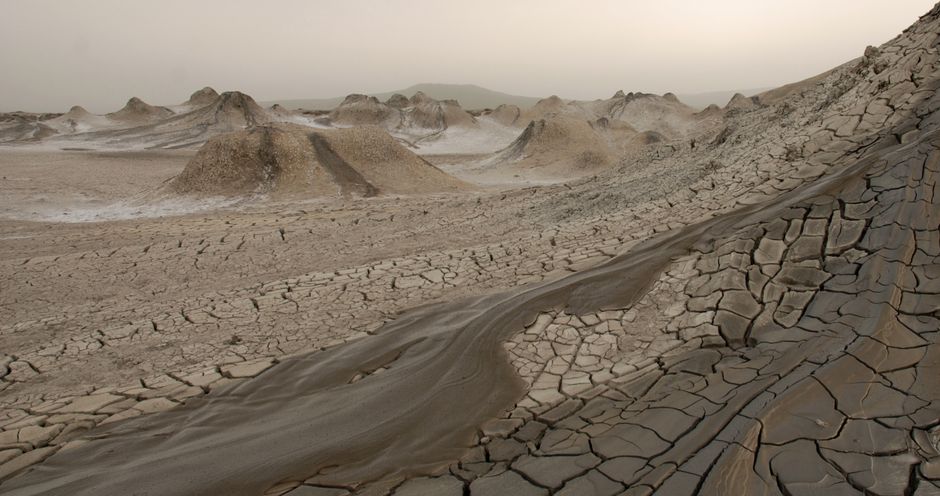
Explore the arid landscapes of Qobustan, Gobustan’s Mud Volcanoes, Azerbaijan
The Food You Can’t Miss
Azerbaijani cuisine is a love letter to lamb, herbs, and the pomegranate — and nowhere is that more evident than in the roadside kebab joints that line the road back from Gobustan. You’ll find a tiny shack called *Köç Əti* (about 5 km north of the mud volcanoes turnoff) where a man named Eldar grills *lyulya kebab* over glowing coals — minced lamb mixed with onion, sumac, and a secret spice blend he inherited from his grandfather. For 5 AZN ($2.95) you get two skewers wrapped in *lavash* with grilled tomatoes and a handful of raw white onion. Eat standing, with the juice running down your chin, and you’ll understand why locals drive 40 minutes just for this.

Explore the unique landscape of Qobustan’s mud volcanoes in Azerbaijan., Gobustan’s Mud Volcanoes, Azerbaijan
For a sit-down experience, *Şərabçılar* (Wine Makers) in Baku’s Old City is your best bet. The specialty is *qovurma* — a slow-cooked lamb stew with chestnuts and dried apricots, served in a clay pot sealed with a circle of dough (18 AZN / $10.50). You break the bread lid yourself, and the steam carries the scent of saffron and allspice. The wine list is excellent: try a bottle of *Savalan* — a local red from the north-west — for 25 AZN ($14.70). Seasoned travelers know to leave room for *shekerbura* (pastry filled with ground almonds and cardamom) — one piece is never enough.
The street food you cannot skip is *qutab* from a pushcart in the Old City. Look for the cart with the longest line, usually near the Gosha Gala Gates. For 2 AZN ($1.18), you get a fresh, crescent-shaped flatbread grilled on a convex metal dome, stuffed with either pumpkin, herbs, or lamb, and served with a squeeze of lemon. You eat it while walking, the paper wrapper growing translucent with oil, and you immediately understand why it’s been a staple here for centuries.
Where to Stay for the Weekend
For a weekend break focused on Gobustan, you want to be in Baku’s Old City (İçərişəhər) or within a 10-minute walk of its gates. This is where the shuttle tours for the mud volcanoes start, where the best restaurants cluster, and where you can step out at midnight to hear the call to prayer echoing off medieval walls. For character and authenticity, the *Old City* offers restored caravanserai-style hotels — rooms with high ceilings, exposed stone, and courtyard fountains. For nightlife and convenience, the *Boulevard* district runs along the Caspian and puts you a short taxi ride from everything.
Booking.com has excellent options like *Hotel Shah Palace* (a 17th-century merchant’s house turned boutique hotel, rooms from 160 AZN / $94 USD per night) or *Baku Old City Inn* (smaller, more affordable, from 90 AZN / $53 USD). For self-catering with local character, try Airbnb — look for apartments in the *Boyuk Qala* street area of the Old City; a whole flat with a terrace overlooking the Maiden Tower runs about 120 AZN ($70 USD) a night. If you prefer a more modern base, the *Boulevard Hotel* on the waterfront offers rooms from 200 AZN ($118 USD) with a rooftop pool and direct elevator access to the promenade.
Before You Go: Practical Tips
- Getting Around: The mud volcanoes and petroglyphs are 65 km from Baku with no public transport. Your best bet is a private driver for the day (120-150 AZN / $70-88 USD, arranged through your hotel or a local tour operator). Shared group tours via *Baku Explorer* cost about 60 AZN ($35) per person and include both sites — they pick up from hotels at 8:30 AM and return by 3 PM. Within Baku, a Bolt or Uber averages 4-8 AZN ($2.35-4.70) for Old City to Boulevard.
- What to Pack: 1) An old pair of sandals or water shoes for the mud volcanoes — the mud stains sneakers permanently. 2) A scarf or light shawl for women — you’ll need it to cover your head and shoulders when entering the small mosque at the Palace of the Shirvanshahs. 3) Wet wipes — the mud dries into a fine grey dust that sticks to your ankles and can take two rinses to fully remove. 4) A sun hat and sealed water bottle — the Gobustan plateau has zero shade, and the nearest shop is 20 minutes away. Locals recommend you bring a small empty bottle to collect a sample of dried mud as a souvenir.
- Common Tourist Mistakes: Travelers often visit the mud volcanoes immediately after rain — the path turns into a treacherous, sticky clay that can swallow your shoes. Check the weather; if it’s been raining within 48 hours, call your driver to confirm the track is passable. Another pitfall: buying carpets from the first Old City shop you see. Prices there are typically 2-3x the market rate. Instead, visit the Yashil Bazaar or a government-certified shop like *Azeri Carpet* on Fountain Square, where you’ll get a certificate of authenticity.
- Money-Saving Tip: Skip the paid guided tour at the Gobustan Rock Art Reserve (an extra 25 AZN). The information panels in English are excellent, and the free audio guide (available via QR code at the entrance) covers all major petroglyphs. That saves you enough for a full dinner at *Art Club Restaurant* later.

