
Carabane Island, Senegal Weekend: Colonial Ruins (2026)
You step off the pirogue onto a beach of powdered silver sand at low tide, the air thick with the scent of salt and mangrove mud. A distant calabash rhythm drifts from the old village, mixing with the laughter of children kicking a deflated football. For the next 48 hours, Carabane will slow your pulse to the rhythm of the Casamance River—a place where history whispers through crumbling French colonial walls and every meal tastes of the ocean.
Quick Facts Before You Go
- Best Months: November to May (dry season, fewer mosquitoes, clear skies). Avoid August–October when heavy rain and impassable roads can strand you.
- Currency: West African CFA franc (XOF). 1 USD ≈ 600 XOF. Carry cash—there are no ATMs on the island. Cap Skirring has a few but they often run empty.
- Language: French and Wolof are official. English is spoken only at a handful of tourist lodges and by guides. Learn a few phrases in Jola, the local dialect: “*kasumay*” (thank you) goes a long way.
- Budget: $40–80 USD per day, including meals, a basic bungalow, and pirogue transfers. Luxury eco-lodges push it to $120–150.
- Getting There: Fly into Cap Skirring International Airport (CSK) from Dakar (1 hour, ~$150 round trip). Book at Skyscanner. From Cap Skirring, take a shared minibus to the village of Elinkine (30 min, 1,500 XOF), then a pirogue across the river to Carabane (20 min, 2,000 XOF per person).
Day 1: Arriving into Silence – Wandering Ruins & Sunset Oysters

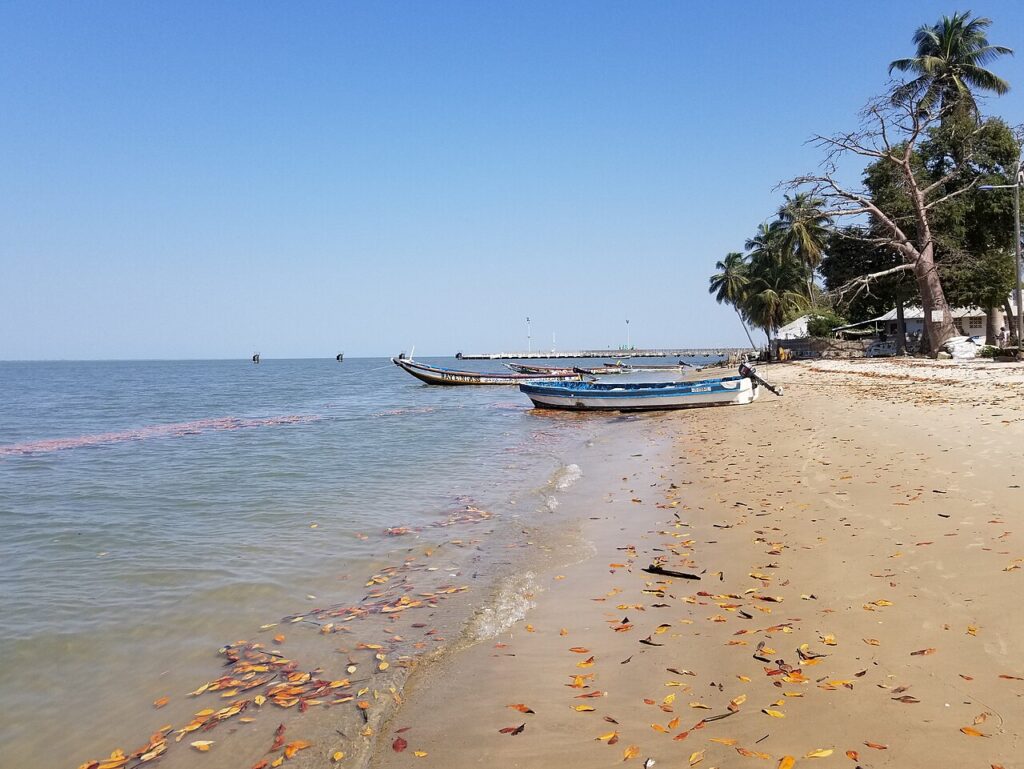
One of the most beautiful spots in Senegal surrounded by very pure water, Carabane Island, Senegal
You arrive just before noon, the pirogue scraping onto the sand near the collapsed customs house—a ghost of French colonial trade from the 1840s. The island has no cars, no motorbikes, and only a single sandy path that loops the island in an hour. You drop your bag at your lodge and immediately feel your shoulders drop. The only soundtrack is the rustle of palm fronds and the distant chop of a machete against a coconut.
- Morning (8–11am): The journey alone eats the morning. Aim to leave Cap Skirring by 7:30am to catch the 8am minibus to Elinkine. The pirogue crossing costs 2,000 XOF per person (shared). By the time you’ve checked in and bought a cold *Gazelle* beer (500 XOF) at the island’s only shop, it’s nearly noon—that’s Carabane time.
- Lunch: Chez Mamadou, a sandy terrace under a thatched awning overlooking the old French pier. Order the *capitaine grillé* (grilled Nile perch) served with sticky white rice and a searing-hot *mafé* (peanut sauce) – 4,500 XOF. The fish was swimming three hours ago. Locals recommend the *poulet yassa* (onion-marinated chicken) on Saturdays when the market chicken is fresh.
- Afternoon (1–5pm): After lunch, walk the circular path west through the village of detached thatch huts. You’ll pass the ruins of the 19th-century French governor’s house—four stone pillars and a wrought-iron balcony, now home to a family of goats. Savvy visitors know to bring a flashlight to peek into the small “slave house” cellar, a quiet memorial to the island’s role in the triangular trade. Continue to the island’s southern tip at low tide to spot herons and white pelicans. Most tourists miss this side entirely, but here you’ll find the abandoned lime kilns from 1885, overgrown with bougainvillea.
- Evening: Sunset at **Le Campement de Carabane** is a ritual. Grab a plastic chair on the deck and order a bowl of freshly shucked *huîtres* (mangrove oysters) – 2,000 XOF for six – served with lime and chili. They’re small, briny, and phenomenal. You share the sunset with a handful of other travelers, all of you speaking in hushed tones as the sun melts into the Casamance River. Dinner at the same spot: *thiéboudienne* (Senegal’s national dish of spiced fish and broken rice) – 5,000 XOF – followed by a digestif of *bissap* (hibiscus juice) laced with local rum.
Day 2: Kayaks, Calabash & One Last Feast

Charming coastal townscape featuring colorful historic buildings along the …, Carabane Island, Senegal
- Morning (7:30–10:30am): Breakfast at your lodge – usually a baguette with butter and local honey, strong Nescafé, and papaya slices (included in most rates). Then rent a kayak from **Kayak Carabane** (the owner, Abdou, sets up a stand near the pier). 5,000 XOF for two hours. Paddle into the mangroves behind the island where the channels narrow to one-boat width. You’ll spot yellow-billed storks and, if you’re silent, monitor lizards sunning on roots. The secret is to go during the rising tide—the paddling is easier and the water pushes you back home.
- Midday (11am–12:30pm): Visit the **Jola village market** (Wednesdays and Saturdays only; otherwise ask locals if someone can open the small community shop). You’ll find handwoven *renta* fabrics (3,000–8,000 XOF per length), calabash bowls carved with geometric patterns, and necklaces of polished cowrie shells. Locals recommend buying directly from the women of the *Groupement Féminin*—the cooperative near the school. Prices are fixed, fair, and every purchase supports the island’s only preschool.
- Afternoon (2–5pm): Return to the kayak area to find **Ousmane**, the village drummer, who often gives informal calabash workshops for 2,000 XOF. He’ll teach you the basic three-beat rhythm that underpins all Jola dance. Travelers often discover that after 20 minutes of drumming, the language barrier melts entirely. Alternatively, hike the short trail to the island’s abandoned **Catholic mission** (built 1850) – now a roofless skeleton of coral stone – and imagine the nuns who taught reading under that very baobab.
- Final Evening: For your farewell dinner, book ahead (your lodge can help) a meal at **Chez Aissatou**, a home restaurant run by a grandmother whose cooking has been praised in Senegalese magazines. The set menu (6,000 XOF) includes: a bowl of *soupou kandja* (smoked fish and okra stew) followed by *yassa poulet* so caramelized it almost tastes sweet. You eat on her concrete courtyard under string lights, surrounded by family photos and bougainvillea. After dinner, walk the length of the island by moonlight—the path is safe and you’ll have it entirely to yourself.
The Food You Can’t Miss

Colorful Senegalese flag and nautical ropes on a boat deck, Carabane Island, Senegal
Carabane’s culinary heart beats at the daily fish market—a simple concrete slab under a mango tree near the pier, operating from 7:30 to 9am. You choose a whole *capitaine* or *barracuda*, the fisherman cleans it on the spot, and you carry the dripping prize to any lodge kitchen that will cook it for a 1,000 XOF fee. This is island eating at its most primal: grilled over mangrove charcoal, seasoned with nothing but salt, lime, and a splash of *maggi* cube broth.
Don’t leave without trying *palme wine*—a cloudy, slightly sour drink tapped from palm trees. You’ll find it at the village bar near the dock, served in a calabash gourd for 200 XOF. It’s an acquired taste, but sharing one with the old men playing *walo* (a shell game) is a memory that sticks.
Where to Stay for the Weekend
Carabane has fewer than a dozen accommodations, so book ahead, especially in December–February. The island is only 1.5 km long, so location matters less than vibe.
- Le Campement de Carabane – The most established option, with en-suite bungalows under coconut palms facing the river. Doubles from 35,000 XOF/night (high season). The deck restaurant is the social hub of the island. Book via Booking.com.
- Ecolodge Chez Jean & Marie – Three rustic cabins built from recycled materials at the island’s quiet northern end. No electricity after 10pm (solar lanterns provided), but you get a private beach and the most attentive hosts. 25,000 XOF/night per person, includes breakfast. Locals recommend this for travelers seeking true silence.
- Chambres d’Hôtes Chez Fatou – The budget pick: two rooms in a family compound near the village center. Shared bucket shower, but you’ll eat dinner with Fatou’s family and learn Jola words over *bissap*. 10,000 XOF/night, no online presence – just show up or ask at the market. Also consider Airbnb for a few other guesthouses listed under “Cap Skirring & islands”.
Before You Go: Practical Tips
- Getting Around: Your feet are your only option on the island. No bikes, no scooters. The entire perimeter is a 45-minute walk at a leisurely pace. For transfers to and from the mainland, the pirogue costs 2,000 XOF per person shared, or 10,000 XOF for a private crossing (arrange through your lodge).
- What to Pack: A headlamp (there’s no street lighting after 7pm), reef-safe sunscreen (the sun hits hard even through cloud cover), a sarong to cover shoulders when visiting the village (modesty matters), and a reusable water bottle (filtered water is available at most lodges for 500 XOF refills). Don’t forget insect repellent with DEET – mosquitoes come out at dusk.
- Common Tourist Mistakes: Overpacking. You carry everything from the pirogue to your lodge on foot over sand. Pack light. Also, snapping photos of villagers without asking – always gesture or say “*T*” and smile. Most locals will nod yes.
- Money-Saving Tip: Bring all your cash from Cap Skirring. There is no ATM on Carabane and the nearest working one is 30 km away in Ziguinchor. Withdraw a large sum in Dakar airport (the rates are fair) and stash it in two places. Budget 30,000 XOF per day for comfortable solo travel, including three meals, water, and transport.
You leave Carabane by pirogue on Sunday afternoon, the island shrinking to a green smudge on the horizon. As the mainland noise returns – honking minibuses, kids selling phone credit – you’ll already be planning your return. That’s the secret: Carabane doesn’t try to impress you. It just sits there, timeless, waiting for you to remember what silence tastes like.

