
Bikaner, India for Adventurers: 7 Desert Trails That Transform You into a Bedouin (2026)
Your camel’s hooves sink into the shifting dunes as the sun bleeds crimson over the Thar. The wind whips your turban loose, sand stings your cheeks, and the only sound is the creak of leather and the distant cry of a lapwing. You’ve been riding for two hours, and the silence has stripped away every city noise from your soul. This is Bikaner’s raw pull – an adventure that doesn’t just show you the desert, it makes you part of it.
The Main Event: Overnight Camel Safari into the Thar Desert
For most tourists, a camel ride is a ten-minute photo op. In Bikaner, locals recommend a full-day or overnight safari that takes you deep into the shifting sands where no jeep can follow. You’ll start at 4:00 PM from the camel breeding station near the city (about 8 km south), where your guide – often a Rajput with generations of desert knowledge – will help you mount a steady, well-trained dromedary. The ride lasts until sunset, covering 12–15 km over dunes and hard-packed gravel. Difficulty is moderate: you’ll need core strength to balance, but the camels are docile and the pace is leisurely.
Cost: around ₹1,500–2,500 per person (US$18–30) for a 4-hour sunset safari, or ₹3,500–5,000 for an overnight trip including dinner and a simple desert camp. Best season: October to March, when days are warm and nights are cool. What to bring: a light cotton scarf for the dust, sunscreen, a refillable water bottle (at least 2L), and a sense of stillness – your phone will have no signal. Insider tip: ask for a guide named Ram Singh from the Bikaner Desert Safari company (they’re reliable) and request the route via Gajner Sand Dunes – it’s quieter than the popular Sam dunes near Jaisalmer.
Activity #1: Overnight Camel Safari – Deep Dive
You’ll rendezvous with your guide at the Bikaner Camel Breeding Farm (opens 8 AM, but most safaris start late afternoon). The farm itself is fascinating: it’s the only one of its kind in Asia, established in 1964 to preserve indigenous camel breeds. Your safari cost includes a trained camel, a guide, and a simple dinner of dal, roti, and vegetables cooked over a dung fire. Seasoned travelers prefer to book through Bikaner Camel Safari Tours (contact via their Facebook page) because they use lightweight sleeping gear and leave no trace. You’ll ride southwest, passing the ghostly white salt flats of Devi Kund and then climbing the first real dune. At dusk, the desert turns from gold to violet. Your camp will be a windbreak made of camel blankets, and after eating, you’ll lie on the sand staring at the Milky Way – the light pollution is nil. Wake at 5 AM for a sunrise ride back, watching the desert come alive with desert foxes and larks. Insider tip: request a kashmiri scarf from your guide to wrap your head like a real desert traveler – it combats the 40°C daytime heat.
Activity #2: Jeep Safari in Gajner Wildlife Sanctuary – Deep Dive
While the camel ride is slow and meditative, the jeep safari is pure adrenalin. Gajner Wildlife Sanctuary, 30 km east of Bikaner, covers 27 square kilometers of scrub and open water. You’ll hire a 4×4 from the sanctuary entrance (multiple operators, but Gajner Palace Hotel runs a reliable morning safari at 6:30 AM). Cost: ₹2,000–3,000 per jeep (holds up to 6 people) for a 3–4 hour loop. Difficulty is easy – you just hold on as the driver bounces over termite mounds and dry riverbeds. The real adventure is the game: you’ll spot blackbucks, chinkara, desert cats, and more than 150 bird species including the great Indian bustard (if lucky). The best time is between November and February, when migratory birds fill the lake. Most tourists overlook this sanctuary, but savvy visitors know that the early morning light on the water is worth the 5 AM wake-up. Bring binoculars and a sense of patience – the animals are shy but abundant.

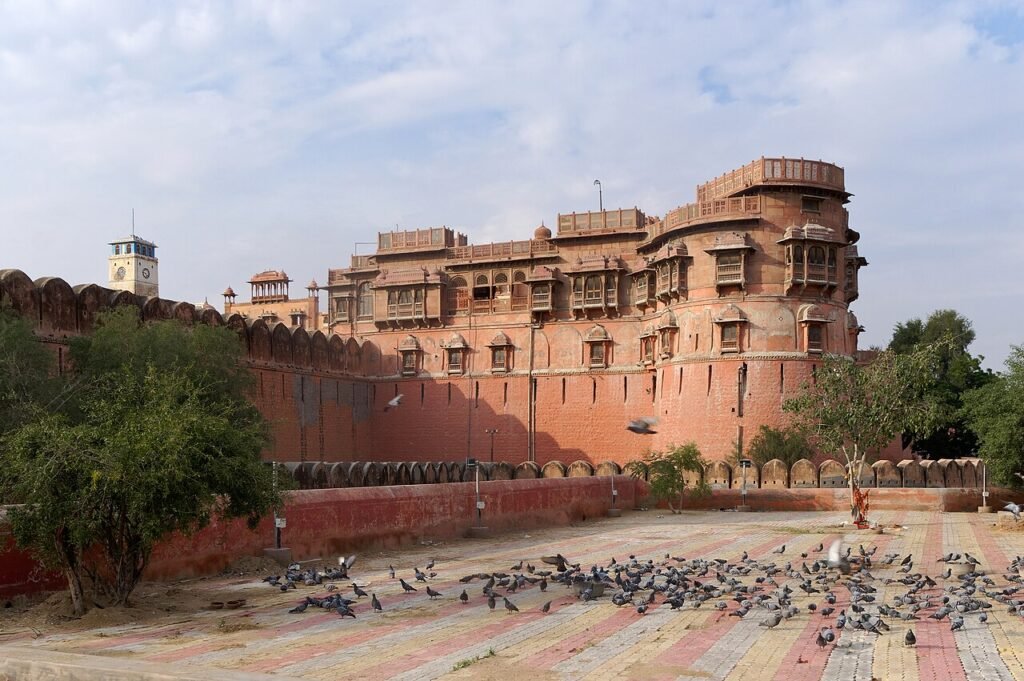
Interior of the Junagarh Fort in Bikaner, Bikaner, India
Refuel: Where Adventurers Eat
After a day in the saddle or on the dunes, your body craves fuel – not fancy fusion, but honest Rajasthani food that locals swear by. Start at Bhikharam Chandmal (opposite the Kote Gate), open since 1860. Their bhuna murga (spicy chicken curry) and missi roti are legendary. A full meal costs around ₹300 (US$3.60). For a quick post-safari snack, head to Chhotu Maharaj near the railway station for pyaaz kachori (onion-filled pastries) at ₹20 each. If you want a sit-down dinner that matches the desert vibe, reserve a table at Surya Restaurant on Station Road – their laal maas (fiery mutton curry) is the stuff of legend, but go mild unless you’ve built up spice tolerance. Finally, for late-night chai and cigarettes, Bikaner Tea Stall (behind the Junagarh Fort) serves sweet, thick masala chai for ₹10. Locals recommend ending your meal with a malpua – a fried pancake soaked in sugar syrup – from the street vendor right outside the fort gate.
Base Camp: Where to Stay
Adventurers need a place that understands early departures and gear storage. Narendra Bhawan (₹5,000–8,000 per night, US$60–96) is a boutique heritage hotel that used to be a prince’s residence – they offer packed breakfast boxes for sunrise safaris and a secure room for your extra bags. Surya Palace (₹2,500–4,000, US$30–48) is more modest but has a central location and a rooftop that’s perfect for repacking your camel bag. For budget-conscious trekkers, Hotel Raj Haveli (₹1,200 per night, US$14) has a quiet courtyard and staff who can arrange last-minute camel rentals. Book via Booking.com to compare prices and read recent reviews – especially for noise levels (you’ll need sleep before a long ride).

Beautiful Bikaner, India scenery
Gear & Prep Checklist
- Lightweight cotton or linen long-sleeve shirt and trousers – protects against sun and sand, but breathes. Avoid denim – you’ll cook.
- Wide-brimmed hat with chin strap – the wind will steal any loose cap
- Scarf or bandana – wrap it over nose and mouth when the dust rolls
- 1–2 liter reusable water bottle plus electrolyte tablets – the dry air dehydrates you faster than you think
- Sunscreen SPF 50+ – reapply every two hours
- Fitness requirement: moderate core strength and flexibility for camel riding (you’ll need to lean forward and back with the gait). A few days of squatting practice helps.
- Safety consideration: never ride a camel without a guide who knows the dune patterns – shifting sands can create steep drop-offs. Also, wear sturdy shoes – scorpions hide under rocks.
Getting There & Around
- Flights: Bikaner has a small airport (BKB) with limited flights from Delhi (one daily by SpiceJet, around ₹5,000–8,000). Most travelers fly into Jodhpur (6-hour train) or Jaipur (5-hour train) and connect by road or rail. Book at Skyscanner for best fares.
- Local Transport: From the city center, auto-rickshaws cost ₹100–150 to the camel breeding farm. For Gajner Wildlife Sanctuary, hire a private taxi (₹1,500 round trip) from the main local taxi stand at Kote Gate.
- Best Season: October to March are perfect – daytime temperatures 25–30°C, nights 10–15°C. Avoid April–June (45°C+). Monsoon (July–September) brings risk of flooding and fewer safari options.

Brown and white concrete building, Bikaner, India
Is Bikaner, India Worth It?
If your idea of adventure is summiting peaks or whitewater rapids, you might find Bikaner’s adrenaline quieter – it’s a horizontal kind of wild. But if you’ve ever wanted to feel the vastness of a true desert, to sleep under stars with nothing but sand in every direction, this is unmatched. The camel safari is the core experience – no other desert city in India offers the same intimacy with the animals and the dune landscape. Jaisalmer is more famous and crowded; Bikaner is the secret that seasoned travelers protect. You’ll come for the adventure, but you’ll stay for the silence. Honestly, after a night in the Thar, you’ll never look at a camel the same way again.

