
Beyond the Terraced Hills: Why Las Terrazas, Cuba, Stays With You Long After You’ve Left (2026)
In 1968, as Fidel Castro’s government launched a radical reforestation project, a young agronomist named Omar Pérez stood on a barren, eroded hillside in Cuba’s Artemisa province. He planted the first mahogany sapling in what would become a living experiment. Fifty-five years later, you’ll stand in the same spot, surrounded by a lush, man-made rainforest—a testament to what happens when a community decides to rebuild its land, and itself, from the ground up.
The Story Behind Las Terrazas, Cuba
Long before the terraces, this region was a French coffee plantation in the early 19th century. In 1821, French colonists fleeing the Haitian Revolution established the Cafetal Buenavista, a sprawling estate that produced some of Cuba’s finest coffee. You can still see the stone ruins of the drying patios and slave quarters, a haunting reminder of the wealth built on forced labor. By the 1890s, the plantation had collapsed, and the land was left to erode, stripped of its topsoil by decades of monoculture.
The modern story begins in 1968, when the Cuban government declared this 5,000-hectare area a “Forestry Reserve.” The idea was radical: create a self-sustaining community that would live in harmony with a replanted forest. Over 200 families moved in, building homes, schools, and a small hotel. By 1994, UNESCO recognized the Sierra del Rosario, the mountain range that cradles Las Terrazas, as a Biosphere Reserve. What you see today—the terraced hillsides, the abundant birdlife, the crystal-clear river—is the result of a deliberate, decades-long act of ecological restoration.
Travelers often discover that Las Terrazas feels different from the rest of Cuba. There are no all-inclusive resorts here. Instead, you’ll find a cooperative community where locals run guesthouses, guide tours, and manage a small eco-resort. The spirit of the place is one of collective pride. You’ll hear it in the way your host at a *casa particular* talks about the forest, and you’ll see it in the careful way the trails are maintained. This isn’t a theme park; it’s a living, breathing community that chose a different path.
Neighborhood by Neighborhood
El Pueblo (The Village)
Your journey begins in the compact, car-free village that is the heart of Las Terrazas. You’ll arrive at a small plaza dominated by a mural of Che Guevara and a towering ceiba tree. The architecture is simple—pastel-colored houses with red-tiled roofs, all built in the 1970s. The main street, Calle Principal, is a dirt road lined with bougainvillea and hibiscus. Here, you’ll find the small grocery store, the *bodega* where locals buy their rations, and a tiny art gallery. The real action happens in the late afternoon, when residents gather on their porches, children play soccer in the street, and the smell of *congrí* (rice and black beans) drifts from open windows. Don’t miss the community bakery, where you can buy fresh *pan de agua* for a few Cuban pesos.
The River Corridor (Río San Juan)
A 15-minute walk downhill from the village brings you to the Río San Juan, the lifeblood of Las Terrazas. This is where you’ll find the most dramatic natural beauty. The river forms a series of turquoise pools and small waterfalls, perfect for swimming. The most popular spot is the *Baños del San Juan*, a set of natural pools where you can float under a canopy of bamboo. Locals recommend arriving by 8:00 AM, before the tour buses from Havana arrive at 10:00 AM. You’ll also find the ruins of the Cafetal Buenavista along the riverbank—a perfect spot for a picnic. The trail that follows the river is called the *Sendero del Río*, a 2.5-kilometer loop that takes about an hour to walk. Your best bet is to wear sturdy water shoes, as the rocks can be slippery.
The Lookout (Mirador de Las Terrazas)
For the best view of the entire community, you need to hike up to the Mirador, located on the eastern ridge of the reserve. The trail starts behind the village and climbs steeply for about 40 minutes. It’s a workout, but you’ll be rewarded with a panoramic view of the terraced hillsides—the very shape that gave the place its name. From here, you can see the patchwork of trees: mahogany, cedar, and the iconic royal palm. Seasoned travelers prefer to come at sunrise, when the mist lifts from the valley and the birds begin their chorus. You’ll hear the distinctive call of the *tocororo* (the Cuban trogon, the national bird) and, if you’re lucky, spot a *cartacuba* (a small, colorful bird known locally as the “Cuban nightingale”).
The Local Table: What Denizens Actually Eat
Food in Las Terrazas is a reflection of its isolation and its cooperative spirit. You won’t find elaborate restaurant menus here. Instead, you’ll eat what the community grows and catches. The staple is *pollo campesino* (country-style chicken), slow-cooked with garlic, cumin, and sour orange juice. You’ll also find *pescado a la plancha* (grilled fish) from the nearby coast, usually served with *tostones* (fried green plantains) and a simple salad of tomato and avocado.

Las Terrazas, Cuba
The best home-cooked meal in Las Terrazas is at *Casa de Marta*, a family-run *paladar* on Calle Principal. Marta, a grandmother with a warm smile, serves a fixed menu for 10 CUC (about $10 USD) that includes soup, a main course, dessert, and a glass of *guarapo* (fresh sugarcane juice). Travelers often discover that the real treat is the *ropa vieja* (shredded beef in tomato sauce), which she cooks for four hours with a secret blend of spices. For a quick snack, head to the *kiosko* near the river, where you can buy fresh coconut water and *churros* (fried dough sticks) dusted with sugar.
What surprises most visitors is the lack of imported ingredients. There’s no olive oil, no imported cheese, no fancy condiments. But this simplicity is the point. You’ll taste the freshness of the *yuca*, the sweetness of the *malanga* (a root vegetable), and the earthy flavor of the *frijoles negros* (black beans). Locals recommend ending your meal with *café cubano*, a strong, sweet espresso that will give you the energy for your next hike.
Art, Music & Nightlife
Las Terrazas is not a party destination, but it has a vibrant, low-key creative scene. The community is home to the *Estudio de Arte*, a small gallery and workshop run by local artist José Fuster. You’ll find his colorful ceramic pieces—birds, fish, and abstract shapes—adorning walls and benches around the village. He often works in the open, and you can watch him paint while he tells you stories about the community’s founding. The gallery is open daily from 9:00 AM to 5:00 PM, and pieces start at 5 CUC (about $5 USD).
Music is the heartbeat of Las Terrazas. Every Saturday night, the community gathers at the *Casa de la Música*, an open-air pavilion near the plaza. From 8:00 PM to midnight, a local *son* band plays traditional Cuban music, and you’ll see everyone—from toddlers to grandparents—dancing. The vibe is family-friendly and authentic; there are no cover charges, and you can buy a bottle of *Cristal* beer for 1 CUC ($1 USD). Savvy visitors know to bring a flashlight for the walk back to their *casa particular*, as the village has no streetlights. In February, the community hosts the *Festival del Río*, a weekend of music, dance, and environmental workshops. If you’re planning a visit, check the dates with your host.
Practical Guide
- Getting There: Fly into Havana’s José Martí International Airport (HAV) from major hubs like Miami, Madrid, or Toronto. From Havana, you can take a shared taxi (*colectivo*) to Las Terrazas for about 25 CUC ($25 USD) per person—a 1-hour drive west. Book flights at Skyscanner
- Getting Around: The village is walkable. For the river and trails, you’ll walk or hire a horse-drawn cart (*carretón*) for 5 CUC ($5 USD) per trip. Bicycles are available for rent at the village entrance for 3 CUC ($3 USD) per day.
- Where to Stay: Your best bet is a *casa particular* (private homestay) in the village. Try *Casa de María y Pedro* for a clean, friendly room with breakfast included (25 CUC/$25 USD per night). For a splurge, book the *Hotel Moka*, a 1970s-era eco-lodge perched on a hill (80 CUC/$80 USD per night). Check Booking.com
- Best Time: December to April is the dry season, with sunny days and cool nights. Avoid August and September, when the heat and humidity are intense and the mosquitoes are aggressive. February is ideal, with the *Festival del Río* and pleasant temperatures around 24°C (75°F).
- Budget: Plan for 40-50 CUC ($40-50 USD) per day, including accommodation, three meals, and one activity. Bring cash in small denominations—there are no ATMs in Las Terrazas.

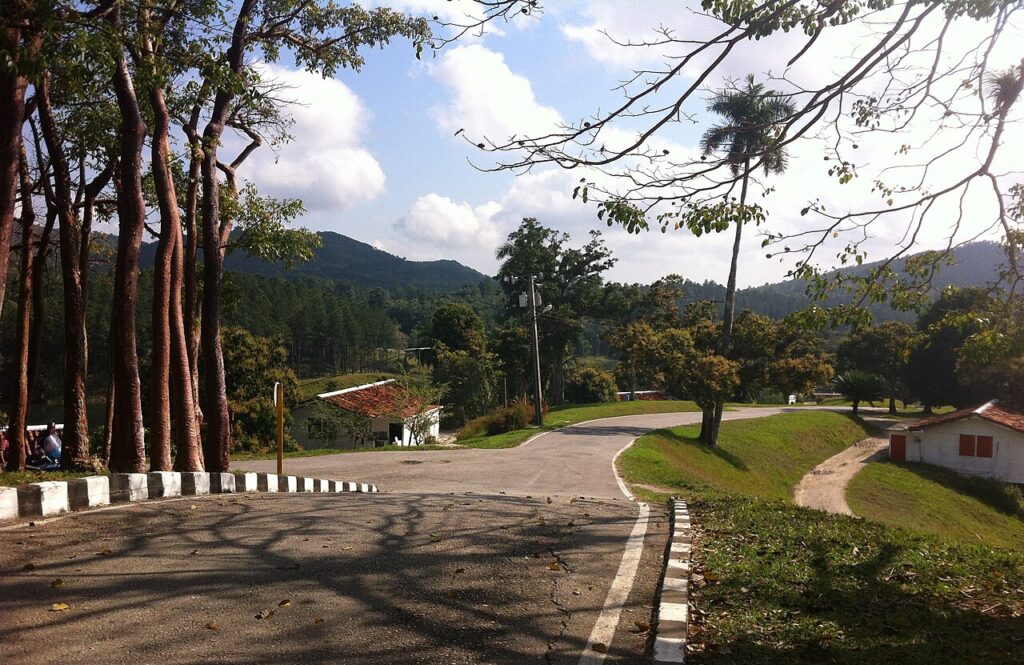
Road near concrete house, Las Terrazas, Cuba
What Surprises First-Time Visitors
The first surprise is the silence. After the chaos of Havana—the honking cars, the blaring music, the constant street vendors—Las Terrazas feels like a different country. At night, you’ll hear only the rustle of leaves and the distant call of a night bird. Many travelers find this disorienting at first, but within a day, you’ll feel your shoulders drop and your breath slow down.
The second surprise is the lack of Wi-Fi. There is no internet in Las Terrazas. No cell service. No data. The only public phone is at the village office, and it works sporadically. For many visitors, this is the most challenging aspect of the trip. But locals recommend embracing it. You’ll find yourself having real conversations with your host, reading a book by candlelight, and noticing the constellations in the pitch-black sky. It’s a digital detox that you didn’t know you needed.
The third surprise is the community’s self-sufficiency. You’ll see a small farm with pigs and chickens, a vegetable garden, and a workshop where furniture is made from fallen trees. Travelers often discover that Las Terrazas produces its own coffee, honey, and even rum. The *Miel de Las Terrazas* (honey) is sold in the village store and is incredibly fragrant—buy a jar to take home. The community also runs a small reforestation nursery, where you can plant a tree for 5 CUC ($5 USD) and receive a certificate with your name on it. It’s a small gesture, but it connects you to the place in a way that a souvenir never could.
Your Las Terrazas, Cuba Questions
Is Las Terrazas safe for solo travelers? Absolutely. This is one of the safest places in Cuba for solo travelers, especially women. The community is small, everyone knows each other, and crime is virtually nonexistent. You can walk alone at night without worry, though you should bring a flashlight for the unlit paths. Locals are incredibly friendly and will often invite you for coffee or a meal. Your best bet is to stay in a *casa particular*, where your host will look out for you and give you insider tips.

Three assorted-colored vintage car on road, Las Terrazas, Cuba
How much time should I spend in Las Terrazas? Most travelers find that two full days and one night is the sweet spot. This gives you time to hike the river trail, swim in the pools, visit the coffee plantation ruins, and enjoy a Saturday night music session. If you’re a serious birder or hiker, add a third day to explore the longer trails in the Sierra del Rosario. Avoid trying to do it as a day trip from Havana—you’ll spend more time in transit than actually enjoying the place.
Can I use U.S. dollars in Las Terrazas? Yes, but with a catch. Cuba has two currencies: the Cuban Peso (CUP) for locals and the Cuban Convertible Peso (CUC) for tourists. U.S. dollars are accepted but incur a 10% penalty when exchanged. Your best bet is to bring Euros or Canadian dollars, which exchange at face value. Alternatively, bring a debit card that works with Cuban banks (few do). Cash is king here—there are no credit card machines in Las Terrazas. Plan to bring enough cash for your entire stay, plus a buffer for emergencies.

