
Beyond the Southern Cross: Why Pingtung County Beckons Every Soul-Seeker Who Wanders South (2026)
In 1874, a Japanese expeditionary force landed on the windswept beaches of Hengchun, igniting what locals still call the Mudan Incident—a fierce clash between samurai and Paiwan warriors that forever changed Taiwan’s fate. You stand on that same shore today, the South China Sea whispering secrets of rebellion and resilience. Pingtung County, the island’s sun-scorched southernmost reach, has always been a frontier where cultures collide and the tropics carve their own rules. Travelers who venture here discover a land where indigenous chants echo through misty mountains, where temples hum with the rhythm of centuries-old festivals, and where the relentless sun ripens the sweetest mangoes you will ever taste.
The Story Behind Pingtung County, Taiwan
Long before Han settlers arrived, the Paiwan and Rukai peoples called this land home, their oral traditions tracing back over a thousand years. You’ll find their legacy etched in the slate houses of Wutai and the intricate glass beads that still adorn elders during ceremonies. When the Dutch colonized parts of Taiwan in the 1620s, they cast their eyes on Pingtung’s fertile plains, trading deer hides and rice with local tribes. But it was in 1684, under the Qing Dynasty, that Han Chinese from Fujian and Guangdong began streaming into the Pingtung Plain, draining swamps and carving out rice paddies that would feed generations. By the early 19th century, the region had grown so prosperous that a walled city was built at Hengchun in 1875 to defend against both pirate raids and tribal uprisings.
The Japanese colonial period (1895–1945) transformed Pingtung in ways you can still see today. The Japanese built the Pingtung Line railway in 1913, connecting the county to Kaohsiung and fueling a sugar boom. They planted the now-iconic pineapple fields and established the Pingtung Airport as a military base. You can walk through the Japanese-era wooden houses in Pingtung City’s old district or sip coffee in a restored colonial building. After 1945, the Nationalist government poured resources into agricultural research, and by the 1970s, Pingtung had become Taiwan’s fruit basket. Yet the county remained a rural counterpoint to the industrial north—a place where traditional ways persist, from the elaborate Donggang King Boat Festival to the daily fish auctions that start before dawn. Visitors often discover that this unhurried pace is precisely what makes Pingtung feel like stepping back into a Taiwan that urbanites have forgotten.
Neighborhood by Neighborhood
Pingtung City: The Colonial Heartbeat
Pingtung City greets you with a grid of streets that the Japanese laid out in the 1910s, lined with banyan trees whose aerial roots drape like curtains. Your best bet for understanding the city’s soul is to begin at the Pingtung Art Museum, a converted Japanese colonial school built in 1936. From there, wander south toward the Pingtung Night Market on Minzu Road, where the air thickens with the aroma of grilled squid, oyster omelets, and the irresistible sweetness of candied yams. Notice the Xishi Temple on Guangfu Road, a sprawling Taoist complex from 1784 whose dragon pillars and intricate murals tell stories of sea gods and local heroes. By late afternoon, savvy visitors head to the Ren’ai Road area, where old wooden shophouses house independent cafes and vintage bookstores—a quiet contrast to the market’s frenzy. You’ll find that Pingtung City is not a place of grand monuments; it’s a city of layered textures, where the past sits comfortably alongside the present, and every back lane reveals a temple courtyard or a family-run noodle stall that has operated for three generations.
Chaozhou: The Cold Noodle Capital
Twenty minutes by train from Pingtung City lies Chaozhou, a Hakka-majority town that feels like a secret the rest of Taiwan hasn’t fully shared. Your reason for coming is simple: the legendary Chaozhou Cold Noodle Soup (chao zhou leng mian). At the Chaozhou Leng Miao, a no-frills shop on Zhongshan Road that opens at 10 a.m., you’ll sit on a plastic stool and slurp slippery wheat noodles in a chilled broth made from bonito, soy, and a whisper of sesame oil. Travelers often linger on the town’s main street, Zhongzheng Road, where a morning market sells everything from freshly made tofu to dried squid. Don’t miss the Chaozhou Laojie (Old Street), a 300-meter lane of red-brick houses that once served as the commercial spine of Hakka settlement in the 19th century. Unlike touristy old streets elsewhere, this one feels lived-in—grandmothers shelling peanuts on stoops, a bicycle repairman working on a rusty frame, and the occasional temple procession sending firecrackers into the sky. Chaozhou’s charm is its ordinariness; you come for the noodles, but you stay for the quiet rhythm of daily life.
Donggang: The Seafood Kingdom
On the coast 30 minutes south of Chaozhou, Donggang announces itself with the smell of salt and frying garlic. This is the undisputed seafood capital of southern Taiwan, and your first stop should be the Donggang Fish Market, which thunders to life at 4 a.m. as fishing boats unload their catch. By 7 a.m., the auction floor is a cacophony of shouting buyers inspecting tuna, swordfish, and the prized milkfish. You don’t need to be a chef to be mesmerized. Later, the market restaurants—try Pin Xian on Zhongzheng Road—serve the day’s catch in steaming bowls of seafood congee or grilled over charcoal. Donggang is also home to one of Taiwan’s most dramatic religious events: the Donggang King Boat Festival, held every three years (next in 2026). During this week-long spectacle, a massive wooden boat is built, paraded through town, and then set ablaze on the beach to send plague gods back to heaven. Locals recommend timing your visit to the festival—book accommodations a year in advance—but even without it, Donggang’s waterfront promenade at sunset, with fishing boats silhouetted against the orange sky, will etch itself into your memory.
Kenting: The Tropical Playground
At the southern tip of the county, Kenting is the polar opposite of Chaozhou’s quiet charm. This is Taiwan’s premier beach resort, where the streets pulse with neon signs, surf shops, and the thrum of electric scooters carrying sunburned tourists. Your best bet is to arrive in the late afternoon, check into a guesthouse on Kenting Street (the main drag), and walk to the beach as the sun dips below the horizon. The water at Kenting National Park’s Baishawan Beach is a surprising turquoise, and the coral reefs offshore are a snorkeler’s paradise. But Kenting isn’t just a beach party: the park itself, established in 1984, protects over 33,000 hectares of tropical forest, limestone caves, and hiking trails. The Longpan Park Trail offers cliffside views that on clear days stretch all the way to the Bashi Channel. Seasoned travelers prefer visiting in late September or October, when the summer crowds have thinned, the sea is still warm, and the nightly market on Kenting Street—with its grilled squid, fried milk, and fruit smoothies—feels less frantic. Kenting may lack the historical depth of other Pingtung towns, but its sense of escape is unmatched; you come here to surrender to the sun and salt.
Wutai: The Indigenous Sanctuary
If you crave a deeper connection to Pingtung’s soul, drive two hours east from Pingtung City into the Central Mountain Range, where the village of Wutai perches at 900 meters. This is the heartland of the Rukai people, and you’ll feel the shift the moment the road narrows and the air cools. The Wutai Indigenous Village is a collection of slate-roofed houses decorated with intricate woodcarvings of snakes and ancestor figures. The Rukai believe they are descended from the Hundred-Pacer Viper, and you’ll see this snake motif on everything from door lintels to ceremonial cups. Your visit should include the Wutai Glass Bead Workshop, where artisans demonstrate the ancient technique of creating colored glass beads—each pattern conveying a specific meaning, from love to courage to protection. Plan to spend a night in one of the village’s homestays, where you’ll dine on mountain greens, wild boar stew, and millet wine, and listen to elders sing ballads that recount the tribe’s migration legend. Locals recommend visiting during the Rukai Harvest Festival in August, when the village erupts in dance, but any time of year, Wutai offers a glimpse into a culture that has thrived in these peaks for centuries, resilient as the stone houses themselves.
The Local Table: What Denizens Actually Eat

Beautiful Pingtung County, Taiwan scenery
Pingtung’s table tells the story of its diversity. The Hakka of Chaozhou perfected cold noodles and stuffed tofu, while the Hokkien of Donggang built a seafood culture that worships the ocean. Yet the unifying thread is freshness: you are never more than a few hours from field or sea. Breakfast, locals insist, must be a bowl of *zhua bing* (scallion pancake wrapped around egg and pork floss) from a street cart, washed down with a cup of salty soy milk. For lunch, you’ll find *lu rou fan* (braised pork rice) at nearly every corner stall, but the true Pingtung specialty is *ying yang fan*—a colorful rice dish with minced pork, egg, and vegetables, served on a banana leaf at the Pingtung City Night Market. Your evening meal demands the Donggang seafood experience: head to the Donggang Seafood Plaza on Zhongzheng Road, where you sit at a communal table and feast on steamed shrimp, grilled eel, and a bubbling pot of *sha cha* beef hot pot. The most iconic single dish, however, is the Chaozhou Cold Noodle Soup. At the original Chaozhou Leng Miao, it costs just NT$60 (about US$2) for a bowl that will recalibrate your understanding of what noodle soup can be: refreshing, complex, and utterly addictive. Travelers often return the next day for a second round.
Art, Music & Nightlife
Pingtung’s creative scene is rooted in tradition but not trapped by it. The Pingtung Indigenous Music Festival, held every October at the Pingtung County Cultural Center, showcases the polyphonic singing of the Paiwan and the bamboo mouth-harp melodies of the Rukai—sounds that have survived centuries of change. You can experience this music more intimately at the Sandimen Indigenous Cultural Park, where daily performances draw visitors into the rhythm of songs that tell of hunting, weaving, and courtship. In Pingtung City, the Art Museum hosts rotating exhibitions of contemporary Taiwanese artists, while the Southern Taiwan Art District, a cluster of repurposed shophouses near the train station, features galleries and studios open on weekends. For nightlife, Kenting is the obvious draw: the bars along Kenting Street buzz with live bands playing everything from reggae to pop rock, but for a more authentic vibe, head to the tiny pubs in Hengchun’s old town, where surfers and locals gather over bottles of Taiwan Beer. The Hengchun Folk Music Festival in August turns the historic city wall into an open-air concert venue, blending Aboriginal ballads with indie folk—a testament to Pingtung’s ability to honor its roots while embracing the now.
Practical Guide
- Getting There: Fly into Kaohsiung International Airport (KHH)—it serves over 40 international destinations, including direct flights from Tokyo, Hong Kong, Seoul, and Singapore. From the airport, take the MRT to Kaohsiung Main Station, then a local train to Pingtung City (30 minutes, NT$50). Compare flights at Skyscanner
- Getting Around: The local train system is your backbone—trains connect Pingtung City, Chaozhou, Donggang, and Fangliao, with fares from NT$20 to NT$100. For Kenting and Wutai, you’ll need a bus (Kenting Express bus from Xinting bus station, NT$300 one way) or a rental scooter (NT$600/day). Taxis are available but metered journeys add up quickly; negotiate for longer trips.
- Where to Stay: In Pingtung City, the Fushin Hotel (NT$2,000/night) offers clean, central rooms near the night market. In Donggang, book the Donggang Fisherman’s Inn (NT$1,500/night) for a seafood-view stay. For Kenting, the Kenting Bamboo House (NT$1,800/night) is a surfers’ favorite. For Wutai, the Mountain Spring Homestay (NT$1,200/night) includes a home-cooked dinner. Check availability at Booking.com
- Best Time: October through December—the monsoon rains recede, temperatures hover around 25°C (77°F), and the skies clear for hiking and beach days. Avoid July and August, when the humidity soars and typhoons are frequent.
- Budget: NT$1,500 per day for a backpacker (dorm, street food, local transport), NT$3,000 for a comfortable mid-range traveler (private room, restaurant meals, some taxis), NT$6,000 for a splurge (beach resort, fine dining, rental car).
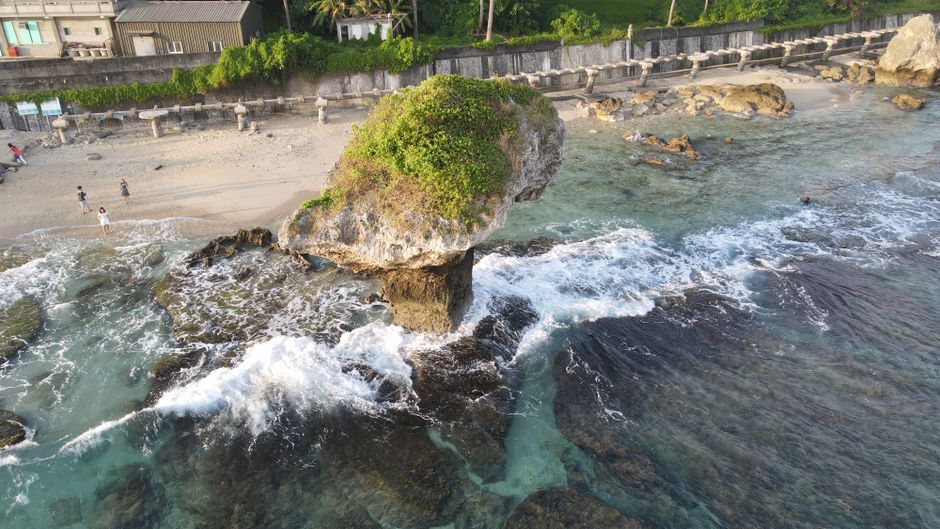
Capture of a unique rock formation along the coast in Taiwan with ocean wav…, Pingtung County, Taiwan
What Surprises First-Time Visitors
The biggest surprise is the quiet. Travelers expect Taiwan’s south to mirror the northern cities’ relentless energy, but Pingtung slows you down. In Chaozhou, shops close for a two-hour lunch break. In Wutai, the only sounds are birds and the rustle of bamboo. You’ll find yourself adapting to this pace, lingering over a bowl of noodles or sitting on a temple step to watch incense smoke uncurl. Another surprise: the cultural depth beneath the tropical veneer. Most tourists see Kenting and assume Pingtung is all beaches and cocktails, but the county’s indigenous and Hakka histories are as rich as any in Taiwan—and far less commercialized. The third surprise is how easy it is to escape the crowds. Even during peak season, you can hike the trails of Kenting National Park and encounter only a handful of people, or wander the narrow lanes of Chaozhou’s old street and feel like you’ve discovered a secret. Pingtung rewards those who venture beyond the obvious.
Your Pingtung County, Taiwan Questions
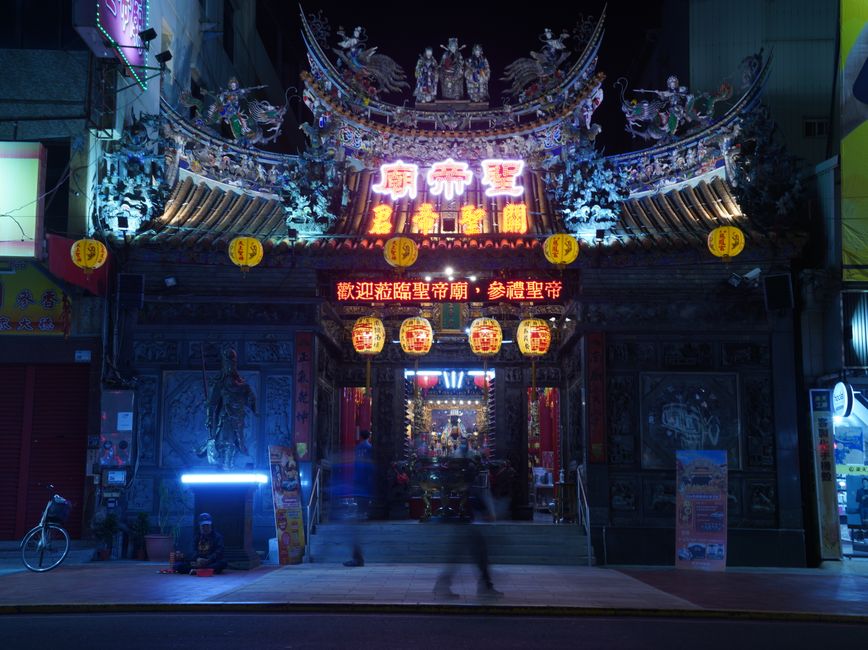
A beautifully illuminated temple facade in Pingtung City, Pingtung County, Taiwan
How do I visit the indigenous villages in Wutai?
Your best bet is to join a guided tour from Pingtung City, which handles transportation and permits (the area is a protected zone). Tour operators like Taiwan Adventures run day trips for NT$2,000 per person, including a lunch of Rukai cuisine. If you prefer to go independently, take a bus from Pingtung City to Wutai (the only daily bus departs at 7 a.m. from the Pingtung Bus Station, NT$250), and arrange a hom

