
Beyond the Red Roofs: Discovering the Soul of Parepare, Indonesia’s Hidden Port City (2026)
In August 1971, a young engineer named Bacharuddin Jusuf Habibie returned to the city of his birth to dedicate a new bridge over the Salo River. The crowd that gathered at the Lapadde beachside watched as he crossed the freshly painted steel span, a moment that fused the quiet pride of Parepare with the soaring ambition of its most famous son. Few onlookers that day could have guessed that within three decades, Habibie would become Indonesia’s third president—and that the city’s name, whispered on the wind off the Makassar Strait, would mean resilience, reinvention, and an unbreakable link to the sea.
The Story Behind Parepare, Indonesia
Parepare’s story begins not with colonialism but with the Bugis, the master navigators who ruled these waters long before any European ship dropped anchor. By the early 16th century, the small fishing settlement at the mouth of the Salo River had grown into a vital node in the spice trade network linking the Maluku Islands to Java and beyond. The Bugis kingdom of Suppa claimed the territory, and local legend holds that the name “Parepare” came from the Bugis phrase paré-paré, meaning “to make” or “to arrange”—a nod to the constant sorting and trading of goods on these shores. The red-tiled roofs that still crown the old warehouses along Jalan Bau Massepe are a direct legacy of that era, their terracotta hues echoing the earth of the surrounding hills.
The Dutch East India Company (VOC) arrived in the late 17th century, but Parepare never submitted as fully as Makassar did. Instead, the city became a quiet haven for Bugis merchants who played a double game—paying tribute to the Dutch while maintaining secret trade routes to Singapore and the Philippines. This independent streak only deepened during the Indonesian National Revolution (1945–1949), when Parepare served as a strategic rear base for Republican forces. Locals recall how the bay’s shallow draft made it impossible for Dutch warships to approach, giving guerrilla fighters a safe harbor to smuggle weapons and organize. The city was officially granted municipal status in 1960, but its character had long been forged: pragmatic, maritime, and fiercely proud.
Perhaps the single most defining event in modern Parepare was the birth of B.J. Habibie on June 25, 1936, in a modest wooden house on Jalan Sultan Hasanuddin. Habibie’s childhood in Parepare—running along the Lapadde seawall, watching phinisi schooners glide into port—imprinted him with a sense of possibility. After studying aerospace engineering in Germany and eventually becoming Indonesia’s president, Habibie never forgot his home. His presidency may have lasted only 18 months (1998–1999), but his legacy in Parepare is tangible: a restored waterfront, a museum dedicated to his life, and a new international airport that bears his name. Travelers often discover that Parepare wears this connection lightly—no grand statues or relentless branding, just a quiet pride that you’ll feel when a local shopkeeper points to the sea and says, “He used to play there.”
Neighborhood by Neighborhood

Kunjungan Rutin B. J. Habibie di Parepare (2014), Parepare, Indonesia
Lapadde — The Waterfront Heart
Lapadde is where Parepare’s soul meets the tide. Stretching along the western edge of the bay, this neighborhood is anchored by the Lapadde Promenade, a breezy esplanade that unfurls for nearly two kilometers between Jalan Andi Cammi and the old fish market. You’ll find families here every evening after the call to prayer, walking slowly, eating fried tempeh from paper cones, and watching the fishing boats bob against the orange sunset. The architecture is a collage: weathered Dutch colonial shop-houses with louvered wooden shutters stand next to cheerful pastel-colored stalls selling pisang epe—pressed, grilled bananas drizzled with palm sugar syrup. Your best bet is to arrive around 5 PM, just as the heat breaks, and join the parade. Don’t miss the small Habibie Museum at No. 12 Jalan Andi Cammi (open 8 AM–4 PM, free entry), where a grim photo of young Habibie at a chalkboard in Aachen, Germany, sits beside a scale model of the N-250 aircraft he designed. The museum is modest, almost intimate—you’ll feel like you’ve stepped into a family living room rather than a state institution.
Soreang — The Market and the Pulse
Soreang is Parepare’s commercial spinal cord, built around the sprawling Pasar Soreang market that has operated since the 1920s. Step into the market’s central hall any morning before 9 AM, and you’ll be swallowed by the scent of fresh anchovies, clove cigarettes, and ripe durian. The Bugis women who run the vegetable stalls wear songkok hats and speak in the rapid, melodic cadence of the Bugis language. Savvy visitors know to look for the coto vendors tucked between the garment stalls—specifically, the cart run by Ibu Rina near the Jalan Bau Massepe entrance. For 20,000 rupiah (around USD 1.30), she ladles a bowl of rich beef tripe soup thickened with peanuts and turmeric, served with ketupat rice cakes. The area south of the market, along Jalan Jenderal Sudirman, transforms after dusk into a night market (pasar malam) where you can eat grilled fish on plastic stools under strings of bare bulbs. Most tourists overlook Soreang, preferring the tidier waterfront, but this is where Parepare’s commerce and everyday life converge without pretense. Expect noise, expect chaos, expect to be offered a taste of something you can’t name—take it.
Kota Lama — The Old Town That Shed Its Age
Kota Lama, the area immediately east of the river, was Parepare’s administrative and trading hub during the late Dutch period. Today it is a study in layered history. Walk down Jalan Sultan Hasanuddin, and you’ll pass the 1920 Grand Mosque with its minaret shaped like a lighthouse—a deliberate nod to the city’s maritime identity. A few blocks south, the former Dutch residency building (now the Mayor’s Office) stands behind a manicured lawn, its white-painted columns looking slightly absurd against the tropical humidity that peels the paint every rainy season. Locals recommend climbing the small hill at the end of Jalan Pettarani, where a rusty 19th-century cannon overlooks the bay. The view from here is a perfect metaphor for Parepare: a jumble of red-tiled roofs, a curve of turquoise water, and the smoke of a dozen fish-smoking kilns rising from the shore. Unlike the polished waterfront of Lapadde, Kota Lama has an authenticity that can feel ragged—graffiti covers some walls, stray dogs nap in the shade of discarded market crates—but that’s its charm. Seasoned travelers prefer to stay in Kota Lama (at a homestay like Rumah Kita, from 150,000 rupiah/night) because it puts you within easy walking distance of both the river and the market, and because the neighborhood’s early-morning silence, broken only by the call of a rooster and the slap of sandals on concrete, feels like a private gift from the city.
The Local Table: What Denizens Actually Eat

Close-up view of ancient stone sculptures and architecture at Borobudur Temple, Parepare, Indonesia
Parepare’s cuisine is a direct translation of its geography. The sea gives generously, and the Bugis people have spent centuries refining the art of turning fish into something memorable. Unlike the elaborate spice bombs of Minangkabau cooking or the sweet braises of Java, Bugis food is about freshness and fire—grilled whole fish, simple sambals, and broths that taste of the coast. The defining ingredient is ikan cakalang (skipjack tuna), which appears everywhere: flaked into cakalang fufu (smoked shredded tuna), stirred into coconut-rich pallubasa, or simply charred over charcoal and eaten with a mound of hot rice. You’ll find the best pallubasa at Warung Pallubasa Hj. Daeng Petta on Jalan Bau Massepe, open 7 AM–noon daily. For 25,000 rupiah, the owner ladles a bowl of thick, golden broth packed with chunks of beef, offal, and shredded coconut, topped with crispy fried shallots and a squeeze of calamansi. It is breakfast, lunch, and a history lesson in a single bowl—the dish dates back to the pre-colonial era when Bugis traders carried dried coconut as provisions.
But to understand how Parepare really eats, you need to head to the Lapadde night market (6 PM–midnight, every night) and find the stall of Pak Ali, who has been grilling fish here for 37 years. Choose your own ikan baronang (rabbitfish) or udang galah (giant river prawns) from the ice chest; Pak Ali will score the skin, rub it with a paste of turmeric, garlic, and bird’s eye chili, and grill it over coconut husks until the skin crackles. You eat with your hands, dipping the flesh into a small dish of sambal dabu-dabu—a raw relish of chopped tomatoes, shallots, and chili splashed with lime juice. A feast for two—fish, prawns, a pile of lalapan (raw vegetables), and a round of es jeruk (fresh lime juice)—will run you about 80,000 rupiah. Plan to arrive by 6:30 PM to secure a plastic table near the water, because by 8 PM the crowd is thick with locals who know that this is the best food in Parepare, period. Don’t ask for a menu; just point, smile, and trust the grill.
Art, Music & Nightlife
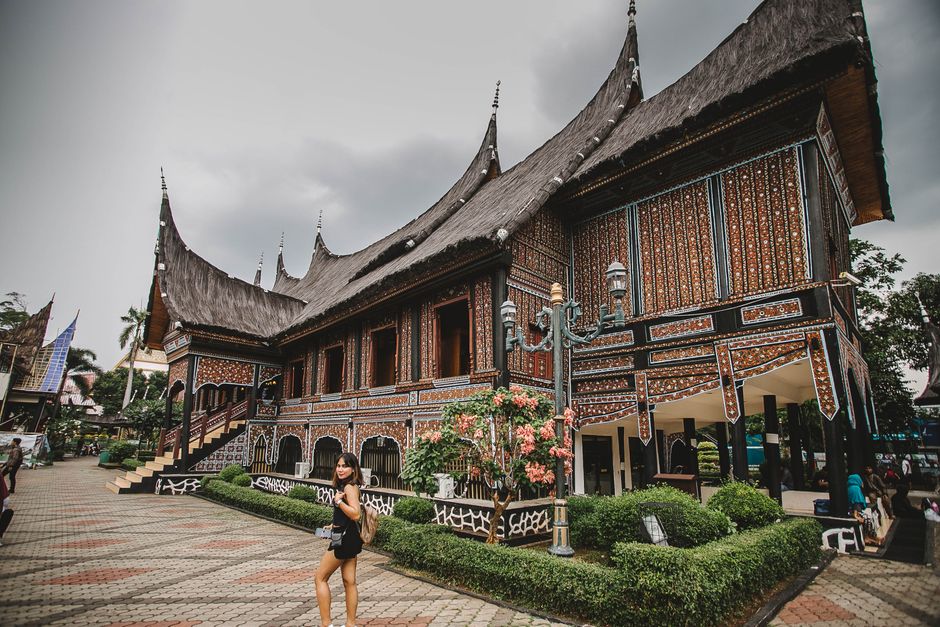
Beautiful traditional Indonesian building with detailed architecture and a …, Parepare, Indonesia
Parepare’s creative scene is small but spirited, rooted in the traditions of the Bugis people. The most visible art form is the building of phinisi schooners—the sleek, two-masted sailing ships that have carried Bugis goods across the archipelago for centuries. In the village of Bulu-Bulu, just 15 minutes north of the city center by ojek (30,000 rupiah each way), you can visit a boatyard where carpenters still shape planks by hand, using no blueprints, only inherited knowledge. The best time to go is early morning (6–9 AM) before the heat drives the workers into the shade. If you’re lucky, an old master might let you try planing a piece of ironwood, his eyes crinkling as your urban clumsiness meets his patient art. On the music front, the city hosts the Festival Teluk Parepare every last weekend of October, a three-day celebration of traditional Bugis gandrang drumming and kandrawari dance, staged on the Lapadde waterfront. The main event is a reenactment of an ancient Bugis sea voyage, with costumed rowers in a 20-meter longboat called a lepa-lepa. Arrive by 3 PM to secure a spot on the seawall; the show starts at 4:30 PM and lasts until dusk.
For nightlife, Parepare is not a party city—you won’t find thumping clubs or rooftop bars. Instead, locals unwind at café tenda, open-air tents that serve kopi tubruk (thick, sediment-heavy coffee) and pisang goreng (fried bananas) well past midnight. The most famous is Café Tenda Malam di Lapangan Sumpang Minangae, on Jalan Jenderal Sudirman, where on Fridays you can catch a live kecapi suling performance—a refined Bugis string-and-flute duo that sounds like ancient water flowing over stones. The music starts around 9 PM and is courtesy of the Sanggar Seni Pakkarena group, who practice in a nearby hall but bring their instruments here for the chance to play to an audience. Plan to order a small pot of ginger tea (teh jahe, 5,000 rupiah) and simply sit, letting the plucked strings and the murmur of the market run together. This is Parepare’s nightlife: subtle, communal, and surprisingly moving.
Practical Guide
- Getting There: Most travelers fly into Sultan Hasanuddin Airport (Makassar, UPG), then take a 2.5-hour drive north. Book the direct bus from Makassar’s Daya Terminal (80,000 rupiah, hourly departures 5 AM–5 PM) or a shared taxi (150,000 rupiah per person). For flights into the smaller Andi Jemma Airport (Parepare’s own airstrip) check Skyscanner for limited Wings Air services from Makassar (once daily, 40 minutes, from 350,000 rupiah one-way).
- Getting Around: Your primary options are ojek (motorbike taxi) and bentor (motorized rickshaw). Standard rates: 5,000–10,000 rupiah per trip within the city center; negotiate for longer rides. For day trips to Bulu-Bulu or the hilltop viewpoint Bukit Cempa, hire an ojek for the day (100,000–150,000 rupiah). Walking is pleasant along the Lapadde promenade and in Kota Lama.
- Where to Stay: For atmosphere and bay views, pick the Lapadde area—Hotel Grand Parepare (from 250,000 rupiah/night

