
Beyond the Red Hills: Why Dassa-Zoumé (2026)
In 1954, a local farmer named Agossou Dossou stumbled upon a natural cave in the red-clay hills above Dassa-Zoumé, a discovery that would transform the town into a pilgrimage site. Within a decade, thousands of Catholics from across Benin and Togo were climbing the rocky escarpment each August, their voices echoing through the groves of baobab and kapok trees. You can still feel that spiritual gravity today—not just at the grotto, but in the quiet rhythm of daily life that pulses through this land of granite outcrops and ancient trade routes.
The Story Behind Dassa-Zoumé, Benin
Dassa-Zoumé sits in the heart of the Collines Department, a region that was once a contested frontier between the powerful Kingdom of Dahomey and the decentralized Mahi peoples. By the 18th century, Mahi communities had established fortified hilltop villages, known as taata, to defend against Dahomean slave raids. You’ll still see traces of these defensive walls in the rocky outcroppings that surround the town—locals will point out the stone enclosures where their ancestors stored grain and sheltered during attacks. The name “Dassa” itself is believed to derive from a Mahi word meaning “meeting place,” reflecting its role as a crossroads for traders traveling between the coast and the interior.
The arrival of French colonial administrators in the 1890s shifted the town’s center from the hills to the flatter land along the Ouémé River. But the most transformative event came in the 1950s, when Catholic missionaries from Lyon established a pilgrimage to the grotto of Notre-Dame de Dassa. Each year on August 15, the Feast of the Assumption, pilgrims process up the hillside, carrying candles and singing hymns in Fon, Yoruba, and French. Travelers who join this march often describe the view from the top—the patchwork of red-earth fields, silver-roofed houses, and distant blue hills—as a moment that silences even the most restless mind.
Today, Dassa-Zoumé remains a place where sacred and secular intermingle. The town’s identity is shaped by its dual heritage: the hilltop grotto draws Catholic worshippers, while the lowland markets hum with the trade of yams, corn, and hand-thrown pottery that Mahi women have produced for generations. Locals often joke that the town has two hearts—one beating from the cave, the other from the market square.
Neighborhood by Neighborhood

Cérémonie au calvaire de Dassa-Zoumé (Bénin)., Dassa-Zoumé, Benin
Le Marché Central – The Pounding Heart
Start your exploration in the Central Market quarter, which sprawls along Avenue de la République. Here, under a canopy of corrugated tin roofs, you’ll find the town’s pulse: women in wrappers and headwraps shouting prices for smoked fish, mounds of egusi seeds, and stacks of bitter cassava leaves. The air carries the smoky-sweet aroma of grilled corn and the sharp tang of fermented palm wine. Your best bet is to arrive by 7 a.m., when the produce is freshest and the light casts long shadows across the stalls. Look for the small alley that leads to the pottery section—a cluster of artisans who shape clay into cooking pots and water jugs using techniques passed down through at least five generations. One potter, a Madame Agossou, has worked her wheel at the same spot for forty years; she’ll let you try your hand for a few hundred CFA. Don’t skip the adjacent “Maquis Chez Fatou,” a simple open-air restaurant where you can scoop up a bowl of pâte rouge (red corn dough) with a spicy sauce gombo for just 600 CFA.
La Colline Sacrée – The Hill of Whispers
A 15-minute walk uphill from the market takes you to the neighborhoods that climb the slopes of the sacred hill. These residential areas—called Hountondji and Sèmè by locals—are where the town’s older houses still stand: mud-brick homes with blue-painted shutters and narrow verandas shaded by mango trees. The streets are unpaved and steep; you’ll share the climb with goats, children kicking soccer balls, and the occasional moto-taxi rattling past. As you ascend, the noise of the market fades, replaced by the rustle of wind through palm fronds and the distant chanting of pilgrims. The Grotte de Notre-Dame de Dassa itself is a cavernous opening in a massive granite boulder, with an altar hewn from the same rock. Visitors often light candles and leave written prayers in a small basket near the entrance. Even if you’re not religious, the site commands a quiet reverence—you’ll find yourself whispering. Seasoned travelers recommend visiting at sunset, when the hills turn a warm ochre and the only sounds are birds settling for the night.
La Ville Nouvelle – The Administrative Core
South of the market, along the main road to Savalou, lies the “New Town,” a grid of paved streets built in the 1970s and 1980s. This is where you’ll find the prefecture, the post office, and the town’s only ATM (a reassuring sight after days in the hills). The architecture is functional—concrete buildings with flat roofs and faded pastel paint—but the neighborhood has its own charm: the small bar-buvettes where men gather to drink tchoukoutou (millet beer) and debate politics, and the open-air bookstalls selling secondhand novels in French. For a midday break, stop at “Pâtisserie la Colline,” a rare bakery in central Benin where you can buy fresh baguettes, cheese-filled croissants, and strong Nescafé with condensed milk. The Neighbors? You’ll see a mix of civil servants, shopkeepers, and university students—the town hosts a small campus of the University of Parakou. By 9 p.m., the streets quiet down, and the only lights come from the maquis kitchens, where supper hovers over charcoal fires.
The Local Table: What Denizens Actually Eat
Food in Dassa-Zoumé is a story of patience and patience again. The staple is pâte, a thick cornmeal dough that you roll into balls and dip into soups. But the real pride of the town is akpan, a fermented corn drink that locals consume as both breakfast and refreshment. Women prepare it by soaking corn kernels in water for two days, then grinding them into a paste, adding sugar and spices, and letting it ferment overnight. Every family has a slightly different recipe—some add vanilla, others a pinch of ginger. You’ll find vendors selling akpan from plastic basins at the market for 100 CFA a glass. Pair it with kuli-kuli (fried peanut cakes) for a perfect afternoon snack.
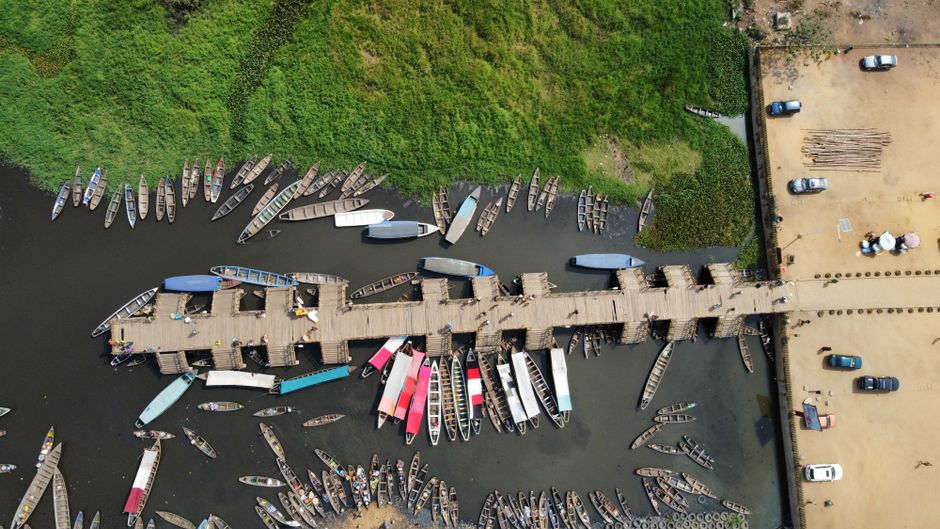
Aerial shot of the Ganvié pier with numerous boats moored in Benin., Dassa-Zoumé, Benin
The dish that travelers must seek out, however, is grillade de mouton at the crossroads stall “Chez Pierre,” just off Avenue de la République. Pierre Dossou has been roasting lamb over an open fire every Friday and Saturday since 1987. He marinates the meat overnight in a paste of onions, garlic, ginger, and local pili-pili chili, then grills it slowly over hardwood coals for two hours. You get a generous portion with a side of grilled plantains and a fiery sauce of crushed tomatoes and scotch bonnet peppers—price 1,500 CFA. Pierre remembers the names of his regulars, and he’ll tell you stories of the grotto’s early pilgrims between turning the skewers. Friday evenings, the whole neighborhood gathers around his grill; you’ll feel like you’ve stepped into a family reunion.
Markets also offer seasonal treats: in May and June, look for soursop (annona) sold by the dozen, and in December, the fonio grain harvest brings a nutty porridge that elders insist is the original health food. Don’t leave without trying tchoukoutou, the millet beer served in calabashes. It’s mildly alcoholic, slightly sour, and wonderfully refreshing after a climb—locals say it’s the best cure for tired legs.
Art, Music & Nightlife
While Dassa-Zoumé is not a party town, its creative life runs deep. Every even-numbered year in October, the Festival des Collines brings together traditional Zangbeto masqueraders (guardian spirits who dance on stilts), Kakilambe drummers from the Mahi country, and contemporary artists from Cotonou. The performances happen in the open field behind the prefecture; you’ll sit on plastic chairs or spread a cloth on the grass. Visitors from the coast often remark that the drumming here feels more primal—the rhythms follow the cycles of planting and harvest, not the metronome of urban clubs. You can ask elders to teach you a few beats; they’ll smile and hand you a drum, amused by your clumsy attempts.
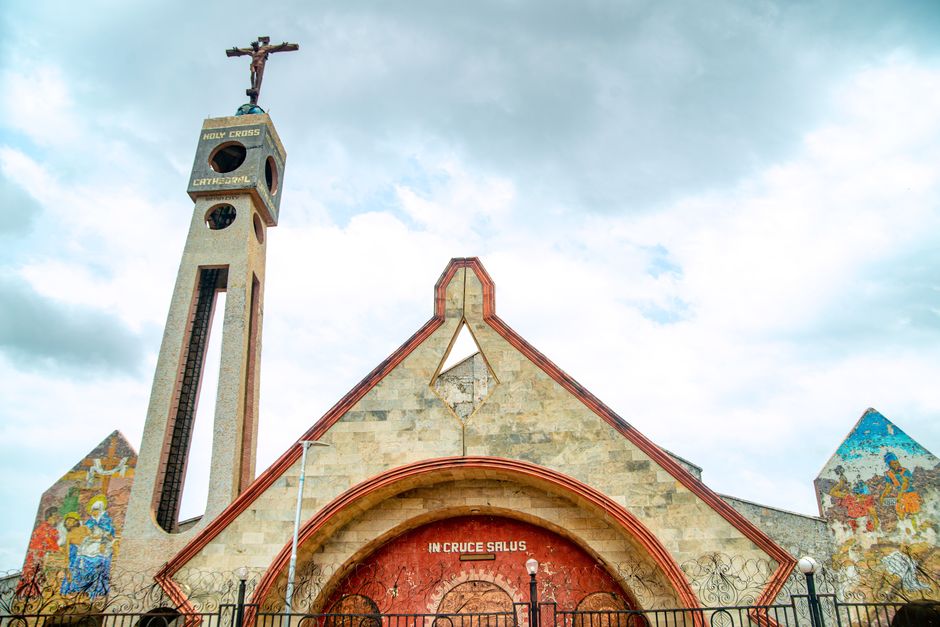
Stunning view of Holy Cross Cathedral, Dassa-Zoumé, Benin
For an evening out, the most reliable spot is “Le Refuge,” a bar-dancing on the road to Savalou. From Thursday to Sunday, a DJ spins a mix of West African hits (Afrobeat, coupé-décalé, and the local tchinkoumé), and the small dance floor fills with everyone from off-duty police officers to teenage couples. Drinks are cheap—a bottle of Benin’s La Béninoise beer costs 500 CFA, and a shot of local sodabi (palm wine distillate) is just 200 CFA. The action usually starts around 10 p.m. and winds down by midnight—the town’s early-rise culture keeps things mellow. For a quieter evening, head to the small gallery run by artist Marie Akplogan at the base of the hill. She paints scenes of Mahi life on recycled cloth, and she’ll open her studio for a chat if you knock politely.
Practical Guide
- Getting There: Fly into Cotonou Cadjehoun Airport (COO) from Paris, Brussels, or other West African hubs. From Cotonou, take a shared bush taxi (4 hours, 3,000–4,000 CFA) or a comfortable coach with Benin Voyages (5,000 CFA, departs at 6 a.m. daily). Book flights at Skyscanner
- Getting Around: Moto-taxis are your best bet—500 CFA per ride within town. Negotiate before you hop on. For longer trips to the grotto or surrounding villages, hire a zemidjan (motorcycle taxi) for 2,000–3,000 CFA per hour.
- Where to Stay: Near the market, “Hôtel La Renaissance” offers basic but clean rooms with fans from 12,000 CFA/night. For a hillside view with air conditioning, “Relais de la Grotte” (15,000 CFA/night) is a few hundred meters from the pilgrimage site. Check Booking.com
- Best Time: December to February – the dry season brings sunny days, cooler nights, and clear views from the hills. Avoid July–August if you dislike rain, though the pilgrimage on August 15 is a unique cultural experience despite the mud.
- Budget: Expect to spend around 30,000–50,000 CFA per day (including basic lodging, three meals, transport, and a drink or two). Budget travelers can manage on 20,000 CFA eating at market stalls and staying in guesthouses.
What Surprises First-Time Visitors
Travelers frequently arrive expecting a dusty, nondescript town and are stunned by Dassa-Zoumé’s natural beauty. The red hills rise like sentinels from the valley, their slopes dotted with baobabs and giant fig trees. You’ll see sudden rock formations that resemble giant fists punching through the earth. The quietness is another revelation: away from the market, you can hear birdsong, the wind in the leaves, and the distant echo of a farmer’s machete. It’s a silence that feels alive, not empty.
Many visitors also underestimate the religious syncretism. At the grotto, you might see a Catholic priest blessing a group of pilgrims while a local vodun priest leaves offerings of corn and gin at a rock shrine nearby. No one blinks. The tolerance is casual, deep-rooted, and humbling. “Here,” a market seller told me, “God speaks in many voices—listen to them all, and you’ll never be alone.” That sentiment colors every interaction; strangers greet you with a warm nod, and you’ll be invited into homes for tea without ceremony.
Finally, the food surprises for its complexity. With just a few ingredients—corn, beans, okra, palm oil, and fish—cooks create an astonishing range of flavors. The <

