
Beyond the Red Dust: Why Lodja Whispers a Congo Few Travelers Know (2026)
In 1910, a Belgian colonial officer named Auguste Verbeken arrived at the confluence of the Lubi and Sankuru rivers and marked a spot on his map for a trading post. He called it Lodja, after a Tetela chief who ruled the surrounding forest. Within a decade, the settlement became a crossroads for rubber, ivory, and later diamonds—a dusty frontier where African traders, European merchants, and Congolese porters met under the relentless equatorial sun. Today, the red dust still rises when a lorry passes, and the market hums with deals made over sweet coffee, as it has for over a century.
The Story Behind Lodja
Lodja’s history is etched not in grand monuments but in the resilient rhythm of daily life. Before the Belgians arrived, the Tetela people had long controlled the region, organizing in chieftaincies that stretched along the Sankuru River. The colonial era, beginning in earnest in the 1910s, transformed Lodja into a forced-labor hub for rubber extraction. You’ll still hear older locals recount stories whispered by their grandparents—of men sent into the forests with empty baskets, expected to return filled with raw latex. By 1936, the Belgians had built a small hospital and a school, run by Catholic missionaries, which taught children in French while suppressing Tetela language and customs. Independence in 1960 brought hope, but the chaos of the Congo Crisis soon followed. Patrice Lumumba, a national hero from a neighboring village, had briefly stayed in Lodja during his early political organizing. Locals still point to the crumbling colonial post office where he was said to have given a fiery speech in 1959, urging the Tetela to demand freedom. In the years since, Lodja has suffered from neglect and episodic conflict, but it has never lost its pulse. The diamond trade, both formal and illicit, now drives the economy, and a quiet resilience defines the town. Travelers who venture here discover a place where history lives not in museums but in the weathered faces of market women and the songs sung at evening gatherings.
You’ll find no slick tourist board or curated heritage trails in Lodja. Instead, the story of the town is written in the red clay bricks of its oldest buildings—like the Catholic mission church, built in 1927, its walls now softened by moss and tropical rains. Inside, the wooden pews are worn smooth by generations of worshippers. The sanctuary still hosts mass each Sunday at 9:00 a.m., and if you arrive early, Father Michel, a Tetela priest in his seventies, will likely shake your hand and tell you about the bell, cast in Belgium in 1925, that still calls the faithful. This is the kind of history you experience, not just read about. Seasoned travelers know that in Lodja, the past is present in every conversation and every shared bowl of fufu.
Neighborhood by Neighborhood
Centre-Ville: The Beating Heart
Start your exploration in Centre-Ville, the compact grid of streets around the main market. The architecture here is a jumble of colonial-era cement shops with peeling blue paint and vibrant wooden stalls overloaded with dried fish, piles of cassava, and plastic basins of bright orange palm oil. The central covered market, Marché de Lodja, operates from 6:00 a.m. until dusk, with the busiest hours between 8:00 and 11:00 a.m. You’ll weave past women in printed pagnes balancing woven baskets on their heads, selling groundnuts, fresh okra, and the tiny, smoky-dried fish called *makayaba*. The air is thick with the scent of spices, sweet coffee, and the faint sourness of cassava fermenting. On Avenue Lumumba, you’ll find the town’s only pharmacy and a handful of cell-phone repair shops where young men charge phones from car batteries. The most striking building is the old Belgian courthouse, now a post office, its facade still bearing the faded initials “BCB” for the colonial railway company. Stop for a coffee at Café Sankuru, a corrugated-iron shack with plastic chairs where a small cup with condensed milk costs 500 Congolese francs (about 20 cents). Locals gather here to debate politics or simply watch the endless parade of bicycles and motos. It’s noisy, dusty, and utterly alive.
Quartier Mandombe: Riverside Serenity
Just a fifteen-minute walk south of Centre-Ville, you’ll reach Quartier Mandombe, a quieter neighborhood hugging the Sankuru River. The red dirt road narrows into sandy paths lined with mango trees and mud-brick houses with thatched roofs. Travelers often discover that this is where Lodja feels most like a village. The pace slows as fishermen paddle their dugout canoes along the dark water, casting nets in the early morning light. There’s no electricity here except from private generators, but the river breeze provides natural cooling. The main landmark is the small Catholic shrine of Notre-Dame de la Sankuru, a simple whitewashed chapel built in 1952, set back from the riverbank. On Sundays, you can hear hymns in Tetela drifting through the trees at 10:00 a.m. Locals recommend visiting at sunset, when the sky turns pink over the water and children play football with a deflated ball in the sandy clearing. If you’re lucky, you might spot a pair of African fish eagles perched in the dead branches of a kapok tree. The only place to eat is Chez Mama Rose, a family-run stall under a mango tree where you can get grilled tilapia fresh from the river, served with plantains and hot pepper sauce for 3,000 francs ($1.20). Bring your own bottle of water—none is sold here.
Quartier Kilo-Moto: The Diamond Quarter
North of Centre-Ville, past the airstrip, lies Quartier Kilo-Moto, named after the legendary gold mines in eastern Congo but now the hub for Lodja’s diamond trade. This neighborhood has a rougher edge: dusty, unpaved lanes, men in mirrored sunglasses lounging outside cinder-block compounds, and the distinctive chatter of dealers sizing stones with handheld loupes. The diamond market happens informally from 9:00 a.m. to noon in the open courtyard behind the Café de la Paix, a two-story building with peeling green paint. You won’t be invited to the serious deals, but you can observe from a respectful distance. The energy is tense and quick, with handshakes and whispered numbers. For visitors, the main draw is the lively street food scene: women fry dough balls called *beignets* in blackened cauldrons, and vendors sell skewers of spicy goat meat grilled over charcoal, dipped in a fiery sauce made from pili-pili peppers. Most tourists overlook this area, assuming it’s dangerous, but savvy visitors know that during daylight hours it’s simply a working-class neighborhood with a fascinating economy. Just keep your camera hidden and your valuables secured. The best time to stroll through is early morning before the heat peaks.
The Local Table: What Natives Actually Eat
Forget any notions of Congolese cuisine being simple. In Lodja, the table is a celebration of the forest and river. The staple is *fufu*, a dense dough made from cassava flour that you roll into dumplings and use to scoop up soups and sauces. But the real hero is *pondu*—a thick stew of cassava leaves cooked for hours with palm oil, smoked fish, and hot peppers. Every family has its own recipe. You’ll find the best pondu in Lodja at Maman Zaina’s stall, located at the eastern edge of the Marché de Lodja. She starts cooking at 4:00 a.m. over a wood fire, and by 7:00 a.m., a bowl of her pondu with a piece of grilled catfish and a heap of fufu costs just 2,500 francs ($1). “The secret is the little red peppers and the time,” she told me once, stirring a blackened pot the size of a car tire.
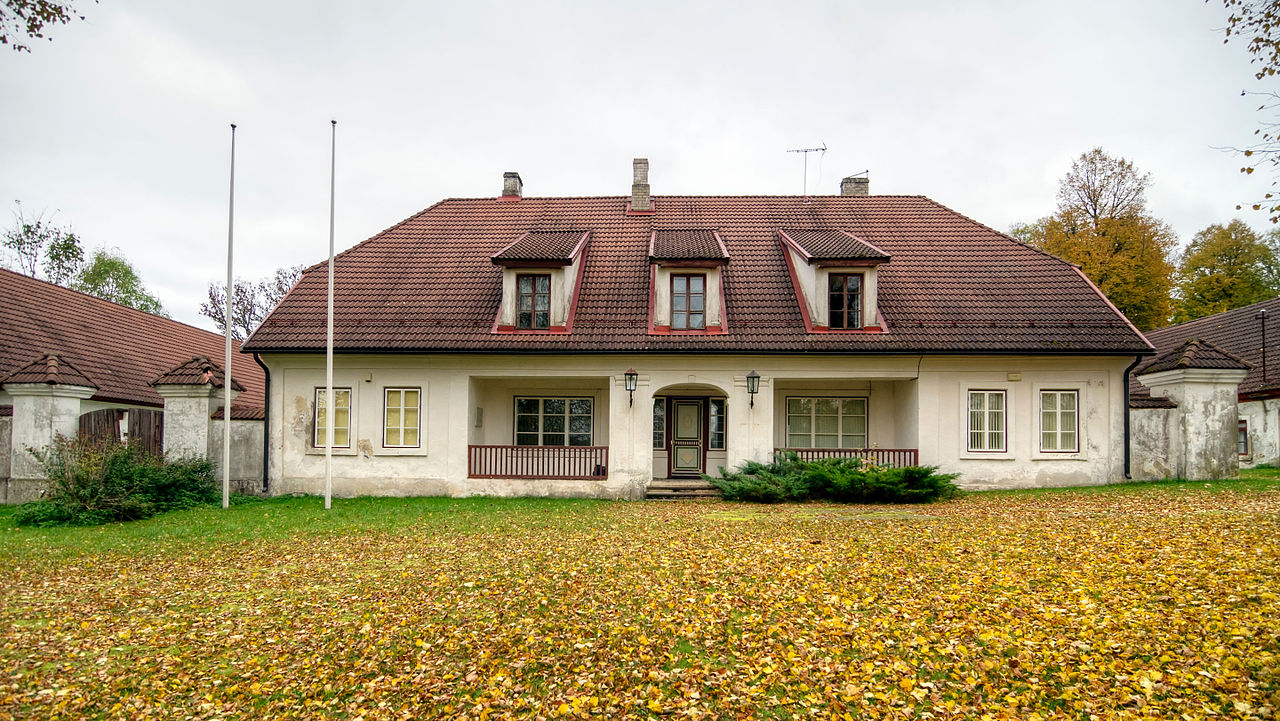
Lodja postijaama peahoone, Lodja, Democratic Republic of the Congo
Another dish you must seek out is *liboke*—fish or chicken wrapped in banana leaves with spices, palm oil, and vegetables, then steamed over coals. It’s a specialty along the river. On weekends, families gather at the sandy banks near the Mandombe chapel to prepare liboke together. You can buy it from street vendors in the late afternoon, served with boiled plantains. The most popular vendor is Papa Emile, who sets up his charcoal grill near the Mandombe crossroads from 3:00 p.m. to 6:00 p.m. A whole tilapia liboke will set you back 4,000 francs ($1.60). For breakfast, locals eat *chikwangue*—a fermented cassava log wrapped in leaves, sliced and fried, often with a sweet peanut sauce. You’ll find it at the Café Sankuru in Centre-Ville for 1,000 francs. And for a real taste of Lodja, try the *mbika*—a dense cake made from ground pumpkin seeds and peanuts, steamed and served with a dollop of honey. It’s sold by women at the bus station on Avenue de l’Indépendance from 5:00 a.m. to 9:00 a.m. Drink everything with *lubisi*—fresh palm wine tapped from raffia palms, slightly effervescent, and best consumed within hours of harvest. Buy it from the men with machetes and buckets at the edge of Quartier Kilo-Moto. A two-liter jerrycan costs 1,500 francs.
Art, Music & Nightlife
Lodja’s creative soul is Tetela music—driving polyrhythms on drums, likembe (thumb piano), and voices that soar across the river valley. The most famous musician from the region is the legendary Franco Luambo Makiadi? No, he was from Sona Bata. But local lore honors the late Tshala Muana, the “diva of mutuashi” dance, who had Tetela roots. You’ll hear her recordings blasting from speakers in the market. For live music, your best bet is Chez Georges, a bar in Centre-Ville on Avenue du Commerce. Every Saturday night from 7:00 p.m. until midnight, a local band called Bana Sankuru plays traditional Tetela songs mixed with modern soukous. There is no cover charge, but bring small bills for tips—the musicians pass a hat. The dance floor is a slab of concrete, and you’ll be pulled in by clammy-handed strangers who insist you learn the *mutuashi* hip-shake.
Visual art is less commercial here, but you’ll find hand-painted signs in the market—elaborate advertisements for hairstyles, beer, and mobile money. There is a small cultural center, Centre Culturel Tetela, on Rue de la Mission, open Tuesdays and Thursdays from 3:00 p.m. to 6:00 p.m. It holds exhibitions of local crafts: masks from the Tetela initiation societies, woven raffia textiles, and carved wooden figures. The curator, a retired teacher named Joseph Ilunga, will happily explain the symbolism if you ask. The center also runs occasional dance workshops. Nightlife beyond Chez Georges is quiet—most locals are in bed by 9:00 p.m. But for a true experience, ask a trusted guide to take you to a *kongolia*—a Tetela storytelling circle that happens in Quartier Kilo-Moto on Friday nights under a full moon. Elders recite epic poems and folktales, accompanied by drums and hand-claps. It starts around 8:00 p.m. and can last until dawn. Bring a torch and insect repellent.
Practical Guide
- Getting There: There is no commercial airline that flies directly to Lodja. The closest city with regular flights is Mbuji-Mayi, served by Congo Airways and Air Kasaï from Kinshasa. From Mbuji-Mayi, you can take a bush taxi (a shared minibus or pickup) for $20–30; the trip takes 8–12 hours on the unpaved RN-1 road. Alternatively, charter a small plane from Kinshasa to Lodja’s airstrip for about $1,500–2,000. Book flights to Mbuji-Mayi at Skyscanner.
- Getting Around: The entire town is walkable, but for longer distances (e.g., from Centre-Ville to Quartier Mandombe), take a *moto-taxi* (motorcycle taxi). The standard fare is 500 francs (20 cents) per ride within town. Negotiate before mounting. Bicycles can be rented at the market for 2,000 francs per day.
- Where to Stay: The only reliable guesthouse is Hôtel Sankuru in Centre-Ville (single room with fan: $15, with private bathroom and generator: $25). Check availability via Booking.com (limited options). For a more immersive experience, ask at the Catholic mission; they sometimes rent simple rooms for $10 a night.
- Best Time: June to September is the dry season—cooler mornings and less mud. Avoid the rainy months of November to March when roads become impassable.
- Budget: Lodja is very cheap. Expect to spend $30–40 per day on lodging, three meals, transport, and incidentals. Bring plenty of small Congolese franc notes.
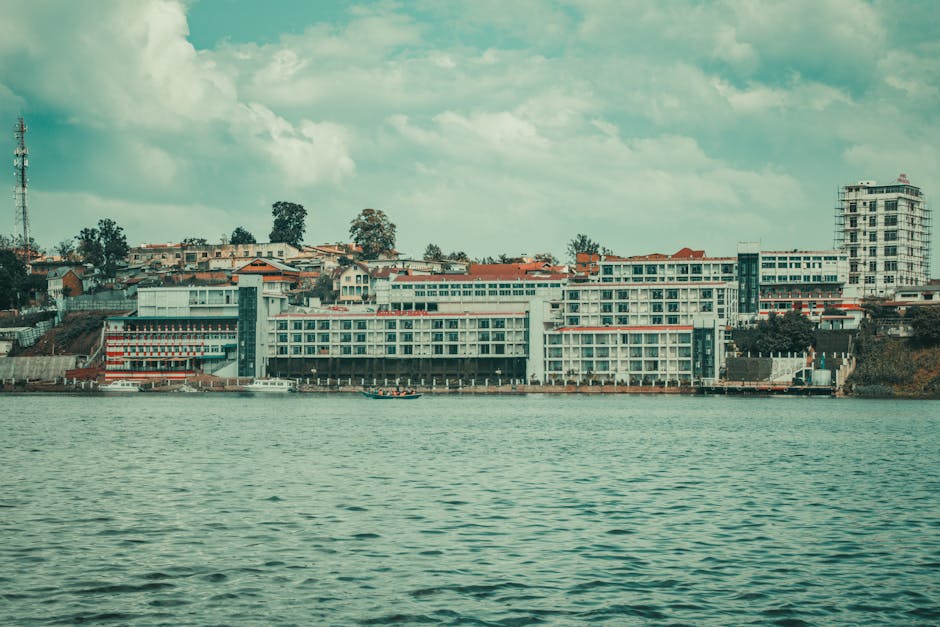
Tranquil view of the Bukavu waterfront with modern architecture and lake in…, Lodja, Democratic Republic of the Congo
What Surprises First-Time Visitors
The biggest surprise is the warmth. Travelers often arrive expecting a tough, closed-off town—after all, the DRC’s reputation precedes it. But within hours, you’ll be invited for coffee, greeted by children shouting “Mundele!” (foreigner) with grins, and helped by strangers when you look lost. In a world of fast-paced tourism, Lodja forces you to slow down. You can’t just tick off sights; you have to engage. The second surprise is the sheer greenness. You imagine a dusty outpost, but Lodja is surrounded by lush forest and palm groves, and the Sankuru River is a wide, gentle presence. The red dust is real, yes, but it’s contrasted by brilliant green cassava fields and crimson hibiscus flowers spilling over fences. Finally, the lack of infrastructure shocks many: no ATMs, unreliable electricity, spotty mobile data. You’ll have to come with cash (Congolese francs—bring them from Mbuji-Mayi) and patience. But that forced disconnection becomes a gift. Without Instagram to scroll, you’ll find yourself sitting on a plastic chair, watching the light fade, and feeling more present than you have in months.
Another aspect that catches visitors off guard is the importance of Tetela language. While most business and government work happens in French, daily life in Lodja is conducted in Tetela. You’ll hear it in the market, at the river, around dinner tables. Knowing just a few phrases—like *bóndi* (hello), *matshiny* (thank you), and *ngbé* (good)—will open doors. People are genuinely charmed by any effort. And if you ask someone to teach you a Tetela proverb, they will likely spend the next twenty minutes sharing wisdom: “*Mbade y’akongo nkengo*” — “The ripe fruit falls only when the tree is ready.” It’s a reminder that in Lodja, time moves at its own pace, and rushing is futile.
Your Lodja Questions
Is it safe to travel to Lodja as a foreigner? This is always the first question. Lod
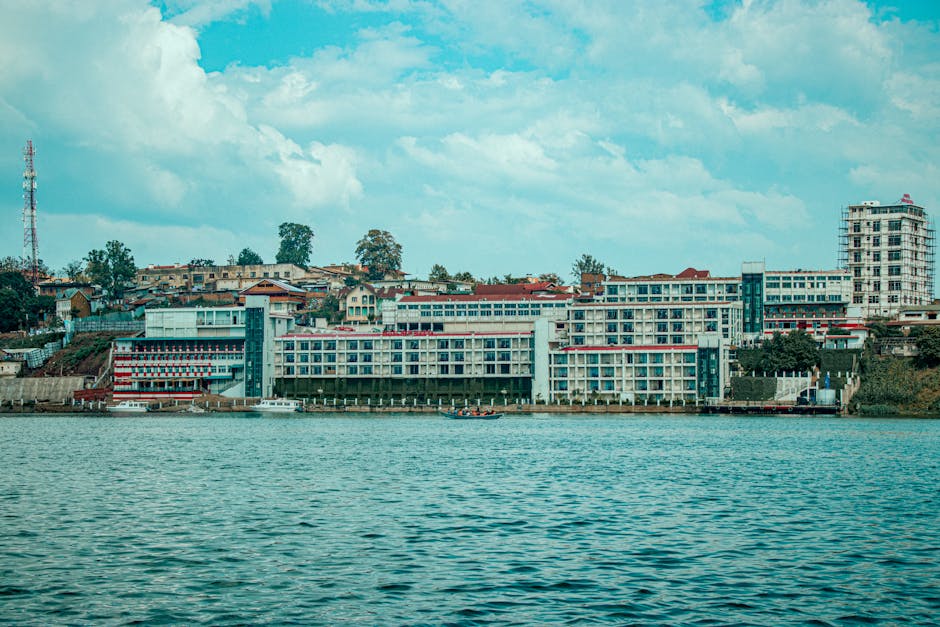
Urban landscape of Bukavu, Lodja, Democratic Republic of the Congo

