
Beyond the Pedestrian Village: Why Mont-Tremblant’s Laurentian Soul Beckons You Back Season After Season (2026)
In 1938, a Philadelphia millionaire named Joseph Bondurant Ryan stood at the edge of Lac Tremblant and looked up at the mountain that would consume the rest of his life. He had just purchased 5,000 acres of Quebec wilderness for $180,000, and his vision—a Swiss-style ski resort carved into the Laurentian forest—seemed preposterous to locals who knew these hills only for logging. Within a year, Ryan had blasted a trail called the Flying Mile down the mountain’s face, and Mont-Tremblant’s transformation from timber camp to international resort had begun.
The Story Behind Mont-Tremblant
Long before Ryan’s ambition arrived by train from Montreal, the Algonquin people called this mountain Manitonga Soutana—”Mountain of the Spirits”—and told stories of a great trembling that shook the earth when the god Manitou stamped his foot in anger. The French fur traders who followed in the 1600s softened the name to Mont-Tremblant, the “trembling mountain,” though geologists will tell you the name more likely comes from the tremulous aspen leaves that shimmer silver in the mountain breeze. You will hear both versions depending on which local you ask, and your best bet is to simply accept that the truth, like the mountain itself, has multiple layers.
The resort’s real turning point came not from Ryan’s initial vision but from the quiet persistence of Quebec’s skiing culture. Throughout the 1940s and 1950s, Mont-Tremblant attracted a hardy crowd of eastern ski pioneers who rode the original single-chair lift—the first of its kind in Canada, installed in 1939—and stayed in rustic lodges heated by wood stoves. When Ryan sold the mountain to the Canadian government in 1965 for back taxes, many assumed the dream was over. Instead, it was reborn. A group of Quebec investors purchased the resort in 1991 and transformed the base area into the colorful, traffic-free pedestrian village you see today—a deliberate imitation of Austrian and Swiss alpine hamlets, complete with cobblestone paths, clattering water wheels, and facades painted in a palette of mustard yellow, terracotta red, and forest green. Locals still debate whether the village feels authentically European or delightfully, knowingly fake, but travelers often discover that the debate itself becomes part of the charm.
What surprises most visitors is that Mont-Tremblant’s identity has never been purely about skiing. The mountain held its first major summer event in 1934—a 100-mile canoe race from Montreal to the resort—and Ryan himself insisted on building an 18-hole golf course before the ski lifts were complete. The region’s year-round rhythm is something you will feel immediately: winter brings the bonfires and fondue, spring the maple syrup harvest, summer the lake-swimming and mountain-biking, and autumn a chaos of red and orange that draws photographers from across the continent. Each season rewrites your experience of the place entirely.
Neighborhood by Neighborhood

Mont-Tremblant, Canada
The Pedestrian Village (Station Mont-Tremblant)
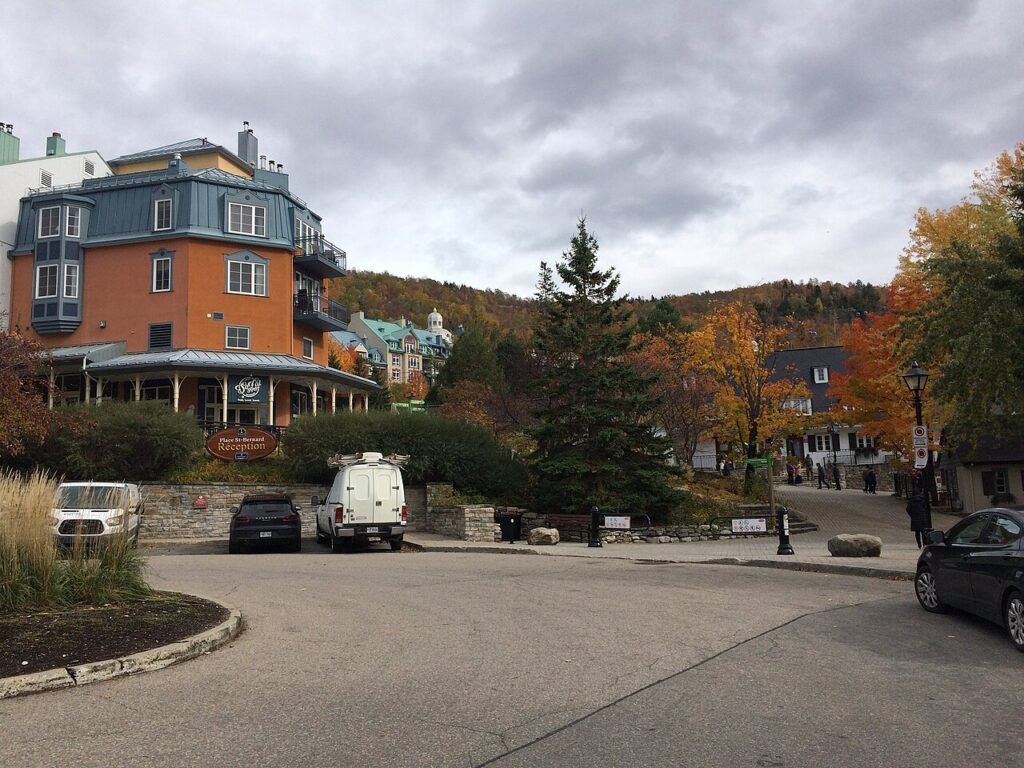
This is the Mont-Tremblant you have seen in brochures—a car-free labyrinth of narrow alleys, outdoor staircases, and steep switchback paths that connect the base of the mountain to the shore of Lac Tremblant. Your best bet is to enter through Place Saint-Bernard, the main square, where a massive stone fireplace burns day and night from November through April, and where you will find the old Roman Catholic chapel (built in 1939 by Ryan’s mother-in-law, no less) sitting incongruously next to a beer garden serving Belgian-style ales. The architecture here is aggressively picturesque—every building seems designed to be photographed, right down to the wrought-iron signs swinging above the patisseries and the window boxes overflowing with geraniums in summer. Plan to spend at least an hour just wandering the upper and lower levels, which are connected by a series of staircases and escalators carved into the hillside. The secret most tourists overlook is the path that leads down behind the Casino to the lakefront promenade, where you can rent a kayak or simply sit on a bench and watch the clouds reflect off Lac Tremblant’s glassy surface. Come early morning, before the day-trippers arrive from Montreal, and you will have the whole village almost to yourself.
Mont-Tremblant Village (Secteur Village)
Eight kilometers south of the pedestrian resort lies the original settlement that gives the mountain its name. This is where actual residents live—teachers, carpenters, the retired couples who have been coming here since the 1950s—and it feels like a proper small town rather than a stage set. The main drag, Rue de Saint-Jovite (which becomes Rue du Roi once you cross the river), is lined with low-slung buildings housing hardware stores, a GP’s office, the local bank, and the sort of casse-croûte (snack bar) where you can get a poutine for $8 and a grilled ham-and-cheese sandwich for $6.50. The real heart of this neighborhood is the Parc de la Mairie, a triangular green space in front of the town hall where a farmers’ market sets up every Saturday from June to September. You will find local honey, unpasteurized cider from a farm in Saint-Jérôme, and a woman named Ginette who makes the best sugar pies you have ever tasted. Locals recommend skipping breakfast before market day so you can eat your way through the stalls without guilt. This is also where you come for practical matters: the grocery store, the pharmacy, the hardware store, and the only gas station for miles that also does car repairs. If you are staying in a rental cottage rather than a hotel, you will find yourself here daily.
Lac-Tremblant Nord
The northern curve of the lake, about a fifteen-minute drive from the pedestrian village, offers a completely different experience—one of deep quiet, private docks, and the sort of wealth that does not announce itself. The houses here are mostly mid-century chalets built between 1940 and 1970, many of them still owned by the same families who built them when a lakeside lot cost $1,500. You will recognize them by their fieldstone fireplaces, screened-in porches, and the unmistakable smell of cedar and woodsmoke that hangs in the air from October through May. There is no commercial district here, no restaurants, no shops—just winding gravel roads that dead-end at the water and the occasional sign for a hiking trail leading up into the forest. Your best bet for accessing this area is to park at the end of Chemin du Lac-des-Plages and walk the path that follows the shoreline for about two kilometers. Savvy visitors know that the sunset view from the small, unnamed beach at the bend of the lake is superior to anything you will find from the crowded resort docks, and you will often have it entirely to yourself on weekday evenings in September.
The Local Table: What Tremblant Locals Actually Eat
Forget the fondues and the $45 entrees of the resort restaurants. The real food culture of Mont-Tremblant is rooted in the French-Canadian tradition of cabane à sucre (sugar shack) cooking, and you will experience this most fully at a place like La Petite Cachée, a family-run spot on Chemin de la Petite Cachée that has been serving the same recipes since 1982. The menu changes with the seasons, but the constants are tourtière (a spiced meat pie made from pork, veal, and potatoes, served with ketchup maison), ragoût de boulettes (pork meatballs simmered in a rich gravy thickened with toasted flour), and the maple syrup pie that locals call pouding chômeur—”unemployed person’s pudding,” a Depression-era invention of cake batter drenched in maple syrup and cream. A full meal here, including a carafe of local rosé from the Domaine de la Rivière du Chêne winery, will cost you about $35 per person, and you will leave stuffed.

A lake that has some water in it, Mont-Tremblant, Canada
But the food story that travelers often discover first is the fromagerie—specifically, the Fromagerie du Village on Rue de Saint-Jovite in the Secteur Village. Jean-Pierre and his wife have been making their own raw-milk cheese here since 1996, and you can watch them work through a glass window behind the counter. Their specialty is a washed-rind cheese called Le Tremblant, which they age for sixty days in a basement cave and which develops a sticky orange rind and a flavor that hits you like a punch: grassy, barnyardy, and deeply savory. Buy a wedge for $12, grab a baguette from the boulangerie next door, and eat it on a bench in Parc de la Mairie while you people-watch. You will understand why locals buy it by the half-kilo.
The seasonal ingredient you must seek out is the wild mushroom—specifically, the chanterelles and morels that grow in the forests around the mountain from late May through early July. Locals forage for them along the trails of Parc National du Mont-Tremblant (you can do so too, but you need a permit from the park office, cost $9 per day). The best way to taste them is to visit the Auberge du Coq au Vin, also in the Secteur Village, where the chef takes the morning’s foraged mushrooms and builds a dish around them: a creamy risotto with chanterelles and aged Parmesan for $28, or a roasted chicken with morel cream sauce for $34. Go on a Tuesday or Wednesday evening, when the dining room is quiet and you can hear the river rushing past the back terrace.
Art, Music & Nightlife
The creative scene in Mont-Tremblant is understated but surprisingly vibrant, and it clusters around two poles: the visual arts and the folk-music tradition. The Galerie d’Art du Village on Rue de Saint-Jovite represents about thirty Quebecois painters and sculptors, and you should plan to spend an hour here just to see the work of Marc-Aurèle Fortin, a mid-century painter who captured the Laurentian landscape in a style that combines pointillism with raw, almost violent brushstrokes. The gallery’s owner, a retired university professor named Hélène, gives impromptu talks if you ask nicely, and she will tell you that Fortin spent his summers in a cabin on Lac Tremblant’s north shore, painting the same view of the mountain every morning for twenty years.

A lake surrounded by trees with a mountain in the background, Mont-Tremblant, Canada
Music comes alive during the Festival de la Chanson de Mont-Tremblant, held every August on the shores of the lake, where you will hear Quebecois chansonniers (singer-songwriters) perform in French on an outdoor stage built to look like a log raft. The festival’s ten-day run attracts about 15,000 people, and the best free show happens on the final Sunday afternoon, when amateur musicians from the region gather for a communal jam session under the big tent. For nightlife beyond the festival, your options are limited but specific. Le P’tit Caribou in the pedestrian village is the rowdiest spot—a ski-bum bar where the floors are sticky, the beer is cheap ($7 a pint), and the DJ plays exactly the sort of schmaltzy 1990s rock that gets a crowd of exhausted skiers dancing like fools. If you prefer quiet, walk ten minutes down the hill to Le Bar du Lac, where you can sit on a dock with a glass of ice cider ($14) and watch the moonlight scatter across the water. This is where locals end their evenings, and you will understand why.
Practical Guide
- Getting There: Fly into Montréal–Trudeau International Airport (YUL) on Air Canada, WestJet, or Porter Airlines from major Canadian hubs, or direct from select U.S. cities like New York, Chicago, and Los Angeles. From the airport, you will drive about 1.5 hours north on Autoroute 15. Alternatively, the bus company Galland runs four daily services from Montreal’s Gare d’Autocars to the Secteur Village (2 hours, $32 one-way). Book flights at Skyscanner
- Getting Around: Without a car, you are stuck—the pedestrian village, Secteur Village, and Lac-Tremblant Nord are eight to fifteen kilometers apart. Rent a car from Budget or Hertz at the airport (about $45 per day in low season, $80 in winter). A taxi from the Secteur Village to the pedestrian village costs $22 flat. There is a free shuttle between the two every 30 minutes from 8 AM to 11 PM during peak seasons.
- Where to Stay: Stay in the pedestrian village if you want convenience and crowds—the Fairmont Tremblant starts at $290 per night in winter, while the more modest Hotel Quintessence runs $210. Choose the Secteur Village for authenticity and value: the Auberge La Porte Rouge offers cozy rooms from $140 per night, including breakfast. Check Booking.com
- Best Time: Come in late September for the fall colors (peak is typically the last two weeks of the month) when the maple forests set the mountainside ablaze and the summer crowds have vanished. February is ideal for skiing, with consistent snow and the Fête des Neiges winter festival. Avoid mid-July through mid-August unless you love traffic jams on the lake road.
- Budget: Expect to spend about $150–$200 per day per person in high season, including basic meals, a mid-range hotel, and lift tickets or golf fees. In shoulder seasons (May, October), that drops to $100–$130.
What Surprises First-Time Visitors
The first surprise is the silence. Travelers arrive expecting the buzz of a major ski resort—crowds, music, non-stop activity—but Mont-Tremblant, for all its infrastructure, is remarkably quiet. At night, after the restaurants close and the village lights dim, you can stand in the middle of Place Saint-Bernard and hear the wind moving through the pines on the mountain’s slopes. The lack of traffic in the pedestrian village—by design, with underground parking for all visitors—creates a profound sense of calm that you will not find at other North American resorts. Locals guard this quiet fiercely, and you will notice that even in high season, the village has an early-evening hush that sets in around 10 PM.
The second surprise is how much French you will hear, and how little English many locals speak. This is Quebec, not “Canada in the mountains,” and the region’s identity is proudly, unapologetically francophone. You will find that shopkeepers and restaurant staff in the pedestrian village speak English easily, but if you drive ten minutes to the Secteur Village, you will encounter waiters who speak only French and grocery checkout lines where the conversation flows entirely en français. Savvy visitors learn five phrases before arriving: bonjour, merci, s’il vous plaît, l’addition (the bill), and où sont les toilettes (where are the toilets). Your attempts to use them will be met with warm smiles and a sudden willingness to help—and maybe a recommendation for a secret hiking trail that does not appear on any map.

